

The grand vision of resurrecting the ancient international glories of Nalanda University may take some time to fulfil as ambitions are being tailored to current financial limitations, admitted Noble Laureate,Amartya Sen, chairman of the Nalanda Mentor Group.

Nalanda was violently destroyed in an Afghan attack , led by the ruthless conqueror, Bakhtiyar Khilji, in 1193, shortly after the beginning of Oxford University and shortly before the initiation of Cambridge. Nalanda university, an internationally renowned centre of higher education in India, which was established in the early fifth century, was ending its continuous existence of more than seven hundred years as Oxford and Cambridge were being founded, and even compared with the oldest European university, Bologna.

Nalanda was more than six hundred years old, when Bologna was born. Had it not been destroyed and had it managed to survive to our time, Nalanda would be, by a long margin, the oldest university in the world. Another distinguished university, which did not stay in existence continuously either, viz. Al-Azhar University in Cairo, with which Nalanda is often compared, was established at a time, 970 AD, when Nalanda was already more than five hundred years old. It was an old centre of learning that attracted students from many countries in the world, particularly China and Tibet, Korea and Japan, and the rest of Asia, but a few also from as far in the west as Turkey. Nalanda, a residential university, had at its peak 10,000 students, studying various subjects.

Chinese students in particular, Xuan Zang in the seventh century, wrote extensively on what he saw and what he particularly admired about the educational standards in Nalanda.From an early age, Xuan Zang’s extraordinary intelligence stood out. By listening to a lecture on a scripture one single time and studying it by himself another time, he could memorize an entire scripture. This was amazing considering that each scripture consists of millions of words. His fellow monks hailed him as a genius. When his father died in 611, he and his brother continued studying at Jing Tu monastery, until political unrest forced him to flee to the city of Changan (Eternal Peace – now known as Xi An). After that, he went to Chengdu of Sichuan (Four Rivers) for further studying, growing in knowledge and reputation. At age 20, Xuan Zang was fully ordained as a Buddhist monk.

The more Xuan Zang studied, the more he was dissatisfied with the quality of the Buddhist texts available. There were many different interpretations of a single scripture, most contradicting each other. There was no one single standard version of the scriptures. This was because the translations of the Buddhist scriptures of that period were mostly done by foreign monks, from India and elsewhere.

Language barriers hindered accurate translation, compounded by the fact that each translator had different understandings of the original scriptures themselves, which were inherently hard to understand. Different branches of Buddhism also complicated the process of interpretation. The followers of each branch had different views of the teachings, which were frequently disputed by members of different sects.

All these led Xuan Zang to a conclusion: In order to gain true understanding, he would have to go to the West to get the original holy scriptures.As fate would have it, a disciple of Abbot Silabhadra (the president and highest ranking monk of Nalanda University) arrived in Changan by sea. When he knew that Xuan Zang was planning a pilgrimage to India, he told Xuan Zang: “To really understand the true meanings of the holy texts, you must go to Nalanda University and study under the Abbot Silabhadra.”

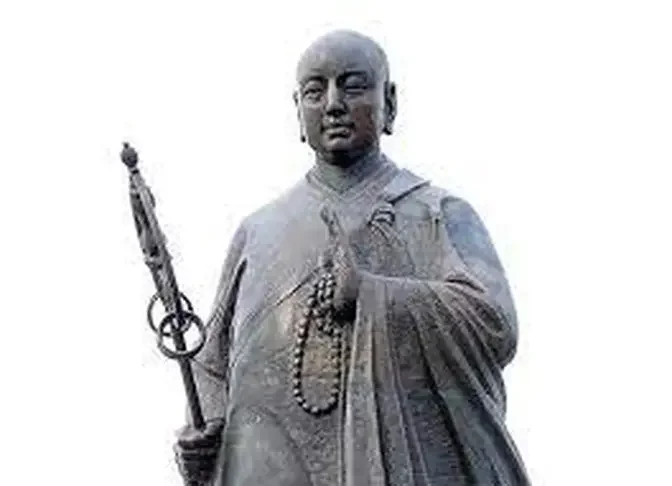
Xuan Zang or Hsüan Tsang was the most famous Chinese Buddhist pilgrim and traveler in India and a translator of Buddhist texts.Xuan Zang, also spelled Hsüan Tsang, is the Buddhist designation of the Chinese holy monk whose family name was Ch’en and personal name, Chen. He was born in Honan midway in the brief Sui dynasty (589-617), which represented the first successful attempt at reunifying the Chinese Empire since the end of the Han dynasty (220). Xuan Zang followed the example of an elder brother and joined the Buddhist monastic order in Loyang at the age of 12. The boy monk traveled extensively in China in pursuit of Buddhist learning, particularly the Vijnanavadin school.

A burning desire for knowledge prompted Xuan Zang to leave for India in 627. Surviving the rigors of forbidding deserts and mountains, he passed through the central Asiatic regions of Turfan, Karashahr, Tashkent, Samarkand, and Bactria. He kept a journal of his unique experiences and observations during his nineteen-year sojourn, which later became known as the Hsi-yü Chi. This stands today as the single written record of conditions at that time in India and central Asia. He finally entered India in 631 by crossing the Hindu Kush into Kapisa.

After a two-year study period in northwest India, Xuan Zang sailed down the Ganges to visit the holy land of Buddhism. His itinerary included Kapilavastu, the birthplace of Buddha; Benares; Sarnath, where Buddha delivered his first sermon; and Bodhgaya, where Buddha attained his nirvana under the bodhi tree. The trip terminated at Nalanda, the leading center of Buddhist learning in India, where Xuan Zang took up the study of Vijnanavada in earnest.
After a study period of fifteen months at Nalanda, Xuan Zang resumed his travel, going south along the east coast. Through the introduction of the king of Kamarupa (Assam), Xuan Zang was received with full honors by Harsha, the emperor of India. Xuan Zang now decided to return to China. Emperor Harsha provided him with escorts and gifts. and he arrived back in Ch’ang-an in 645. He was received with royal honors by Emperor T’ai Tsung and Xuan Zang presented him valuable Buddhist manuscripts.
Xuan Zang settled down to the monastic routine and devoted himself to the translation of the texts which he had brought back. When Xuan Zang died at the age of 62, the Emperor canceled his audiences for three days, and just about every resident of Ch’ang-an marched in the funeral procession.
Comments