


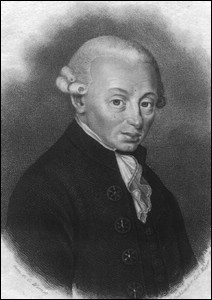
Immanuel Kant (1724-1804) focused on elements of the philosophy of religion for about half a century─from the mid-1750s, when he started teaching philosophy, until after his retirement from academia. Having been reared in a distinctively religious environment, he remained concerned about the place of religious belief in human thought and action. As he moved towards the development of his own original philosophical system in his pre-critical period through the years in which he was writing each Critique and subsequent works all the way to the incomplete, fragmentary Opus Postumum of his old age, his attention to religious faith was an enduring theme. His discussions of God and religion represent a measure of the evolution of his philosophical worldview. This began with his pre-critical advocacy of the rationalism in which he was educated. Then this got subjected to the systematic critique that would open the doors to his own unique critical treatment. Finally, at the end of his life, he seemed to experiment with a more radical approach. As we follow the trajectory of this development, we see Kant moving from confidently advocating a demonstrative argument for the God of metaphysics to denying all theoretical knowledge of a theological sort, to affirming a moral argument establishing religious belief as rational, to suspicions regarding religion divorced from morality, and finally to hints of an idea of God so identified with moral duty as to be immanent rather than transcendent. The key text representing the revolutionary move from his pre-critical, rationalistic Christian orthodoxy to his critical position (that could later lead to those suggestions of heterodox religious belief) is his seminal Critique of Pure Reason. In the preface to its second edition, in one of the most famous sentences he ever wrote, he sets the theme for this radical transition by writing, “I have therefore found it necessary to deny knowledge, in order to make room for faith” (Critique, B). Though never a skeptic (for example, he was always committed to scientific knowledge), Kant came to limit knowledge to objects of possible experience and to regard ideas of metaphysics (including theology) as matters of rational faith.Immanuel Kant (1724-1804) focused on elements of the philosophy of religion for about half a century─from the mid-1750s, when he started teaching philosophy, until after his retirement from academia. Having been reared in a distinctively religious environment, he remained concerned about the place of religious belief in human thought and action. As he moved towards the development of his own original philosophical system in his pre-critical period through the years in which he was writing each Critique and subsequent works all the way to the incomplete, fragmentary Opus Postumum of his old age, his attention to religious faith was an enduring theme. His discussions of God and religion represent a measure of the evolution of his philosophical worldview. This began with his pre-critical advocacy of the rationalism in which he was educated. Then this got subjected to the systematic critique that would open the doors to his own unique critical treatment. Finally, at the end of his life, he seemed to experiment with a more radical approach. As we follow the trajectory of this development, we see Kant moving from confidently advocating a demonstrative argument for the God of metaphysics to denying all theoretical knowledge of a theological sort, to affirming a moral argument establishing religious belief as rational, to suspicions regarding religion divorced from morality, and finally to hints of an idea of God so identified with moral duty as to be immanent rather than transcendent. The key text representing the revolutionary move from his pre-critical, rationalistic Christian orthodoxy to his critical position (that could later lead to those suggestions of heterodox religious belief) is his seminal Critique of Pure Reason. In the preface to its second edition, in one of the most famous sentences he ever wrote, he sets the theme for this radical transition by writing, “I have therefore found it necessary to deny knowledge, in order to make room for faith” (Critique, B). Though never a skeptic (for example, he was always committed to scientific knowledge), Kant came to limit knowledge to objects of possible experience and to regard ideas of metaphysics (including theology) as matters of rational faith.
1. Kant and Religion
This article does not present a full biography of Kant. A more general account of his life can be found in the article Kant’s Aesthetics. But five matters should be briefly addressed as background for discussing his philosophical theology: (1) his association with Pietism; (2) his wish to strike a reasonable balance between (the Christian) religion and (Newtonian physical) science; (3) his attempt to steer a middle path between the excesses of dogmatic modern rationalism and skeptical modern empiricism; (4) his commitment to the Enlightenment ideals; and (5) his unpleasant encounter with the Prussian censor over his religious writings.
Kant was born, raised, educated, worked, lived, and died in Königsberg (now Kaliningrad, part of Russia), the capital city of East Prussia. His parents followed the Pietist movement in German Lutheranism, as he was brought up to do. Pietism stressed studying the scriptures as a basis for personal devotion, lay governance of the church, the conscientious practice of Christian ethics, religious education emphasizing the development and exercising of values, and preaching designed to inculcate and promote piety in its adherents. At the age of eight, the boy was sent to a Pietist school directed by his family’s pastor. Eight years later, he enrolled in the University of Königsberg, where he came under the influence of a Pietist professor of logic and metaphysics. Even during later decades of his life, when he ceased to practice religion publicly (see letter to Lavater in Correspondence, pp. 152-154) and found external displays of pious devotion distasteful, his thought and values continued to be influenced by the Pietism of his earlier years.
Second, as a university student, Kant became a follower of Newtonian science. The dissertation for his graduate degree was more what we would consider physics than philosophy, although in those days it was called “natural philosophy.” Many of his earliest writings were in Newtonian science, including his Universal Natural History and Theory of the Heavens of 1755 (in Cosmogony), dedicated to his king, Frederick the Great, and propounding a nebular hypothesis to explain the formation of our solar system. He had reason to worry that his thoroughly mechanistic explanation might run afoul of Biblical fundamentalists who advocated the traditional doctrine of strict creationism. This is illustrative of a tension with which he had to deal all of his adult life—regarding how to reconcile Christian faith and scientific knowledge—which his philosophy of religion would address.
Third, although this is a bit of an oversimplification, before Kant, modern European philosophy was generally split into two rival camps: the Continental Rationalists, following Descartes, subscribed to a theory of a priori innate ideas that provide a basis for universal and necessary knowledge, while the British Empiricists, following Locke, subscribed to a tabula rasa theory, denying innate ideas and maintaining that our knowledge must ultimately be based on sense experience. This split vitally affected views regarding knowledge of God. Descartes and his followers were convinced that a priori knowledge of the existence of God, as an infinitely perfect Being, was possible and favored (what Kant would later call) the Ontological Argument as a way to establish it. By contrast, Locke and his followers spurned such a priori reasoning and resorted to empirical approaches, such as the Cosmological Argument and the Teleological Arguments or Design Arguments. An important Continental Rationalist was the German Leibniz, whose philosophy was systematized by Christian Wolff; in the eighteenth century, the Leibnizian-Wolffian philosophy was replacing scholasticism in German universities. Kant’s family pastor and the professor who was so important in his education were both significantly influenced by Wolff’s philosophy, so that their young student was easily drawn into that orbit. But he also came to study British Empiricists and was particularly disturbed by the challenges posed by the skeptical David Hume, which would gradually undermine his attachment to rationalism. A vital feature of Kant’s mature philosophy is his attempt to work out a synthesis of these two great rival approaches.
Fourth, the eighteenth century was the heyday of the intellectual movement of the Enlightenment in Europe (as well as in North America), which was committed to ideals that Kant would appropriate as his own—including those of reason, experience, science, liberty, and progress. Frederick II, who was the Prussian king for most of Kant’s adult life (from 1740 to 1786) was called both “Frederick the Great” and “the Enlightenment King.” Hume and Wolff were both Enlightenment philosophers, as was Kant himself, who published a sort of manifesto for the movement, called “What Is Enlightenment?” (1784). There he calls his an age of developing enlightenment, though not yet a fully enlightened age. He champions the cause of the free use of reason in public discussion, including freedom from censorship regarding publishing on religion (Essays, pp. 41-46).
Fifth, Kant himself faced a personal crisis when the Prussian government condemned his published book, Religion within the Limits of Reason Alone. As long as Frederick the Great, “the Enlightenment King,” ruled, Kant and other Prussian scholars had broad latitude to publish controversial religious ideas in an intellectual atmosphere of general tolerance. But Frederick was succeeded by his illiberal nephew, Frederick William II, who appointed a former preacher named Wöllner as his reactionary minister of spiritual affairs. The anti-Enlightenment Wöllner issued edicts forbidding any deviations from orthodox Biblical doctrines and requiring approval by official state censors, prior to publication, for all works dealing with religion. Kant managed to get the first book of his Religion cleared by one of Wöllner’s censors in Berlin. But he was denied permission to publish Book II, which was seen as violating orthodox Biblical doctrines. Having publicly espoused the right of scholars to publish even controversial ideas, Kant sought and got permission from the philosophical faculty at Jena (which also had that authority) to publish the second, third, and fourth books of his Religion and proceeded to do so. When Wöllner found out about it, he was furious and sent Kant a letter, which he had written and signed, on behalf of the king, censuring Kant and threatening him with harsh consequences, should he ever repeat the offense. Kant wrote a reply to the king, promising, “as your Majesty’s most loyal subject,” to refrain from all further public discussion of religion. Until that king died (in 1797), Kant kept his promise. But, as he later explained (Theology, pp. 239-243), that carefully worded qualifying phrase meant that the commitment would pass with that king, after whose death Kant, in fact, did resume publishing on religion.
2. God in Some Pre-critical Writings
Kant’s pre-critical writings are those that precede his Inaugural Dissertation of 1770, which marked his assumption of the chair in logic and metaphysics at the university. These writings reflect a general commitment to the Leibnizian-Wolffian rationalist tradition. Near the beginning of his Universal Natural History and Theory of the Heavens of 1755, Kant observes that the harmonious order of the universe points to its divinely governing first Cause; near the end of it, he writes that even now the universe is permeated by the divine energy of an omnipotent Deity (Cosmogony, pp. 14 and 153). In his New Exposition of the First Principles of Metaphysical Knowledge (of the same year), he points to God’s existence as the necessary condition of all possibility (Exposition, pp. 224-225).
In The One Possible Basis for a Demonstration of the Existence of God of 1763, after warning his readers that any attempt at proving divine reality will plunge us into the “dark ocean without coasts and without lighthouses” that is metaphysics, he develops that line of argumentation towards God as the unconditioned condition of all possibility. He denies the Cartesian thesis that existence is a predicate, thus undermining modern versions of the Ontological Argument. The absolutely necessary Being that is the ground of all possibility must be one, simple, immutable, eternal, the highest reality, and a spirit, he argues. He analyzes possible theoretical proofs of God into four possible sorts. Two of these—the Ontological, which he rejects, and his own—are based on possibility; the other two—the Cosmological and the Teleological (Design), both of which he deems inconclusive—are empirical. The final sentence of the book maintains that, though we must be convinced of God’s existence, logically demonstrating it is not required (Basis, pp. 43, 45, 57, 69, 71, 79, 81, 83, 87, 223, 225, 229, 231, and 239). That same year, Kant also published his Enquiry concerning the Clarity of the Principles of Natural Theology and Ethics. Here, while still expressing doubts that any metaphysical system of knowledge has yet been achieved, he nevertheless maintains his confidence that rational argumentation can lead to metaphysical knowledge, including that of God, as the absolutely necessary Being (Writings, pp. 14, 25, and 29-30). What we see in these pre-critical writings is the stamp of Leibnizian-Wolffian rationalism, but also the developing influence of Hume, whom Kant was surely studying during this period.
Comments