


William Of Orange
by Jessica Brain
William III was born on 4th November 1650. A Dutchman by birth, part of the House of Orange, he would later reign as King of England, Scotland and Ireland until his death in 1702.
William’s reign came at a precarious time in Europe when religious divide dominated international relations. William would emerge as an important Protestant figurehead; the Orange Order in Northern Ireland is named after him. His victory at the Battle of Boyne on 12th July is still celebrated by many in Northern Ireland, Canada and parts of Scotland.
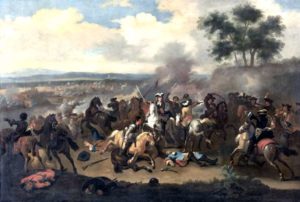
The Battle of Boyne, by Jan van Huchtenburg
William’s story begins in the Dutch Republic. Born in November in The Hague he was the only child of William II, Prince of Orange and his wife Mary, who also happened to be the eldest daughter of King Charles I of England, Scotland and Ireland. Unfortunately, William’s father, the prince, died two weeks before he was born, resulting in him assuming the title of Prince of Orange from birth.
As a young man growing up, he received tutelage from various governesses and later received lessons daily from a Calvinist preacher called Cornelis Trigland. These lessons instructed him as to the destiny he must fulfil as part of Divine Providence. William had been born into royalty and had a role to fulfil.
When William was only ten years old, his mother died of smallpox whilst visiting her brother in England. In her will, Mary wished her brother Charles II to take care of William’s interests. This proved to be a contentious issue as his general education and upbringing was brought into question by those who supported the dynasty and others in the Netherlands who supported a more republican system.
In the years that followed, the English and Dutch would continue to jostle for influence over the young royal to the point at which during the Second Anglo-Dutch War, one of the peace conditions included an improvement in William’s position, as requested by his uncle Charles II in England.
For the young William back in the Netherlands, he was learning to be an astute autocrat, entitled to rule. His roles were two-fold; leader of the House of Orange and stadtholder, a Dutch word referring to the head of state of the Dutch Republic.
This initially proved difficult due to the Treaty of Westminster which ended the First Anglo-Dutch War. In this treaty Oliver Cromwell demanded the Act of Seclusion be passed, forbidding Holland to appoint a member of the royal House of Orange to the role of stadtholder. However, the impact of the English restoration meant that the act was voided, allowing William to attempt to once again assume the role. His first attempts to do this however proved fruitless.
Comments