


Class logistics
1hr lecture + hands-on game time (dimension lecture + mobius strip practice)
30min snack break
1hr exercise game time (big game!) (coordinates lecture + dimensional treasure hunter game)
Review of last week's concept: Particles!
Kids were amused by analogy of oranges.
Follow-up Q: If oranges are made of oranges (that's what they come up with to joke with me), and the oranges that made up oranges are also made of oranges, then how many oranges are in an orange?
A: Countless! Many, many, many, many oranges! So, if you look at a human body, can you guess how many cells, as we know in science, are in a human body?
17 trillion. (put that number into context: if all of us start counting your cells (11 people), 10 cells in 1 second, don't eat don't drink don't sleep, 24 hours a day, 7 days a week, 365 days a year, start counting: 1 cell, 2 cells, 3 cells, when you graduate from high school, we are still counting, college, go to work, get married, have your kids, get old, retired, get sick and died, and born again, and…)
we will need to count 5,000 years. that is 17 trillion particles you have in your body, on a cell level.
But cells are made of smaller particles called molecules, and molecules are made of atoms, and atoms are made of smaller particles!
galaxies:

human brain under microscope:
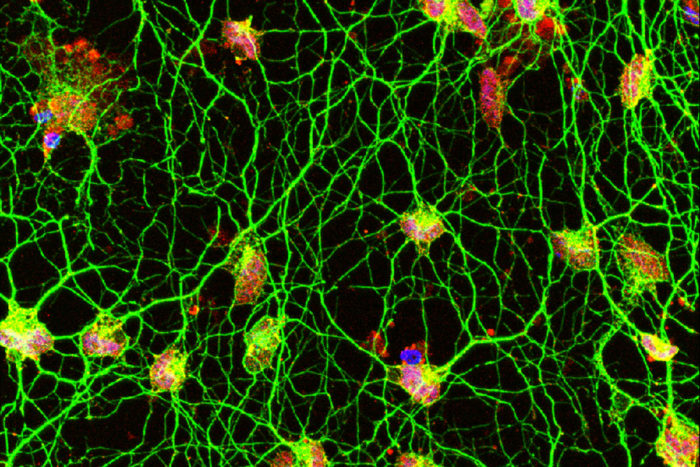


remember our Laniakea? our supercluster of galaxies?
vs human nervous system:


when the brain is active, scientists combine many photos to get this one:

(source: Neurons in a dish learn to play Pong — what’s next? Nature News 12 Oct 2022 https://www.nature.com/articles/d41586-022-03229-y)
galaxies watched in the sky at night by big telescopes (the Hubble):

(source: wikipedia)
Conclusion: The world is made of particles!
Today's Concept: Dimensions
What is a dimension?
Dimension is how scientists describe space. Scientists describe space with numbers.
How many numbers we need for us to tell exactly where something is at, is called “dimension”.
for example:

you need only one number to tell where something is on a ruler. So a ruler measures something in 1-dimension.

you need two numbers to tell where something is on a map, so a map measures something in 2 dimensions.
Question: how many numbers you need to measure a present box?

so, a gift box has 3 dimensions!
How many numbers you need to measure me?
How ___(tall, fat, wide..or fat) I am, you need 3!
In our world, most of what we see is in 3 dimensions.

But, a scientist called Einstein said there are another number needed to measure this world…

Time.
You need to know how __(old) I am.
He called this dimension “time”. So time is also a space (huh?)

It's ok if you don't know what I just said.
In our class, when you don't understand something in class, instead of saying “I don't know”, now you can say “I think we are in different dimensions”!
Let's begin understanding dimensions by a simple paper toy, called a “mobius strip”.
Start with introduction and exercises on a mobius strip:
Ok, it looks cool, but what use is that?
Well, a famous composer called Bach made music out of it!

(Johann Sebastian Bach, 1685-1750)
Bach's Crab Canon on a Mobius Strip
Bonus question:
is there dimensions that are not integers (1,2,3..etc.)?
Yes! they are called fractals:
1-hour game time:
Dance room game: know your coordinates!
Dancing classroom put up mats to imitate a grid of coordinates.
Every kid has a number assigned to them; they have to find another person to reach their treasure in the grid.
Start from 1-dimension (a line)
then 2-dimensions (a grid)
then three dimensions! (I will hang it from the ceiling)
Comments