


During the Allied occupation of Germany, Patton was named military governor of Bavaria, but was relieved for making aggressive statements towards the Soviet Union and questioning denazification. He commanded the United States Fifteenth Army for slightly more than two months. Severely injured in an auto accident, he died in Germany twelve days later, on 21 December 1945.
Patton's colorful image, hard-driving personality, and success as a commander were at times overshadowed by his controversial public statements. His philosophy of leading from the front, and his ability to inspire troops with attention-getting, vulgarity-laden speeches, such as his famous address to the Third Army, was received favorably by his troops, but much less so by a sharply divided Allied high command. His sending the doomed Task Force Baum to liberate his son-in-law, Lieutenant Colonel John K. Waters, from a prisoner-of-war camp further damaged his standing with his superiors. His emphasis on rapid and aggressive offensive action proved effective, and he was regarded highly by his opponents in the German High Command. An award-winning biographical film released in 1970, Patton, helped popularize his image.
Early life
George Smith Patton Jr. was born on 11 November 1885,[1][2] in the Los Angeles suburb of San Gabriel, California, to George Smith Patton Sr. and his wife, Ruth Wilson, the daughter of Benjamin Davis Wilson, the second mayor of Los Angeles, and Margaret Hereford, a widow from Virginia.[3] The wealthy Patton family resided at Lake Vineyard, built by Benjamin Wilson, on 128 acres (52 ha) in present-day San Marino, California.[4] Patton had a younger sister, Anne, nicknamed "Nita".[5] Nita became engaged to John J. Pershing, Patton's mentor, in 1917, but the engagement ended because of their separation during Pershing's time in France during World War I.
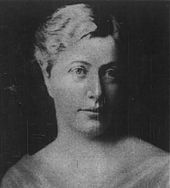
Anne Wilson "Nita" Patton, Patton's sister. She was engaged to John J. Pershing in 1917–18
As a child, Patton had difficulty learning to read and write, but eventually overcame this and was known in his adult life to be an avid reader.[a] He was tutored from home until the age of eleven, when he was enrolled in Stephen Cutter Clark's[6] Classical School for Boys, a private school in Pasadena, for six years.[7] Patton was described as an intelligent boy and was widely read in classical military history, particularly the exploits of Hannibal, Scipio Africanus, Julius Caesar, Joan of Arc, and Napoleon Bonaparte, as well as those of family friend John Singleton Mosby, who frequently stopped by the Patton family home when George was a child.[5] He was also a devoted horseback rider.[8]
Patton never seriously considered a career other than the military.[8] At the age of seventeen he sought an appointment to the United States Military Academy at West Point, New York. He also applied to several universities with military corps of cadet programs, and was accepted to Princeton, but eventually decided on Virginia Military Institute (VMI), which his father and grandfather had attended.[9][10] He attended the school from 1903 to 1904, and though he struggled with reading and writing, performed exceptionally in uniform and appearance inspection, as well as military drill.

Patton at the Virginia Military Institute
While he was at VMI, Senator Thomas R. Bard nominated him for West Point.[11] He was an initiate of the Beta Commission of Kappa Alpha Order.[12]
In his plebe (first) year at West Point, Patton adjusted easily to the routine. However, his academic performance was so poor that he was forced to repeat his first year after failing mathematics.[13] He excelled at military drills, though his academic performance remained average. He was cadet sergeant major during his junior year, and the cadet adjutant his senior year. He also joined the football team, but he injured his arm and stopped playing on several occasions. Instead he tried out for the sword team and track and field and specialized in the modern pentathlon.[14] He competed in this sport in the 1912 Summer Olympics in Stockholm, and he finished in fifth place—right behind four Swedes.[15]
Patton graduated number 46 out of 103 cadets at West Point on 11 June 1909,[16] and received a commission as a second lieutenant in the Cavalry branch of the United States Army.[17][18]
At age 24, Patton married Beatrice Banning Ayer, the daughter of Boston industrialist Frederick Ayer, on 26 May 1910, in Beverly Farms, Massachusetts. They had three children, Beatrice Smith (born March 1911), Ruth Ellen (born February 1915), and George Patton IV (born December 1923).[19] Patton's wife Beatrice died on 30 September 1953, from a ruptured aneurysm[20] after falling while riding her horse in a hunt with her brother and others at the Myopia Hunt Club in South Hamilton, Massachusetts.[21]
Patton was an Episcopalian.[22]
Ancestry
The Patton family was of English, Irish, Scots-Irish, Scottish, French and Welsh ancestry. His great-grandmother came from an aristocratic Welsh family, descended from many Welsh lords of Glamorgan,[8] which had an extensive military background. Patton believed he had formerly lived as a soldier and took pride in mystical ties with his ancestors.[23][24][25] Though not directly descended from George Washington, Patton traced some of his English colonial roots to George Washington's great-grandfather. He is a 1st cousin six times removed of George Washington.[26][27]
He was also descended from England's King Edward I through Edward's son Edmund of Woodstock, 1st Earl of Kent.[26] Family belief held the Pattons were descended from sixteen barons who had signed Magna Carta.[26] Patton believed in reincarnation, stating that he had fought in previous battles and wars before his time, additionally, his ancestry was very important to him, forming a central part of his personal identity.[28] The first Patton in North America was Robert Patton, born in Ayr, Scotland. He emigrated to Culpeper, Virginia, from Glasgow, in either 1769 or 1770.[29]
George Patton, Jr.'s paternal grandfather was George Smith Patton, who commanded the 22nd Virginia Infantry under Jubal Early in the Civil War and was killed in the Third Battle of Winchester, while his great-uncle Waller T. Patton was killed in Pickett's Charge leading the 7th Virginia Infantry regiment during the Battle of Gettysburg. Patton also descended from Hugh Mercer, who had been killed in the Battle of Princeton during the American Revolutionary War. Patton's father, who graduated from the Virginia Military Institute (VMI), became a lawyer and later the district attorney of Los Angeles County. Patton's maternal grandfather was Benjamin Davis Wilson, a merchant who had been the second Mayor of Los Angeles.[30]
His father was a wealthy rancher and lawyer who owned a one-thousand-acre (400 ha) ranch near Pasadena, California.[30][31][32] Wilson had married into one of the original Southern California settler families by marrying Ramona Yorba, who was the daughter of prominent Californio (Spanish and Mexican settlers in California) Bernardo Yorba, after whom the city of Yorba Linda is named. Patton is also a descendant of French Huguenot Louis DuBois.[33][34]
Personality
George S. Patton is believed to have had Narcissistic Personality Disorder by many modern psychologists and historians.[35][36]
Early military career
Patton's first posting was with the 15th Cavalry at Fort Sheridan, Illinois,[37] where he established himself as a dilligent leader who impressed superiors with his dedication.[38] In late 1911, Patton was transferred to Fort Myer, Virginia, where many of the Army's senior leaders were stationed. Befriending Secretary of War Henry L. Stimson, Patton served as his aide at social functions on top of his regular duties as quartermaster for his troop.[39] Patton had a high-pitched voice and worried that this would make it impossible for him to inspire his troops.[40]
1912 Olympics

Patton (right) fencing in the modern pentathlon of the 1912 Summer Olympics
For his skill in running and fencing, Patton was selected as the Army's entry for the first modern pentathlon at the 1912 Olympic Games in Stockholm, Sweden.[41] Patton was the only American among the 42 pentathletes, who were all officers.[42] Patton placed twenty-first on the pistol range, seventh in swimming, fourth in fencing, sixth in the equestrian competition, and third in the footrace, finishing fifth overall and first among the non-Swedish competitors.[43]
There was some controversy concerning his performance in the pistol shooting competition, in which he used a .38 caliber U.S. Army-issue pistol while most of the other competitors chose .22 caliber firearms. He claimed that the holes in the paper from his early shots were so large that a later bullet passed through them, but the judges decided that one of his bullets missed the target completely. Modern competitions at this level frequently now employ a moving backdrop specifically to track multiple shots through the same hole.[44][45] If his assertion was correct, Patton would likely have won an Olympic medal in the event.[46] The judges' ruling was upheld. Patton's only comment on the matter was:
The high spirit of sportsmanship and generosity manifested throughout speaks volumes for the character of the officers of the present day. There was not a single incident of a protest or any unsportsmanlike quibbling or fighting for points which I may say, marred some of the other civilian competitions at the Olympic Games. Each man did his best and took what fortune sent them like a true soldier, and at the end we all felt more like good friends and comrades than rivals in a severe competition, yet this spirit of friendship in no manner detracted from the zeal with which all strove for success.[44]
Sword design
Following the 1912 Olympics, Patton traveled to Saumur, France, where he learned fencing techniques from Adjutant Charles Cléry, a French "master of arms" and instructor of fencing at the cavalry school there.[47] Bringing these lessons back to Fort Myer, Patton redesigned saber combat doctrine for the U.S. cavalry, favoring thrusting attacks over the standard slashing maneuver and designing a new sword for such attacks. He was temporarily assigned to the Office of the Army Chief of Staff, and in 1913, the first 20,000 of the Model 1913 Cavalry Saber—popularly known as the "Patton saber"—were ordered.

Patton then returned to Saumur to learn advanced techniques before bringing his skills to the Mounted Service School at Fort Riley, Kansas, where he would be both a student and a fencing instructor. He was the first Army officer to be designated "Master of the Sword",[48][49] a title denoting the school's top instructor in swordsmanship.[50] Arriving in September 1913, he taught fencing to other cavalry officers, many of whom were senior to him in rank.[51]

Patton on his steeplechase horse, Wooltex, in 1914
Patton graduated from this school in June 1915. He was originally intended to return to the 15th Cavalry,[52] which was bound for the Philippines. Fearing this assignment would dead-end his career, Patton travelled to Washington, D.C., during 11 days of leave and convinced influential friends to arrange a reassignment for him to the 8th Cavalry at Fort Bliss, Texas, anticipating that instability in Mexico might boil over into a full-scale civil war.[53] In the meantime, Patton was selected to participate in the 1916 Summer Olympics, but that Olympiad was cancelled due to World War I.[54]
Pancho Villa Expedition
In 1915, Lieutenant Patton was assigned to border patrol duty with A Troop of the 8th Cavalry, based in Sierra Blanca.[55][56] During his time in the town, Patton took to wearing his M1911 Colt .45 in his belt rather than a holster. His firearm discharged accidentally one night in a saloon, so he swapped it for an ivory-handled Colt Single Action Army revolver, a weapon that would later become an icon of Patton's image.[57]
In March 1916, Mexican forces loyal to Pancho Villa crossed into New Mexico and raided the border town of Columbus. The violence in Columbus killed several Americans. In response, the U.S. launched the Pancho Villa Expedition into Mexico. Chagrined to discover that his unit would not participate, Patton appealed to expedition commander John J. Pershing, and was named his personal aide for the expedition. This meant that Patton would have some role in organizing the effort, and his eagerness and dedication to the task impressed Pershing.[58][59] Patton modeled much of his leadership style after Pershing, who favored strong, decisive actions and commanding from the front.[60][61] As an aide, Patton oversaw the logistics of Pershing's transportation and acted as his personal courier.[62]
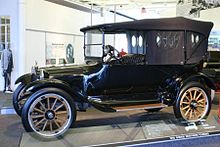
The durability of the 1915 Dodge Brothers Model 30-35 touring car won renown for the new automaker following its use in the 1916 Pancho Villa Expedition[63]
In mid-April, Patton asked Pershing for the opportunity to command troops, and was assigned to Troop C of the 13th Cavalry to assist in the manhunt for Villa and his subordinates.[64] His initial combat experience came on 14 May 1916, in what would become the first motorized attack in the history of U.S. warfare. A force of ten soldiers and two civilian guides, under Patton's command, with the 6th Infantry in three Dodge touring cars surprised three of Villa's men during a foraging expedition, killing Julio Cárdenas and two of his guards.[59][65] It was not clear if Patton personally killed any of the men, but he was known to have wounded all three.[66] The incident garnered Patton both Pershing's good favor and widespread media attention as a "bandit killer".[59][67] Shortly after, he was promoted to first lieutenant while a part of the 10th Cavalry on 23 May 1916.[55] Patton remained in Mexico until the end of the year. President Woodrow Wilson forbade the expedition from conducting aggressive patrols deeper into Mexico, so it remained encamped in the Mexican border states for much of that time. In October Patton briefly retired to California after being burned by an exploding gas lamp.[68] He returned from the expedition permanently in February 1917.[69]
Citations
- ^ D'Este 1995, p. 29.
- ^ Brighton 2009, p. 17.
- ^ Loomis, Jan (2012). Westside Chronicles: Historic Stories of West Los Angeles. Charleston, South Carolina: The History Press. p. 22. ISBN 9781609496234.
- ^ Manchester, William (1974). The glory and the dream: a narrative history of America; 1932 - 1972 (2. print ed.). Boston: Little, Brown. p. 6. ISBN 978-0-316-54496-2.
- ^ Jump up to:a b c d Axelrod 2006, pp. 11–12.
- ^ "Classical School for Boys". calisphere. 1891. Archived from the original on 8 September 2022. Retrieved 7 September 2022. Classical School for Boys, 59 So Euclid Ave opened in 1889. New building erected in 1891. Steven Cutter Clark, principal
- ^ "Lot Detail – George Patton's 1899 School Report Card and Signed Envelope Dated 1906". goldinauctions.com. Archived from the original on 28 April 2022. Retrieved 7 September 2022.
- ^ Jump up to:a b c Axelrod 2006, p. 13.
- ^ "Patton Family at VMI". Virginia Military Institute. Archived from the original on 8 September 2022. Retrieved 8 September 2022.
- ^ Jump up to:a b Axelrod 2006, pp. 14–15.
- ^ Blumenson 1972, p. 92.
- ^ "distinguished-achievement-award/george-s-patton-jr". kappaalphaorder.org. Archived from the original on 26 September 2018. Retrieved 26 September 2018.
- ^ Zaloga 2010, p. 7.
- ^ Axelrod 2006, pp. 20–23.
- ^ Brighton 2009, p. 19.
- ^ "v1909 15". digital-library.usma.edu. Archived from the original on 24 June 2021. Retrieved 17 November 2020.
- ^ Axelrod 2006, p. 24.
- ^ D'Este 1995, pp. 58, 131.
- ^ Axelrod 2006, pp. 28, 35, 65–66.
- ^ Totten, Ruth Ellen Patton (27 March 2005). The Button Box: A Daughter's Loving Memoir of Mrs. George S. Patton. University of Missouri Press. ISBN 9780826264657 – via Google Books.
- ^ "Key West Times". Archived from the original on 14 June 2021. Retrieved 14 June 2021.
- ^ Barrett, Claire (16 December 2021). "Patton and the Battle of the Bulge: 'As soon as you're through with me, I can attack the day after tomorrow morning'". HistoryNet. Retrieved 5 August 2024.
- ^ Army Times (1967). Warrior; the story of General George S. Patton. Putnam. p. 15.
- ^ Michael Keane (2014). George S. Patton: Blood, Guts, and Prayer. Regnery. p. 84. ISBN 978-1-62157-298-5. Archived from the original on 4 August 2016. Retrieved 13 November 2016.
- ^ Willard Sterne Randall; Nancy Nahra (2014). Great Leaders: George Patton. New Word City. pp. 3–4. ISBN 978-1-61230-622-3. Archived from the original on 4 August 2016. Retrieved 13 November 2016.
- ^ Jump up to:a b c Rice 2004, p. 32.
- ^ "Family relationship of General George S. Patton and George Washington via Lawrence Washington". famouskin.com. Retrieved 3 July 2024.
- ^ 21st Century Patton: Strategic Insights for the Modern Era edited by J. Furman Daniel III, p. 61.
- ^ D'Este 1995, p. 9.
- ^ Jump up to:a b "Patton family". Social Networks and Archival Context. Archived from the original on 8 September 2022. Retrieved 8 September 2022.
- ^ Essame (10 November 2008). Patton. Da Capo. p. 2. ISBN 978-0-7867-4305-6.
- ^ Zaloga 2010, p. 6.
- ^ Bennett, Abram Elting. Huguenots migration: descendants' contributions to America. University of Wisconsin-Madison, 1984. p. 109.[ISBN missing]
- ^ Patton, Robert H. The Pattons: A Personal History of an American Family. 1994, pp. 3–5.[ISBN missing]
- ^ PATTON | Kirkus Reviews.
- ^ Lilienfeld, Scott O.; Arkowitz, Hal (January 2013). "A Dose of Narcissism Can Be Useful". Scientific American. doi:10.1038/scientificamericanmind0113-64. ISSN 1555-2284. S2CID 263465007. Retrieved 2 September 2023.
- ^ Brighton 2009, p. 20.
- ^ Axelrod 2006, pp. 26–27.
- ^ Axelrod 2006, pp. 28–29.
- ^ "Patton: Loved, Hated, Appreciated", Richard Sassaman, www.americainwwii.com, 2018. Retrieved October 27, 2022
- ^ Zaloga 2010, p. 8.
- ^ Thierry Terret; J. A. Mangan, eds. (2013). Sport, Militarism and the Great War: Martial Manliness and Armageddon. Routledge. p. 104. ISBN 9781135760885. Archived from the original on 26 June 2022. Retrieved 26 January 2021.
- ^ Axelrod 2006, p. 30.
- ^ Jump up to:a b Blumenson 1972, pp. 231–234.
- ^ D'Este 1995, pp. 132–133.
- ^ D'Este 1995, p. 134.
- ^ D'Este 1995, pp. 140–142.
- ^ Axelrod 2006, pp. 31–32.
- ^ D'Este 1995, p. 145.
- ^ Brighton 2009, p. 21.
- ^ Axelrod 2006, pp. 33–34.
- ^ D'Este 1995, p. 153.
- ^ Axelrod 2006, p. 35.
- ^ D'Este 1995, p. 148.
- ^ Jump up to:a b Axelrod 2006, p. 36.
- ^ D'Este 1995, pp. 158–159.
- ^ Jump up to:a b Zaloga 2010, p. 9.
- ^ D'Este 1995, pp. 162–163.
- ^ Jump up to:a b c d e Zaloga 2010, p. 10.
- ^ D'Este 1995, p. 165.
- ^ Brighton 2009, p. 31.
- ^ Axelrod 2006, pp. 38–39.
- ^ Jowett & de Quesada 2006, p. 25.
- ^ Axelrod 2006, p. 40.
- ^ Axelrod 2006, pp. 41–42.
- ^ D'Este 1995, pp. 172–175.
- ^ Brighton 2009, p. 32.
- ^ Axelrod 2006, p. 43.
- ^ Jump up to:a b Axelrod 2006, p. 46.
Comments