Technology for Humanity
Gan Jing World is dedicated to promote kindness, respect, and trust among people. Our non-addictive content prioritizes meaningful information, while upholding freedom of speech and user privacy.
Explore
SUBSCRIBE
Sign In
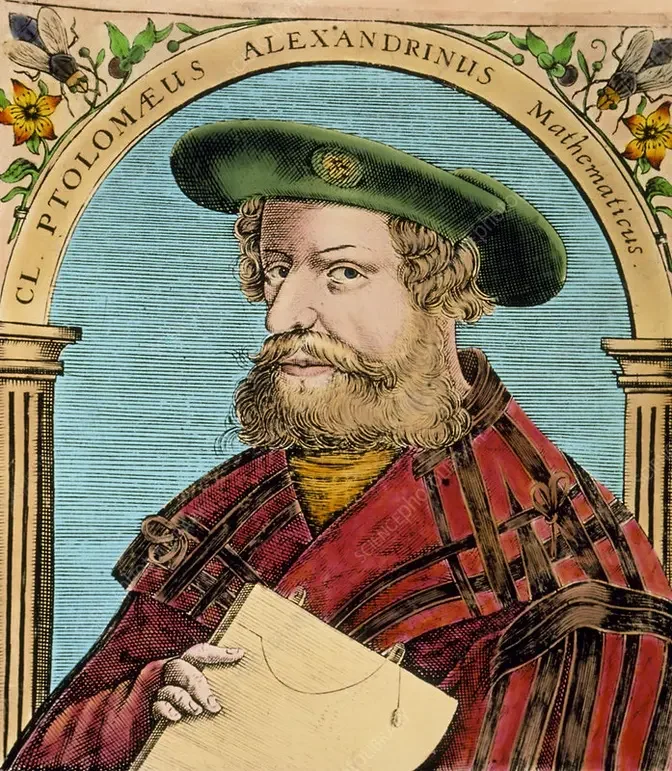
Claudius Ptolemy
Follow
3
followers
·
64
content items
Claudius Ptolemy (/ˈtɒləmi/; Greek: Πτολεμαῖος, Ptolemaios; Latin: Claudius Ptolemaeus; c. 100 – c. 170 AD) was a Roman mathematician, astronomer, astrologer, geographer, and music theorist, who wrote about a dozen scientific treatises, three of which were of importance to later Byzantine, Islamic, and Western European science. The first is the astronomical treatise now known as the Almagest, although it was originally entitled the Mathēmatikē Syntaxis or Mathematical Treatise, and later known as The Greatest Treatise. The second is the Geography, which is a thorough discussion on maps and the geographic knowledge of the Greco-Roman world. The third is the astrological treatise in which he attempted to adapt horoscopic astrology to the Aristotelian natural philosophy of his day. This is sometimes known as the Apotelesmatika (lit. "On the Effects") but more commonly known as the Tetrábiblos, from the Koine Greek meaning "Four Books", or by its Latin equivalent Quadripartite. Unlike most ancient Greek mathematicians, Ptolemy's writings (foremost the Almagest) never ceased to be copied or commented upon, both in Late Antiquity and in the Middle Ages. However, it is likely that only a few truly mastered the mathematics necessary to understand his works, as evidenced particularly by the many abridged and watered-down introductions to Ptolemy's astronomy that were popular among the Arabs and Byzantines alike.
Claudius Ptolemy (/ˈtɒləmi/; Greek: Πτολεμαῖος, Ptolemaios; Latin: Claudius Ptolemaeus; c. 100 – c. 170 AD) was a Roman mathematician, astronomer, astrologer, geographer, and music theorist, who wrote about a dozen scientific treatises, three of which were of importance to later Byzantine, Islamic, and Western European science. The first is the astronomical treatise now known as the Almagest, although it was originally entitled the Mathēmatikē Syntaxis or Mathematical Treatise, and later known as The Greatest Treatise. The second is the Geography, which is a thorough discussion on maps and the geographic knowledge of the Greco-Roman world. The third is the astrological treatise in which he attempted to adapt horoscopic astrology to the Aristotelian natural philosophy of his day. This is sometimes known as the Apotelesmatika (lit. "On the Effects") but more commonly known as the Tetrábiblos, from the Koine Greek meaning "Four Books", or by its Latin equivalent Quadripartite. Unlike most ancient Greek mathematicians, Ptolemy's writings (foremost the Almagest) never ceased to be copied or commented upon, both in Late Antiquity and in the Middle Ages. However, it is likely that only a few truly mastered the mathematics necessary to understand his works, as evidenced particularly by the many abridged and watered-down introductions to Ptolemy's astronomy that were popular among the Arabs and Byzantines alike.
Follow
Loading…
Loading…
Home
Shorts
Create
Topics
Library
Videos from Claudius Ptolemy
VISUAL PROOF - PTOLEMY THEOREM
What is Ptolemy? Explain Ptolemy, Define Ptolemy, Meaning of Ptolemy
Episode 3.8: The Great Syntaxis
Models of the Universe [Geocentric to Heliocentric]
Reel- 46 | About Claudius Ptolemy | Blade Learner's Encyclopedia | Geography #shorts
Ptolemy of Alexandria and the Almagest
Penn Library's LJS 268 - Ptolemy's Almagest (Video Orientation)
Ptolemy's Predictive Package: Part 2: The Joust
Ptolemy's Predictive Package. Part 1 -- Introduction to a New Learning Series
The Hellenistic Astrologers: Claudius Ptolemy
The Almagest - Objectivity 124
The Almagest conceptualization of Mercury and the Sun orbiting Earth
Home
Videos
Shorts
Articles
Followers
Loading…
Loading…
Videos
Ptolemaic Cosmology
Heliocentrism and Geocentrism
Epicycles Animation 2