
The Ancient Mythical History Of King Arthur | Awaking Arthur | Odyssey
14 Video Views·Jan 5, 2023
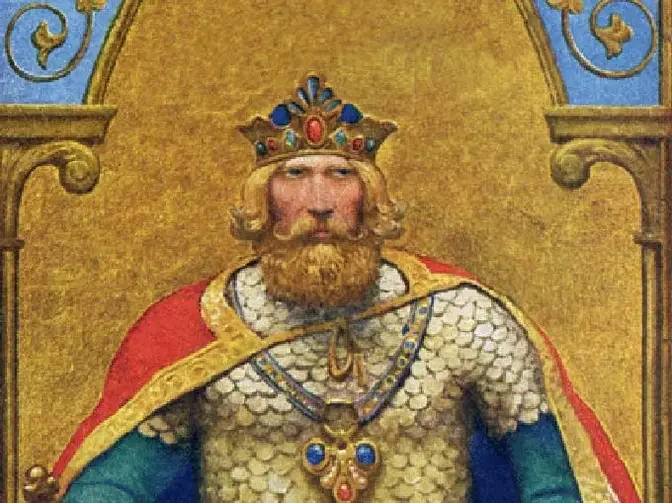
Treasured in folklore, as the glorious ruler of a fairy tale kingdom,
King Arthur is perhaps Britain's most famous regent.
In fabled Camelot, King Arthur is said to have summoned a great fellowship of heroes
to sit at a magical round table.
Today, King Arthur enjoys more popularity than ever.
Not since the Middle Ages has his legend been more acclaimed or emulated.
It seems we still yearn for the lost glory of knightly deeds
and the charms of courtly love that existed in King Arthur's golden era.
But the source of King Arthur's enduring power
lies in a realm far deeper than that portrayed in medieval romance.
The mythology of King Arthur is immeasurably old
and emanates from the ancient customs of a prehistoric dream time.
So who was King Arthur?
Was he an historical king of the Britons?
Did he ever exist?
Or was he, as some believe, an ancient solar deity who has lived many times?
Those who believe in King Arthur romances
claim that there still exist today many places that are still haunted by King Arthur.
So come join us now as we go in search for the once and future king.
Located in South East Wales is the mysterious Arthur's Cave.
Welsh folklore maintains that deep within this cave
King Arthur is slumbering peacefully in a concealed chamber.
The origin of this Welsh legend is perhaps many thousands of years old
for the cave was once occupied by Neolithic people
who venerated the great cave bear.
Early man would have witnessed the bear's death-like hibernation during the winter
and its remarkable awakening months later in the spring.
It may have been from these primitive observations of the natural world
that resurrecting heroes such as King Arthur gradually evolved.
Throughout the ages, caves have come to be regarded
as the shadowy domain of not only bears, but also fiery dragons.
The ancients were awed by these fabulous beasts.
Images of the bear and the dragon were even recognised in the stars
which form the constellations at the centre of the northern sky.
The age-old combination of these two creatures
is all the more fascinating when we realise
that together the bear and the dragon form King Arthur's original Welsh title
Arth Pendragon.
Other similar sounding Gaelic words such as Arthac, Arthlac and Arthau
if you'll excuse my Gaelic pronunciation
mean respectively giant, ethereal and ancestor.
While giant ethereal ancestor accurately describes King Arthur
his abbreviated name, Art, is an old Irish word meaning simply a rock.
The ancient association of King Arthur's name with rocks,
supernatural beings and ancestral giants
may explain why so many of Britain's oldest landmarks
have been named in his honour.
Persisting from time immemorial
is the belief that primeval giants had shaped various landforms
and had erected huge megalithic monuments throughout the British Isles.
Ancient mythology suggests that these legendary giants
were the offspring of celestial beings who had descended from the starry realms.
The massive standing stones, circles and tombs
which these giants are said to have built
are not only numerous but extremely widespread.
It is now generally accepted by scholars
that the original purpose of these monuments
probably involved some sort of astrological function.
But a grand circular temple
which measured the movements of the sun and stars
had long been known in folklore as the Giant's Dance.
The most famous of these circles is Stonehenge on the Salisbury Plain.
An Arthurian legend tells of how Merlin
discovered the secret of the Giant's Dance in Ireland.
Using his supernatural powers
he is said to have spirited this magical ring of stones
across to England
where it became the focus of ancient regeneration rituals.
Less than 20 miles to the north of Stonehenge
lies a larger and far older megalithic site.
The enormous Avebury Sun Temple, Silbury Hill and West Kennet Barrow
are all located within walking distance of each other.
5,000 years ago
the Giant's Dance at Avebury was indeed an elaborate affair.
Little of its former glory remains today.
Most of the massive standing stones
were smashed in the 17th and 18th centuries
to construct the village of Avebury
and many of its buildings actually lie within the original outer circle.
There were once four entrances to the inner temple
and from the southern one a great avenue of stones
led to a tomb known as West Kennet Barrow.
Huge sarsen stones obscure its entrance.
Of the thousands of burial mounds in Britain
this is the longest
and dating to 3,500 years before Christ
it is also the oldest.
There are stories that when barrows like this were opened
the excavators were astonished
to find the skeletons of giant men 8 feet tall or more.
The tomb of West Kennet Barrow
overlooks yet another grand enigma
that of Silbury Hill.
Covering over five acres
Silbury Hill is the largest artificial mound in Europe.
According to local tradition
it is the resting place of an ancient sun king.
Although excavations have shown
that the hill is filled with huge layers of chalk blocks and rubble
the legend persists
that deep within the centre of this mound
an undead king
sits astride a great war horse.
Clad in golden armour
he, like King Arthur
awaits his call to battle.
The image of a solar king on horseback
was central to the religions
of Europe's earliest metal civilisations.
The eastward spread of the Indo-Europeans
saw the equestrian sun god revered across a landscape
which stretched from Scandinavia to India.
Often the sun was represented as a golden disc
which was mounted upon a fiery chariot.
It was escorted in its arc across the sky
and into the underworld of night
by a solar hero.
A closer inspection of this 3,000 year old statue from Denmark
reveals that such a sun king once sat upon the horse.
The image of King Arthur as a mounted solar warrior
is integral to the legend of his expected return.
The equestrian concept of Arthur
is linked with two of Scotland's oldest hilltop fortresses.
Utilised in the Bronze Age
these strongholds were built high upon hilltops
that held a commanding view of the vales below.
According to Scottish tradition
the fortresses were built near subterranean caverns
wherein King Arthur is said to lie sleeping.
It's a time honoured belief
that when King Arthur awakens
he will descend from this high peak
mounted upon a magical steed called Dun Stallion.
Scholars now agree
that over the centuries
two separate Arthurs have been unintentionally co-mingled
to form the King Arthur character
that we are familiar with today.
One of these Arthurs was a mythical king
who was venerated from the earliest of prehistoric times.
The other, an historical war leader,
lived in the 5th century AD.
Ten years after the death of Christ
Britain was absorbed into the mighty Roman Empire.
Although conquered
the tribal Brits were now able to witness
the marvels of Roman engineering
as well as the undreamed of luxuries
that civilisation provides.
For almost 400 years
Britain experienced the benefits
of a strong centralised government
and the protection of Rome's efficient armies.
However, with the death of Constantine III
Britain's last Roman ruler
and the sudden withdrawal of all troops
to defend Rome itself
the British Isles were once again
plunged into an age of darkness.
It was a time of massive upheaval
for the abandoned Romano Brits
as wave after wave of marauding Picts
Scots and Anglo-Saxons
descended upon their shores.
The disorganised Brits were powerless
to halt this savage onslaught
and for 15 years
the mayhem continued.
In 425 the Welsh leader Vortigern
managed to assume an absolute power
over the quarrelsome British tribes.
In an effort to stop incursions
into northern Wales
Vortigern decided to build a fortress
high in the mountains of Snowdonia.
The site he chose
was close to an abandoned Roman copper mine
but despite all efforts
the great tower of the fortress
kept falling down.
In desperation, Vortigern called in
his druid priests.
The druids suggested that the foundations
of the tower should be sealed
with the blood of a fatherless child.
The intended victim was an unusual boy
who was to grow into manhood
as the famous wizard Merlin.
Merlin's early prophetic powers
revealed that the tower kept collapsing
because in a cavern far below it
two ancient dragons
were constantly at war.
According to Merlin
the white dragon represented the invading Saxons
and the red symbolised the Welsh people.
He predicted that the red dragon
would eventually overcome the white
and to this day
the red dragon flies proudly
as the national flag of Wales.
When Vortigern was killed
the mantle of the Welsh dragon
fell upon a powerful war leader
called Uta Pendragon.
Recalled from his exile
in the French province of Brittany
Uta became the High King of Britain.
The focus of the Pendragon Saga
now shifts to the rugged coast of Cornwall.
Throughout its long history
the Kingdom of Cornwall
had maintained a proud cultural independence
from the rest of England.
This was partly due to its formidable cliffs
which provided a natural protection
from seaborne invasions.
From the vantage point of these high cliffs
the people of Cornwall were able to keep
a constant surveillance of their rugged coastline.
Although their coastal citadels
were vulnerable to Atlantic squalls
and pounding seas
it was these very elements
together with the wild beauty of the landscape
that inspired the otherworldly magic
of Cornish folklore.
It's easy to understand
how here in Cornwall
history became infused with romance.
For it was amidst this enchanted setting
that legend places the curious circumstances
of King Arthur's birth.
To celebrate the coronation of Uta as High King
a lavish feast was held in Londinium.
From even the remote areas such as Cornwall
the great lords and chieftains
came to swear their allegiance to the new king.
It was during these festivities
that Uta Pendragon fell in love
with a beautiful woman named Igraine.
Unfortunately, Igraine was already married
and to a loyal supporter
Gulwaz, the Duke of Cornwall.
Undaunted by this fact
Uta Pendragon promptly ordered the duke
off to a distant war.
Fully aware of the king's desire for his wife
the duke had made arrangements
for Igraine's immediate return
to his castle at Tintagel.
Almost an island
the Tintagel Headland is itself
a natural fortress.
Today it's connected to the mainland
by this modern bridge.
The original causeway that existed
at the time of Arthur
has long since crumbled into the sea.
Given the rugged isolation
Gulwaz must have believed
that Igraine and their three daughters
would be safe here.
Yet Uta remained utterly infatuated.
And so he sought from Merlin
a magical intervention.
The wizard consented to help
but on the condition
that Uta must surrender to him
the child that would be born
of this illicit union.
Having agreed, Uta swallowed a magical potion
and was transfigured
into a perfect semblance of the lady's husband.
In this disguise
Uta Pendragon hastened to Cornwall.
There he crossed the causeway
and climbed the long stairway
to the castle's gatehouse.
Unchallenged by the guards
Uta made his way
to Igraine's private quarters.
That night
the Duke of Cornwall mysteriously died in battle
and King Arthur
was conceived.
The following spring
a strange apparition appeared upon the sea.
It seemed a ship
the shape thereof a dragon winged
and all from stern to stern
bright with shining people on the decks.
And gone
as soon was seen.
And down the waves in flame
was born a naked babe
and rode to Merlin's feet
who stooped
and caught the babe and cried
The King!
Uta's secret contract with Merlin
had been fulfilled.
Tennyson's account of King Arthur's birth
was inspired by Merlin's cave.
It's located
in a cove far below the towering cliffs
of the Tintagel Headland.
Stretching clear through the headland's base
the cave is accessible
only at low tide.
And it's here that a young Arthur
is said to have been schooled by Merlin.
But these lessons
held deep within a cave
couldn't have been ordinary
for caves were timeless
otherworldly spaces.
And as such
Merlin's cave may once have been
an ancient place of initiation.
It's also possible
that a boy like Arthur
may have received a Christian education
from the monks who built
a small monastery here during the 5th century.
Although these legends
of Arthur's birth and upbringing
are usually considered to be pure fantasy
claims of his
actual presence at Tintagel
were given an unexpected boost
in 1998.
Archaeologists excavating
the headland's many ruins
unearthed a stone slab
which appropriately dated
to the 5th century and
inscribed upon it was the name
Arthur.
Such is the power of Arthur's myth
that this find
not only made headlines locally
but was reported all around
the world. From antiquity
stones have been regarded
as symbols of permanence
and otherworldly powers.
They were thought to be receptacles of energy
which could be transmitted
to certain individuals who came into
contact with them. Because of this
special stones became
an essential feature of coronation
ceremonies. Even today
the practice continues.
The present British Queen, Elizabeth
II, was crowned upon
the illustrious Stone of Destiny
which lay beneath the seat
of the coronation throne in Westminster
Abbey. This stone
had previously been used by the Scottish
and Irish kings
and before them the biblical kings
of Judea.
A similar Stone of Destiny is
central to the story of King Arthur's
enthronement. It concerns
a mighty sword embedded deeply
within an enchanted megalith.
Arthur proved himself to be
the true-born king when he was
able to free this sword from
its ancient encasement.
Hidden within this colourful imagery
are the vestiges of
an extremely old tradition.
As Arthur was barely 15
years old when he withdrew the sword
this feat may
represent an ancient rite of passage
which marked the attainment
of manhood. Across
the Irish Sea, another great
stone stands upon the Hill of Tara.
Since Neolithic times
the Hill of Tara was regarded
as the most sacred site in Ireland
and it was here that her
Celtic high kings were crowned.
The ancient monolith
was said to have come from the mythical city
of Fallius and so
was endowed with magical powers.
The stone would resonate
when touched by the rightful king
who would then perform a symbolic
mating with the goddess of the land.
It was believed that this age-old
ritual would ensure
that the earth remained fertile.
The countrysides of north-western
Europe once abounded in
great standing stones and fertility
rings, but with the advent
of Christianity they came
to be reviled as pagan symbols
and most of them were destroyed.
A few of the huge
fertility monuments survived
especially in France.
They'd been engraved with Christian
symbols or surmounted with
the Christian cross.
The ancient Celts also believed
that magical powers flowed through
springs and lakes,
but these had a feminine aspect
and were mostly concerned with
healing. It was from the Lady
of the Lake that Arthur received
yet another sword,
the legendary Excalibur.
Woven into its scabbard
were charms that could heal
the wounds of battle.
Armed with his magical regalia
Arthur Pendragon was inaugurated
as the High King of Britain.
His might was proclaimed
and his destiny sealed.
Having received the mantle
of rulership, King Arthur
is said to have undertaken a series of
adventures, each brimming
with supernatural marvels.
One of his most famous exploits
begins aboard a magical
ship called Prydwen,
upon which he ventures into the Celtic
underworld. The other world
was a dark and untamed realm,
guarded by
monstrous serpents and hostile
demons. King Arthur's
quest was to bring back
the miraculous Cauldron of
Immortality. Despite
the terrifying forces arrayed against him
and the loss of all but seven
of his crew, King Arthur
was eventually able to win
the mystical vessel.
This cauldron reputedly had the power
to resurrect the dead.
Arthur continued to explore the depths
of his ancient Celtic heritage
and strange were the contests
he faced in that unearthly
place. But as King Arthur
was being taught the age-old traditions
of solar kingship,
a new way to life everlasting
was taking hold in Britain.
In Arthur's time,
hermit monks were spreading the message
that the true Son of Light had arrived
and that this Christ
was the King of all
Kings. As sovereign
of his land, it would have been
Arthur's duty to consider these claims
and so he also made
journeys to newly Christianised
sites. Located in Cornwall,
the remains of St. Madden's
cell are now surrounded by
the overgrown ruins of a later
medieval enclosure.
At one end of the hermit's tiny retreat
is an ancient granite slab
which served as his altar.
At the other end is a baptismal
font into which water from
an old sacred spring still bubbles.
The old texts
record that Arthur once visited
such a monk and apparently
he abode in this very area.
It was during his stay with
a hermit that King Arthur
is said to have been inspired to have
the image of the Madonna and Child
emblazoned upon his shield.
Medieval writers believed
it was this conversion
that empowered King Arthur to win
his twelve decisive victories
against the Saxon invaders.
When peace had returned to the
war-torn land, Arthur decided
he needed a queen
and he chose the fair Guinevere.
With her dazzling beauty
she seemed the very essence
of spring, light
and new life.
And so Guinevere became Arthur's flower bride.
As her dowry
Guinevere brought a magnificent
round table.
It had long ago been fashioned by Merlin
and held in safekeeping
by her father.
It was on the day of the King's wedding
that the fellowship of the round table
met for the very first time.
At fabled Camelot
one hundred knights
swore an oath to honour a code of chivalry
that was to inspire the royal
courts of Europe for centuries to come.
Most scholars now
agree that the site of Camelot
was probably an ancient hill fort
which is now called Cadbury.
Utilised as a stronghold
since 3000 BC
a substantial fortress was
constructed here in the 5th century.
Although this fortress
was never the glittering castle that poets
imagined Camelot to be
it nevertheless contained a royal hall
wherein large banquets were celebrated.
Looking out over
the little village of Camel today
it is indeed difficult to understand
how this grassy hilltop
has for centuries been known
as Arthur's Palace.
Nevertheless, archaeological
excavations that were undertaken
in the 1960s confirm
that Cadbury may well be the place
where an historical King Arthur
held court.
Made of unmortared stone
this 16 foot thick wall
still surrounds the top ramp
at Cadbury. Now this is quite
a sophisticated defence system
and it would have required a vast
amount of labour to construct it.
It certainly was a secure place
from which a king could launch his campaigns
into Britain and even further afield
into Gaul.
Bonjour
and welcome to France.
We're standing on the borders of the French
provinces of Normandy and Brittany.
Now Brittany is so named
because of the Britons that came across
here in the 5th and 6th centuries
AD. This is the time
of the historical
King Arthur. A French
monk writing in the 11th century
probably within these
very walls recorded
the events of these 6th century migrations.
The monk tells of a king
of the Britons named Arthur
who crossed the channel and landed
in this area with 12,000
ship-borne troops.
This Arthur waged war against
the Germanic and Slavonic barbarians
who were decimating the
countryside of Gaul.
Many of the Britons who had accompanied King
Arthur in his campaigns remained
in Brittany. These settlers
cherished the legends of King Arthur's
historic feats and in
some instances wove them
into the older traditions of local
folklore. One of these stories
concerns King Arthur's battle
with a fearsome giant.
The giant had kidnapped the king of Brittany's
niece and had imprisoned her
on this island which is known today
as Mont Saint-Michel.
Although the damsel didn't survive
the ordeal, King Arthur
succeeded in killing the giant.
It's a tale which probably symbolises
Christianity's expulsion
of pagan cults from the region.
But long before anything was built
on this island, Mont Saint-Michel
was known as Mont Tombe
or Tomb on the Hill.
Island hill tombs
were usually the domain of Dagda.
Dagda was the most ancient
Celtic lord of life and death.
It was believed that the
great Dagda could even control
the changing of the seasons.
Certain Christian sources
had thus alleged that in times
of famine, the Druid priests
would attempt to appease this agricultural
giant with mass human sacrifices.
If Arthur's crusades
in Brittany had brought an end
to such practices, then
perhaps this might explain why
the title Rigotamus
meaning Supreme King
was bestowed upon Arthur at that time.
An historical British
war leader had come to be regarded
as more than a mere mortal.
He was now a great solar king
triumphant over the powers
of darkness. This Arthurian
ideal has since been
transferred to the Archangel Michael
whose image crowns the
monastery's soaring cathedral spire.
The island of Mont Saint-Michel
is but one of many
ancient pre-Christian sites
that have been consecrated in the name
of this mighty solar warrior.
Back across the channel
in England is another hilltop
imbued with ancient lore.
Rising steeply from the fields
of Somerset, it is the
atmospheric Glastonbury Tor.
As the geographical
centre of all Arthurian tradition
the Tor is still a
mecca for those who believe in a mystical
king. Although the Tor
looks artificially shaped, it is
a natural formation.
Two thousand years ago, it
was surrounded by watery marshes
and so the Celtic Britons
called it Inishvitrin,
the Isle of Glass.
The old high place was once
the focal point of a great
Celtic sanctuary.
At the Tor's base is a secluded
vale. It is the popular
setting for perhaps the most
famous of all the Arthurian legends.
The quest
for the Holy Grail.
King Arthur's knights had believed
that just a glimpse of the Holy Vessel
could heal the incurable
and restore fertility to a
blighted land. Since medieval
times, an old
druidic font in this garden grove
has been known as the Chalice
Well. The early Glastonbury
chronicles suggest
that the Holy Grail had at one time
been hidden at the bottom of this
ancient well shaft. Fed
from the Tor's sacred spring,
Chalice Well has allegedly
never run dry.
Grail magic still lingers here
for even today, its
red-tinged waters are believed
to have healing powers.
Overlooking the site, the empty
tower of a ruined church
stands at the Tor's summit.
The monks who built the church
had dedicated it to Saint Michael
so that this whole area
might be cleansed of its long
pagan history. The shadows
of the old religion
continually surface throughout the
Arthurian legends.
And in this sense, Merlin
was never a mere court magician.
He was the guardian of
the most ancient of ways.
Using his deep arcane knowledge,
Merlin had created
a mystical round table for King
Arthur and his illustrious
company of knights.
The table was to represent the age-old
relationship between the
starry realms, the king,
and the land.
It symbolized an ideal of the
perfect earthly kingdom.
The circular shape
meant that no knight was more
exalted than his fellow when seated
or rounded. The unity of the
whole was paramount.
During the Middle Ages,
entertainments called round tables
were very popular with the nobility.
Ancient circular
earthworks, such as this
one below Stirling Castle in Scotland,
were the center of such
gatherings. Dressed in
Arthurian costume, the participants
feasted and paraded about the mound
in imitation of the stories
they were reading.
However, the Christian monks,
who had transformed the ancient traditions
into medieval romance, also
felt bound to teach that earthly
life has been tainted with innate
or original sin,
and that even the brightest and best could
fall. With the exception of
Galahad, every character in
the Arthurian stories was thus
blemished. But it was in
Lancelot Dulac, the king's
favorite and most trusted knight,
that the point was made most
clearly. Lancelot's
overwhelming love for the beautiful Guinevere
had set in motion
the division of the round table's unity.
The incessant rumors
of the queen's infidelity with Lancelot
created a crisis
in loyalty.
His acts were not only humiliating for the king,
they were considered treason.
A conspiracy was hatched
to surprise Lancelot and Guinevere
during one of their secret meetings.
The exposure of the adulterous
affair resulted in
the death of many former companions
of the round table,
and Guinevere was condemned to burn
at the stake. Lancelot
rode in to free her, and together
they escaped to a castle
on the Northumbrian coast.
But in the fury of the rescue,
several innocents had also been
slaughtered. The kingdom
was irretrievably divided
as civil war raged throughout
Britain. Having delivered
Guinevere to a nunnery,
Lancelot retreated back to his native
France, pursued
by an enraged Arthur.
The round table had been rent asunder,
and Merlin's dream
of the perfect earthly realm
had vanished.
But from the start, King Arthur had been
chosen to play the role of the
sacrificial sun king.
He was the mythic hero
who must activate the great
primal wheel of life,
death, and rebirth.
With the news that
his illegitimate son Mordred had claimed
his kingdom, Arthur
left off his feud with Lancelot
and hastened back to Britain.
On a mist-enshrouded plain,
the forces of light
met those of darkness,
as Arthur and his army faced
Mordred's vast host.
An uneasy truce was
formed, but fate could not
be avoided.
From its hiding place, a serpent
slithered towards the tent's
warriors. Glimpsing
the snake, a startled knight
raised his sword.
As the serpent struck, the
sun flashed briefly upon the unsheathed
weapon. Seemingly,
the truce had been broken,
and the bloody mayhem of the final
battle began.
The war-horns had
sounded. Son against father,
brother against brother.
The battle raged till near on
nightfall. By then,
all but a few lay dead upon the
moor. A gory stillness
wreathed the battlefield.
It was shattered by a thunderous
cry as Arthur saw that Mordred
still lived.
As men possessed, they charged
in a crimson fury of
hatred and revenge.
And in the end,
Arthur and Mordred fell
to each other's mortal blow.
In Celtic mythology,
death usually took place
near running water.
It was a portal that swirled down
into the other world.
Some believe this final battle
occurred on Cornwall's eerie
Bodmin Moor, near the shores
of the tear-shaped Dosmerey Pool.
Others favour an icy
pass, high in the rugged
Welsh mountains of Snowdonia.
The whereabouts of Camlyn,
the site of Arthur's last battle,
remains as obscure
as the mists in which it happened.
The name Camlyn
means crooked bank,
and Cornish tradition steadfastly
pinpoints the site as here,
by the River Camel.
A dense canopy veils
the tiny river.
From the battlefield of Camlyn,
a mortally wounded Arthur
sought refuge amidst
the thick undergrowth.
Through these tangled branches,
the dying king is said to have stumbled
his way down to the water's edge.
Today,
an ancient moss-covered stone
lies by the bank of the River Camel.
Faint inscriptions
in Latin and Druidic Ogham
were once thought to commemorate
the place where Arthur eventually fell.
Of his knights,
only Sir Bedivere had survived
the slaughter.
When he came upon the dying Arthur,
he was commanded to return Excalibur
back to the waters from whence it came.
On his third
reluctant attempt,
Sir Bedivere hurled the sword
far out over the lake,
and there came a glistening arm and hand
above the water to meet it.
Thrice Excalibur was brandished in the air,
before submerging
back into the deep.
As Sir Bedivere returned,
he saw across the waters
a gilded barge silhouetted
against the setting sun.
On board were nine
sorrowing queens.
In the lap of one of them,
Arthur had laid his head.
And so Morgan le Fay ferried the dying king
to the island of Avalon.
It was a golden land,
concealed by enchantment
from the grasp of mortal beings.
In Geoffrey of Monmouth's
twelfth-century poem,
Morgan le Fay is described
as High Priestess of Avalon,
the Apple Isle.
On this magical island
she and her eight maidens
tended Arthur's wounds
and healed him of his earthly pain.
According to the myths,
King Arthur still rests beneath
Avalon's fragrant apple blossoms.
Cared for by the priestesses,
he waits until the world
has need of him again.
To the poets, Avalon
was a wondrous isle
of joyous immortality.
But it was not just poetic symbolism
that saw King Arthur ferried to an island
which lay in the direction
of the setting sun.
The practice of ferrying the dead
to a blessed isle in the West
was virtually universal
throughout the Western world.
And as a result,
a vast number of islands
along the European Atlantic seaboard
had at some time been utilised
as sacred burial places.
Island tombs such as this one
in Brittany were constructed
about 6,000 years ago
and are of major importance
to archaeologists.
Perhaps the most famous isle of the dead
is that of Iona.
The tiny island is situated
off the western coast of Scotland
and until the Middle Ages
it was the place to which
all Scottish kings were ferried for burial.
Given Iona's rugged isolation,
it must have been
a formidable voyage.
On this island there is an ancient mound.
Around it there extends
a remarkable cemetery
which came to be known
as the Royal Burial Ground.
It is recorded that 48 Scottish kings
including Macbeth
and many Highland and Hebridean chiefs
are buried here.
So revered was Iona
that even Irish, Norwegian
and French kings chose this
remote and windswept isle
as their final resting place.
Arthurian romance
emulated the ancient custom
of island burial in depicting
King Arthur's final resting place
as the mystical island
of Avalon.
Since medieval times the Glastonbury
area has been traditionally accepted
as the most likely site for this
isle of apples.
It was once surrounded by water
and Avalon's mythic white flowers
still blossom in a well-tended orchard
which overlooks the old monastery.
In 1190
the monks at Glastonbury
announced that they had exhumed
the skeletons of Arthur and Guinevere.
Their bones were placed in a marble tomb
in front of the high altar
of the main abbey church
and here they remained for 300 years.
However,
these relics disappeared during the 16th century
when King Henry VIII
ordered the dissolution
of all British monasteries.
But Cornish, Welsh
and Scottish folklores insist
that King Arthur did not die
and therefore he had no grave.
They preserve a belief
that King Arthur resides
upon an enchanted isle
or sleeps within an ancient cavern
awaiting the appointed time
for his return.
From the 6th century
through to modern times
writers have proclaimed
that the return of King Arthur
will occur when the world
is in its darkest hour.
Awakened to a land
that has been ravished by insatiable greed
Arthur is expected
to begin a ruthless campaign
of purification.
The Eildon Hills of Scotland
are but one of a number of sites
which lay claim to this legend
of an avenging Arthur.
An ancient tale made famous
by Sir Walter Scott
asserts that under the highest
of the three hills is an immense
cavern. It is said
that at the sounding of a great horn
King Arthur shall arise from his
stony chamber. Fully armoured
and mounted upon a mighty battle steed
Arthur is to
appear over the Eildon Hills.
This account of Arthur's
mythical resurrection
is also associated with another of
Scotland's Bronze Age hill forts.
A hollow between two
high points of this extinct volcano
provides its name
Arthur's Saddle.
It has long been a local tradition
that it will be from here
high above the city of Edinburgh
that a giant Arthur
will one day commence
his avenging ride.
The mythology of a mounted solar king
who defeats the powers
of darkness is immensely
old and widespread.
Its imagery has permeated
the religions of the Medeans of Persia
the Assyrians
and the ancient Greeks.
The concept of an equestrian
avenger is also central
to St John's vision of a
biblical apocalypse.
But at its core the legend
of King Arthur is like all
glorious heroic sagas.
It's concerned with man's
attempt to understand
the mysterious cycle of life
death
and regeneration.
From the dawning of time
the great megaliths had
symbolised an imperishable anchor
against the transience of
the material world.
The massive standing stones
were of fundamental importance in the
life-sustaining rituals of prehistoric
peoples. Writing at the
time of the historical King Arthur
the Welsh bard Taliazin
described the celebrations at one of these
ancient ceremonies.
In spring the giant
trilithons which formed the inner
circle of Stonehenge
were covered with veils
and upon these the history of the
Dragon King was delineated.
This resurrecting Sun King
was variously known as
Hugh, Lou, Beli
and much later
Arthur Pendragon.
On May Day morn the song of a
cuckoo bird would herald the awakening
of the Dragon King from his
long winter sleep.
At the precise moment of the sun's rising
the King would emerge
from what was known as his stone
cell of tranquility.
The moment was welcomed with a great din.
Shouts of joy were
accompanied by chants, horn
blowing and the beating of drums.
Each year
huge crowds still gather at Stonehenge
to celebrate the summer solstice.
Sensitive to an ever
increasing threat to the natural world
some attempt to restore a balance
with ancient druidic practices.
But this modern
day druid and his followers are
denied access to the Temple of Stonehenge
and so their dawn ceremony
takes place in an adjacent field.
Forming their own circle
the group calls forth
the spirit of the land and that
of King Arthur.
Arthur, Lou,
come again as of old
into this fine hand.
Show us the lovely realms
of the gods.
Promote it be.
The blessing of the flowers,
the conjoining of heaven and earth.
One, two,
three.
Whilst the nature loving
druids believe that they are participating
in the dawning of a new age
Camelot, other more
eccentric devotees
are convinced that King Arthur's mysterious
return from the other world
will be by way
of a flying saucer.
Very few of us expect King Arthur
to alight from a shiny UFO
or to emerge from an ancient standing stone.
However as we enter
the 21st century there's a growing
expectation, especially amongst
new ages, that a return of
King Arthur is imminent.
Written a thousand years before
Nostradamus, the 6th century
book of Merlin's prophecies
predicts that King Arthur's return
will coincide with the awakening
of the primordial dragon.
The dragon's rising
is to trigger massive upheavals
throughout the world.
The same manuscript proclaims
that just before these apocalyptic
events occur, King Arthur
and Merlin will be
reunited. Their predestined
meeting is to take place at
this ancient table of stones in Cornwall.
Once again
our search for Arthur
has led us back to the great megaliths.
Ultimately King
Arthur represents the same
giant ethereal ancestor
who was evoked by the earliest
of men in their times of need
and uncertainty. In this
sense the heroic deeds of a
megalithic solar king
have been able to span the vast
passages of time.
Even in our present day world
the legend of King Arthur survives.
It offers us far more
than just a glimpse into the customs
of medieval life
or the simple enjoyment
of a mere fairy tale.