
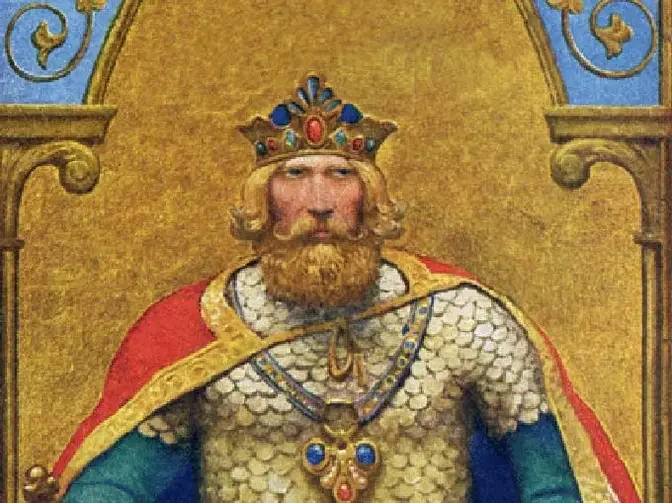
King Arthur
142 Video Views·Feb 16, 2023
Long, long ago, after the death of Uther Pendragon, there was no king in Britain, and every knight
hoped to seize the crown for himself.
The country was in chaos, and laws were broken on every side, and the corn which was to give
the poor bread was trodden underfoot, and there was none to bring the evildoer to justice.
Then, when things were at their worst, came forth Merlin the Magician, and fast he rode
to the place where the Archbishop of Canterbury had his dwelling.
And they took counsel together, and agreed that all the lords and gentlemen of Britain
should ride to London, and meet on Christmas Day, now at hand, in the great church.
So this was done.
On Christmas morning, as they left the church, they saw in the churchyard a large stone,
and on it a bar of steel, and in the steel a naked sword was held, and about it was written
in letter of gold,
Whoso pulleth out this sword is by right of birth King of England.
They marveled at these words, and called for the Archbishop, and brought him to the place
where the stone stood.
Then those knights who desired to be king could not hold themselves back, and they tugged
at the sword with all of their might, but it never stirred.
The Archbishop watched them in silence, but when they were faint from pulling, he spoke,
The man is not here who shall lift out that sword, nor do I know where to find him.
But this is my counsel, that two knights be chosen, good and true men, to keep guard over
the sword.
Thus it was done.
But the lords and gentlemen at arms cried out that every man had the right to try to
win the sword, and they decided that on New Year's Day a tournament should be held, and
any knight who would, might enter the lists.
So on New Year's Day, the knights, as was their custom, went to hear service in the
great church, and after it was over, they met in the field to prepare for the tournament.
Among them was a brave knight called Sir Ector, who brought with him Sir Kay, his son, and
Arthur, Sir Kay's foster brother.
Now Sir Kay had unbuckled his sword the evening before, and in his haste to be at the tournament,
had forgotten to put it on again, and he begged Arthur to ride back and fetch it for him.
But when Arthur reached the house, the door was locked, for the women had gone out to
see the tournament as well, and though Arthur tried his best to get inside, he could not.
So Arthur rode away in great anger and said to himself, Sir Kay shall not be without a
sword this day, I will take that sword in the churchyard and give it to him, and on
his horse he galloped fast until he reached the gate of the churchyard.
He jumped down and tied his horse tightly to a tree, then, running up to the stone,
he seized the handle of the sword, and drew it easily out.
Afterwards, he mounted his horse again, and delivered the sword to Sir Kay.
The moment Sir Kay saw the sword, he knew it was not his own, but the sword of the stone,
and he sought out his father, Sir Ector, and said to him, Sir, this is the sword of the
stone, therefore I am the rightful king.
Sir Ector made no answer, but signed to Sir Kay and Arthur to follow him, and they all
three went back to the church.
Leaving their horses outside, they entered, and here Sir Ector took a holy book, and asked
Sir Kay to swear how he came by that sword.
My brother Arthur gave it to me, replied Sir Kay.
And how did you come by it, asked Sir Ector, turning to Arthur.
Sir, said Arthur, when I rode home for my brother's sword I found no one to deliver
it to me, and as I resolved he should not be swordless, I thought of the sword in this
stone and I pulled it out.
Were any knights present when you did this, asked Sir Ector.
No none, said Arthur.
Then it is you, said Ector, who are the rightful king of this land.
But why am I the king, asked Arthur.
Because, answered Sir Ector, this is an enchanted sword, and no man could draw it but he who
was born a king.
Put the sword back into the stone, and let me see you take it out.
Arthur returned the sword to the stone, and Sir Ector himself tried to draw it, but he
could not.
Now it is your turn, he said to Sir Kay.
Sir Kay fared no better than his father, though he tugged with all his might.
Now you, Arthur.
And Arthur pulled it out as easily as if it had been lying in its sheath, and as he did
Sir Ector and Sir Kay sank to their knees before him.
Why do you, my father and brother, kneel to me, asked Arthur in surprise.
No my lord, answered Sir Ector, I was never your father, though until today I did not
know who your father truly was.
You are the son of Uther Pendragon, and you were brought to me when you were born by Merlin
himself, who promised that when the time came I should know from whom you sprang, and now
it has been revealed to me.
But when Arthur heard that Sir Ector was not his father, he wept bitterly.
If I am king, he said at last, ask what you will, and I shall not fail you.
For to you, and to my lady and mother, I owe more to anyone in the world, for she loved
me and treated me as her son.
I considered many different subjects for the first episode, but it seemed fitting to start
with the lore that began my personal love of storytelling and literature.
Arthurian legends stretch far beyond the original ancient texts.
King Arthur and related legends have permeated our culture so much, so that most people are
likely familiar with the basic story of the sword and the stone.
There have been countless pieces of Arthurian media over the past century, including numerous
films and television shows of many different genres.
Ah, well actually I am a knight of the round table.
You're a knight of the round table?
I am.
Go ahead, son.
That sword is stuck fast in solid stone.
And you're going to pull it out?
Merlin, it's impossible.
Arthur, you're the true king of Camelot.
For around you stand the legendary chiefs and warriors who have come here, as you have,
to see Arthur Pendragon receive the enchanted sword Excalibur, and so become the rightful
king of all England.
And many books from fictional spin-offs, to compilations of all Arthurian legends.
Who was King Arthur?
Was he a historical king of the Britons?
Did he ever exist?
Let us investigate and enjoy the timeless legend of King Arthur, together.
The historicity of King Arthur has been debated by both academics and popular writers alike.
There have been many suggestions that Arthur was indeed a real person in history.
But the current consensus among academic historians is that he is a mythological or folkloric
figure.
Despite this, there are still people who continue to defend Arthur's real existence.
The first definite mention of Arthur appears around 828 in the Historia Britannum, The
History of the Britons.
It is the earliest source that presents Arthur as a historical figure, and is the source
of several stories which were repeated and amplified by later authors.
In Historia Britannum, Arthur is painted as a military leader fighting against the invading
Saxons in the 5th to 6th centuries.
Arthur developed into a legendary figure in the matter of Britain from the 12th century,
which is the body of medieval literature and legendary material associated with Great Britain,
and all of the legendary kings and heroes associated with it.
Geoffrey of Monmouth's Historia Regum Britanniae is a central component of the matter of Britain.
Geoffrey drew on a number of ancient British texts, including the Historia Britannum.
Geoffrey's structuring and shaping of the Arthurian myths propelled forward their vast
popularity, which continues into the modern era, and he is generally viewed by scholars
as the major establisher of the Arthurian canon.
His effect on the legend of King Arthur was so vast, that Arthurian works have been categorized
as pre-Galfridian and post-Galfridian, depending on whether or not they were influenced by him.
Over the decades, historians have proposed many possible sources for the myth of Arthur,
suggesting that perhaps his character and the myth are merely a collection over time
from a variety of sources, and that the myth is drawn from a variety of different people
in history combined together.
Until the late 20th century, there was much academic debate about Arthur's historical
existence among both historians and archaeologists.
In the 21st century, academics have rejected it.
In 2018, British archaeologist and historian Nicholas Hyam refuted all the outstanding
claims for a historical Arthur, summarizing his position as,
that Arthur has produced extraordinary quantities of smoke, is in large part because he is so
well suited to be a fulcrum of make-believe, but there is no historical fire underlying
the stories that congregated around him, just highland mist.
The same year, British medievalist Tom Shippey summarized the situation as,
Modern academic historians want nothing to do with King Arthur.
In a 2019 review, Brian David reported that,
Few topics in late antique and medieval history elicit scholarly groans quite like the idea
of a supposedly factual King Arthur.
Yet historians and other scholars made cases for Arthur's existence in historical and literary
studies until the 1980s.
For academics today, the question of the realism of King Arthur has been largely banished to
popular books, video games, and movies.
The scholar Andrew Brees argued in both 2015 and 2020 that Arthur was historical, and claims
to have identified the locations of his battles, as well as the place and date of his death.
Of course, his conclusions are being disputed to this day.
Why do the myths surrounding King Arthur capture the hearts and imaginations of so many people
around the world?
Why is there something in our hearts that tells us that King Arthur is so much more
than just, highland mist, as Nicholas Hyam says?
Arthur has become a worldwide symbol of courtly chivalry, justice, and rightful kingship.
The legend of King Arthur is one of the most powerful and fascinating stories ever, and
for many, many reasons.
It has all the elements of a great story—drama, adventure, romance, conflict and betrayal,
interesting characters—plus the magical elements, though the King Arthur legend would
still be a great story without the magic.
Damsels in distress, doomed and forbidden love, epic battles and quests in pursuit of
strange creatures—this is the world of Arthurian legend, and at the center of it all, there
is the once and future king—Arthur himself, who according to the stories, pulled a sword
from a stone to become the greatest king that Britain has ever known.
What more could anyone who loves legends possibly want?
In 2016, British art critic Jonathan Jones wrote a piece for The Guardian in which he
proclaimed,
King Arthur forged our Britain, and English heritage is right to celebrate him.
In many ways the myth of Arthur created medieval civilization.
It also helped create Britain as we know it.
Cultural fantasy and real history are not opposites.
Arthur is woven into the landscape and identity of Britain, and we're very lucky to have such
a great global myth written into our rocks.
Arthurian legends are perhaps one of the best examples of how powerful myths can be, shaping
the history of Britain and all of our imaginations for centuries.
In a world where looking to the deeds and myths of our ancestors is frowned upon, King
Arthur may be the best example we have of how powerful our heritage can be, and that
is what mythic revival was created to celebrate.
So what do you think?
Is King Arthur more than Highland Mist?
What do legends like the Arthurian legends mean to you?
I hope you enjoyed this first episode of Mythic Revival.
If you would like to support the content, check the video description for a link to
our channel merch.
It's the best way to support the channel and future content.
This first video also marks the beginning of a mini-series covering all Arthurian myths.
Which ones are your favorite Arthurian legends?
Who should we cover next?
Leave us a comment below and let us know.
And we will see you next time.