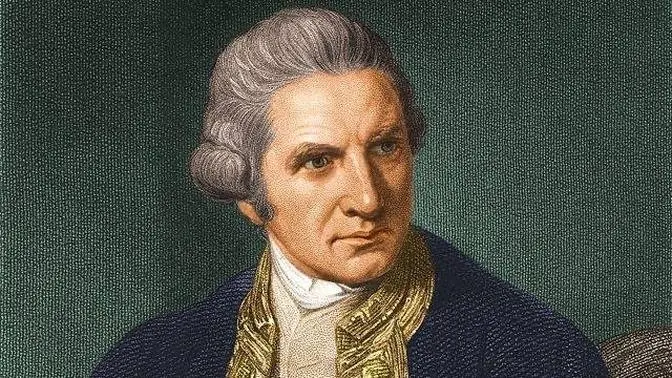
Captain James Cook was not even a Captain when he went on his incredible voyage to discover the 'Great Southern Continent', and he didn't even discover it! How fun! From humble stock, James Cook was promoted to Lieutenant and took the HMS Endeavour on a routine mission to Tahiti to facilitate the observation of the passage of Venus. However, he also had secret orders...to discover a mysterious continent in the South Pacific. What he found wasn't the long imagined continent, but instead found Australia, a discovery which shaped the history of the Pacific forever!
This video covers: 1) Why the 'Great Expedition' was launched 2) Who Captain Cook Was 3) How Vasco Da Gama made it to Australia 4) The legacy of the voyage
These videos are made by Andy Hassan as part of the History Blast series. These are meant for educational purposes only.
At the start of the video, I introduced the channel as 'History Bite'. Please note that this is the old name of History Blast, which was changed in August 2021. The use of the name can be attributed to the Trademark 'History Bites', registered to Solomon Schmidt.
Hello and welcome to History Byte and today we're going to be talking about the journey of James
Cook in the discovery of Australia. We're going to find out where the journey started,
why the journey happened, and the effect it had on the British Empire.
Our story begins on the 16th of February 1768. The Royal Society, the national institution of
science and learning in England, petitioned King George III to finance a scientific expedition to
the Pacific. At the time, the Pacific had not been extensively explored, so the Royal Society
were keen to study the upcoming movement of Venus across the sun, an event that only occurs twice
per century. This would enable them to measure Earth's distance from the sun. It was also a
critical opportunity to collect new animals and plant specimens on the way, and this would truly
be a voyage of exploration and discovery filled with scientists and botanists, no less so than
Joseph Banks, a man who had already become famous for his work in Newfoundland a year before.
For this purpose, the government had bought the HMS Endeavour, a barque refitted to have
more space for scientific work to be carried out on board. So they had their scientists,
but who would lead the expedition? Well, there were a few candidates in mind, but in 1767,
the Navy appointed James Cook to undertake the mission to the South Pacific. But who was James
Cook and why was he chosen to lead this expedition? Well, James Cook was born in 1728 to a poor
Scottish family and eventually became a greengrocer until boredom took him into a new
career shipping coal up and down the English coast. It wasn't a glamorous background, but
throughout this career, Cook was able to perfect his skills of navigation and geometry, especially
map making and astronomy. After joining the Royal Navy in 1755, his dedication, hard work and keen
skills in mathematics and cartography led to his promotion as a ship's sailing master, and in 1768,
the Royal Navy finally approved his appointment to the Endeavour for the great expedition to the
Pacific. So now they had James Cook to captain the voyage, they could go on their way. The Endeavour
departed from Plymouth on the 26th of August, 1768, carrying 94 people and 18 months of provisions.
But as well as his mission to the Pacific to allow the scientists to observe the movement of Venus,
Cook also had a secret assignment. Cook wouldn't know this until later, but after the Venus mission
was completed, he was to investigate a long imagined sixth continent, which at the time was
referred to as the Southern Continent. For years, people had speculated that a landmass existed in
the Southern Hemisphere, but had never found it. If such a continent did exist, Cook was to claim
it for England before any other nation, particularly the French, were to discover it. Cook's voyage
first sailed into the Atlantic, stopping at Madeira to take on supplies and water. From there, the
expedition moved on to Brazil, stopping at Rio de Janeiro before moving down to Tierra del Fuego.
After rounding the Cape, the Endeavour arrived at Matavai Bay in Tahiti on the 13th of April, 1769,
and it was there on the 3rd of June that the observations were taken of the movement of Venus.
They didn't know this at the time, but they didn't have the proper equipment to fully measure the
observations. However, once this was completed, he was able to open his secret orders. And he now had
a new mission, to find Terra Australis, the mysterious Southern Continent which was believed
to exist and could add huge land to Britain's empire. Originally, Cook set off south, but not
finding land, he headed west, where he believed New Zealand was. New Zealand had previously been
discovered around 100 years before by the Dutchman Abel Tasman, but after a fight with the local
Maoris, they'd escaped. Now, Cook was the first European to return and successfully found it on
the 6th of October, 1769, naming the Cook Strait between the islands and spending six months charting
both islands, establishing their coastlines. The maps he drew were spectacular for their time.
After landing in March 1770 and claiming it as British territory, he decided he needed to move on,
and so he did, continuing west. And on the 29th of April, the Endeavour then became the first
European vessel to make a landfall on the eastern coast of Australia, when Cook landed one of the
ship's boats at Botany Bay. Cook planted a flag in the ground and claimed it for Britain,
even though there were tribes living nearby. For the next four months, Cook sailed the Endeavour
north, charting the coast, until an accident happened, and they hit the Great Barrier Reef.
They had to stop, and spent seven weeks repairing the Endeavour on the north coast.
But these seven weeks weren't wasted, and Joseph Banks made loads of discoveries,
including a new animal which he called the kangaroo, and he wrote about it in his diaries
in 1770. Cook was also able to establish relations with the locals. He wrote about
them on his arrival, saying that he could see several people of dark or black colour.
These were the Aboriginal Australians, the people who had been there before.
There were around 500,000 Aboriginals living across Australia, with over 200 languages between
them. In fact, the word Aboriginal comes from the Latin word ab, which means from,
and origo meaning beginning, as if they'd been there from the beginning.
Cook decided that Australia was a great place for future British settlers to come and open a colony.
On his way home, Cook stopped at Batavia in the Dutch East Indies, and then sailed east
across the Pacific, before rounding the south coast of Africa and returning back to England
on the 10th July 1771, just over two years after he had left.
Cook's voyage had been incredibly long, but on the way he'd managed to claim New Zealand
and find Australia. But why else was this voyage so important?
The journals of James Cook and Joseph Banks were immediately published by the Admiralty,
and their voyage was hailed as miraculous, not just for the discovery of the mysterious
southern continent, but also because they'd been gone so long that people had feared them
lost at sea. Banks had also managed to find enough samples of new plants to have made him famous.
Eighteen years after Cook's first landing, the British would return and set up a permanent
settlement, beginning the exploration of the further continents. These colonists would build
Sydney, today Australia's largest city. Cook's discovery had added a huge morale boost to
Britain, and it also added a huge amount of land to the British Empire. And what would
they use that land for? Well, from 1788, the British would use Australia as a penal colony,
a place to send their criminals, and for the next hundred years, at least 162,000 prisoners
would be sent there for various crimes, from murder down to simple thefts. Most would never
return home. Unfortunately for the Aboriginals of Australia, later voyages by the British brought
diseases that would kill more than half of the population over the coming decades. The British
saw the population as inferior, and they were subdued and eventually dwindled down as time went
on. Even to this day there are huge discrepancies in the education and life expectancies of
Aboriginals in Australia. Australia would continue to be part of the British Empire,
fighting with them in World War I and World War II, and only gaining their independence in 1942,
almost 200 years later. And as for Cook, he would spend the next 10 years sailing the Pacific on
various other voyages of discovery. He's now widely regarded as one of the world's most famous
captains, who took care of his sailors and created incredibly accurate maps. Unfortunately though,
on a later voyage, Cook was involved in a fight with locals of Hawaii and was killed on the 14th
February 1779. But James Cook is remembered world-round for that incredible discovery and
the bravery of the crew to find new places. Cook can be remembered from his various statues
commemorating this great achievement. His name has been used to name hospitals, museums, coins,
stamps, and even a famous rum. There's even a crater named after him on the moon. As well as
that, James Cook is immortalised through the existence of Cook Town in Northern Australia,
established where Cook has spent all those weeks repairing the Endeavour after she got damaged.
The nearby Endeavour River bears the name of the famous ship. Today, the site where Cook was killed
in Hawaii is remembered by a plaque, a reminder of a great man and the great discoveries to which
he gave his life.