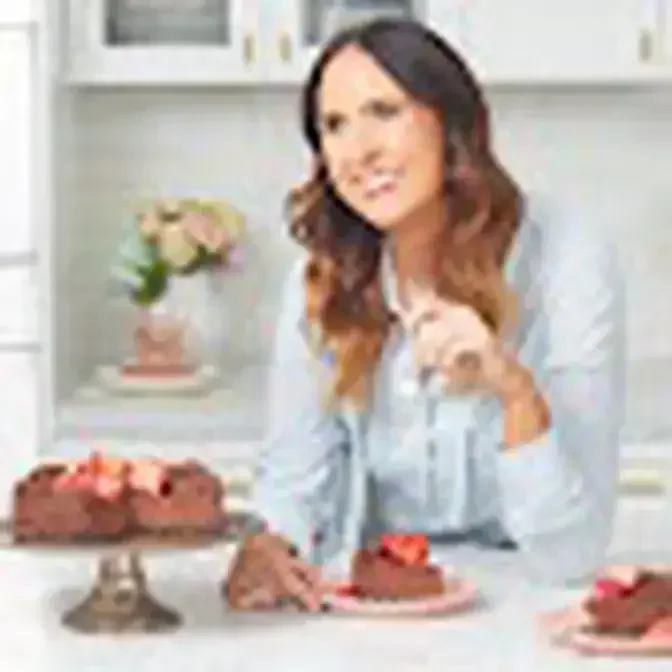
Hi Bold Bakers! Ami and I are in my test kitchen today creating a different type of no-bake cheesecake. Stovetop Cheesecake, no oven required! Discover the secrets to achieving a velvety cream cheese filling, tangy lemon notes, and a perfect cookie crust, all cooked on your stovetop.
Chapters: 0:00 Welcome to My Test Kitchen! 0:36 No-Bake Stovetop Cheesecake 1:16 The Game-Plan 2:03 Round One 6:04 A Few Hours Later... 7:40 Round 2 Round 3…?
📌Stovetop Cheesecake Recipe📌 Prep time: 20 minutes Chill time: 8 hours Yield: One 8-inch (20 cm) cheesecake 1 Cookie Crust 2 cups (16 oz/450 g) cream cheese, softened 6 tablespoons lemon juice 1 teaspoon vanilla extract 3 large eggs, room temperature 1½ cups (12 fl oz/360 ml) heavy cream ½ cup (4 oz/115 g) plus ½ cup (4 oz/115 g) granulated sugar *Press the cookie crust into an 8-inch (20 cm) springform pan. Set aside. *In a large bowl, whisk the cream cheese, lemon juice and vanilla extract until well blended. Place a fine mesh sieve over the bowl and set aside near the stove. *In a medium bowl, whisk together the eggs and ½ cup (4 oz/115 g) sugar. Set aside near the stove. *In a medium saucepan, combine the heavy cream and ½ cup (4 oz/115 g) sugar. Cook over medium heat until the cream begins to simmer. *Temper the eggs by whisking them constantly while pouring in the hot cream a little bit at a time. *Return the cream and egg mixture to the saucepan, turn the heat to low and whisk without stopping until the custard thickens enough to coat the back of a spoon. *Immediately pour the mixture through the sieve and onto the cream cheese. *Whisk until the filling is smooth and evenly combined, then pour this into your prepared pan. *Smooth the top and then refrigerate for at least 8 hours, or overnight. *When ready to serve, run a thin knife along the edge to loosen the cake, then unmold and serve immediately. *Store leftovers in the refrigerator for up to 3 days or in the freezer from up to 1 month. *Defrost for a few hours in the refrigerator before serving. 📌Notes A cooked cheesecake filling, done quickly on the stovetop - no oven necessary! This lies somewhere between the light, gelatin-based no-bake cheesecake and a dense, baked cheesecake. 📌Tips * Use good quality brick-style cheesecake like Philadelphia. Some brands are too watery and tub cheesecake won’t be firm enough. * The acid in the lemon helps the cream set. The riper the lemon, the more acid it has so choose the ripest lemons you can find to ensure a firmer set. You can also use bottled lemon juice which has a standard, higher level of acid. * This is a softer set cheesecake and must stay refrigerated until you want to serve it. * If you would like a bit more firmness to this cheesecake, whisk 2 teaspoons of cornstarch into your eggs before you temper them and cook the custard. * If you are traveling with this cheesecake, pop it in the freezer for a couple of hours before you go to keep it cold. * We like this cheesecake refrigerator cold but you can also serve it frozen for an icy summery treat! This cheesecake would be lovely served with fresh berries or a drizzle of Raspberry Sauce!
This is no joke, I've literally never seen that happen before, I've never seen that happen.
Hi there, I'm Chef Gemma Stafford and welcome to my test kitchen.
This is where my team of experts and I have fun experimenting, problem solving, geeking
out and answering a lot of baking questions and you are a fly on the wall so welcome in.
We do a lot of fun things here, today we're going to be experimenting with something that's
a little bit different that I've never heard before but we're going to try it as Ami, come
over here and tell us what we're doing today.
Hey, so I just recently came across a recipe for no-bake cheesecake but not the kind of
no-bake cheesecake that we've normally done, it's actually cooked, it's a cooked filling
on the stove like a custard and I really like, I really like a cooked cheesecake but it gets
hot in the summer so I thought this might be a really interesting idea if it works.
Yeah, no gelatin, there's an egg involved on the stove top, I've never heard of it,
like I said, I think it's going to be fun, we'll see what happens.
I have, if Patesville was wrong, I have a solution to rescue it, I think.
Looking at the list of ingredients we were even talking about earlier, like how do we
even mix this together on the stove?
In terms of mixing it together, I think I was wondering, do we want to cook the egg
and the cream first with the sugar and then mix it into the cream cheese?
Yeah, I think we heat up the majority of ingredients first, cream cheese, cream, sugar, lastly
add in the egg and the vanilla, that's my personal thought because once that egg goes
in there, it's kind of game over, you don't have a lot of time.
Right, ok, and then we're going to temper the egg a little bit so it doesn't, ok.
And then should we strain it all the way we would a custard before we put it in?
It's not in the recipe but I personally think you should, and it's usually egg whites
that cook and I think we should.
Ok, so we've got all our ingredients measured out and so let's head over to the stove.
Ok.
Ok, so here we are, I'm going to just turn my stove on to medium, medium low, and I'm
going to get going with my ingredients, I've got cream, and to that I'm going to add corn
starch, sugar, and I'm just going to get that all nice and smooth, just make sure that corn
starch doesn't get lumpy.
Alright, now that that looks like it's smooth and incorporated, I'm going to add in the
cream cheese, and I'm going to let all this heat up.
I mean, where'd you get the idea for this?
You know, I've always been curious about cooking cheesecake filling over the stove, mostly
because there's always these issues with cooking cheesecake filling, you don't want to have
cracks in your cheesecake, do you use a water bath?
I thought, you know, we cook a lot of custards on the stove, you know, why wouldn't it work?
Alright, so this cream cheese looks like it's softening up.
One thing I'm noticing is that this is going to be a fairly small filling, comparatively
to most cheesecakes baked in the oven.
I'm going to switch this to a bigger bowl so I can temper it a bit.
I'm going to just add this slowly, and I want to make sure that the egg is nice and beaten,
into some of this cream cheese mixture before I move it back into the pot so that nothing curdles.
Alright, so that's nice and smooth, I'm going to take that back to the stove, I'm going
to slowly incorporate that in, and now at this point, I'm going to stir pretty constantly.
You know, I mean, it looks nice and smooth, it's not, you know, the egg's going to take
a few minutes to cook.
Now that I've incorporated the eggs on lower heat, I think I'm going to bring the temperature
back up to a medium low, and I'm going to switch over to my spatula, my rubber spatula,
so I can really keep cleaning off the sides, because where the egg is going to cook fastest
is where it's hot against the pot.
The other thing I'm going to do is I've got a crust here, this beautiful crust that Gemma
made for me, and I'm going to put a strainer right over that so that when it seems like
this is thickening and ready to go, I'm going to pour this whole custard through a sieve.
So this is looking fairly cooked to me, now one of the challenges is with a regular custard,
you see that it thickens up, and so you really know that your egg is cooked, whereas we've
got the cream cheese incorporated in here, so it's already thick, so it is clearing the
sides of the bowl and holding together, and it's bubbling a little bit, so I'm guessing
that the egg is cooked and the cornstarch is cooked.
Usually the signs are when you're cooking a custard and you're using egg and cornstarch,
you go from a liquid to a fairly thick filling, because we've got the cream cheese in here,
it's already pretty thick.
I would say that this is almost like a mayonnaise consistency.
So I'm going to stop there.
I'm going to actually push this through into a bowl so I can stir in the vanilla.
Stir in the vanilla, this is already looking pretty nice and thick.
This is not a lot of filling to crust ratio, I kind of feel like we could double this,
or triple it.
Yeah, this is a very simple amount of filling.
There it is, here's our stovetop cooked cheesecake.
Doesn't look like there's a whole lot of filling in here, but we're going to get it in the
fridge, we're going to let it set for a few hours, and we're going to cut into it and
have a look and a taste.
Okay, here it is.
I'm just going to loosen the edge, make sure it's not stuck.
Aww, it's a baby cheesecake!
I knew, I knew when we were mixing it together, I was like, it's kind of like a tart.
This is the skinny cheesecake.
Shall we?
You're going to have to give me half of it if you're going to, it's going to be that
skinny.
No, I got it.
So, it's like all crust.
This is a crust lover's cheesecake.
My favorite type of cheesecake, all crust.
Right off the bat, you can see it's like way too thin, so I would say double or triple
recipe.
Maybe add a touch more sugar too, I just felt like the sweetness of the crust was overpowering
compared to the cheesecake.
I kind of feel like taste-wise, it could be a little, like we could add a little lemon
juice, like the way you normally do to brighten the flavor a little bit.
This texture makes me think we definitely don't need the cornstarch.
And I think we're going to change up the mixing method.
I think we're going to, I was a little concerned that the eggs weren't cooking in the filling
because the whole thing was so thick, it was really hard for me to see it.
So I think we're going to cook the eggs with the cream and the sugar first, and then stir
it into a softened cream cheese.
I get it, that's interesting.
All right, so we're going to do all those things and see if it works out.
Welcome to day two of our cheesecake test kitchen, and we've made some progress.
Okay, so we decided after the first time we tripled all the ingredients and we put it
together, and then it turns out that it wasn't as easy as we would have thought.
We had some problems with it.
It was overly dense, and if you can see over here, it didn't really hold very well.
It's a little soft, it's not really setting, and if it stays out of the fridge a little
too long, we think it's just going to fall over.
Yeah, for round three, we decided to cut back on the cream cheese.
We didn't want to cut back on the cream, just the cream cheese, but then we thought we might
run into the same setting issues.
But we also know that acid, like lemon juice, can set cream cheese, if you're familiar with
a posse or with homemade cream cheese.
And so what we decided to do was increase the lemon juice.
So we've added a lot more lemon juice to help set the cream.
We have a triple amount of cream, but just doubled on the cream cheese.
All right, so here we are.
Unmolding our third attempt.
It's double time cheesecake.
I'm already very optimistic about this.
Well, you know.
Look how lovely it looks.
You know, it looks okay.
I think sometimes I'm worried that the whole thing's going to fall over and...
I really want to poke it, can I poke it?
Still looks pretty soft.
Holding together.
Let's have a little tasty taste.
Oh, it's good.
Flavor's spot on.
But it's really good.
It's perfect.
Five stars for flavor.
So I have to say the extra lemon juice doesn't really make it taste overly lemony.
It seems appropriately tangy for cheesecake.
Yummy.
I think the pulling back on the cream cheese was right.
I think if somebody hands that to me, I'd be like, this is cheesecake.
And they just need to add a little bit more something to set it.
The question we have is, can you make a cheesecake on the stovetop?
And my answer, my answer is yes.
Yes, you can.
You can.
This is what you're going to get.
In the world of cheesecakes, what would you rate that cheesecake,
ten being the highest and one being the lowest?
I'd say like a seven, eight.
I would say to me, in the two worlds of cheesecakes, I'm going to say six out of ten.
I actually really like this.
Yeah.
That's a real compliment, isn't it?
So we started this out wondering if you could make a stovetop cheesecake and it turns out
you can.
Yay, best thing ever.
Another easy way to make cheesecake.
Yeah.
Recipe is in the description box, give it a try.
Ami, let us know what is next for us in our pound kitchen.
Well, I make a lot of cakes and I've been really wondering about egg substitutes and
specifically which egg substitutes are going to work best for a pound cake.
I was wondering about our mochi recipe heading into the summer.
Lots of people say that it freezes very hard.
And I do know that there's some easy solutions.
We can tweak the recipe a little bit and make the results even better.
So those are our suggestions.
Let us know in the comments below which one of those you'd like to see or if you'd like
to see something else.
And we'll see you back here again really soon.
Bye.
I want more of this.
It reminds me of my mom's cheesecake.
It's like the cheesecake.