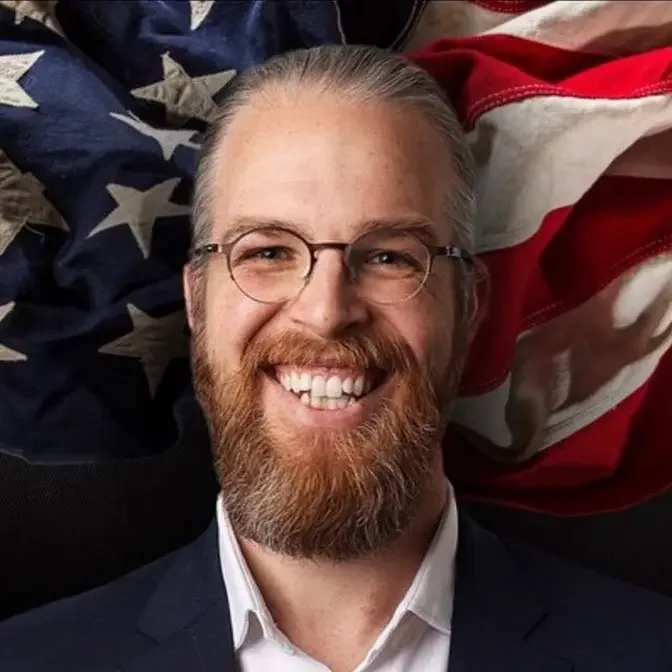
Welcome to Man in America. I'm your host, Seth Holhaus. So as we unpeel the layers of the onion
and understand who's behind this massive change, this push that we've seen, the loss of our
freedoms, as everything seems to be heading towards a great reset, we look at it and we
understand that it's a lot of times it's the elites, it's the powerful families. Now I wonder
if you could ever get a perspective from people that are within those families. Well, joining me
today is Edward Habsburg. It's from the Habsburg dynasty. And I didn't know this actually before,
you know, doing some research, but the Habsburgs were actually, since ancient Rome, they're the
largest ruling family in history. So assigned from ancient Romans, they had the largest empire
across Europe, which was just incredible. Now that changed over the past, say 100, 150 years or so.
But so joining us, so Edward is someone that is very, very involved. He's very active on social
media, but he's someone that's going to help provide a perspective of from, you know, his shoes,
you know, what he sees in terms of how the elites are involved with this, what their overall plans
are, but also what are really practical ways that we can fight back against this, you know, what
you call probably a satanic agenda that's trying to push us into this one world government, etc.
So he has, he has some very practical advice in ways that he thinks that we need to, to really
kind of take, take seriously to return back to our tradition, you know, traditional ways of living
that will help really to give us strength to fight off this threat we have. So this is gonna be a
really interesting interview. I hope that you really enjoy it. Before we get started, though,
make sure you're following me on social media at Man in America. Also, you can find me on LFATV.
If you go to Rumble, they've got a great channel, huge network, LFATV. You can also find the show
there. And every show is done as a podcast as well. So if you want to listen instead of watch,
just go to your favorite podcast app and search for Man in America, and you'll find me there.
All right, folks, let's jump into this interview with Edward Habsburg.
So Edward, it is a pleasure to have you on the show today. Thank you for joining us.
Thank you very much for inviting me. This is actually my first interview about my book.
Oh, very good, very good. So let us first understand a little more about your family
history. I'll be completely honest in saying that before the, you know, kind of coming across your
book and the potential interview, I wasn't that familiar with your family history, but
because it's not one of the family names that we see commonly talked about, like the, you know,
the Rothschild or some of the bigger European names. But through my research, I discovered that,
you know, the the Habsburg Empire was the largest empire, Western empire since Rome,
which was significant. So can you can you just give us a little bit of history of your family?
My family was a part of and influenced European history for about 800 years,
from the 1270s to the 20th century. And the Habsburg family ruled in those in those centuries,
more or less, Germany, Austria, for a time, Spain, Netherlands, and for a longish time,
large parts of the world in the famous empire where the sun didn't set.
It's a family that got famous not for murder, massacre, and wars, but mostly by having huge,
numerous families with many children, by performing marriage politics, and by being
very Catholic. I think saying that Habsburg is Catholic is like saying that the Pope is Catholic.
So yeah, that's more or less my family. And our heartland, so to speak, where Austria,
very, very early on Switzerland, but we got kicked out of Switzerland in the 15th century.
And yes, and most people would associate the Habsburgs with Vienna, with with the castles
there. And most Americans, if you go on Google and try to find sort of which search goes most
with Habsburgs is usually Habsburg jaw, which is that famous slightly deformed lower jaw that
the Habsburgs had in those 150 years of the Spanish branch. And that's also the part of
my family that I get most confronted with when people try to troll me on Twitter.
Actually, I did come across the Habsburg jaw in my research.
And so today, today on Twitter, today on Twitter, somebody, somebody, they discussed about me,
and somebody said, well, they even lost the Habsburg chin. And I said, if you're disappointed,
you can go and look at paintings from the 17th century.
Yes. So you've got a very unique position in understanding what's happening in the world.
And, you know, I think that, you know, we've seen, you know, in this world, we've seen the
rise and fall of empires, you know, the Roman Empire came and went, your, your family empire
kind of came and I think is around what World War One when a lot of the power shifted with your
family. And so that's, you know, it's, it's nothing new to have the rise and fall, but right
now it feels like we're in a very different situation, I guess, in a lot of ways. I've been
looking at the, the, the globalists and, and, you know, the communists and everything. And I,
I see that, you know, you had a post recently about communism and the Memorial in Hungary
about communism. It was a very beautiful quote about communism and Christianity,
which I thought was very good. And so, you know, from, from your vantage point,
how do you view what's happening in the world right now? And how does that tie into your book,
which, you know, is really about the, the lessons in the, in the rules and principles that we need
to get through these turbulent times? Yes. Well, one of the reasons I wrote the book was to try
to answer the question, something is wrong with our, with our world. Something is going wrong.
And have we lost something? I'm not saying have we lost something when we kicked the monarchies
out a hundred years ago, but shouldn't we take a look, a long look at the values that made these,
these, these very strong empires work? And shouldn't we think about whether to
implement them today in, in whatever way is, is right. Now, what really helped me with that
was not only that my family is the Habsburg family, but also that I'm ambassador of Hungary
right now to the Holy See, which my eyes are always on faith. My shoulders and my back are
firmly planted in Hungary. Hungary is a country that stands for traditional family values,
for faith, for sovereignty, for subsidiarity, a very important word in my book. So my job as
diplomat for Hungary, the place where I work at the Holy See and my roots that are in the Habsburg
family really encouraged me to reach out, write a book and encourage people to take a look at
these values that we don't have anymore. And I came up with the so-called Habsburg way, the seven,
seven rules for turbulent times, which are basically the seven principles of our family
that I think largely have gone, have gone missing today. And I propose them, I propose that to
anyone who reads the book to, to, to think about it. I mean, for instance, I give you one example.
For me, one of the greatest Habsburgs was also one who ruled only very, very briefly
in the worst possible moment, his blessed emperor Karl. He was the last emperor of the Habsburgs.
He came after the decades, decades, decades long empire of Franz Joseph. And he was only emperor
for one and a half years at the end of the first world war. He was a giant of faith. He was a
deeply humbled man, a loving father of eight children and with a wonderful wife. And when he
lay dying and he died like a really deep man of faith in lots of pain, and he offered up his pain
for his people. He offered God his life for his people and for the peace of his people.
Now look around and see whether you can imagine any politicians to go that far in, in your love,
in your feeling of duty and responsibility. Even when Karl was in exile in Madeira and lay dying,
his first thought was to his people. Now that of course comes from having been raised all your life
for the, for service. And I suppose that we have, thank God, a few good politicians,
but we may have a few who may just want to, want to get something out of it. And then afterwards,
find a pleasant place where they can earn a lot of money. And this is sometimes not the leaders
that we feel can lead us through very difficult times. So all of this together makes me encourage
people to read about the Habsburgs, what made them tick and why that was not a bad thing.
You know, United States are very strongly built on the myth of you have to fight tyranny. You have
to fight Kings and all of this is bad. But most rulers were there to make their people
live better. And this was historically so. They were bound to law. They were bound to their faith.
They were raised to be servants. Very few rulers were really those crazy, giggling
maniacs that we know from movies. And I can just say the Habsburgs lived for their people.
They did everything for their people. And therefore, yes, the idea of my book is
our society, our politicians, and every one of us can learn a bit from this and try to improve
Folks, I've got a quick message for you. Right now, the world is very, very actively going
through a process that the experts are calling de-dollarization. And look, I've been talking
about this for well over a year now, but maybe you're now starting to see it in the mainstream
because they're now talking about it because it's really happening. What does this mean? Well,
there's a few factors, but there's two main factors. One is that the BRICS nations,
this is Brazil, Russia, India, China, South Africa, and a whole coalition,
they are actively getting rid of the U.S. dollar. They're stopping their trade in the U.S. dollar.
And this is significant because the dollar's losing its status as a global reserve currency
and as a petrodollar. This is what gives our dollar its value. But the other thing is that
we have an enemy that's within our own government. Biden and his administration,
they're actively working to destroy the dollar. And you can see it in their actions that they're
not trying to save the dollar. They're actually trying to destroy it because they want to roll
out their central bank digital currency. So you have these two forces coming in both the same
time working to destroy the dollar because what happens when that dollar gets destroyed? Well,
literally your life savings, if they're sitting in the dollar, whether it's in a savings account
or a bank account or the stock market or an IRA or a 401k, those savings, that money could
literally be wiped out in a matter of days, weeks, even a couple of months. We're already seeing it
with inflation, which is going to be much, much worse. If you're seeing the writing on the wall
and you're thinking, what can I do to protect myself? Well, there's a few recommendations that
I always have. One is just to make sure you've got your food. If you have land, you know, ammunition,
whatever it takes, real tangible assets. But fundamentally, the thing I recommend most is
precious metals, gold and silver. Look, precious metals have survived the collapse of currencies,
the rise and fall of civilization. And also a big factor in this is that the BRICS nations,
their new currency they're introducing to replace the dollar. A lot of experts are saying it will be
backed by commodities like precious metals. And so you can see there's going to be a stabilization
and I believe a dramatic increase in the value of precious metals. Not to mention, look at the
past six months, we're seeing 30% plus increase in the prices of silver and gold. So if you would
go back and say you put a hundred grand in the silver six months ago, it could be worth well
over $125,000, $130,000 because the dollar is losing its value. So folks, if you want someone
that you can trust for buying your precious metals or gold and silver, I would highly recommend Dr.
Kirk Elliott. So Dr. Kirk Elliott is a good friend of mine, but he's a strong Christian patriot.
He understands what's happening in the world. He's got two PhDs, one in theology, one in economics.
So it's the perfect blend of understanding realistically money in the end times. So if
you want to set up a free consultation with Kirk's team, head on over to goldwithseth.com.
So again, that's goldwithseth.com or call 720-605-3900. Again, it's goldwithseth.com.
You go to the website, you scroll down, there's a simple form that you fill out right there.
You put your email name, contact information, and that sets you up for a free wealth consultation
where you can talk to either Kirk or one of his experts to really understand what your options
are. Or you can just call 720-605-3900 to take action today. Can you actually just walk through
a list of the seven principles, the seven rules for tribulate times? Okay. So the first one,
of course, with the Habsburgs is get married and have lots of children. I can attest to this
personally. I am married. I have six children. I have a very courageous wife. It's the greatest
decision I've made in my life. It changes everything. It changes your outlook on life.
It makes you immune also to intervention by the state. Family is a stronghold to live in.
And the Habsburgs were a family family. Now, my second point is be Catholic and practice your
faith. The Habsburgs were Catholic. Now, you don't have to be Catholic to practice your faith.
So all of this, of course, goes for anyone else who is strong in his Christian faith.
You know, we've grown used to politicians trying not to show their faith in their political life,
not in the States, but in Europe especially. The idea is that you shouldn't have a religion,
then you are a good politician. But if someone has a faith, then I can know what I can hold him to.
And I know what the criteria of his life are. Believe in the empire and in subsidiarity.
Now, this is a very strong plaidoyer for the empire, not understood as the Star Wars empire,
where one cackling maniac emperor suppresses everyone, but the empire as the Habsburgs
was a living together of different nations, different languages, different religions,
different personalities, different sets of laws, of rules, under an emperor that had always to
juggle, to balance, to make peace between. And this never encouraged you to be an evil dictator.
You couldn't. You had to keep everybody alive. So believe in the empire, but most of all in
subsidiarity. That is probably one of the most important words in my book. It is the principle
that the United States are built upon. You are built upon bottom to top. You are built on the
local level. You are not a centralistic nation. In theory, there are always tendencies to centralize,
but in reality, the township and the family are the basis of your nation. That's why
we also look to the United States as a place of hope right now. Stand for law and justice
and your subjects. This is the chapter where I speak a lot about how the Habsburgs felt bound
to law and didn't interpret it in a creative way and to justice and for their subjects.
Then know who you are. This is the place where I speak about tradition and live accordingly.
Know your roots. Know where you come from. Don't cut them all off. We can't invent ourselves anew.
Man in the 20th century isn't neither more brilliant nor more wise than all those generations
in the last 50,000 years that lived before us. Be brave in battle. I don't want everybody to
be a soldier, but the Habsburgs had to stand in battle. For a long time as an emperor,
you couldn't just do diplomacy and get married, but sometimes you had to put on the helmet,
take out the sword, and lead your armies. Blessed Carl was in the field. He fought in the First
World War. Of course, the last and most important thing that I might have begun with is die well.
This is about the way the Habsburgs prepared for death. They were Catholics, and they knew
that their last moment decided over their eternity. They wanted to prepare for that moment,
and they wanted people to pray for them after they had died. I encourage everybody to see their life
from their potential point of death, to say, is my life so that if I die tomorrow, I'm ready.
I'm ready to go, and I'm ready to render my life back to God. There is a very touching story in my
book. One of the 16 children of Empress Maria Theresia in the 18th century, they got a disease,
the pox. I think smallpox, I suppose. It's a version of smallpox then.
When you got smallpox, there were two ways to get out, three ways. In the rarest case,
you got out of it normally. Most probably, you were scarred for life, and there was a good chance
that you died. Her father writes in the diary that one of his daughters, the moment she got
the smallpox, she knew she was ill. She immediately asked for a priest and made a
life confession. She died two days later. Just to know that even as a child Habsburg,
you had this priority to die well, deep inside your matrix. I think in Latin, you say,
whatever you do, do it wisely and keep the end in sight. Yes, I could have put this at the first
spot, but this is my seven points. In a way, funnily enough, afterwards, when I looked at the
book, it says it's a self-help book. Michael Knowles wrote in his endorsement that I redeemed
the self-help book. Now, Habsburgs have done a lot over the centuries, but redeeming the
self-help book is an achievement I'm rather proud of. That's very funny. Michael Knowles,
he's a funny guy, for sure. One of the points that stood out to me that you're talking about
there, and you mentioned how basically don't fall for the wisdom and the arrogance of the young
person that doesn't look back at the tens of thousands of years of culture and history. I
think that that's one of the things that we've really lost in our modern civilization is our
roots. Also, you talked about not severing your roots. I'm sure that for you, you can probably
trace your family tree back hundreds and hundreds of years and know that you're the great, great,
great, great, great, great, great, great grandson of this person. Here in America, our country,
in the grand scheme of things, we're like a two-year-old child compared to some of the
countries that are so old. Look at China, which has a 5,000-year culture. If you look at the
attack on humanity that we're experiencing right now, I think that one of the big parts of it is
really separating us from our roots, separating us from the wisdom of the elders. Even what I can say
with how things are done here, it's very typical for people, once they get to a certain age,
they get put into a home somewhere. Whereas a lot of the people that I know that are from Europe
or the Europeans or from the Asian countries, their parents will, when the time is right,
their parents come back with them, and they take care of their parents until the end of their
lives. Imagine the opportunity to take the wisdom of the older generation and pass it to not just
yourself, but to your children and to your children's children. I think that it's a very
important thing that has been lost in our world today, is just the respect for antiquity. And if
you look at a lot of the communist movements, which I think that's really what's behind a lot
of what we're seeing today, it's really about destroying that antiquity. It's like when the
Chinese Communist Party took over in China, they destroyed all the cultural heritage of China
because they knew that they would not be able to survive if that cultural heritage was sustained.
Yes, we live in a time where you are encouraged to be alone, without family bonds, without roots,
without past, without beauty, without values, without anything, to reinvent yourself every
five minutes. And I have to say, this is a lesson that the Catholic Church has learned
in a very hard way, because suddenly in the 60s, 70s, they decided that they don't need all these
old things, this old dusty stuff, that old Latin language, those old rites, those old
forms of devotion and piety. We don't need that anymore. We're grown up. There was this idea that
man has suddenly stepped across a threshold. Humanity is nearly there. We're nearly there
to the perfect human being. We don't need all these old fashioned things. And you're absolutely
right. Communism tried to destroy everything that tied you to your past, to your roots,
to beauty, to greatness, to sacrifice for the sake of others. So you asked at the beginning
of your question, you asked, if you can't trace your family back centuries, how do you find these
roots? And I can give you an example from the Habsburg family history. The Habsburgs had a
really steep departure. They got one of the counts of Habsburg from Switzerland to become
king of the Holy Roman Empire. But after that, his son wasn't, and his grandson wasn't. They
were kicked out again. And they were moping in Austria and wanting to get back into the
leadership position. And what they did is they looked at the things they really aspired to,
and they decided that they wanted to be that. So they invented for themselves a set of values of
traditional ideas. And for instance, they discovered a document apparently written by
Emperor Nero that gave the ancestors of the Habsburgs a title. And that was, of course,
a forgery. But it gave the Habsburgs the idea we come from something really old,
even older than we come. We stand for values that are very old. And since then, they call
themselves Archdukes. That was a title that only exists in our family, and in some science fiction
novels, but in our family. And then, of course, the emperor declined the document, said this is
a forgery. But two emperors later was a Habsburg, and he accepted the document is real. And since
then, we are Archdukes. Now, you can say this is in a way inventing, but if you are cut off
from your values, you have to find those that are really good and adopt them. Take them into
your identity and live according to them. That's one thing you can do. For me, it's easier because
I know what my great-grandparents stood for. Through my father, I can look back at least 100
years. Through my grandfather, more. And I can read books about my family, and I know how my
ancestors died for something. If you don't have that, then look up to people, values that aspire
you. Put them into your life and live them. And in America, it's easy because you have a very strong
founding myth. And it's something that we sometimes, we in Europe, really look up to you
because you have this strong myth. And that's an interesting point, because it's good to be
reminded of that. Because while I can't say that I can trace my family lineage back to, you know,
400 or 500 years and know exactly where I came from, what I can do is I can trace back to 1776
and say that our forefathers, they fought and died for our freedoms. And it's an interesting
phenomena that's happening right now here in America, which I think that it's rippling,
as you mentioned, to other countries in the world. I think that in America, we got very
comfortable. As one of my history teachers would say, we got fat, happy, and stupid, right? Life
became so good, very opulent, not a lot of threats, you know, oh, we'll never, our country
will never fall. But over the past couple of years, I think that a lot of people have realized
how fragile our freedom is. And we know that we truly do have the threat of multiple totalitarian
regimes and groups and organizations at our doorstep. And what I've seen though, is that
I've seen a massive revival in people seeking out the founding principles again. You know,
where you see, you know, I live in a very rural area and I regularly, I see trucks driving and
they'll have a big flag that says like 1776, right? It's very common. So you can see that even
though, yes, a lot of Americans, you know, we're kind of like mutts, you know what I mean? We're
10 different kind of ethnicities mixed together. And it's like, well, it's like, I've got, you
know, I've got Irish, I've got Welsh, I've got, you know, Scandinavian, I've got, you know,
probably some African, it's all kind of mixes in and we don't have those roots, but we do have the
roots of America. We have the roots of our, of the founding fathers. And that's, it's a good
reminder to see your perspective on that. You know, Seth, freedom is a very, very important
world. We live in a time where unfortunately, and I talk about this in my book, where you see
people with an interest in control that are unfortunately very often far removed from
democratic legitimation, are on higher and higher levels, try to offer security in exchange for
freedom. And I see people who have, you know, the Habsburgs were always listening to their people
and to the lower levels. They were listening to the demands of the people and they were listening
to the grassroot level. One Habsburg tried not to do that. That was Joseph II. And he had ideas
with capital I. And in the name of these ideas, he imposed control measures and sanctions and
centralism on his different people because he thought it's good for them. Does that remind
you of something? It definitely does me. And it went terribly wrong. He was only emperor for 10
years. In the end, he had to take back a lot of these measures because he realized this doesn't
fit to man. Man needs freedom. Man needs respect from his leaders. You are not the subjects of
your politicians. Your politicians are elected leaders. And be very worried if strongly supernatural
forces decide upon what is happening in the country. Hungary is experiencing a bit of this
in the European Union, where centralistic tendencies in Brussels try to tell us how to
make our school laws, for instance. And this is always a bad sign. And I don't have to tell you
that in the last two years, there were more traces of giving up freedom for security because you're
afraid. And all of this, you will find things about this in my book, too. So another reason to read it.
And one question I have that I kind of have to ask, and I'll accept whatever answer you have, but
you're from a very powerful, bloodline lineage of European families. And as I've
done my own research, and also a lot of people that are watching the show, they're very well
researched, and they've looked into a lot of different things. And a lot of it, like you just
mentioned, it really kind of goes to that there's this drive for more control from these people that
are so far removed from us. It's unimaginable, some of these families, the amount of
castles and the wealth and the control that they have. And there's, when you're kind of digging and
asking, okay, who's behind this or what's behind this? A lot of people will, they say, oh,
it leads back, it's the World Economic Forum, it's the big globalist organizations, it's the UN, it's
the Chinese Communist Party. But there's also then a lot of the powerful banking families, you know,
the Rothschilds, the Morgans, etc. That when you start to look at what they're doing, you can see
that, yeah, a lot of what manifests in our society as a loss of freedom or a push for a very radical
agenda, whether it has to do with the family or our culture, you can trace it back to some of
these operatives coming from these very, very high levels of society. And so the question I have for
you is just like, what is your perspective of that? Because you're someone that you see
a different, you're looking at things from a different vantage point than I can look at things.
I just, I'd love to hear just what you're seeing. What I see is that man is basically made for
family. And the level that man is happy with, the level that man can understand his family,
homestead, township, county, state, nation in your case, but everything above that gets very hazy
and very dangerous. People who want to save the entire world, the globe, the world climate,
people who have so much money that they can afford to force their ideas onto people.
And that have, you know, listen to a Habsburg talk about democracy, that have no democratic
legitimization, that are not controlled by democracy, but can just get everything that
they want, because they have this idea. And this idea now has to be the idea of everybody.
This is very dangerous. This is a danger to democracy, and it's a danger to human beings.
And again, I repeat it, everything that is above state or nation level should be handled with
lots of caution. And we haven't had so far, I mean, if you look at your constitution,
there is no real place for rich transnational players with enormous amounts of monies that
have so much money that they can buy out an entire nation. That's not, it's not an idea
that should be there. It is there. The problem is it's here. So what is the answer? The answer is
go back to the roots, go back to the traditional values. As I said, right in the beginning,
when I spoke about family, if you have six or eight children and they are close with their
parents, you eat together, you live together, pray together, you talk together. This is a circle
where the state can't interfere, where woke ideas from very high above can't easily get in. They
will get in because we all carry around our mobiles and we all are on social media,
but it's more difficult. If you're alone out there, if you're a single, if you have changing
partners all the time, all that, the sort of lifestyle that is strongly encouraged nowadays,
you are lost. You're a ping pong ball in the wind. So go back to those traditional values.
And the great thing is you have these very simple tools. You can build it up from the base,
from the grassroots. You don't need someone up there to tell you how to do it.
Yeah. And as I repeat, read my book, there is a few ideas about that. What are values that really
are the basis of our society? It's really a profound yet simple way of looking at it. And I
couldn't agree more. I feel like if I could go back in time to when I was 20 years old,
I would just say, get married and make it my goal to have 10 children by 35. It's like,
that's what I wish I could go back and do. Because it's like, I want to populate the
earth with more good people. That's how we're going to fight the globalists.
Yes, yes, yes, yes, yes, yes, yes.
Edward, it's been such a pleasure speaking with you and I really appreciate you taking the time.
I'll bring up a link to your book here and this will be in the description below as well. But
your book, you can pre-order it right now. It comes out April 16th. It's The Hattsburg Way,
Seven Rules for Turbulent Times. You can find it, all the major places that sell books. And
I think that just what you stand for and what you're pushing forward is a very important
message right now. And look, maybe it's a really good thing that we're being pushed to the edge of
destruction and it's going to cause us to go back to our roots and to go back to tradition and reject
modernity and reject the globalist agenda.
Absolutely. Thank you very much. Isn't it a great idea that a Hattsburg and an American
YouTuber podcaster can talk about these topics and agree on them?
Isn't that wonderful? That is truly globalist.
That's true. It is. Well, thank you so much for joining us and take care.
Please, we'll keep in touch.
God bless. All the best. Bye-bye.
All right, folks, I've got a quick message for you. I have one simple question. If today
you could no longer go purchase more food for your family with the food stores that you have
in your home, how long would you be able to feed your family? Would it be a week, three weeks,
a month, two months, a year? This is a really important question, folks, that we have to be
very realistic about because the elites are proactively trying to put us into a state of
food crisis and a state of famine. I'm sure you've seen all of the different food processing
plants and farms that are blowing up. You've got cattle dying by the tens of thousands.
They're proactively trying to collapse our food system because they know if they can control our
food, they can control us. And so one of the best ways to be outside of their control is to be able
to have our own stores of food and to be able to produce our own food. So there's really two things
I would recommend. One is having heirloom seeds that you can grow your own food with, making sure
that they're non-GMO heirloom seeds. That way you can harvest your seeds this year, use them next
year. You can use these seeds for generations. Literally, that's how it will work. The other
thing, though, is high quality storable food. This is food that's sitting somewhere. It's hidden in
your basement, buried in your backyard, whatever it is. So that way, if there is a crisis, if there
is an emergency, you might have three months set aside to get through that time period. And so for
this, I would highly recommend a company called Heaven's Harvest. This is an amazing Christian
owned Patriot company. And what they're doing is they're making high quality storable food. Again,
a lot of the food companies, they say these food buckets, they're all about maximizing calories per
dollar. They're filling the buckets with a bunch of filler and junk like sweet beverages, etc.
But Heaven's Harvest, they focus on very high quality food that will last up to 25 years on
the shelf. They also sell heirloom seeds. You can buy all of your seeds. You can buy all of your
storable food. And look, folks, personally, I would recommend having at least three months per person
in your household, if not six months or even a year. Again, depends on your budget. But definitely
make sure you have some seeds because those seeds could be worth their weight in gold, if not
more in the future. So to go ahead and do this right now, go put up a new tab and go to
heavensharvest.com. And if you use the promo code Seth, that's S-E-T-H, promo code Seth, you'll save
15% off of your entire order. So again, folks, the time is running out and you'd rather be three
months or one year early than one day late. Again, heavensharvest.com and use promo code Seth to save
15% today.