
Archimedes: More than Just a Screw
2 Video Views·Jun 12, 2023
Comments are disabled for this video.
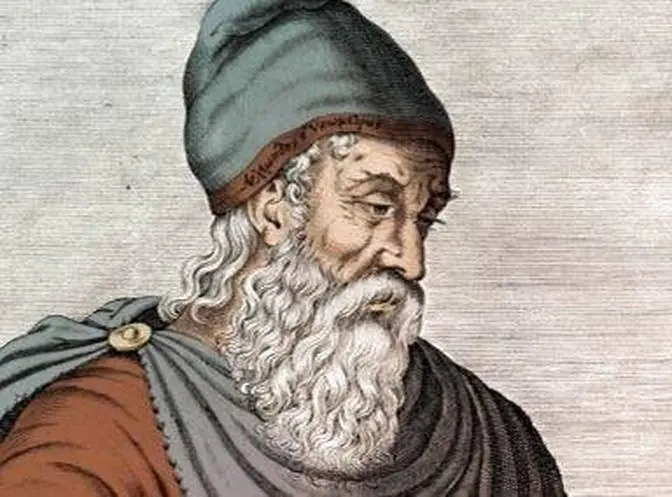
If looks alone determine intellect, Archimedes may have risen to great heights based solely
on his stately appearance.
Sculptures and paintings depict a wise and contemplative face, framed by an unruly, wide
beard, and everyone knows that people with beards look smarter.
He also had a nearly hairless scalp, which, again, I don't want to repeat myself, but
everyone knows that smart people have balls.
It's our brains pushing our hair out.
Though the venerable tinkerer and problem solver isn't as well known as some other
ancient sages, he's credited with a number of impressive technological advances, many
of which are still used today.
I'd say that Archimedes is fairly well known.
When Archimedes was born near the end of the 3rd century BC, the Sicilian city of Syracuse
was a thriving center for trade, science, and the arts.
As the gifted and perpetually curious son of a prominent local stargazer and mathematician,
he was encouraged to pursue his interests early on, but surprisingly little is actually
known about Archimedes' childhood years.
It's alleged that his family was related to King Hero II, who reigned from 270 to 215
BC.
Though these claims are subject to some disagreement, they would explain his close relationship
with the king in later years.
Gleaning all he could from local teachers long before his fellow students, Archimedes
set out on a journey of discovery to the famed Egyptian city of Alexandria, founded by Alexander
the Great less than a decade before.
Accounts of his time in Alexandria are scarce, but he may have studied under the famous mathematician
Euclid, a man often referred to as the father of geometry.
Whether or not he did, evidence suggests that Archimedes was influenced by Euclid's work
and that he incorporated elements of it into his own.
Upon returning to Syracuse from Alexandria, Archimedes pursued a life of deep musings,
practical invention, and imperial service.
In fact, many of his inventions and advancements were solutions to problems that the king himself
hired him to solve, or so the stories go.
Many of the tales associated with Archimedes contain elements of the dramatic, comical,
downright absurd.
According to historians, it's pretty likely that some of these were fabricated after he
died in order to add flair to some fairly otherwise mundane topics.
Archimedes' claims to fame include advancements in mathematics and military technology, but
he's most lauded for his labor-saving screw.
According to legend, King Hero II was constantly bothered by rain and leaking seawater collecting
in the hulls of his ships.
Unable to come up with a simple and effective solution, he turned to Archimedes for help.
After pondering the problem carefully and ruling out more traditional methods of removal,
the inventor devised an ingenious contraption.
The device consisted of a screw or auger twisted around a central shaft set snugly inside a
larger cylinder.
Alternate methods used a hollow tube coiled into a spiral around a shaft, which eliminated
the need for an exterior cylinder.
Early examples were made of wood, while later ones were constructed from metal.
The latter were heavier and more durable, but rudimentary metallurgy techniques meant
that fabrication was expensive and laborious.
Nonetheless, they were relatively portable and could be used in a variety of applications.
Regardless of design, one end was lowered into the offending water, while the other
was elevated over it at an angle of about 45 degrees.
On the top side, a worker or workers would crank a handle.
The spinning screw or tube gulped water intermittently and transmitted it upward with each successive
turn.
With continuous cranking, it wasn't long before a steady stream ejected from the top
Artists' renderings show man-sized devices with diameters greater than a foot that would
have been capable of moving large quantities of water with relative ease.
The uncomplicated yet efficient machine worked amazingly well, and so well that it is still
used today.
Today, Archimedes' screws are typically powered by diesel engines for flood and rainwater
management applications, but in some developing countries they're often still cranked by
hand and used in agriculture.
By contemporary standards, it seems odd that a king would trouble himself with concerns
so petty as stagnant water in the hulls of ships, but it makes for an interesting story.
Yet another story involving Archimedes and Hero is based on a new crown that the king
commissioned from a local craftsman.
According to legend, Hero allotted a fixed amount of solid gold for the project.
It was weighed beforehand, and when the finished product was presented, it bore the exact same
weight.
The story might end there, but the weary king caught wind that the craftsman may have substituted
some of the gold for cheaper silver and pocketed the difference.
Archimedes was tasked with determining whether or not he'd been bilked.
The situation perplexed his astute mind, and after considering the conundrum from nearly
every angle, he wasn't anywhere close to concluding the business.
Then after a long day of contemplation, the weary thinker eased himself into a public
bathtub to soothe his frazzled nerves.
As his feet, legs, and torso became submerged, he noticed that the volume of water cascading
over the tub's edge increased.
He realized with a start that this common phenomenon was the answer he'd been looking
for all along.
Like the water disturbed by his body entering the tub, he surmised that he could accurately
discern the density of the crown by submerging it and measuring the water it displaced.
Since he already knew the crown's weight and could easily ascertain its volume, determining
its density and therefore purity would require only relatively easy calculations.
Silver is less dense and therefore lighter than gold, and gold that has been adulterated
with silver will displace more water than solid gold of the same weight.
It's claimed that upon this revelation, Archimedes leapt from the bath and ran unclothed into
the street, bellowing, Eureka, Eureka, or I found it, I found it.
Ironically, in the story, there's no mention of whether or not the artisan was guilty.
If the story is true, then there are two likely outcomes.
If he'd done nothing underhanded, he might have lived out the remainder of his days in
faithful service to a grateful king.
On the contrary, the punishment for theft may have been banishment, imprisonment, or
you guessed it, execution.
Either way, an ending of some sort would have been nice, and whether this is just a story
or whether it actually happened, we don't know.
Whereas many of Archimedes' inventions dealt with benign problems like royal crowns and
stagnant seawater, others were more bellicose in nature.
Due to its strategic location and commercial might, Sicily was constantly on the front
lines of geopolitical events in the region.
Caught in a massive tug of war between Rome and Carthage, the threat of invasion perpetually
loomed on the horizon during the reign of Hero II.
Not one to sit around, waiting for nature to run its course, Hero employed Archimedes
to beef up the island's defenses.
Archimedes' work included strengthening fortress walls and building innovative war
machines the likes of which the world had never seen.
Shortly thereafter, when a rogue faction within the government openly declared its loyalty
to Carthage, embittered Roman politicians and military commanders began amassing forces
for the inevitable onslaught.
Then, in the early years of the 2nd century BC, Roman forces made a final push for the
island of Sicily, and though the defenders were unable to stave off the invaders permanently,
many of Archimedes' inventions were used with some success.
It's often claimed that the catapult was one of the inventor's designs, but there
were other, more dramatic ones, like the claw, which consisted of a giant iron talon connected
to a chain and beam concealed behind the wall of a coastal position.
Although specific size and weight measurements seem to have vanished over time, accounts
and drawings suggest that the implements were at least as tall as ships and weighed many
tons.
The claw's immense bulk and gravity did much of the work, but only after they were
hoisted into position by large pulleys and stout men.
Some accounts claim that the colossal device grasped the bottoms of approaching ships and
capsized them, while others say it plunged down from above, toppling rigging and superstructure
before sending the unlucky vessels to the seabed in a dramatic fashion.
As impressive and effective as these devices might have been, it's Archimedes' burning
mirrors that supposedly took things to a whole other level.
Limited by scant resources and inadequate manpower, Archimedes did what he did best
when devising ingenious ways to protect his island home.
To use a modern term, Archimedes was certainly thinking outside the box.
Legend has it that before the invasion, he invented a method of focusing sunlight using
mirrors, and when the conditions were right, the results were nothing short of spectacular.
As anyone who's ever burned a leaf with a magnifying glass knows, it doesn't take
long to make a fire.
On a much grander scale, Archimedes' system was apparently able to destroy enemy vessels
far out at sea.
Reports of ships exploding and bursting into flame abound.
Though it's fun to imagine, and it's theoretically possible to reduce wooden ships
to ashes using concentrated sunlight, it's highly impractical even by 21st century standards.
Nevertheless, the legend does persist.
But even if it is true, it wasn't enough, because the island did eventually fall after
a two-year siege.
Over the years, the burning mirrors legend has caught the attention of a number of scientists,
historians, and adventurers who've sought to prove or debunk the whole thing once and
for all.
In the early 1970s, a Greek team conducted an experiment during which dozens of sailors
reflected the sun's rays with oblong mirrors nearly five feet long onto a pitch-coated
wooden boat 150 feet away.
Apparently the boat caught fire rather quickly, but another experiment by the crew of the
television show Mythbusters, nearly four decades later, had rather different results.
They used 500 volunteers aiming 500 mirrors, all of which had nearly no effect on a harmless
boat bobbing peacefully in the distance.
More likely interpretations are that the mirrors were designed to blind and disorient nautical
invaders, or to frighten them into believing they were up against powerful technology they
couldn't compete against.
Whatever the case, it seems unlikely that Archimedes' laser-like invention built with
primitive mirrors sent many enemy ships into the murky depths.
Though many of them don't exactly make for engaging reading, some of Archimedes' lesser
known advancements and inventions have had the biggest impact on modern society.
He's said to have crafted the world's first odometer using a wheelbarrow-like cart
with a contraption rigged to its front wheel that dropped a pebble into a bucket after
each revolution.
Archimedes also did groundbreaking work with pulleys and levers, famously saying of the
latter,
Give me a place to stand on, and I can move the earth.
He also delved heavily into mathematics and physics, and is credited with a number of
breakthroughs in geometry, including methods by which the volume of spheres and cylinders
are calculated.
However, he's probably most famous for discovering the law of hydrostatics, which is now commonly
referred to as Archimedes' Principle.
The principle deals with submerged objects, buoyancy, and water displacement.
If that sounds vaguely familiar, it's because it's the formal name for the discovery he
apparently made in the bathtub while contemplating the crown thing.
Archimedes was purportedly more proud of his theoretical work than his machines, which
he considered to be rather clumsy and inadequate.
Keen on harnessing Archimedes' great mind for their own aims, Roman generals sent soldiers
after him.
It's reported that when he was located, the 75-year-old was so immersed in a confounding
mathematical problem that he dismissed the soldiers rudely, after which one killed him
with the blow of his sword.
Sadly, many of Archimedes' original texts have been lost forever.
A few of the more notable ones were last seen in the 14th and 16th centuries.
On the bright side is Palimpsest, now a very safe place, but an unlikely place.
It's the Walters Art Museum in Baltimore, Maryland.