
King Henry VIII: The Tyrant King - Where did it go wrong?
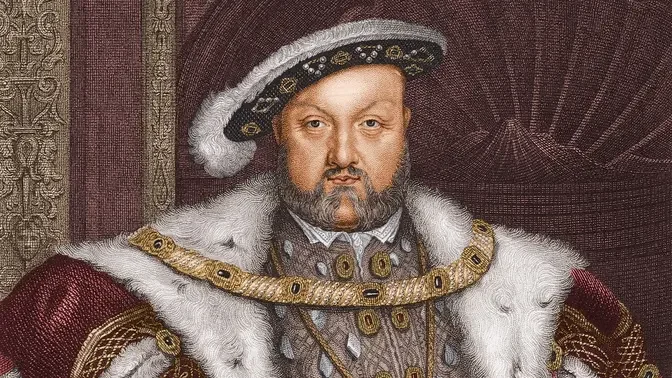
Once a beloved monarch, Henry VIII is now remembered as a tyrannical king who will
forever be remembered for his six wives, his break from the Catholic Church, and his bloody reign.
But what led to this controversial king's downfall? King Henry VIII was known as one of the
most influential and powerful monarchs in British history. His rule was marked by ambition, tyranny,
and bloodshed. He was the first monarch to introduce the dissolution of the monasteries,
an act that led to the destruction of many of England's most important cultural and religious
institutions. He executed and exiled many of his detractors, including two of his six wives.
His legacy is one of grandeur, but also of questionable morality and ruthlessness.
What made the handsome, attractive, and athletic King Henry VIII furious, aggressive,
and a tyrant ruler of England? Was it lust for power, or the desperate desire for a son to
carry on his legacy? Perhaps a combination of both? Join us as we dig into the past and fast
forward through history. You will not want to miss the startling revelations of the infamous
king's downfall at the end of this video. Henry VIII was the second son of King Henry VII
and Elizabeth of York. The young prince was never meant to be king, he was the spare heir.
Following royal tradition, Henry had a very happy and easy upbringing. He received a first-rate
education from leading tutors and was fluent in Latin and Greek. The young Henry also excelled
in music and sport. Henry's brother, Arthur, on the other hand, was groomed from birth to become
the next monarch. Arthur, the Prince of Wales, was betrothed to Catherine of Aragon in order
to forge an Anglo-Spanish alliance against France. In 1501, at age 15, Arthur met his future bride,
and in less than two weeks, their marriage ceremony took place. Just six months into their
marriage, Arthur and Catherine were both afflicted by an unknown, highly contagious illness that was
sweeping through England, now assumed to be sweating sickness. And although Catherine fully
recovered, Arthur died six months shy of his 16th birthday. It would be seven more years until Henry
would succeed his brother and be crowned King of England in 1509. Shortly after his coronation,
the 17-year-old Henry also married a Spanish royal, his brother's widow. But before he could
marry Catherine, her previous marriage to Arthur would have to be annulled. Pope Julius II approved
the request only after Catherine testified to the court that her marriage to Arthur was never
consummated, and as such, not valid. Despite this marital controversy, Henry and Catherine's
relationship appeared blissful. The happily married couple was often seen riding and
hunting together. The Gentleman King had a love for sport, particularly hunting, tennis,
and jousting. It was the dawn of a new age, and the promise of his joyful union to Catherine
was matched with his promise to the people and the political affairs of 16th century England.
One of Henry's first orders of business was to demonstrate his new authority.
Two of his father's unpopular advisors were swiftly arrested, showing a break from King
Henry VII's greedy reign. The former monarch had heavily taxed the country, and for that misdeed,
the council members were found guilty of treason and executed at the famous Tower of London.
Although his early decisions were supported by most, the verdicts and tactics brought a
glimpse of what was to come, and how Henry would deal with those who stood in his way.
As years passed, Catherine gave birth to six children, but only one survived, a daughter,
the soon-to-be Queen Mary I, also known as Bloody Mary. King Henry VIII was growing desperate for a
male heir, and this became a critical issue because as Catherine grew older, it became
more difficult to fulfil her husband's desire for a son. As King Henry lost faith in his marriage to
Catherine, his eyes wandered and fell upon the young and beautiful Anne Boleyn. King Henry was
so eager to marry Anne that he trampled the love of Catherine underfoot. An annulment of his
marriage was required, and could only be granted by the permission of Pope Clement VII. Henry
claimed that the earlier dispensation was invalid, and that Catherine had indeed consummated her
relationship with his brother, Arthur. Catherine, of course, denied these allegations, and although
the Pope refused the annulment, Henry would soon take drastic measures. In a stunning political
move, Henry broke with the Roman Church, declaring himself the only supreme head on earth of the
Church of England. The country would never be the same. Despite the humiliation, Catherine never
stopped loving her husband. "'Mine eyes desire you above all things,' she wrote in her last letter to
Henry, and signed it Catherine the Queen. She stayed true to what she believed to the bitter end.
In 1536, Catherine died, just three years after the annulment of her marriage from her beloved.
King Henry's marriage to Anne Boleyn would be fraught with much change in political controversy.
Now cut off from the wealth and protection of the Catholic Church, monasteries were dissolved,
and their wealth and assets seized. It was believed that he used the wealth of monasteries
to fund military campaigns and improve his own lavish lifestyle. The formation of the Church of
England was opposed by many, and you could understand why some would believe that this
was for the King's personal gain. For Henry, dealing with dissenters was simple. They were
either convinced of his supremacy or executed for treason. The once-gentleman king was now
officially a tyrant. Notable and religious figures were put to death for arguing against
the religious change, one of which was bishop and theologian John Fisher, who was executed
for defending the supremacy of the Catholic Church. Another was Sir Thomas More, who was
a well-reputed scholar and a statesman. He was executed for refusing to take the oath
that recognised Henry as the supreme head of the Church of England.
But was the cruelty of King Henry VIII limited to religious and political opponents,
or were his personal affairs becoming a battleground as well? Henry had given everything
to his union with Anne Boleyn. There was a seven-year courtship that entailed the birth
of a daughter, who would later be named as Queen Elizabeth I, who reigned England from 1558 until
her death in 1603. The joyful birth of a daughter was overshadowed by the king's maddening frustration
for a male heir. The king became furious and aggressive. In 1536, Henry, who was once the
admirer of Anne Boleyn, charged her with adultery with several men, and also infidelity and incest
with her brother George. There was strong evidence in favour of Anne Boleyn proving her innocence.
Despite the allegations that were based on false pretenses, the now belligerent king
concluded his relationship with Anne by having her beheaded at the Tower of London.
Was it merely frustration that drove Henry's irrational decision to execute his own wife?
As it turns out, something did happen that changed everything.
The same year of Anne's fateful execution, Henry was involved in a serious jousting accident.
It wasn't the first time the king had been injured from jousting, but it was the most irreparable.
The fall left Henry unconscious for several hours, and when he awoke, he would never be the same.
Some historians view this event as the defining moment where we recognise a stark change in
Henry's personality. It is suggested that his controlling behaviour increased,
and the inscribed image of the robust figure emerged. What's more, an incurable leg would
have left the king in constant pain, which would have had unimaginable lasting effects
on his day-to-day decisions. His demeanour often came across as impulsive, rash, and violent.
Unable to participate in his love of sport, and as such becoming steadily obese,
it is quite possible that this jousting accident was the principal cause of Henry VIII's downfall.
Henry was no longer the charming, handsome, and athletic prince.
After the debacle with Anne Boleyn, King Henry VIII took four more wives,
Jane Seymour, Anne of Cleves, Catherine Howard, and Catherine Parr. And like Anne Boleyn,
Catherine Howard also became the victim of Henry's cruelty, and was beheaded in 1542.
His behaviour continued to be destructive, and his greedy actions began to parallel that of his
father. In 1544, Henry began the Great Debasement, where he would reduce, and in some cases replace,
gold and silver coins with cheaper base metals such as copper. This was done to pay for his
lavish lifestyle and fund foreign wars. The king may have increased revenue for the crown,
but it came at a cost of having the people's wealth stolen by stealth.
The once gentle songwriter had also amassed a collection of 6,500 handguns,
and slept with a giant axe next to his bed.
The descent of King Henry VIII is filled with romance, disappointment, and audacity.
The once athletic and respected king plunged the country into a religious war,
foreign wars, and had thousands upon thousands of detractors executed.
It is estimated that during Henry's 36 years of reign, over 72,000 met their death,
which was equivalent to 3% of the population at the time. A desperate urge for a male heir,
physical disorders that were brought from his love for sport,
and the pressure of keeping the country together contributed to his oppressive rule.
Is it any wonder that no other king would ever bear his name?