
The Six Wives of Henry VIII – Part 1
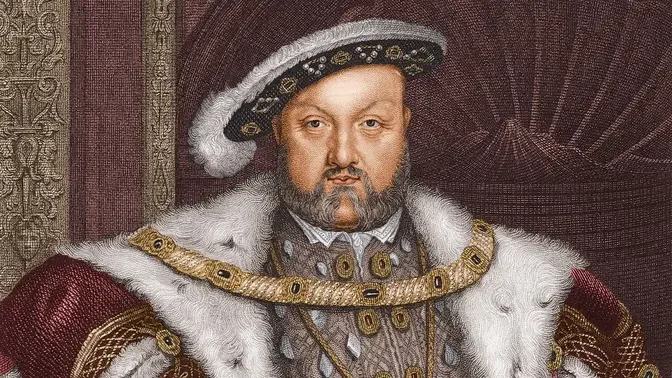
The Six Wives of Henry VIII Henry VIII is one of the most famous kings
in English history.
He is renowned for his voracious appetites for food, wine, power, and women.
During his 38-year reign, he went through six wives, and for them triggered seismic
changes in the religious and political landscape of the nation.
But who were the women for which this larger-than-life monarch's passion ran hot and cold?
And who were they before, and in some cases after, their fates were in the hands of this
fearsome king?
Here are the stories of the Six Wives of Henry VIII.
Catherine of Aragon Catherine was the youngest child of Isabella
I of Castile and Ferdinand II of Aragon, the power couple who set in motion the unification
of Spain, began the Spanish Inquisition, and launched Christopher Columbus' expedition
to the New World.
Young Catherine grew up with the influence of her powerful mother and learned how to
be a queen.
She was well-educated in multiple disciplines, including literature, history, music, needlepoint,
and of course, the Catholic religion.
She spoke several languages and loved to read.
At the age of three, she was betrothed to Prince Arthur, heir to the English throne.
They were an excellent political match, as in addition to Catherine's powerful Spanish
family, she was a descendant of Edward III of England via his Lancastrian descendants,
so her blood would bring legitimacy to the fledgling Tudor dynasty.
At sixteen, the princess traveled to England to be married.
Her large retinue of Spanish attendants included several African servants, thought to be some
of the first Africans to arrive in London.
Catherine was short in stature and had long red hair and wide blue eyes.
She and Arthur struggled to communicate as neither spoke the other's language.
The teenage newlyweds traveled to Ludlow Castle, Arthur's seat as Prince of Wales.
The castle was damp and cold, and within a few months, both royals contracted the sweating
sickness.
Arthur died.
Catherine recovered, but found herself a widow with an unclear future.
Both her father and her father-in-law, King Henry VII, claimed it was the other's duty
to support the dowager princess.
So the once glamorous lady lived hand to mouth and had to dismiss many of her servants and
sell her jewelry for food.
Henry VII wanted to keep her large dowry and considered marrying the teenage princess himself,
but Catherine's father refused.
During this time of uncertainty, Catherine held the position of Spanish ambassador and
was the first female ambassador in Europe.
After seven years in limbo as a widow, Henry VII died and his son, now King Henry VIII,
married Catherine on Midsummer's Day.
The handsome and athletic new king was just 18, five years Catherine's junior, but he
was very much in love with his intelligent and confident new bride.
Seven months into their marriage, Catherine miscarried a baby girl.
A year later, on New Year's Day, she gave birth to a son, Henry, Duke of Cornwall.
The birth of the new heir was celebrated throughout the country, bells were rung and fountains
filled with wine.
But the baby died after just 52 days of life from an intestinal malady.
In 1513, Henry appointed Catherine regent while he went to war in France.
During her regency, King James IV of Scotland invaded northern England and Catherine, heavily
pregnant, rode north in full armor at the head of the army.
She gave a stirring speech and won the Battle of Flodden Field, defeating the Scots.
King James was killed in battle and Catherine sent Henry his blood-soaked coat as a trophy.
A few days later, she went into premature labor and delivered a stillborn son.
The next year, another stillbirth followed.
At 30, Catherine's prayers were finally answered and she gave birth to a healthy child.
However, Henry was disappointed that it was a daughter, Mary, not the heir he had hoped for.
Catherine made pilgrimage to pray for a healthy son, but her sixth and seventh pregnancies
also ended tragically.
As time passed, Catherine focused on the prospects of her one living child, Mary, and encouraged
her education.
The Queen donated to several colleges and made educating women fashionable in England.
But Henry still felt that a male heir was essential for cementing his fledgling dynasty.
The last time a woman had attempted to rule England, Matilda, some 400 years earlier,
she lost the throne in civil war.
During Catherine's many grievous pregnancies, Henry philandered to his heart's content
with numerous ladies, fathering at least one illegitimate son, Henry Fitzroy.
After 16 years of marriage, Catherine entered menopause and Henry transferred his dynastic
ambitions to a certain lady-in-waiting, Anne Boleyn.
It was suggested to Catherine that she quietly retire to a nunnery to make room for Anne,
but the Queen refused.
Henry obsessed over a biblical passage from Leviticus which stated that it was a sin to
marry your brother's widow and that such a couple would be childless.
He pled with Pope Clement VII for an annulment, but the Pope was under siege from the Holy
Roman Emperor Charles V, who happened to be Catherine's nephew.
Catherine asked that the legality of their marriage be tried in a public court, during
which she proclaimed to everyone that her marriage to Prince Arthur had never been consummated
and was therefore unlawful.
This embarrassed and infuriated Henry, and the Pope declined to dissolve the marriage.
So Henry used the Protestant movement to make himself head of the new Church of England.
He dissolved the monasteries and enriched himself by looting their wealth, much to the
horror of the devout Catherine.
In 1531, Catherine was exiled from court and her rooms were given to Anne.
In her banishment, she confined herself to a single room, leaving only for Mass.
She wore a hair shirt and fasted continuously.
Henry forbade Catherine and their daughter Mary to see each other, but sympathetic servants
secreted letters between the two.
Henry offered mother and daughter better accommodations and permission to see each other if they would
acknowledge Anne as queen and denounce Mary's legitimacy and claim to the throne.
Both refused.
Catherine went to her death, calling herself the king's one true wife.
She died at the age of 50.
Her post-mortem revealed a black growth on her heart, which launched rumors that Anne
had had her predecessor poisoned.
Anne and Henry both wore yellow when they received the news of Catherine's death, which
was seen as a vulgar insult to the late queen.
However, medical historians believe that the heart's discoloration was actually a sign
of cancer.
Henry did not attend the funeral of his first wife, and he forbade their daughter Mary from
mourning her mother.
Anne was the daughter of Thomas Boleyn, Earl of Wiltshire, and Lady Elizabeth Howard.
Her father was a talented diplomat and was sent to the Holy Roman Empire as ambassador.
There he so impressed the emperor's daughter, Margaret of Austria, that she offered the
12-year-old Anne a position as lady-in-waiting.
Anne traveled to the Netherlands to attend Margaret, who ruled there as regent.
Margaret said that Anne was so presentable and so pleasant considering her youthful age.
Later Anne was sent to France to attend first Henry VIII's sister Mary, Queen of France,
and then Queen Claude of France.
Anne lived at the sophisticated French court for seven years, where she gained knowledge
of art, dance, fashion, music, poetry, and the flirtatious art of courtly love.
Anne's older sister Mary was also at the French court, where she conducted affairs
with several men, including King Francis I.
To save her reputation, their father sent Mary back to England, where she commenced
a short-lived affair with Henry VIII.
Fair Mary was considered the more beautiful of the sisters, while Anne was the more intelligent.
At 21, Anne was called back to her homeland for an arranged marriage to an Irish cousin,
James Butler, but that fell through.
Instead, she became a lady-in-waiting to Queen Catherine of Aragon.
Anne had dark hair and eyes, olive skin, a slender figure, and decent looks, but her
beauty lay in her dazzling wit and humor.
She popularized wearing the French style of headdress, which revealed a shocking amount
of hair.
She enjoyed playing cards, drinking, hunting, gossiping, and loved a good joke.
Anne established herself as the brightest star at court and had numerous young men vying
for her attention.
She became secretly engaged to Henry Percy, son of the Earl of Northumberland, but his
father objected to the match.
Soon Anne caught the eye of an even bigger player, King Henry himself.
Unlike other ladies, including her own sister, who had gone quickly to Henry's bed, Anne
played a coquettish game of resistance.
Why settle for being a royal mistress when she could be queen?
With promises of a longed-for son, Anne convinced Henry to leave Catherine and make her Queen
of England.
Henry was confident that he could obtain a quick annulment and swap Catherine for Anne
in a matter of months.
He didn't count on seven years of legal battles with Catherine and unconsummated courtship
with Anne.
Anne, too, was frustrated.
She was approaching 30, middle-aged by 16th century standards, and wanted to be married
before her childbearing days were behind her.
She had passed up other chances to marry noblemen and had bet seven years of her life on winning
the ultimate prize.
But she wasn't about to sleep with Henry until she could secure the crown and the legitimacy
of their offspring.
She slowly gained power, securing titles for her kin and setting spies in the Queen's
household until she was at the center of court and Catherine was on the outskirts.
In France, Anne learned of Enlightenment ideas about church reform.
She encouraged Henry to embrace the Protestant movement, split with Rome, and declare himself
head of the new Church of England.
Anne's Catholic enemies accused her of using witchcraft to ensnare the king.
And even years after her death, tried to discredit Anne's Protestant daughter by claiming that
In November 1532, after a triumphant trip to France to secure alliance with Anne's
old friend, King Francis I, and with a divorce now all but inevitable, Anne finally went
to bed with the king.
The couple were married in a secret ceremony which technically made the king a bigamist,
but it couldn't wait as Anne was already pregnant.
The divorce was finalized in May and in September Anne gave birth to a healthy baby, but to
Henry's consternation he had another daughter, Elizabeth.
The couple were happy and very much in love for the next two years, secure in the hopes
that other children of the male persuasion would follow.
Henry decided that if he couldn't prove his masculine virility by fathering a son,
he would show it in the tilting yard.
During a jousting match, the king was struck and fell from his horse.
He was unconscious for two hours and everyone feared the worst.
He recovered but he suffered a leg wound that plagued him for the rest of his life, ending
his athleticism and allowing him to pile on weight.
Historians hypothesize he also sustained a serious concussion and brain damage that would
explain his hair-trigger temper from then on.
The shock of the accident also caused Anne to miscarry their second child, a son.
Increased strife in the marriage, partly due to Anne's refusal to ignore her husband's
philandering, caused Henry to resent his wife.
Anne's talents in courtly flirtation, so admired in a mistress, were unacceptable in
a wife.
Her enemies at court carried tales of her flirtations back to the king, who became enraged
Musician Mark Smeaton confessed under torture that he had slept with the queen and named
four other men in his testimony.
They included the king's best friend, Henry Norris, as well as Anne's own brother, George
Boleyn.
On May 2, 1536, after two and a half years of marriage, Anne was arrested and brought
to the Tower of London.
There she was tried in court for adultery, incest and treason.
Anne was almost certainly guiltless.
She pled her innocence and begged her husband for mercy, but Henry decided that he was done
with the woman he had once moved heaven and earth to win.
While in the tower waiting to die, Anne spent her final days coming to terms with her mortality.
She composed the poem, Oh Death, Rock Me Asleep, and was at peace at the end.
The five men accused alongside Anne were beheaded on Tower Hill in sight of her room.
Two days later she was brought to Tower Hill.
The punishment for her crimes was burning at the stake, but Henry, ever generous, commuted
her sentence to beheading and hired an expert swordsman from France to do the job far more
quickly and less painfully than the more clumsy axe.
On the scaffold, Anne gave a moving speech to the crowd and knelt before the swordsman
with dignity.
The fallen queen's body was placed in an arrow box, and she was buried in an unmarked
grave in the Tower of London's chapel.
Before Anne's body was cold, Henry was on to wife number three.
Jane Seymour
Jane was the daughter of Knight Sir John Seymour and Margaret Wentworth.
She was a proper English rose, and as such was far less educated than her more continental
predecessors, Catherine and Anne.
She could read and write a little, but was more expert at needlework and household management.
She served as a lady-in-waiting to Queen Catherine, whom she loved dearly, and later to Queen
Anne.
In February 1536, a few months before Queen Anne's arrest, Henry took notice of the beautiful
and fair Lady Jane.
Henry sent Jane a letter, summoning her to the royal bed, but she returned it unopened
responding that she wished to make an honorable marriage.
Jane's virtue further stirred the king's desire.
Contrary to the witty and seductive Anne, Jane was gentle, meek, and chaste.
She came from a large family, a sure sign that she could produce a large brood of sons
for the king.
The day after Anne's execution, Henry and Jane were betrothed, and they were married
ten days after that.
However, Henry was forced to postpone her public coronation because of outbreaks of
the plague in London.
He may have also wanted to see results from this marriage in the form of a bouncing baby
boy before he granted Jane this honor.
As queen, Jane was strict, conservative, and rather less fun than Anne had been.
Music and entertainment at court were greatly reduced, and Jane banned the French fashions
Anne had introduced.
She took the motto, Bound to Obey and Serve, and lived by it.
She only involved herself in politics once, to beg the king for mercy for the rebels of
the Pilgrimage of Grace.
Henry reminded his wife of the fate of her predecessor when she meddled in his affairs,
and Jane never spoke up again.
Jane had great love for Catherine of Aragon, and she convinced Henry to invite Mary, his
daughter by Catherine, back to court.
Jane was particularly close to her stepdaughter, and her sympathy for the late Queen Catherine,
always much more popular than Queen Anne, endeared Jane to the common people.
But while Henry regained a daughter, he lost his only living son, the illegitimate Henry
Fitzroy, who died at 17 from tuberculosis.
Henry was in despair and doubted that he would ever father a son to survive him.
But in early 1537, Jane became pregnant, and spent the summer in confinement, protecting
the fragile life of what she and Henry fervently hoped would be the coveted male heir.
In September, after three nights of labor due to the baby being in the breech position,
Jane delivered Henry's fondest wish, a healthy son.
Weeks later, the baby prince was baptized in grand style, but his mother was not present.
She was ill due to an infection contracted during the difficult childbirth, and fading
by the day.
At the end of October, Jane died.
She was 29 years old and had been queen for just 17 months.
She was the only one of Henry's wives to receive a royal funeral.
Henry wore black for three months following his beloved wife's death.
In the second episode, we'll meet wives four through six, a foreign princess, a teenage
queen bee, and an outspoken authoress.
Stay tuned.
If you enjoyed this video, please consider supporting me on Patreon and help me make
more fascinating videos.
Patrons get cool perks like exclusive content, mentions in videos, and can even request video
topics.
A link to my Patreon is in the description.
Thank you for watching!