
The Death, Funeral & Burial of King Henry VIII of England - Myth and History
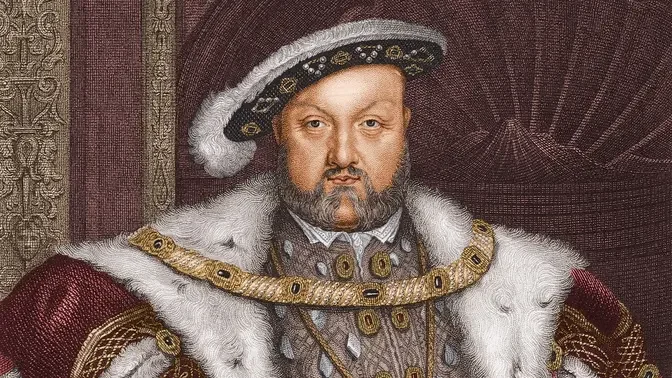
On the 20th of January 1547, in the Palace of Whitehall, King Henry VIII died. He was 55 years
of age. He had reigned for 36 years and in that time he had undergone a complete transformation
of appearance and personality, from being an intelligent, athletic and well-respected sovereign,
to being an irascible and rather unhinged despot. His leg had been injured in a jousting accident
in 1536 and he may also have been unconscious for a couple of hours following it and that
caused a change. From there on in he became increasingly immobile, his wound in his leg
developed into a superating sore. It is no surprise given the constant pain he must have been in
that he became moody and politically erratic. His death, which we are told by contemporaries
was peaceful and in which he was reconciled to God, caused rather a lot of panic in the
royal household. Henry's heir Edward was only nine and well under age and a form of regency
or protectorate would have been necessary and there was predictably an ensuing battle for power.
People knew their history and were well aware that when English kings
come to the throne as boys that doesn't bode well. Often the situation in times past had led
to civil war, as it had done in that context. It took three days for the Lord Chancellor
to tell the Privy Council that Henry had died. Before we get on with the main parts of the video
I want to thank all of you for your kind support and your comments. I'm trying to work through and
answer all of the comments but please bear with me as I've received so many all of a sudden and
my channel has grown so quickly that it's taking me some time. If you like the content here you
will also love my magazine The Antiquary which has lots of articles on the more obscure aspects
of British history. October's edition is just about to hit the press. Purchasing and subscribing
to it in either print or digital form really helps support my work on this channel. So back to the
death of Henry VIII. After his death is announced to the Privy Council then the whole mechanism of
arranging the funeral began. The arrangements being put into the hands of the heralds of the
College of Arms. Henry's body was probably embalmed as was usual. This would have been performed by
the royal household's wax chandler, the candle maker. The process involved evisceration but
primarily consisted of wrapping the corpse tightly in waxed cloth. It would then have been
coffined in a lead anthropoidal coffin that fitted more or less to Henry's form and then that was
placed in a wooden case. This coffin would not have been left uncovered. It would have been hidden
from view under a rich funeral pall or hearse cloth made of cloth of gold embroidered with Henry's arms
and his heraldic badges. A couple of such hearse cloths remain that were commissioned by the
Universities of Oxford and Cambridge at the time of the death of Henry's father in 1509 and they
give us a fair indication of what Henry VIII's cloth would have looked like. This is the Oxford
example which is made of rich cloth of gold with a red velvet cross upon it embroidered with the
Henry VIII's coffin would have been covered in the hearse cloth until it was taken to be laid
in the grave. Knowing the end was in sight, Henry had written very detailed instructions in his will
of December 1546 as to what would happen to his body next. It had long been his plan to be buried
in St George's Chapel, Windsor close to the burial place of his grandfather King Edward IV
and he asks to be buried in the choir midway between the choir stalls and the high altar of
St George's Chapel. Charles Rithsley, who was Windsor herald at the time of the king's death
and would have been intimately involved in the proceedings, gives us a vivid account
of the obsequies of the king in his chronicle. The preparation for the funeral of the king began
on the 8th of February and every parish in London was required to celebrate a solemn
dirige for the king. The dirige, from which we derive the word dirge, was the office of
matins, morning prayer for the dead, although it was celebrated most often as it was in this case
by anticipation in the evening. The following day, the first mass of the morning, the morrow mass,
was to be a mass of requiem for the king and each parish was to get out their parish hearse
and set candles around it. I will come on to what a hearse is in a moment.
So why the delay of over a week between the announcement of the king's death and his
obsequies? Well, that's so that the whole of England could be informed and every parish
church across the land could have similar services for the dead king. During all of this
waiting time, the king's body was lying in state in the audience chamber at his palace of Whitehall
where he died. On the 14th of February, the procession bearing the king's remains left Whitehall
and headed to Windsor. Rithsley tells us that the king's coffin was solemnly and with great honour
carried along in a chariot with his image on top of the coffin. Now, if you've watched my video on
the history of the lying in state, you will already know what Rithsley is talking about
when he refers to an image and I recommend you to watch that video for a fuller account of it.
It was usual in this period, during the lying in state and the funeral processions of English
sovereigns, for a timber and plaster effigy of the king to be placed on top of the coffin,
wearing all the robes of their estate, their parliamentary robes and their crown. We know
that King Henry VIII's effigy was particularly fine and that he was wearing his very own
parliamentary robes. He had rings on his fingers and the glorious state crown made for him,
or his father, on his head. Though we don't have an illustration of what Henry's funeral
procession looked like, we do have an illustration of his daughter Elizabeth's funeral in 1603
and that gives us some evidence of the splendour of the scene as this long cavalcade made its way
along the narrow roads to Windsor. The queen's coffin is shown on a cart pulled by four horses
that are clad in black coats emblazoned with the royal arms. Her funeral effigy can be glimpsed on
top of the coffin. Around her coffin are the gentlemen pensioners, what are now called the
hooded cloaks, who escort the coffin as pallbearers. Some of the gentlemen pensioners
are holding reversed halberds and some hold banners with various arms of the queen
and the nobility. And ahead of the chariots are the heralds who carry what are called
the funeral achievements. These were an important part of funeral ritual in the late medieval and
early modern period. These achievements, the sword, the tabard on the helm, were hung up over the grave
after the burial. Very few now survive, although those of Edward the Black Prince of Wales still
remain in Canterbury Cathedral. This splendid procession took two days to reach Windsor
with an overnight stop in the church of the former Brigidine Abbey at Zion, which ironically
Henry had of course dissolved and was lying empty and unused. Rithsley tells us in his
chronicle that at Zion the body of the king rested overnight in what he describes as a hearse.
Now I know this particular term is going to cause endless confusion as these days a hearse
is a vehicle in which a body is moved. It wasn't a vehicle then. A hearse was a temporary structure
that was placed over a body during the funeral ceremonies to give honour to it. The hearse at
Zion, Rithsley tells us, was a structure that was nine storeys high and was covered in hundreds
of wax candles. When the coffin got to Windsor it was placed in yet another hearse,
this time even grander than the last and 13 storeys high. Now we have one really useful
piece of evidence that illustrates what these temporary structures, these hearses, looked like.
It is from a manuscript called the Islip Roll that records the funeral ceremonies of John Islip,
who was the abbot of Westminster at the beginning of the 16th century and the end of the 15th.
One of the illustrations, and this is a reproduction as it's easier to see
than the faded original, shows the hearse erected for Islip's funeral directly in front of the high
altar of Westminster Abbey Church. Islip's coffin is at the bottom and the hearse is this extraordinary
canopy over the coffin that supports layer upon layer of brackets for wax candles. Now I think
that by Rithsley's reckoning this is probably a six storey hearse as there are six layers of
candle branches on it. Henry's hearse at Zion would probably have been very similar indeed to
this but the one at Windsor would have been considerably larger. Such hearses were erected
for all levels of society and parishes usually had one and a communal funeral pall or hearsecloth
so that the poor as well as the rich could have a dignified funeral too. The richer the individual
the more elaborate they were of course. Now we know that these grand candle-filled hearses caused
some practical problems within church buildings for mourners. All that heat and smoke from those
candles would have created a stifling and unbearable environment. At the funeral of John
Paston, a Norfolk gentleman in 1466, the atmosphere became so unbearable in Bromholme Priory Church
that a couple of the windows of the clerestory had to be taken out to let out the fumes.
Now what most people seem to remember about Henry's funeral procession is an episode that
is said to have taken place while his body was resting at Zion. It is said that his coffin burst
open and that his bodily fluids spilled out onto the floor and that dogs were seen licking up his
blood. It is a story that is almost certainly fictitious and is first recorded in Bishop
Burnet's History of the Reformation, published at the end of the 17th century. He gives no source
for the story and then it was popularised and further embroidered by Agnes Strickland in her
Lives of the Queens of England, published in the 1840s. I can't see how a body that was embalmed
and wrapped up in seer cloth and lead and placed in a wooden case could have decomposed to such a
degree in winter for this incident to have occurred, nor can I see how dogs would have been allowed
anywhere near his coffin in Zion Abbey Church, which would have been guarded overnight by the
gentlemen pensioners. Although probably fictitious, the story is related to a real historical event,
one that took place a decade earlier. In Easter of 1532, just as Henry was trying to deal with
his great matter and dispose of his first wife Catherine of Aragon in favour of Anne Boleyn,
a Franciscan friar called William Peto was invited to preach before the king.
Peto decided to use this opportunity to teach Henry of the error of his ways, casting off one
wife or another, and predicted that like Ahab in the Old Testament, the king of Judah, who had
married Jezebel, dogs would lick up his blood at his death. The king was absolutely furious at being
compared to Ahab and Anne Boleyn to Jezebel, and he summoned Peto before him, and Peto quite
flatly told Henry that he would lose his kingdom because of his subject's opposition to the divorce.
Peto left the country in a hurry and never returned to England during the remainder of Henry's reign.
This legend probably has its basis then in this event, and may be a fiction first suggested by
Catholic detractors of Henry wanting to see that prophecy of Peto's fulfilled. So when the
procession reached Windsor, the body of the king rested in the second hearse, and the funeral
obsequies were repeated with a placebo and dirige of vespers and matins for the dead, followed by
an early morning mass of requiem, and then Henry VIII was deposited in a brick burial vault he had
already prepared at the time of the death of Queen Jane Seymour. He was buried next to his beloved
wife, the mother of his heir, and as we will see, it is still where he lies. It was Henry's intention
to have a very large monument erected over his burial place, and he had begun preparations for
that well before his death. The monument was not complete at his demise, and he made provision in
his will for its completion. As it happens, it was never completed. Henry didn't pay for the whole of
the monument himself. The monument had in fact been begun in 1524 by Cardinal Thomas Wolsey, who
intended to be buried in what is now the Albert Memorial Chapel at the east end of St George's,
which had been granted to him as a burial place by the king. Wolsey's intention was to create for
himself a monument that was bigger than that of King Henry VII of Westminster, and he
brought over to England an Italian sculptor called Benedito de Bovisano. When Wolsey fell
from grace and then died in 1530, the monument was still unfinished, and Henry VIII then took
elements from it, intending to incorporate them into a monument for himself. Wolsey's monument
consisted of a sarcophagus of black marble touchstone, with a gilt bronze effigy of himself
on top, surrounded by four pillars topped with angels holding candlesticks. It would have looked
a little like the monument to Dr Young, the master of the rolls in the Rolls Chapel in London,
a monument that is by Torrigiano. Only Wolsey's monument would have been freestanding and on a
larger scale. Henry intended to use Wolsey's sarcophagus as his own, adding his own effigy to it.
He then intended to add to the four pillars Wolsey had made six more, and between them place
ten large bronze candlesticks. Sadly, this ambitious project wasn't complete at Henry's death,
and there was absolutely no will to complete it during the successive reigns, so the various parts
of this incomplete scheme languished in the Albert Memorial Chapel. Some bits, such as the large
candlesticks and angels, were sold during the Commonwealth in the middle of the 17th century.
The massive bronze candlesticks are now to be found in front of the high altar at St Bevo's
Cathedral in Ghent in Belgium. The four bronze angels that were commissioned by Wolsey were
recently rediscovered at an auction after serving for many years as the gateposts of a stately home
in Northamptonshire. They are now in the Victoria and Albert Museum. The black marble sarcophagus
that both Wolsey and Henry intended as their own was still in Windsor in the early 19th century.
In 1805, it was offered by King George III as a memorial to Lord Nelson, and it can now be seen
in St Paul's Cathedral. Where the effigies might have been, there is now a Viscount's coronet.
Henry never did things by half, and had his monument be finished, it would have been the
grandest and perhaps the finest Renaissance monument in all of England. It would have
dominated completely the interior of St George's Chapel, blocking the view of the high altar from
the west. Henry also made lavish provision in his will for his soul, and despite the religious
changes he had ushered in, they demonstrate Henry's very orthodox and conservative Catholic faith.
He willed that a canopied altar be erected at the west end of his tomb, and he gave 600 pounds worth
of land and tenements to the Dean and Chapter at Windsor to be used to provide two priests to say
Mass at that altar daily. What Henry is establishing here is what is called a perpetual
chantry. The late medieval Catholic viewpoint, it may still be the Catholic viewpoint, was that
multiple celebrations of the Mass on behalf of the deceased had a spiritual benefit, and helped
release the soul from the pains of purgatory. The richer you were, the more provision you could
afford of this sort. It should be said that the more powerful you were, the more likely you were
to have committed a serious sin and have a longer stint in purgatory, so more anxious one would be
to create such a provision. Images of the Last Judgment from medieval Europe often show kings,
bishops and popes being dragged off to hell. Sadly, like the monument, these soul provisions
were never fulfilled. In 1548, a year into the reign of his son Edward VI, the Crown put a stop
to these practices, and as part of a stricter phase of the Protestant Reformation, dissolved
all the chantries in England. So Henry's plans for a grand chantry in front of his grand monument
came to nothing. Sir Henry VIII with Jane Seymour rested in the vault at Windsor in the middle of
the choir, with no memorial whatsoever for the next 300 years. This illustration of the interior of the
chapel by Wenceslas Holler from 1663 shows the choir, and there is no indication on the floor
at all as to where Henry and Jane are buried. The location must have been known at this time,
as 15 years before this engraving was made, the floor was lifted and Charles I was buried
in Henry's vault. The remains of Henry, Charles and Jane were discovered again by chance when
the royal vault of George III was being constructed and the area below the new catafalque
enlarged in 1814. The Prince Regent, later King George IV, went down to see the vault,
and lying within were the three coffins. Those of Henry and Jane were roughly anthropoidal
lead shells, the wooden cases having entirely decayed. The lead shell of Henry had decayed too,
as is not uncommon with lead shells, and the skeleton of the King, with some of the hairs of
his beard attached to the skull, could still be seen. The vault was closed again and has not been
fully opened since. So what is all this display about? The pomp of the funeral procession, the
elaborate candle-covered hearses, and the grand funerary monuments. Is it all entirely self-aggrandizement
and pride? Well, perhaps to some degree yes, but it's much more complex than that. Let's try to
look at it from a medieval and early modern perspective for a moment, rather than from that
of the 21st century. Having a simple funeral these days is considered a virtuous and self-effacing
thing. That is due to the effects, primarily, of the Protestant Reformation and Puritanism
on Western culture. Having a simple funeral in the 16th century, if you had the means to do better,
would not have been seen in a positive light. If Henry had had a simple funeral, the populace would
have considered that he was degrading the office and position of the Sovereign. The Sovereign
embodied the nation and there was an expectation, as the embodiment of England, that the King lived
in style and went out in style. Kings such as Henry VI, who liked to live a simple life and
wear simple clothing and didn't make an effort to display the prestige of their royal house,
were not a success. If a king was buried simply, that would diminish the monarchy and let the
country down in the eyes of other nations. Henry puts it very well in his own will.
Bear in mind what he says might have an element of faux humility in it, but he states that we,
as the royal we, would be content to have our body buried in any place accustomed for Christian
folks. But, he says, because we would be loathe in the reputation of the people to do injury to
the dignity to which we have been unworthily called, we will let our body be buried at Windsor.
Thanks very much for watching. If you like what you see on this channel,
please subscribe and share. You can help support my channel at PayPal and the website
BuyMeACoffee. Details are below in the description box and links are on the home page.