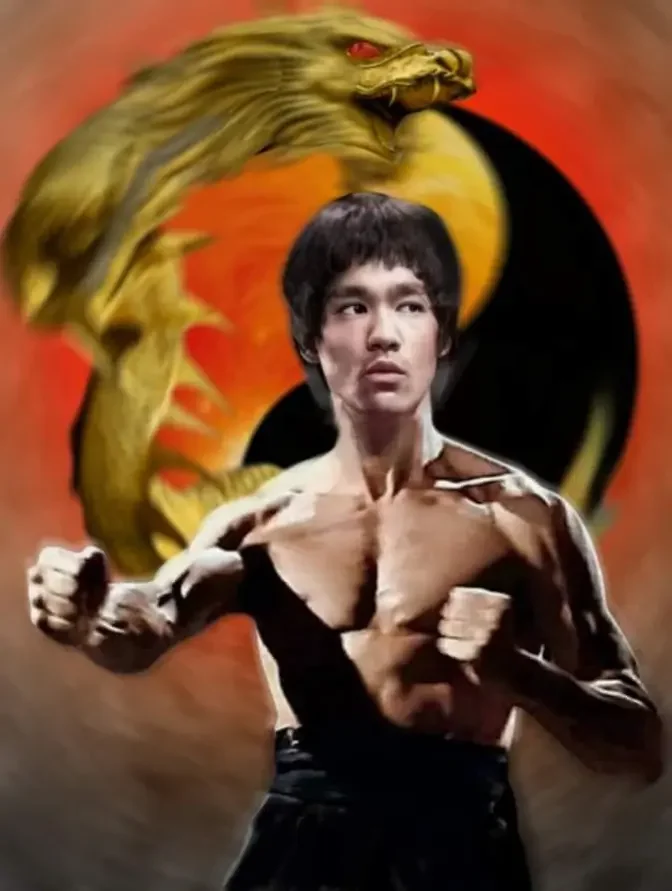
Thanks again for tuning in to the All Bruce Lee show, We appreciate you. Another rare interview testimonial from Shannon Lee talking about her dad's childhood, upbringing, early martial arts practice and training his evolution the opportunities and adversity he faced in the New American Home he came back to Enjoy and Have a good one and as always, BE KIND BE NICE BE POSITIVE.
Shannon Lee DOB - 04/19/1969 Year of the Rooster
Be water, my friends. Like an ocean, Be relentless. Thanks again you loyal faithful subscriber we have been elated with the recent interest in our content and have encouraged us to do more. Thanks again we are halfway there with our Watch Hour goal so Watch out for our content short and full video also and help us with our 2022 Channel goal for charities.
My father was born in 1940,
in the year of the dragon and in the hour of the dragon.
So he was a dragon through and through.
November 27th, Sagittarius.
My father was raised in Hong Kong.
He was part of a showbiz family.
Very first on-screen appearances when he was an infant.
But he went on to act in over 20 films before the age of 18.
My father started training in Wing Chun Kung Fu at the age of 13.
So he would be in school during the day,
acting at night,
studying Wing Chun Kung Fu with his Sifu, Yip Man.
He would walk down the street with weights in his hand
and punching the air
and just always trying to figure out how to do things better,
how to be faster.
And he got really good really quickly
to the dismay of a lot of the senior members in the school.
He also became the Cha Cha champion of Hong Kong.
He was the Crown Colony's champion.
He had a lot of fire and he was always moving.
His nickname was Mou Si Ting,
which means never sit still.
At the time, it was really against tradition
to teach Chinese Kung Fu to anybody who was not Chinese.
He was actually kicked out of Yip Man's school at one point
because they found out that he wasn't 100% Chinese.
He had been getting into a lot of trouble
participating in these illegal rooftop matches
where different Kung Fu schools would come together
and go up against each other to see who was better.
So he was competing in these
and if he wanted to claim his U.S. citizenship,
he had to come back before he turned 19.
And so his parents put him on a ship
and sent him to the United States.
Most people think of Bruce Lee as being from Hong Kong,
but actually he's American.
His mother is half German,
so he himself is a quarter European.
When my father came to the United States,
his training had been in Wing Chun.
And then when he started teaching,
he called what he taught Zhen Fan Kung Fu
because Zhen Fan is his given name.
So it was like Bruce Lee's Kung Fu.
But it was essentially Wing Chun.
His first student was Jesse Glover.
He was an African-American man.
Taki Kimura, who was a Japanese man,
he really took on anyone who had a real desire to learn.
His school was very revolutionary in that way.
In early 1965, he had opened his second school in Oakland.
He was part of a community of martial artists
who were really interested in playing with tradition
and really talking more about what works
as opposed to staying within the lines of form.
Already he had Zhen Fan Kung Fu,
so he was going around touting this all the time.
And he had an open-door policy
and was teaching this to anyone.
The San Francisco Chinatown community
did not appreciate that.
They were the old guard and they wanted to shut him down.
They issued a challenge to him and they said,
we're going to bring over our champion
and we want to fight you.
And if you lose, you have to stop teaching.
I have no fear.
I was born in Oakland's Chinatown
and I started to study Kung Fu at a very young age.
And the master, Jack Man Wong,
had this mythical fight with Bruce Lee.
So I remember hearing people say,
hey, our teacher fought with Bruce Lee.
You know, that was really just mind-blowing.
After the fight, even though he had won,
he was very disappointed.
He was winded and his traditional rigid training
had not prepared him for a fight of this nature.
Out of that, he decided to do away
with his traditional training.
And he literally studied boxing,
the simplicity of it,
fencing for the ability to bridge the gap quickly,
but also Newtonian physics.
He studied biomechanics and kinesiology.
And so he was really revolutionary
in just looking at the human body
and saying, if I want to optimize this for combat,
what do I do?
Maybe you better train every part of your body.
One of his students was Kareem Abdul-Jabbar,
who was, you know, over seven feet tall.
And from working with him and training with him,
he gained a huge new perspective
in how he would have to change his approach
to encounter someone like that.
And then how to also teach someone
whose body is that way.
I can show you what I know,
but ultimately you have to test it
and figure out what works best for you.
To move, you're moving.
And when you move, you are determined to move.
He really saw himself as an individual guide
to his students to say,
how do you want to express yourself as a fighter?
You do it, man.
And I'm going to do it, you see.
He wanted to bridge the gap between thought and action,
to be so in tune with your instincts
that you are expressing yourself honestly right now.
Firstly, smart fighter.
It's not just a good fighter,
because I think in martial arts,
some people train so hard to be strong,
but they don't know actually in a fight,
it's the mind that needs to be better than the skill.
People want their food.