
Classical Bust - Mold Making and Cold Casting
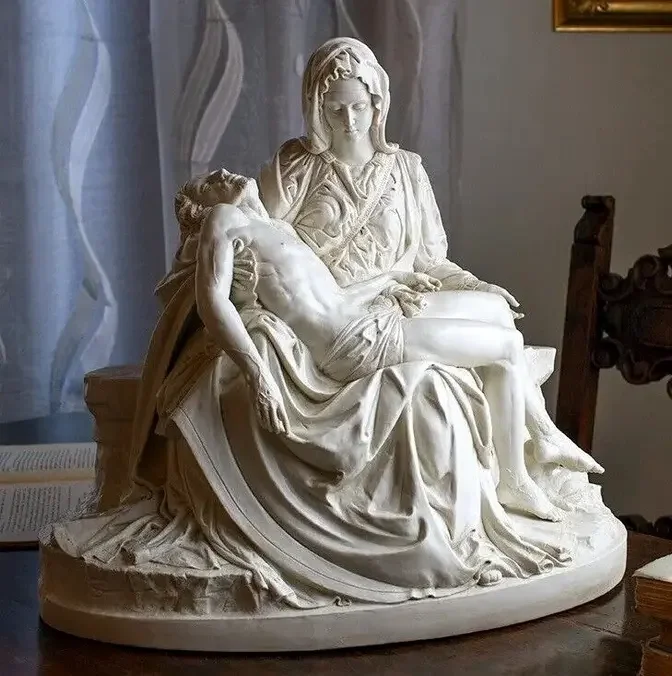
Discover how to make beautiful classical busts and portraits. Learn how to make a bold and cold cast in bronze and plaster.#visualart #Sculpture
Cold bronze and plaster casting. Sculpture by Vladimir London.
Here is the clay model. I will make some finishing touches before it dries.
When this model is dry enough, I can plan the next steps.
The thing to pay attention to is how many undercuts this head has.
Before making a mold, I need to spray the entire sculpture with the Ease Release 200.
For the soft mold, I will be using platinum silicone rubber.
I will also need silicone paint. As well as a silicone thickening agent.
It is very important to use precise proportions of two silicone parts.
I apply this mix with the brush. With the first coat of silicone in place,
I prepare another mix. It has to be applied when the first one is touch dry.
To differentiate two coats. I will add blue paint into this mix.
This coat of silicone is also applied with the brush.
It is time to prepare the silicone mix for the next coat.
I will explain how to use four keyholes later. Because this layer of rubber was orange.
I will color this mix. By adding the blue paint into it.
This time. I will also add the thickening agent.
This will make the rubber stiffer. As you can see.
I can apply this mix with the wooden stick instead of brushing on.
This thickened rubber fills all undercuts. At this step. I also glue the keyholes to the mold.
Here is how I made them. Cut the shape into fours pieces.
When the blue coat is dry. I will apply one more layer of silicone.
You may use turpentine to clean brushes. Cleaning the plastic measuring pot is much easier.
I will cut off excess rubber. You may see how many layers there are because
they are colored differently. I am also cutting the trapezoid shapes.
Which will help to keep the soft and hard molds together.
For the next step. I will be using modeling material.
To be the boundary for the hard mold pieces.
This material is reusable. The hard mold will have two parts.
So, only one border is needed. For the parts to lock together.
I'm making indentations with the wooden stick. I will make the hard mold with plaster bandages.
I cut the bandage in pieces. Wet them in water.
And apply quickly before plaster hardens. Each bandage piece should overlap the
previous one to stick together. I push the bandage into the holes with the
wooden stick. You may notice that the keyholes are sticking out through the holes.
Now. I will use olive oil to prevent two mold parts gluing together.
It is better to apply several coats of oil because dry plaster absorbs it well.
It is time to make the second part of the hard mold.
When plaster is fully dry. I can take apart the mold.
The next step is optional. I scrape the inner surface of the mold with steel wool.
Now, I have to decide where to make the cut. The knife blade should go all the way till the
clay model. It is time to take off the soft mold.
For casting. I will use black plastic resin.
I will also use bronze powder. Although it is not necessary.
I sprayed the inner surface to make demolding easier.
I am assembling the mold together. To keep its parts. I'm using the tape.
A very thin coat of bronze powder will enhance the head cast appearance.
All bronze powder that doesn't stick will be reused.
It is real metal and quite heavy.
I will be casting in gloves. And I also protect my arms with long sleeves.
It is very important to use exact proportions of resin parts.
Bronze powder is added before the part B of resin.
After mixing the first part of resin with bronze powder.
I can add the second part. Which is black.
Because the pot life is only 2 and a half minutes. I have to work very fast.
This is critical part as I am doing rotational molding.
It is very important to make sure that resin covers all the surface without any gaps.
The first cast layer is very thin. It contains expensive bronze powder.
I need to add thickness and strength with the second layer of resin.
This layer doesn't need any bronze. Once again. I have to work very fast.
Resin will cure quickly. I rotate the mold.
Making sure resin covers all the inner surface.
Another portion of resin will be used to build up the wall thickness.
Casting could be quite messy. I will use resin to its end.
Because once the container is opened. Its shelf life will be shortened.
This resin is very hard when dry. It will be a great cast.
It is easy to clean up the mixing cups. It's time to demold the sculpture.
Here we go. I'm very pleased with the result.
All parts are fully casted. The head requires minimal cleaning.
The quality of casting is superb. Here is my fingerprint.
Which I left as the stamp of authenticity. And the best part is it looks like a real
bronze sculpture because it contains metal bronze powder.
The finishing touch is to polish this casted sculpture with steel wool.
It has to be done carefully though. Because the bronze layer is rather thin.
Here it is. Shiny and pretty.
With time, bronze will get some patina. Which will make this sculpture even more appealing.
Now I will show you how to cast a sculpture using resin plaster.
I assemble the mold for casting. The wooden board will serve as the lid.
I'm mixing resin plaster following the instructions it comes with.
After pouring the mix into the mold. I close it with the wooden lid.
Now the mold can be rotated for plaster to cover all surfaces with a thin layer.
When plaster sets. I can open the lid.
It looks rather good. Plaster covered the surface nicely.
To add thickness. I will add another layer of gypsum plaster.
Once again, I rotate the mold for plaster to cover the walls evenly.
I gave several hours for plaster to dry and harden up.
It's time to demold the cast. The result is good.
I will need to fill some small holes left by air bubbles.
Sculpting a portrait requires good drawing skills.
These skills you can learn in the Life Drawing Academy course.
In the Life Drawing Academy course you will discover.
Professional know-how of drawing human figures and portraits.
Various methods of life drawing. How to use soft drawing materials for life drawing.
Classical canons of human body proportions.
Anatomy for figurative artists.
How to draw standing, sitting, and reclining poses.
You will discover unique methods of life drawing that were developed by the course tutors.
You will learn the unique way of drawing a human skull that was invented by Vladimir London
and is not taught anywhere else.
You will discover unique methods of drawing facial features that will advance your portrait
drawing skills.
How to depict emotions in portraiture.
How to draw draperies and clothed figures.
And much more.
The Life Drawing Academy is not only about life drawing.
It is also about drawing figurative artworks from memory and imagination.
What you will learn in this course will put your figurative skills on a higher level.
Whether you practice figure drawing from life or imagination.
In the Life Drawing Academy we teach how to make drawings of figures and portraits in
a realistic manner from life.
This art course is packed with trade secrets and know-how you will not get in any American
or European art college.
To get such knowledge you would have to enter one of the leading Russian art academies.
Life Drawing Academy is your unique opportunity to learn life drawing skills from professional
artists and art teachers from Russia who created this course for you.
Now you can improve your art skills with the full support of dedicated art tutors.
The price you pay today is the only fee for your lifetime membership and unlimited personal
support by the course tutors.
This support includes artworks critique and advice on how to improve your life drawing
skills.
This feedback is provided via email for the lifetime of the course at no extra charge.
Personal tutoring is also available on a one-to-one basis and includes tailored curriculum
specifically created for your level of drawing skills and is provided for a lifetime as well.
Do you know of any art colleges or academies where you can get an art teacher for a lifetime
on the same basis?
If you ever plan to draw people you can't go without learning good skills of life drawing.
To learn these skills enroll in this course now.
It takes only one click to start your professional art education.
We'll see you in a minute when you enroll.