
Taormina, Sicily !
132 Video Views·Oct 1, 2024
Visit Taormina, the Pearl of Europe in Sicily, Italy
Buongiorno from Tarmina. We're going to walk around this beautiful historic town including
going into the Greek theater, the public garden, and so much more. And later we're going to go to
Francavilla, the ancestral hometown of our friend Cindy. We're also going to go to Lingua Glossa,
Fiume Frado, and so much more.
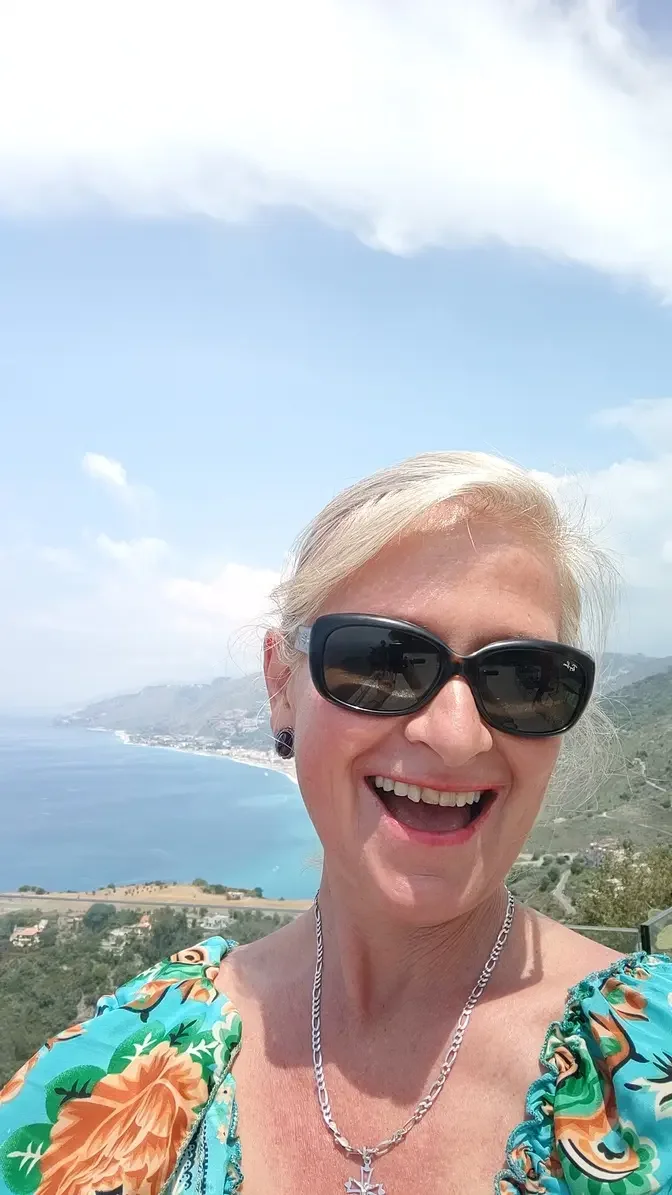
This view never gets old, I'm telling you.
This is the Duomo and you can see it's built like in a fortress. And right across
the cathedral is always the town hall. You can see the flag of Tarmina, the European Union,
the Italian, and the Sicilian flag. What's particular about this too is the Star of David
because this was the old Jewish quarters. Now we're going to enter Piazza April 9th.
Why April 9th? That is the date that Garibaldi, it is said, to have landed here in Sicily.
Don't go too fast or you'll miss this. This is one of my favorite, favorite renditions of
Jesus and Mary. And there's the Church of San Giuseppe.
You know, it wasn't until...
I just like sitting here and people and dog watching.
Get off the main concourse and make sure you come and check out these side streets.
Sicilians are such great artists.
And here's the famous Namuccia. This is where they had the naval battles or, well,
they don't know exactly what this was used for, but it's a beautiful place to walk through.
That plant over there are capers. They're grown wild here. This is just a beautiful walk,
especially in June when everything is blooming, but also in May. This is one of the most
impressive walls in all of Tarmina, but actually inside is a museum.
And there are the famous Testa di Mori.
You guys know the story of these moorheads? Legend has it that there was a baroness who
lived either in Palermo or Tarmina. We're going to say Tarmina. She was in love with the moor man
from Africa. And when she found out that he had family back in Africa, she was so angered
and jealous that she cut off his head in the middle of the night and put him in one of these
planters. And the next few weeks, look at this beautiful vegetation that grew. And from then on,
she became the envy of all her neighbors. And now there's really a symbol of Sicily
to have these moorheads. San Pancrazio. He is the patron saint of Tarmina.
And here's the bambar where you can get granita all year round. It's a beautiful little spot to
people watch and taste some of the local goodies. If you're coming here to the bambar,
especially in the summer, make sure you come first and give your name to one of the waiters
because there's always a wait list. And here we are early June. Lemon and mulberry and a brioche.
And right across from the bambar is Labat, which is one of our favorite restaurants here
in Tarmina. We bring friends, family, also our tours over here. It's been here since 1972.
Family-owned restaurant. This is the street up to the ancient Greek theater. Now we're inside
the Greek theater that was built between the third and fourth century before Christ. Believe it or
not, this theater was carved out of the mountain. They literally carved each one of those seats out
of the mountain. Third and fourth century before Christ. And it is still an active theater with
all types of performances. And in fact, during the film festival of Tarmina, there's performances
and events here every day. This first level here is from the Greek era. And when you see the red
stones, those are more from the Roman era. Of course, some of them were rebuilt or reconstructed,
but you get a little bit of a sense of how the two empires built differently. Here's another
interesting thing to note. The Greeks really enjoyed the beautiful panorama that this location
offered. Meanwhile, the Romans, Greek, built this facade. It was two and a half stories up high
because they wanted to concentrate inside of the theater. Then in the fourth century, there
was an earthquake and all of it, well, most of it collapsed. And this is what you have now.
Look at this marvelous view. And I'm only halfway up here at the amphitheater. No,
it's not an amphitheater, by the way. It's a theater because it's only halfway.
The amphitheater were built by Romans. A good example of an amphitheater is the Colosseum
in Rome. The Greeks only built theaters.
Imagine carving this out of a rock right at the most perfect position. Ancient ingenuity,
it's incredible. When the Greeks built this, they used it for comedies. When the Romans
came and put that facade and perfected or did their own style of the theater,
they had gladiator games. They had to move the bottom part of the stairs to make room to bring
in animals and also have gladiator fights. If you go straight over here, you will hit Messina
up there around. On top of the hills also Savoca and Forza d'Agro, two
towns that are the sites of the Godfather movie. But for us, we love going up there because they're
beautiful cobblestone streets and a little town that hearkened back 100 years back.
Time stands still in those little towns. Imagine during the Greek times, there were 5,000
or so spectators. Then when the Romans built upon it, more like 10,000. Now,
1,000 to 3,000 people are able to sit in here. But just imagine Etna right over there. She's
hiding behind the clouds, but normally you can see the Ionian Sea and Etna and of course the stage.
Check out right here. You have the Ionian Sea and Etna. But really from any angle, it's just beautiful.
When you come out of the Greek amphitheater, you can take this little side street
and all the way down is the public garden. This is a great, great map of Sicily.
How beautiful this is. All right, let's go into the public garden.
Right inside of the public garden, there's this fitness section.
World War I memorial here in the public garden. Look at this cool cannon.
The story of this public garden is actually very interesting. It was a Victorian woman,
Florence Trevelyan, who came here in 1889. She loved all things nature. She was Scottish
and she decided to move here at the age of 37. But as the story goes, she probably had an affair
with Prince Edward of Wales. The story goes that she was encouraged to leave Scotland and relocate
somewhere and she chose Sicily after traveling all over Europe. And then she gifted the public
garden and also Isola Bella to the people of Termina. So now it's a public garden and you can
freely visit. And some of these structures held all types of peacocks and birds.
Very, very, very well kept garden.
This is Corso Umberto, of course, one of the main streets here in Termina. There's Termina
also at the bottom and streets going left and right. But this is sort of the area in between
the Porta Catania, which is the gate of Catania, and the gate of Messina, which is on the other
way. This is halfway between the city of Messina and also the city of Catania. So it was really
this main road was sort of a highway for the people. So just imagine all the horses and
carts and donkeys that went through here passing because this was the highway to go from the two
cities. This is called the Odium, which was covered around the 1800s. It's a small theater
that housed about 200 people of the most important in the Roman era. So all the,
you know, the nobility sort of speak. Now this is built on top of a Greek temple. So this was
a Greek temple dedicated to Apollo. It's built on the remains of it. The seats are the Roman impact.
Let's go back to the bella.
So here's the scene here in early June.
This is Gaetano. He is one of the famous ceramics painters. As you can see, he does it all by hand
and his stuff is very unique. You can't find this in places like
Shaka or Santo Stefano di Camasa. He's got a very, very unique style.
When you come here, you have to stop at our friend Laura's jewelry shop. She has beautiful
items from all over Italy and she's been doing it.
All your family.
And now her daughter is also taking over.
It's her passion. She said she was born practically in the middle of gold. By the way,
we have, this is where I get our trinacrias. If you guys, we still have some sterling silver
trinacrias left. I think I have about 10 of them left and this is what they look like and they get
right from here. Beautiful sterling silver trinacrias. So if you want one, make sure you
message me, but she's got all types of other great Sicilian items. I particularly like the ones over
here with the maps. Those are very cool, but she's got silver, she's got gold, she's got coral,
all Italian products. And when you come here, tell them that Esther and Alfred sent you.
This is right over here by Piazza April 9th.
Here is the skinniest street in all of Italy. And yes, people live up there
and there's also a restaurant up there. Sushi is like the hippest new thing in all of Sicily.
I always find something in this shop. There's one in Taimina, in downtown Catania,
Cefalu, also in Ortigia. Just love their funky funky style.
At this moment, there is an exhibition dedicated to an English woman, Miss Mabel Hill.
Display here dedicated to Mabel Hill, she's English.
And this is dedicated to her.
In 1888, she was transferred here to Taimina.
And she opened a school for sewing, Qui in Taimina.
Wow, look at this. So she taught the Sicilians how to sew, also embroidery here.
That is very cool. And of course, there's always the collection of books from all over Sicily.
Very cool. There's always some kind of display here. If you saw our New Year's Eve video that
we did from Taimina, there was a display of the Christian, Arab and Jewish faiths that
coexisted here. And there were different pieces from that era. So when you're here in Piazza April
9th, and the museum is open, make sure you check it out. Grazie. Ciao. Ciao. I know we brought you
several scenes and videos from Taimina, including one we did on New Year's Eve,
that was spectacular. But here we are six months later. And it's a quite a different scene.
Santa Catarina, this is the oldest church here in Taimina.
Interestingly, here are some more of the Greek remains. So Christina is one of our guides here.
And tell us why Taimina is so historically important. Of course, we know it's beautiful,
but historically it was very important. It was first of all a Greek colony, and then a Roman
town. And it's strategically based between Messina and Catania. So it was a walled town,
over the sea. From here it was possible to see all the surroundings. And it has been an
obliged passage for many people until the middle of the 1800s. And Taimina today is a kind of
summary of what you have all over Sicily. It's a big Sicilian town. You have all the different
populations that we had here in Sicily. You will find them here in Taimina. So that's why many
people want to come here. So it's a summary. And the Greek amphitheater, of course, is one of the
most important. What other sites besides the public garden? The public gardens, the little
Roman theater. Because just, well, very close to the main street, just behind the church,
you have a Roman theater, a small one. Odeon. Odeon. Then you have different churches. For
example, the main church of Taormina, the cathedral, that looks like a castle because it was
also a fortification. Then you have the main square, well, the largest square of Taormina. It's a
beautiful square with wonderful view over Mount Etna, over the sea, Giardina, and so on.
And then in the surroundings, you can go up to the Madonna della Rocca. There is a little church
overlooking the sea and overlooking Taormina. And then you have the side streets of Taormina,
also really interesting, richly decorated. We have the narrow street of Taormina. It's a very narrow
street, less than 50 centimeters, also really nice. And then the views. The view from Taormina,
and then the food, the atmosphere of Taormina. The Granita, the famous bambar. Granita, cannoli,
ice cream, gelato, arancini. Well, the list is too long, maybe. Grazie mille.
This is the town crest of Francavilla. Chiesa San'Annunziata, 16th century.
How does it feel to be here? It's breathtaking, just absolutely breathtaking.
Your grandfather, Antonio? Antonio Tatti, was born here, lived here, came from here to America.
And what are your memories of him? Oh, he was just the loveliest man, just the loveliest man.
Hard worker, just a great, great man. I was only six when he passed away, but I do remember him
vividly. One of my best childhood memories. And what does it feel like being here in Francavilla,
in the very church he was probably baptized in? Very emotional. I didn't think I would be.
You walked in and started. And I felt him. I just felt him here.
So, and I know my dad and my grandfather would be so proud that I'm here.
As you were sitting in that church, you said several prayers. How did you feel? I just felt
like I felt my grandfather's presence. I felt his arms around me. And it was just the best feeling
ever. He came with us on the entire tour. He did. He absolutely did. What was it like walking
on the footsteps your grandfather walked on? It was amazing. All I could think about was him being
a child and, and being there and wondered what his parents were like or what, what his life was
like there. And so blessed that he came to America and gave me my father. So yes. And his name was
Antonio and your father? Antonio Joseph. He would say Giuseppe. Giuseppe. And did you grow up eating
Sicilian food? Absolutely not. No, no, no. My mother was the worst cook in the world.
So for those people considering visiting their ancestral hometown, what would you say?
Oh, absolutely. Do it. It just, you won't believe how it touches your heart and your soul.
1728 here
Look at this wall we just stumbled upon.
Elena. Look at this. This is so... Mon Gibello. That's the name of Etna.
Oh, that's exactly what she's doing right now.
This is absolutely beautiful. This is in front of her house. Mon Gibello in Siciliano. And this is
exactly what Etna is doing. What a beautiful woman.
Look at this. The entire row of houses are hers. Beautiful.
Now here we are in Fiume Freddo, Cold River.
Tarmina is definitely on our list during our 2024 tours of Sicily. So check it out,
www.youmeandsicily.com. We hope to see you in Sicily. On that note, thank you so much for
watching this video and we'll see you on another episode of You, Me, and Sicily.
Vi voglio bene. Arrivederci. Ciao.