
Christopher “why make it linear?” Nolan
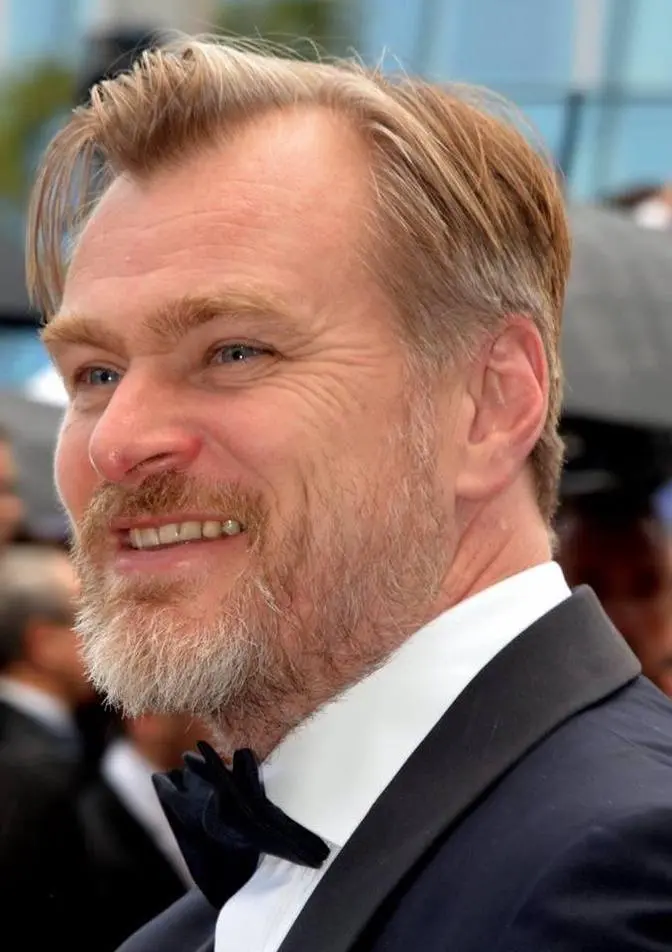
I approach the structure from a very mathematical and geometrical point of view.
A lot of diagrams, a lot of careful planning.
Okay, what do you have? You have the beginning of the film here.
Christopher Nolan's quite famous for his scientific approach to screenwriting.
That's relativity, folks.
He wrote Interstellar with the help of a theoretical physicist.
There's no way, the laws of physics forbid that.
And he's forever saying stuff like this.
You take a mathematical approach, a geometrical approach,
you're drawing diagrams, doing all this complicated stuff.
When talking about his pre-production process.
Planned the structure very carefully before I wrote the script.
Some people think this is genius.
His haters think it's pretentious.
But no matter which side you're on,
you've got to admit he's damn good at exploring one specific topic.
Time isn't the problems.
Getting out alive is the problem.
Oh, by the way, I'm Jack, this is Scene It,
and today we're starting with a question.
If you're a filmmaker, how would you represent time differently?
Because Nolan's not the only one doing it.
Every film manipulates time in some way.
We're sending you back to the future.
This starts with basic continuity editing,
which relies on cutting between shots
to create the illusion of seamless action.
That's what I'm talking about.
Like here, when a character pushes on a door
and it cuts to him walking into another room.
Because we're not stupid,
we can deduce that the door led to this other room
and the spatial and temporal continuity is maintained.
But this continuity is often broken for the sake of impact
or entertainment or even a joke.
And there's plenty of other ways editors mess with time.
Like I've re-edited this clip from Commando to make it temporally accurate.
Matrix hits the detonator, the building blows up and he runs away.
Simple.
But this is what the editors did.
The same explosion from six angles,
breaking continuity to emphasise a big moment.
And then they show us three more angles,
you know, just to make sure.
And there's countless other ways time is manipulated in movies.
Flashbacks, flash forwards, montages, slow motion,
a completely jumbled collection of stories and timelines.
Mysterious thing, time.
Time is everywhere but Nolan makes it everything.
I've always been fascinated by time, by the subjectivity of time.
From casting.
The way we still fight wars, we send our children to fight these wars.
We send 18, 19, 20 year olds off to fight
and so we wanted to fight people of that age.
To sound.
It actually is derived from a recording I made of a watch they own
that I had a particularly insistent ticking.
To the various subplots in his stories.
I need five minutes alone.
No, there's no time.
Nolan lets time guide his screenplays rather than the other way around.
Three, two, one.
From a surface level, the story of Dunkirk already has a built-in temporal element.
The Allied soldiers had to escape the beach as quickly as possible or they'd die.
It's a high-stakes countdown, a ticking clock.
But Nolan took it one step further.
And so the structure I settled on is one that,
it's based on a musical structure called the shepherd tone,
which is a musical illusion whereby you can keep climbing up the scale.
It's something I'd used in my schools,
like the David Julian School for the Prestige was the first time we experimented with it.
The bat pod in The Dark Knight has an ascending engine that never diminishes.
So it's an audio illusion whereby you create the feeling of continually rising pitch.
This musical influence can clearly be seen and heard throughout.
The shepherd tones are pretty hard to ignore.
Begins from the first frame and it ends when he falls asleep on the train.
And it materialized as a unique narrative structure.
And I wanted to try writing a script that obeyed those principles
so that you braid together the three storylines
and they're continually rising in anxiety, if you like, or intensity.
And so as one is peaking, the other one is starting to build
and the other one is entering the last phase of it.
One week on the beach, one day on the water, one hour in the air.
Three stories that all converge at the same point at the end of the film,
but somehow ramp up in intensity at equal levels.
We wanted the language of suspense, which is the most visual of cinematic languages.
So we were looking to the silent era.
We were looking to the great suspense masters like Hitchcock and Clouseau
and their visual storytelling.
No one has sort of done this time convergence before in Inception,
where the levels of the dream have exponential degrees of time dilation.
Five minutes in the real world gives you an hour in the dream.
But here he was focused on using time to humanize the horror,
bravery, fear, desperation, but also acts of humanity that occur during Total War.
I want to tell this in a very subjective way, in a very human scale way.
I only want to see really what the characters are seeing, who are involved.
So how do you do that without cutting to politicians
or generals in rooms with maps and pushing symbols around and stuff?
This is a fair question.
Movies like 1917 stay with the one character
to give us a subjective view of war and the people in it.
But Dunkirk wasn't just foot soldiers.
It was an operation across land, sea and sky,
all of which operated different speeds and time zones.
Every hour the enemy pushes closer.
So Nolan's solution was three strands of time.
Time to get off the beach.
Time to save your countrymen.
And time before your fuel runs out.
Fortis 2, what's your fuel?
All these sub-narratives have their own moments of excitement,
sadness and horror.
So there's levels of depth to the story,
but they're linked by the simple metric of time.
It's coming back round!
While other Nolan films use time as a way to reveal a twist.
I know you're a cop, but what do you want?
Have I done something wrong?
Or show how consequences can change a person.
Dunkirk uses time as a universal constant,
because time is as universal to humans as the character's quest for survival.
It's intrinsically linked, as Nolan also shows in Interstellar.
And today I'm the age you were when you left.
We're only on the planet for a finite amount of time,
and what we do in it defines us as people.
When you're cross-cutting these different timelines,
you're never departing from the subjective storytelling,
the human scale storytelling.
But you are starting, hopefully,
to build up a coherent picture of the larger events
that need telling in any version of the Dunkirk story.
In closing, I'm definitely not Christopher Nolan's biggest fan.
He's got some serious exposition issues,
and his sound mixing can be really...
Well, we better put it out the hole before the bomb goes off, eh?
Yeah, not great.
But I'll always respect his commitment to making meaningful stories
as layered and entertaining as possible,
particularly Dunkirk.
My grandfather fought in the British Navy during World War II,
so it's an event that's always been incredibly important to my family.
Well, Churchill got his 30,000.
And then some.
But even if you have no connection to this story,
I still think it's Nolan's use of time
and the subjective lens of the characters
that makes it feel so intimately personal.
I met some of the Dunkirk veterans.
We met about 30 last week at the UK premiere.
They're in their mid-90s now.
They came to the film?
They came to the movie.
Oh, that must have been extraordinary.
Pretty amazing.
I said, what did you think of the film?
They said the film was louder than the battle.