
Chapter 35 - A Pair of Blue Eyes
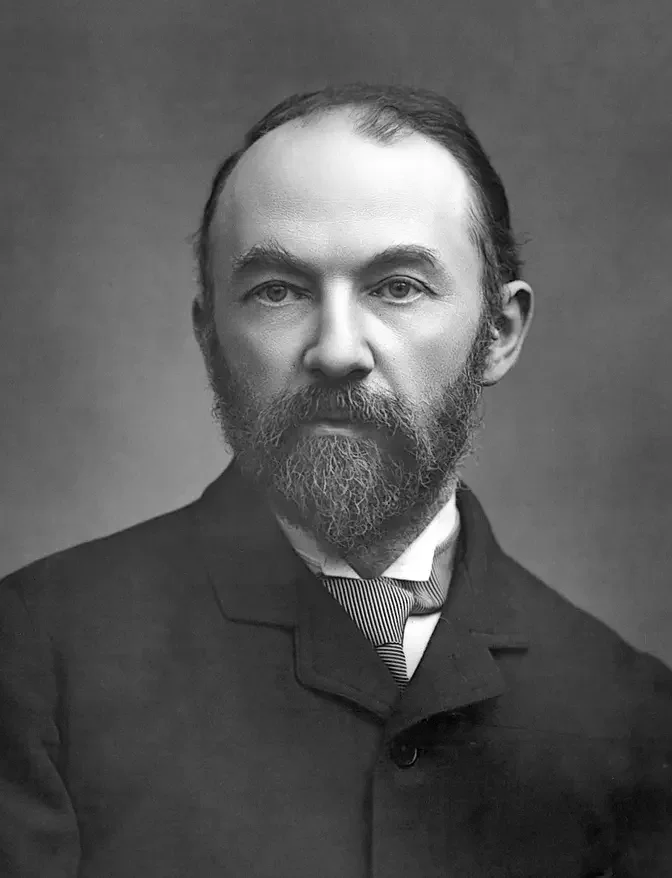
A Pair of Blue Eyes by Thomas Hardy.
Chapter XXXV.
And wilt thou leave me thus?
Say nay.
The scene shifts to Knight's Chambers in Bede's Inn.
It was late in the evening of the day following his departure from Endelstow.
A drizzling rain descended upon London, forming a humid and dreary halo over every well-lighted
street.
The rain had not yet been prevalent long enough to give to rapid vehicles that clear and distinct
which follows the thorough washing of the stones by a drenching rain, but it was sufficient
to make footway and roadway slippery, adhesive and clogging to both feet and wheels.
Knight was standing by the fire, looking into its expiring embers previously to emerging
from his door for a dreary journey home to Richmond.
His hat was on, and the gas turned off.
The blind of the window overlooking the alley was not drawn down, and with the light from
beneath, which shone over the ceiling of the room, came, in place of the usual babble,
only the reduced clatter and quick speech, which were the result of necessity rather
than choice.
Whilst he stood thus, waiting for the expiration of the few minutes that were wanting to the
time for his catching the train, a light tapping upon the door mingled with the other sounds
that reached his ears.
It was so faint at first that the outer noises were almost sufficient to drown it.
Finding it repeated, Knight crossed the lobby, crowded with books and rubbish, and opened
the door.
A woman, closely muffled up, but visibly of fragile build, was standing on the landing
under the gaslight.
She sprang forward, flung her arms round Knight's neck, and uttered a low cry.
Oh, Harry!
Harry, you are killing me!
I could not help coming!
Don't send me away!
Don't!
Forgive your Elfride for coming!
I love you so!
Knight's agitation and astonishment mastered him for a few moments.
Elfride! he cried.
What does this mean?
What have you done?
Do not hurt me and punish me!
Oh, do not!
I could not help coming!
It was killing me!
Last night, when you did not come back, I could not bear it!
I could not!
Only let me be with you, and see your face, Harry!
I don't ask for more!
Her eyelids were hot, heavy, and thick with excessive weeping, and the delicate red rose
of her cheeks was disfigured and inflamed by the constant chafing of the handkerchief
in wiping her many tears.
Who is with you?
Have you come alone?
he hurriedly inquired.
Yes.
When you did not come home last night, I sat up hoping you would come, and the night was
all agony, and I waited on and on, and you did not come.
Then when it was morning, and your letter said you were gone, I could not endure it,
and I ran away from them to St. Lawrence's, and came by train, and I have been all day
travelling to you, and—and you won't make me go away again, will you, Harry?
Because I shall always love you till I die."
"'Yet it is wrong of you to stay.
Oh, Elfride, what have you committed yourself to?
It is ruin to your good name to run to me like this.
Has not your first experience been sufficient to keep you from these things?'
"'My name!
Harry, I shall die soon, and what good will my name be to me then?
Oh, could I but be the man, and you the woman!
I would not leave you for such a little fault as mine.
Do not think it was so vile a thing in me to run away with him.
How I wish you could have run away with twenty women before you knew me, that I might show
you I would think it no fault, but be glad to get you after them all, so that I had you.
If you only knew me through and through, how true I am, Harry!
Cannot I be yours?
Say you love me just the same, and don't let me be separated from you again, will you?
I cannot bear it, all the long hours and days and nights going on, and you not there, but
away, because you hate me.'
"'Not hate you, Elfride,' he said gently, and supported her with his arm.
But you cannot stay here now—just at present, I mean.'
"'I suppose I must not.
I wish I might.
I am afraid that if you lose sight of me something dark will happen, and we shall not meet again.
Harry, if I am not good enough to be your wife, I wish I could be your servant and live
with you, and not be sent away never to see you again.
I don't mind what it is except that.'
"'No, I cannot send you away—I cannot.
God knows what dark future may arise out of this evening's work, but I cannot send you
away.
You must sit down, and I will endeavour to collect my thoughts, and see what had better
be done.'
At that moment a loud knocking at the house-door was heard by both, accompanied by a hurried
ringing of the bell that echoed from attic to basement.
The door was quickly opened, and after a few hasty words of converse in the hall, heavy
footsteps ascended the stairs.
The face of Mr. Swancourt, flushed, grieved, and stern, appeared around the landing of
the staircase.
He came higher up, and stood beside them.
Glancing over on past night with silent indignation, he turned to the trembling girl.
these your tricks, madam?
When will you get rid of your idiocies, and conduct yourself like a decent woman?
Is my family name and house to be disgraced by acts that would be a scandal to a water-woman's
daughter?
Come along, madam—come!'
"'She is so weary,' said Knight, in a voice of intensest anguish.
Mr. Swancourt, don't be harsh with her.
Let me beg you to be tender with her, and love her.'
"'To you, sir,' said Mr. Swancourt, turning to him as if by the sheer pressure of circumstances,
"'I have little to say.
I can only remark that the sooner I can retire from your presence the better I shall be pleased.
Why you could not conduct your courtship of my daughter like an honest man, I do not know.
Why she, a foolish, inexperienced girl, should have been tempted to this piece of folly,
I do not know.
Even if she had not known better than to leave her home, you might have, I should think.'
"'It is not his fault.
He did not tempt me, papa.
I came.'
"'If you wished the marriage to be broken off, why didn't you say so plainly?
If you never intended to marry, why could you not leave her alone?
Upon my soul it grates me to the heart to be obliged to think so ill of a man, I thought,
my friend.'
Knight, soul-sick and weary of his life, did not arouse himself to utter a word in reply.
How should he defend himself when his defence was the accusation of Elfride?
On that account he felt a miserable satisfaction in letting her father go on thinking and speaking
wrongfully.
It was a faint ray of pleasure, straying into the great gloominess of his brain, to think
that the vicar might never know but that he, as her lover, tempted her away, which seemed
to be the form Mr. Swancourt's misapprehension had taken.
"'Now, are you coming?' said Mr. Swancourt to her again.
He took her unresisting hand, drew it within his arm, and led her down the stairs.
Knight's eyes followed her, the last moment begetting in him a frantic hope that she would
turn her head.
She passed on, and never looked back.
He heard the door open, close again.
The wheels of a cab grazed the kerbstone, a murmured direction followed.
The door was slammed together, and the wheels moved, and they rolled away.
From that hour of her reappearance a dreadful conflict raged within the breast of Henry
Knight.
His instinct, emotion, effectiveness, or whatever it may be called, urged him to stand forward,
seize upon Elfride, and be her cherisher and protector through life.
Then came the devastating thought that Elfride's childlike unreasoning, and indiscreet act
in flying to him, only proved that the proprieties must be a dead letter with her—that the
unreserved, which was really artlessness without ballast, meant indifference to decorum.
And what so likely has that such a woman had been deceived in the past?'
He said to himself in a mood of bitterest cynicism.
"'The suspicious, discreet woman who imagines dark and evil things of all her fellow-creatures
is far too shrewd to be deluded by man.
Trusting beings like Elfride are the women who fall.'
Hours and days went by, and Knight remained inactive.
Lengthening time, which made fainter the heart-awakening power of her presence, strengthened the mental
ability to reason her down.
Elfride loved him, he knew, and he could not leave off loving her, but marry her he would
not.
If she could but be again his own Elfride, the woman she had seemed to be.
But that woman was dead and buried, and he knew her no more.
And how could he marry this Elfride?
One who, if he had originally seen her as she was, would have been barely an interesting
pitiable acquaintance in his eyes no more.
It cankered his heart to think he was confronted by the closest instance of a worse state of
things than any he had assumed in the pleasant social philosophy and satire of his essays.
The moral rightness of this man's life was worthy of all praise.
But in spite of some intellectual acumen, Knight had in him a modicum of that wrong-headedness,
which is mostly found in scrupulously honest people.
With him, truth seemed too clean and pure an abstraction to be so hopelessly churned
in with error as practical persons find it.
Having now seen himself mistaken in supposing Elfride to be peerless, nothing on earth could
make him believe she was not so very bad after all.
He lingered in town a fortnight, doing little else than vibrate between passions and opinions.
One idea remained intact, that it was better himself and Elfride should not meet.
When he surveyed the volumes on his shelves, few of which had been opened since Elfride
first took possession of his heart, their untouched and orderly arrangement reproached
him as an apostate from the old fate of his youth and early manhood.
He had deserted those never-failing friends, so they seemed to say, for an unstable delight
in a ductile woman, which had ended all in bitterness.
The spirit of self-denial, verging on asceticism, which had ever animated Knight in old times,
announced itself as having departed with the birth of love, with it having gone the self-respect
which had compensated for the lack of self-gratification.
Poor Elfride, instead of holding as formerly a place in the religion, began to assume the
hue of a temptation.
Perhaps it was human and correctly natural that Knight never once thought whether he
did not owe her a little sacrifice for her uncherry devotion in saving his life.
With a consciousness of having thus, like Antony, kissed away kingdoms and provinces,
he next considered how he had revealed his higher secrets and intentions to her, an unreserve
he would never have allowed himself with any man living.
How was it that he had not been able to refrain from telling her of adumbrations heretofore
locked in the closest strongholds of his mind?
Knight's was a robust intellect, which could escape outside the atmosphere of heart, and
perceive that his own love, as well as other people's, could be reduced by change of scene
and circumstances.
At the same time, the perception was a superimposed sorrow.
O last regret!
Regret can die!
But being convinced that the debt of his regret was the best thing for him, he did not long
shrink from attempting it.
He closed his chambers, suspended his connection with editors, and left London for the Continent.
Here we will leave him to wander without purpose, beyond the nominal one of encouraging obliviousness
of Elfride.