
Karnak Temple at Luxor Egypt
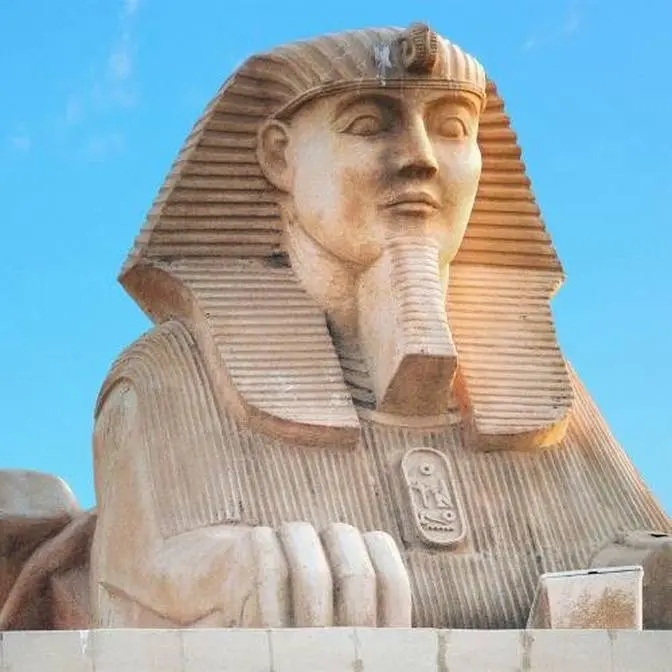
Karnak Temple is a vast complex of temples, built over a period of 2,000 years,
of which only the precinct of Amman Ray is open to the public, yet this one section could fit 10
European cathedrals within it. An avenue of ram-headed sphinxes, each holding a statue
of Ramses II in its paws, leads to the west entrance. Behind the sphinxes is the first
pylon, which was never completed. It was actually the last to be built,
together with massive enclosure walls, from the time of Nekhtenbo the First.
To either side of the entrance of the second pylon stands a pair of statues of Ramses II.
The one to the left includes Princess Bentanth, daughter of one of his most important wives.
To the side of the second pylon is the temple of Ramses III, a small-scale replica of his temple,
Medinet Habu, with matching scenes on the entrance, and the same statues of Ramses inside.
As we move further into the complex, we go back in time, with the new additions at the outside,
as successive pharaohs added to the complex, expanding it.
The second pylon was built by Horemeb, using stone from the demolished monuments of Akhenaten.
The hieroglyphs were only partly completed at his death, and then usurped by his grandson,
Ramses II, who replaced Horemeb's cartouches with his own.
The hippostyle hall was built over three generations, starting with Ramses I,
a nobleman rather than of royal birth. He was chosen to succeed as pharaoh by Horemeb,
to prevent any succession difficulties. However, already an old man, his reign lasted only one year,
before being succeeded by his son, Seti I. The hall was finally completed by his son,
Ramses II. The general public was not admitted into the temple halls, and even the priests
had to purify themselves before entry. Inside, it was dark, as the entire roof was covered,
with only small windows above the centre aisle. The use of incense abounded, its importance shown
by depictions of the journey to the land of Punt, in search of incense.
Punt is now situated in the land of Somalia and Eritrea.
The columns and walls in the hippostyle hall were covered in representations of Amun,
the king of the gods, sometimes accompanied by his wife Mot. This obelisk was erected by
Queen Hatshepsut. It had taken seven months to carve from pink granite in the distant quarries
of Aswan, before being transported hundreds of miles and erected here. The ancient Egyptians
had observed the scarab beetle rolling dung and associated this with the sun rolling across the
sky. This granite statue was brought to Karnak from the mortuary temple of Amenhotep III and
placed near the sacred lake. As we look across to the seventh pylon, we see a small part of the
massive jigsaw puzzle remaining. Thousands of blocks, large and small, make up this three
dimensional jigsaw, yet without an indication of the end result, it requires years of careful
detective work to piece the blocks together. Many beautifully detailed pieces await the time they
will return to their former glory. Every last detail was meticulously carved, as we see on this vulture.
One of the last areas to be built was the Ptolemaic Gate at the entrance to the Temple of
Khonsu. It was built almost 2,000 years after the first buildings in Karnak. We can see more colours
here, especially areas shaded from the harsh sunlight. This gate was at the end of an avenue
of sphinxes that ran to Luxor Temple. The Temple of Khonsu was originally constructed by Ramses III
on the site of an earlier temple. The temple is dedicated to Khonsu, the moon god,
son of Amun and Mut, and sometimes represented by a baboon. Many of the blocks creating this temple
were reused from previous temples, especially during reconstruction during the Ptolemaic
times, as can be observed when engravings do not match, are upside down or overscribed.
At the opposite end of Karnak lies the Temple of Ptah.
This statue is of Sekhmet, the goddess of war,
and wife of Ptah. It is located in the chapel dedicated to Hathor.
Unlike most of Karnak, this temple of Teutimosis IV was a place where townspeople could make their
This beautiful chapel was probably originally located between the obelisks of Queen Hatshepsut.
However, one of her successors demolished it and used this beautiful stone as infill in pylon walls.
The quality of workmanship in such a hard stone is exquisite. This is one of the oldest chapels,
that of Amenhotep I. Built out of alabaster marble and dedicated to Amun,
it was disassembled by Amenhotep III to fill his third pylon.