
Hubert Robert
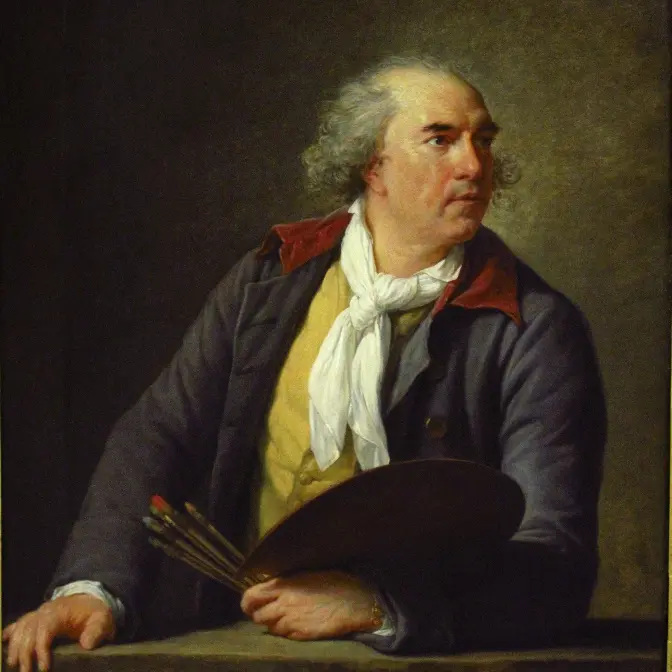
Hubert Robert was a French painter, noted for his landscape paintings and picturesque depictions of ruins.
Biography
Early years Hubert Robert was born in Paris in 1733.
His father, Nicolas Robert, was in the service of François-Joseph de Quassiel,
Marquis de Stainville a leading diplomat from Lorraine.
Young Robert finished his studies with the Jesuits at the Collège Novart in 1751 and entered the atelier of the sculptor Michel-Ange Slotz who
taught him design and perspective but encouraged him to turn to painting.
In 1754 he left for Rome in the train of Étienne-François de Quassiel, son of his father's employer,
who had been named French ambassador and would become a Secretary of State for Foreign Affairs to Louis XV in 1758.
In Rome he spent fully eleven years in Rome.
A remarkable length of time after the young artist's official residence at the French Academy in Rome ran out,
he supported himself by works he produced for visiting connoisseurs like the Abbé de Saint-Nan,
who took Robert to Naples in April 1760 to visit the ruins of Pompeii.
The Marquis de Marigny, director of the Bâtiments du Roi kept abreast of his development in correspondence with Natoire,
director of the French Academy, who urged the pensionnaires to sketch out-of-doors from nature.
Robert needed no urging – drawings from his sketchbooks document his travels.
The contrast between the ruins of ancient Rome and the life of his time excited his keenest interest.
He worked for a time in the studio of Panini, whose influence can be seen in the Vieux Imaginaire de la Galerie du Louvain Ruin.
Robert spent his time in the company of young artists in the circle of Piranesi,
whose Capricci of romantically overgrown ruins influenced him so greatly that he gained the nickname Robert des Ruins.
The albums of sketches and drawings he assembled in Rome supplied him with motifs that he worked into paintings throughout his career.
In Paris his success on his return to Paris in 1765 was rapid.
The following year he was received by the Académie royale d'Aupenture aide a sculpture with a Roman capriccio, The Port of Rome,
ornamented with different monuments of architecture, ancient and modern.
Robert's first exhibition at the Salon of 1767 was greeted in print by Denis Diderot.
The ideas which the ruins awaken me are grand.
He was successively appointed Designer of the King's Gardens,
Keeper of the King's Pictures and Keeper of the Museum and Counsellor to the Academy.
Robert was arrested in October 1793 during the French Revolution.
He survived his detentions at Saint-Pelagie and Saint-Lazare by painting vignettes of prison life on plates before he was freed at the fall of
Robespierre. Robert narrowly escaped the guillotine when through error another prisoner died in his place.
Subsequently he was placed on a committee of five in charge of the new National Museum at the Palais du Louvre.
The revolution also resulted in the destruction of some of Robert's work.
Robert had designed the decorations for a little theatre in the new wing at the location of the current staircase Gabriel in the Palace of
Versailles. Designed to seat about 500 this theatre was built from the summer of 1785 and opened in early 1786.
It was intended to serve as an ordinary court theatre, replacing the theatre of the Prince's Court which was too old and too small,
but was destroyed during the time of Louis-Philippe, a watercolour of Robert's designers in the National Archives in Paris.
Robert died of a stroke on 15 April 1808. Style and legacy
The quantity of his work is immense.
The Louvre alone contains nine paintings by his hand and specimens are frequently to be met within provincial
museums and private collections. Robert's work has more or less of that scenic character which justified his selection by Voltaire to paint the decorations of his theatre at Ferney.
His work was much engraved by the Abbé de Saint-Non,
with whom he had visited Naples in the company of Fragonard during his early days in Italy His work has also been frequently reproduced by
Chatelaine, Linard, Lévi-Au, and others.
He is noted for the liveliness and point with which he treated the subjects he painted.
Along with this incessant activity as an artist, his daring character in many adventures attracted general admiration and sympathy.
In the fourth canto of his L'Imagination, Jacques de Lisle celebrated Robert's miraculous escape when lost in the catacombs.
Robert and picturesque gardens Enterprising and prolific, Robert also acted in a role similar to that of a modern-day art director,
conceptualizing fashionably dilapidated gardens for several aristocratic clients.
Summarized by his possible intervention at Ermenenville, there he would have been working with the architect Morel for the Marquis de Girardin,
who was the author of compositions des passages and had distinct views of his own.
In 1786 he began his better-documented collaboration at Maraisville with his most significant patron, the financier Jean-Joseph de Laborde,
who found François-Joseph Belang's plans too expensive and perhaps too formal.
Though documents are again lacking, Hubert Robert's name is invariably invoked in connection with Marie Antoinette's
creation of an informal landscape garden at the Petit Trianon, and the setting of the Petit Hamon.
Robert's contribution to garden design was not in making practical ground plans for improvements but in providing atmospheric inspiration for the
proposed effect. At Ermenenville and at Maraisville, Hubert Robert's paintings both recorded and inspired.
According to W.H. Adams, Robert's four large ruin fantasies painted in 1787 for Maraisville may be searched in vain for direct connections with the garden.
Hubert's paintings of the Moulin Joli of his friend Claude-Henri Waitelot render the fully grown atmosphere of a garden that had been underway since
His set of six Italianate landscape panels painted for Bagatelle were not the inspiration for the formal turf parterre set in the thinned
woodlands. Designed by Bellinger, the later picturesque extensions of Bagatelle were carried out by its Scottish gardener
William Blakey. Robert's commissioned painting of the long-delayed rejuvenation of the park at Versailles,
begun in 1774 with the cutting down of the trees for sale as firewood, is a record of the event, resonant with allegorical meaning.
Robert was more certainly responsible for the conception of the grotto and cascades of the Baths of Apollo, tucked within a grove of the chateaus,
park and built a house François Girard and celebrated sculpture group Apollo attended by nymphs.