
Virtual Tour-only: Art Escapes, Ep. 2: Development of Buddhist and Hindu Sculpture
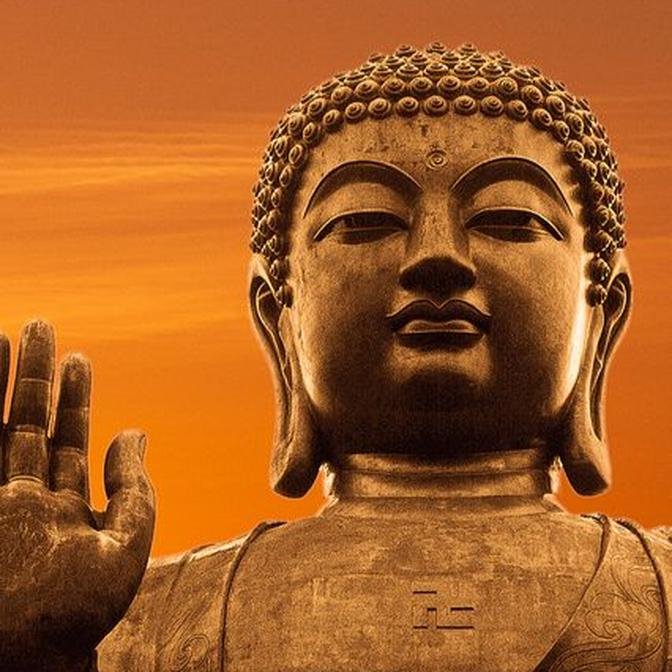
#AntiqueBuddhaStatue"Development of Buddhist and Hindu Sculpture with Forrest McGill
Swaying bodies, palms extended elegantly, chins nodding to the beat of an unheard rhythm: immortal, sacred movement defines sculpture across Southern Asia and the Himalayas. From larger-than-life temple reliefs to bronzes created for ceremonial parades, uncover how, for millennia, artists have shown us the vital connections between sculpture, life, and the spirit.
Focusing on a single subject at a time, each 20-minute virtual Art Escapes tour is led by an expert who shares insights into millennia of craft and creativity and reveals the stories behind the art."
Hi everybody and welcome. I'm Forrest McGill, a curator here at the Asian Art Museum.
We're going to be looking at some of our South Asian galleries today. South Asia encompasses
Pakistan and Bangladesh and India as well as some other countries. The Asian Art Museum's
collection of art from this region is a very strong one. One of the important collections of
the type in the country. We have very rich holdings that I hope you'll come and look at
when you have a chance. A couple of general points. One is diversity is really important.
The geographical area is huge and it encompasses deserts and mountains and river valleys. There's
great linguistic diversity, so many, many, many different languages. Lots of religious diversity.
There's Hinduism and Buddhism, which mostly doesn't survive in India, although it's been
reintroduced. And Jain tradition, Sikh tradition, Islamic tradition, and so on. So huge cultural
diversity and that's one of the delights and enriching parts of studying the arts of South
Asia, to encounter and enjoy that enormous diversity. Follow me, if you will, and we'll
have a look at some of the beginnings of art in the South Asian region. The great religious
traditions that we associate with South Asia, Hinduism, Buddhism, Sikhism, Jainism, and of course
Islam later on, developed very high art traditions that we'll be looking at more in a little bit.
But before those traditions had developed to the elaboration that they eventually achieved,
it seems like there were cults of local goddesses and gods that had to do with rivers and mountains
and streams and fertility. These were sort of local folk deities. And here we're seeing some
examples of those. There's not a lot of representations of them. These three are all
about 2,000 years old. All of them are mold made. They're clay that was pushed into a mold and then
fired to harden it. They were made in multiples and they still exist in multiples sometimes.
This one, a very beautiful young woman with very elaborate garments and jewel decorations and this
wild hairdo with hair piled way up on her head and this big sort of flounce coming out on the front
must have been the height of fashion in this area 2,000 years ago. Holding a bunch of fruit,
so that suggests the association with fertility. And in other contexts in South Asian art we see
young women associated with trees or fruit. There's even stories that a young woman can
kick a tree with her heel and that will bring it into flower or bring it into
fruiting. So there's this association with fertility. With her other hand, her left hand,
she's holding a parrot. We don't know for sure what's going on with the parrot at this early
period, but later on there's a wonderful poetic tradition for centuries in India of the young
woman who treats a parrot as her confidant. So when her lover has done something wrong that she's
upset about, she confides this to the parrot and the parrot is her friend and the receiver of her
confidences. This one, also mold made, very elaborate body. You can imagine the emphasis
on fertility because the hips are very wide, the breasts are very prominent, and so on. This was the
ideal figure for a physique for a woman 2,000 years ago in India. Also has a very elaborate hairdo,
and you can see that in her hairdo she has what must be hairpins, but they're in the shape of
miniature weapons that are put into her hairdo. And this brings up two sides, two aspects,
of female deities in South Asia. Nurturing associated with fertility, associated with
nature, having some of those same associations, but with the added connection of weapons and war,
and they're female deities who are primarily nurturing, and they're female deities who have
it in them to get furious and to go into battle for the religious ideas and principles that they're
supporting. Several of the world's great religious traditions originated in South Asia, and one of
them, of course, is Buddhism. Here we're seeing the founder of Buddhism, who lived about 2,500 years
ago. We don't have artworks, there aren't artworks surviving from the first few centuries after his
life, so the artworks are retrospective in a way. They're all, in some sense, visionary
depictions of what he was thought to look like. He had a supernatural anatomy, and we'll see more
of that later, but in this instance we can see it with the tuft of hair on his forehead between his
brow, and another is what looks like a hair bun, but actually is understood to be a lump of extra
cranium on the top of his head that's also covered with hair. So in religious art in South Asia, in
a lot of traditions, there develop standardized hand gestures that people can understand and
recognize, and they're used century after century in various areas too. You want people to be able
to recognize visually very quickly what they're looking at. This one, the two hands together like
this, is preaching. There's a metaphor that what the Buddha is doing is setting in motion the wheel
of the Buddhist doctrine. So this is, in some sense, symbolically he's spinning a little wheel
that represents the Buddhist doctrine, but what it means is that he's preaching the religious
ideas that he has come to understand and wants to share with everybody. What we're seeing here
is a series of reliefs that recount episodes in the life of the Buddha, and in their original
context they come from northwestern Pakistan. They would have been on the exterior of a stupa,
that's a Buddhist reliquary mound, and often in this period 1,800 years ago, 1,700 years ago,
there would be a series of reliefs like this arranged on the exterior of this structure.
One of the things that they would tell is the legendary story of the Buddha. The ones we have
here are arranged to tell the story in order, but they're not part of a set originally. They came
from different original locations and so on. We're just going to focus on one. This is the
Buddha's miraculous birth, and very interesting scene. His mother is here, she's standing up,
and this is the standard way it's represented, holding on to a tree, so that's that association
with fertility of the beautiful young woman and the tree. The baby is coming out of her right side,
and he's immediately received by the gods. You see this one is holding a towel to receive the
baby that's coming out. We don't see it here, but the texts tell us that as soon as the baby
was born, he took seven steps and said, this is going to be my last human existence. So you
remember the idea of reincarnation. We humans, we eventually want to break out of the cycle of
reincarnation. We want to not have to be reincarnated anymore. So this baby, in saying,
this is my last birth, what that means is he's going to achieve the spiritual status in this
life of his, so that he can break out of the system of birth and death and rebirth,
and not have to be reborn further. We've been looking at early traditions of Buddhist art
in South Asia. Now we're moving to look at early traditions of Hindu art. The development of
Hindu sculpture, both as images and as relief sculpture that's telling stories, was happening
2,200 years ago, 2,000 years ago, 1,800 years ago, in both the Hindu tradition and the Buddhist
tradition. This is the Hindu god Vishnu, one of the most important Hindu gods, still very widely
worshipped today. Very important deity. We see him here wearing an elaborate headdress that's
actually understood to be a crown. He has kingly attributes because he's understood to be extremely
powerful. He's associated with creating stability in the world in the way that ideally a righteous
king would do. The king, the god, creates the stability in the world that allows us to do
our farming and our trading and all of our activities that can't happen without a platform
of righteous stability. Also, this body position of Vishnu, standing absolutely straight up
symmetrically, is the most formal, the most dignified, and associated with a kind of eternal
aspect of the deity. Unmoving, unchanging, the deity is permanent in this symmetrical, standing
up straight, body position. You see that he has four arms. He's holding a lump of earth, a conch
shell, a war discus, and something else. We don't know what was in this hand. These emblems become
standard for Vishnu. So, ever after these early periods, Vishnu is typically seen holding at least
some of the war discus, the conch shell, the lump of earth, and so on. So, these kinds of
emblems, attributes, become standardized so that people can recognize Vishnu because of his
hairdress, his four arms, what the arms are holding, and also the halo because as a great
kingly deity, he radiates light and that's symbolized by the radiance around his head.
We were just in the gallery that focuses on the early traditions of religious art in South Asia.
In this gallery, we're looking at the five, six hundred years later flowering of those traditions
that had their beginnings earlier on. We're looking at a Buddha image. The body is recognizable,
wearing a monk's robe, although it's very sheer and it clings to the body, but also wearing a crown
and some elaborate jewelry. In the legendary story of the life of the Buddha, he was born as a prince
and by the time he was a teenager, he had gotten disillusioned with the life in the palace. He was
not happy with the luxurious and pampered life of a prince, so he rejected his princely status and
set out on a kind of spiritual quest. So, why do we see him again wearing a crown and royal jewelry
if he's rejected those earlier on? Well, the idea is that by this point in the development of
Buddhism in South Asia, the Buddha is seen ever more as a kind of eternal, celestial, cosmic
figure who did enact these life episodes on earth, but in fact is a kind of eternal abstraction
that exists beyond his earthly life. And that change in status is symbolized by the crown and
royal jewelry. The way the life of the Buddha is represented has also been kind of transformed.
We saw those reliefs earlier on that showed a whole series of episodes from the life of the
Buddha. By this point, those episodes, eight of them have been singled out to become a standard
set of eight major events in the life of the Buddha, and they become emblematic as much as
narrative. So, for example, here's the Buddha's mother. We saw her before. She's standing up,
giving birth. She's holding on to a tree, as we saw before, and you can just barely see it there.
The infant is coming out of the right side of her torso. The other figures that were in the
earlier relief that we saw have gone away. We're not seeing the gods receiving the little baby on
the towel and so on. At this point in Buddhist art, it's not necessary to really tell all the
details of the stories anymore because people know the stories, so they just need a hint.
They just need a kind of summation that, oh, here's the birth of the Buddha,
and then they can run the story in their minds because they know it already.
Another development in later Buddhist art in South Asia is the emergence of very important
female deities. They are understood to be embodiments of different kinds of intellectual
and spiritual principles. Here's a female deity with many arms and also multiple faces. This
becomes common in both later Hindu and later Buddhist art for deities to be depicted with
multiple heads or faces and multiple arms. This represents the fact that they are not
regular human beings and they have superhuman powers and capabilities that are symbolized by
the multiple heads and multiple arms. This deity with her very beautiful decorations, jewelry,
really intricately carved. Look at this sash here coming off, how delicately it's represented,
or on her lower garment, the carving of the stripes that would be in the fabric of her
lower garment, very detailed and kind of hypnotic to look at. The main deity is surrounded by 10
other goddesses, 1, 2, 3, 4, 5, 6, 7, 8, 9, 10, and this makes this sculpture really a mandala.
A mandala is a kind of a cosmic diagram in which deities are arranged in geometric relationship to
each other and they become aids to meditation. So we as worshippers look at the mandala, which can
be 3D or it can be a painting, we look at the mandala and we enter into it in our meditation
and our spiritual practice. And we identify ourselves with one deity after the other,
trying to absorb the capabilities and the ideas and the powers and the spiritual principles that
are embodied in each of the deities. So in our meditation we go from one to the next to the next,
identifying ourselves, trying to make ourselves one with the deity and the aspects that are
associated with the deity. It's really important to keep in mind the enormous diversity of South
Asia. These three images of Vishnu are put together in order to emphasize that diversity.
So what they have in common is that they're all Vishnu, they all have four arms, they all have
the conch shell and the war discus and so on. They're all from about a thousand years ago,
so they're similar in time period, but what makes the three of them so different from each other
is that they're from different regions of the subcontinent. So the one that's near me here
is from the northeast, the one in the middle is from central India, and the one on the far side is
from southern India. So again the symbolism is very closely related, the time period is very
closely related, but they look quite different because they're from different regions of India
and therefore different stone, because different regions of India have different kinds of
characteristic stone. This northeastern Indian stone, dark gray charcoal colored stone,
is very fine grained and will allow very intense, delicate, detailed carving. The central Indian
red sandstone is grainier, so the artist has to think about volumes more than tiny detail,
because it's not as easy to carve tiny detail in this stone and so on. So regional differences
that also have to do with material differences. This image of Vishnu is from southern India,
and the stone again allows very, very, very detailed carving, and you can see that the
elaboration of everything has gotten enormously rich. So Vishnu's crown has gotten very, very,
very elaborate with lots of deep cutting of the stone. And then he's holding the conch shell,
almost unrecognizable here because it's got so much decoration on it, and the war discus,
again, almost unrecognizable because it's got these garlands on it and elaborate decorations.
So we saw before that Vishnu is associated with the idea of giving stability, giving righteous
order in the world, and there developed the idea of the avatars. We know the word avatar
in English these days. The Sanskrit word is avatara, meaning a descent or an incarnation of
the deity in a different form on earth. And there develops the idea of 10 major avatars of Vishnu
that have different forms, and they come to earth to re-establish order when there's a threat to the
stability of the world. And this sculpture actually shows all 10 of them. There's five on
this side, including a man-lion, partly human, partly lion, and then the other five are on this
side, and they include Rama and Krishna, who later on develop very important religious followings of
their own. When you come back and visit the galleries and walk through the subsequent
galleries, you'll see representations of Rama and Krishna having become focuses of worship
independently from the idea of Vishnu and the 10 major incarnations. So we've seen some of the
beginnings of Buddhist and Hindu art in South Asia. We've seen some of the flowering, some of
the later elaborations of the tradition. We've not yet seen the great deity Shiva, a very important,
very powerful, still a major focus of worship today. He appears in the next galleries to come,
and also there's still another thousand years of the development of artistic traditions in
South Asia. So I hope you'll come back another time to see more of our
South Asian galleries at the Asian Art Museum. Thanks for joining us today.