
Einstein’s Other Theory of Everything
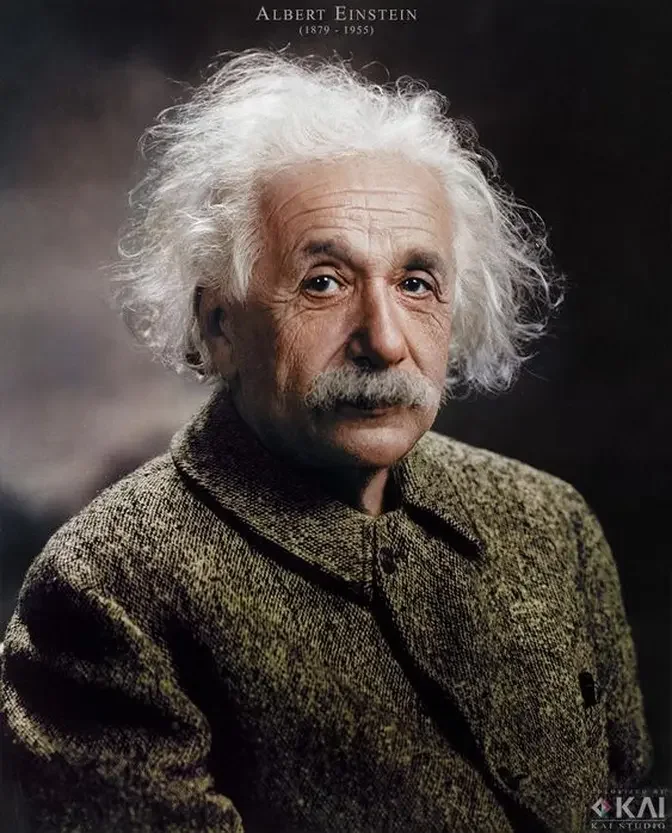
Einstein finished his masterwork, The Theory of General Relativity, in 1915.
He was 37 years old and had lived for another 40 years.
What did he do in those 40 years?
Einstein felt that his masterwork was incomplete and he wanted to develop a unified field theory.
Indeed, it was Einstein who coined the term.
He ultimately failed, but that doesn't make his ideas any less interesting.
I think that Einstein had a very promising start, but then took a wrong turn.
And recently, I've begun to wonder whether anyone even still knows of his starting idea.
Well, if you watched this video, at least you will know.
His idea was roughly this.
Einstein's General Relativity says that gravity is a property of space-time.
It's often depicted with a marble that weighs down a rubber sheet.
The rubber sheet is space-time.
If a smaller marble rolls by, it'll not roll in a straight line.
It'll roll in a curve, as if it was attracted by the bigger marble.
But you still need that marble to cause the curvature in the first place.
It's the same in Einstein's General Relativity.
You need both space-time and matter in it.
Einstein seems to have tried to find a theory in which there's only space-time,
but we interpret some of that space-time as matter.
He wanted to find equations that'll have solutions that correspond to the fundamental
particles of nature.
I must admit that this is partly speculation based on what Einstein wrote in his papers,
but I'll explain in a moment why I think that's what he meant.
Before I can do that, however, I have to tell you what the status of physics was at the time
Einstein set out for his unified theory.
Today, physicists know four fundamental interactions.
Besides gravity, there's electromagnetism and the strong and weak nuclear interaction.
But when Einstein finished his theory of General Relativity,
the strong nuclear interaction had not yet been discovered,
and the theory for the weak nuclear interaction had not yet been developed.
So he really only had two interactions to work with, gravity and electromagnetism.
These two are similar in that the gravitational force law,
which you can assign to a point mass, goes with 1 over r square,
just like the force law for point charge.
And since Einstein had been so successful with describing gravity as the curvature of space-time,
naturally he wondered whether electromagnetism could be described the same way.
In 1919, Einstein published a paper titled
Do Gravitational Fields Play a Role in the Structure of Elementary Particles?
The idea he pursued in the paper is to take a modified version of General Relativity
with different field equations, then he added electromagnetism and asked
whether this would give rise to solutions that could be interpreted as particles.
The conclusion he arrived at is that no, this doesn't work,
because the quantity that could be interpreted as mass could take on any value,
whereas the particles that matter are made of have very specific values for their mass.
In 1923, then, he published another paper titled
Does Field Theory Offer a Solution to the Quantum Problem?
In this paper, he basically says that his previous idea to make matter from space-time
didn't work because there are some equations missing.
He then guesses some equations that might do the job,
but again concludes that this doesn't work.
This video comes with a quiz that lets you check how much you remember.
In 1925, he publishes another paper in which he says that he's tried for two years
to combine electromagnetism with gravity and it didn't work.
He presents a new idea in which he says that the metric tensor
could have an antisymmetric part that might describe electromagnetism.
I know this is somewhat technical, but in General Relativity,
space-time is described by a two tensor. That's basically a glorified matrix.
This matrix is symmetric, meaning that the entries above the diagonal are the same as those below.
In electromagnetism, you have instead something called the field strength tensor,
which is antisymmetric. That means the entries above the diagonal are the same as those below,
multiplied by minus one.
The thing is now that if you have an arbitrary two tensor,
you can take that apart into a symmetric and an antisymmetric part.
So Einstein said, we'll make the metric tensor into an arbitrary tensor,
use the symmetric part for gravity and the antisymmetric part for electromagnetism.
I think that this is where things went wrong, because the metric tensor in General Relativity
is not related to the field strength tensor, but to the electromagnetic potential.
If you wanted to combine the two, you'd have to put the electromagnetic potential
into the metric. And this is indeed what Theodor Kaluza did.
He added a fourth dimension of space and put the electromagnetic potential there.
The idea would later be refined by Otto Klein and is now known as Kaluza-Klein theory.
And this idea works indeed beautifully. It gives you both General Relativity
plus Maxwell's equations for electromagnetic fields from the same mathematics.
But Kaluza-Klein theory only gives you the electromagnetic fields.
It does not give you charged particles. So it didn't solve the problem that Einstein
wanted to solve. It didn't make matter out of space-time.
Maybe this is why he didn't adopt the idea.
But Einstein had another clue for his unified theory, and that was black holes.
Yes, black holes.
You see, as soon as Einstein had finished his theory of General Relativity,
Karl Schwarzschild discovered a solution to Einstein's equations
that described what we now call black holes.
But this solution has singularities, places where some quantities take on infinite values.
Einstein thought that this can't be right.
Singularities shouldn't happen in reality.
And if his theory allowed those, then there was something wrong with it.
He therefore tried to use the requirement that singularities should be absent
to find these solutions that describe elementary particles.
But he made a mistake there.
In Schwarzschild's black hole solution, there isn't just one singularity, but two.
One is at the horizon of the black hole, the other one in the centre.
We know today that the singularity at the horizon
does not correspond to any physically measurable quantity.
It's a mathematical artefact that can be removed.
Einstein tried to find a way to remove this singularity, which wasn't there in the first place.
You'd think that physicists would have learned from this that it's a mistake
to go on about the properties of unobservable quantities,
but it's the same mistake that led to all these wrong predictions for the Large Hadron Collider.
But I digress, back to Einstein.
That Einstein wanted to get rid of black hole singularities
is what led to his famous paper with Nathan Rosen in 1935,
in which they introduced what's now called an Einstein-Rosen bridge.
What they did was to take away the inside of the black hole and instead connect two universes.
It's the simplest known example of a wormhole.
But they didn't write the paper to introduce wormholes.
Oh no, Einstein and Rosen thought these wormholes were elementary particles.
After they've constructed their bridge in the paper, they write very clearly,
we see now in the given solution, free from singularities,
the mathematical description of an elementary particle, neutrons or neutrinos.
They then go on to add electric charges and interpret that as charged particles.
Now, one thing you may have noticed is that we know today that neutrons are not elementary particles.
But this wasn't the main problem with the idea.
The main problem is that one can calculate the size of the bridge,
or wormhole, or whatever you want to call it, from its mass.
And that'll tell you that the size of a neutron would be about 10 to the minus 52 centimetres.
That's more than 30 orders of magnitude smaller than its actual size.
For other elementary particles, this becomes even more extreme.
This means that if elementary particles were wormholes or black holes,
they'd be much smaller than the quantum uncertainty that we measure.
Stephen Hawking also taught us that they'd be unstable.
But again, Einstein couldn't have known this.
In any case, Einstein didn't pursue this idea further.
Instead, he pursued his early idea from 1928 of putting electromagnetism into the metric tensor.
The idea that he introduced is that of teleparallelism,
and it's what's later become known as Einstein's unified theory.
In the following 10 years, he'd published 10 or so papers about this.
In a nutshell, Einstein's unified field theory is a modified version of general relativity
that has more equations.
These additional equations, Einstein said, would represent electromagnetism.
It's called teleparallelism because it first does away with the curvature of spacetime,
but then requires that coordinate frames in different places,
so tele, are parallel to each other.
That's why teleparallelism.
From today's perspective, it's obvious why this couldn't work.
For one thing, we know that electromagnetic fields have quantum properties,
and you wouldn't get the right maths out of this teleparallelism
because it's not a quantum theory.
Einstein probably knew this,
but ignored it because he didn't believe that quantum theory was fundamentally correct.
Einstein's unified theory also doesn't contain the weak and strong nuclear force.
There just aren't sufficiently many equations for that.
But again, he couldn't have known this.
And finally, in 1928, the same year that Einstein laid out the idea,
Dirac understood that all particles of matter have spin one-half,
and these need special equations that you couldn't get out of Einstein's approach at all.
This, by the way, is also why Kaluza-Klein theory ultimately doesn't work
because of the spin one-half fields.
To make that work, you need to introduce supersymmetry, but that's another story.
These are the major reasons why unified field theory was not pursued after Einstein's death.
Because by then, it had become clear that it wasn't compatible
with the new things that physicists had discovered.
That said, I find it somewhat surprising, and maybe even concerning,
that physicists have also thrown out Einstein's original idea
that I want to call his other theory of everything,
the idea that matter is really just made of space-time curved in a particular way.
This notion has survived in some areas of physics,
where such objects are known as solitons or noise-free subsystems,
but mostly it's been given up.
It's been replaced by a different idea of unification
that matter and space-time are both made of something else,
like, for example, strings or loops or networks or what have you.
So why am I telling you this?
Primarily because I think it's interesting what Einstein,
one of the undoubtedly most intelligent people to ever walk on this planet,
did with his life.
But also because I don't want Einstein's idea to be forgotten.
If this video inspired you to develop your own unified theory,
there's no better place to start than Brilliant.org.
Yes, you've heard me talk about Brilliant before,
but have you ever given it a try?
I think you'll really like it.
They have courses on a large variety of topics in science,
computer science and mathematics,
and they're adding new ones each month.
I have found it to be a simple and effective way of learning something new.
All their courses have interactive visualizations
that are super helpful to understand what's going on,
and they all have follow-up questions.
So, you know, that helps me to make sure I don't just
gloss over something and click on next.
I even have my own course on Brilliant.
That's an introduction to my favorite topic, quantum mechanics.
I had a lot of fun working on this together with Brilliant's team,
and I hope you'll enjoy it too.
To give it a try, use our link brilliant.org.
That'll give you access to everything on Brilliant for 30 days
and 20% off an annual premium subscription.
Thanks for watching.
See you tomorrow.