
OIL PAINTING PROCESS // And Thoughts on Art
Alright, hello. So, thanks to all of your kind words and all the encouraging comments
I'm back to talk a bit more about the whys and hows of painting.
And today I'll be taking you through the process of one of my portrait-inspired paintings.
I'm saying portrait-inspired because I don't think of my paintings as portraits.
To me, the faces that I'm painting, or anything else for that matter,
are vehicles to convey feelings and moods. It's never about the individual.
As a matter of fact, I'm often trying to completely ignore who it is or what it is I'm painting.
And that is in order to create something that transcends the mere representation.
I think it's really important that we free ourselves a bit from the idea of representation
in painting. Meaning, constantly asking ourselves the question what we can paint.
Instead, we should ask ourselves how we can paint it and what we want the viewer to
think, feel or experience when viewing it.
Here's a little insider knowledge that probably no one will tell you.
It doesn't really matter what you paint.
And it doesn't even matter that much how you paint it, to be honest.
What matters most are the reactions you are able to create.
And what you're able to invoke in your viewers.
And those things are usually generated in the conceptual stage.
But I'm already digressing here.
And I'm sure this subject will come up more than once in the future.
And please let me know if you want to hear more on this topic.
But for now, we're going to keep things nice and simple and start with the materials I'm using.
For this painting, I'm using yet another unusual painting surface.
This time it's frosted mylar.
Different companies have different names for it.
But what it is, is a polyester film.
And in my case here, it's the translucent version.
Meaning that it's not clear, but you can see through it.
What's great about it is that it's light, but it's also scratch resistant.
And it doesn't tear.
You can also cut it to size with scissors and start painting right away without any priming.
I'm all about making things easier for myself when it comes to painting.
If you spend weeks and weeks priming and sending down canvases and panels for every painting you do,
well, you're doing something wrong.
That being said, I wouldn't recommend painting on polyester to everyone.
It's actually very hard.
It took me years to get used to it and to find a way to make use of all its advantages
while working around the downsides.
The frosted polyester film doesn't really absorb paint.
And although it has some tooth to it, it's also quite slippery.
Painting on such a surface can be super frustrating when you're not used to it.
Since the sheet of mylar is very thin,
it's taped to a white panel so that I can paint on a sturdy surface.
Apart from that, I'm using very simple tools and materials.
Oil paints, safflower oil, a few brushes and paint rollers.
I mostly use cheap brushes because painting on a sturdy surface wears them down very quickly.
And I have to throw them away every few weeks.
As for the oil paints, I only use high quality oil paints.
As a matter of fact, some of my paintings use pigments that pretty much cost an arm and a leg.
There's a huge difference between cheap and highly pigmented paints.
But some pigments are also just rare and therefore expensive.
Ultramarine blue is not a substitute for lapis lazuli.
And contrary to popular belief,
you cannot mix every color you see with a regular set of oil paints.
You can certainly paint anything to look realistically with just a few colors.
But we're not in the business of painting just anything realistically here.
We are trying to create something that goes beyond that.
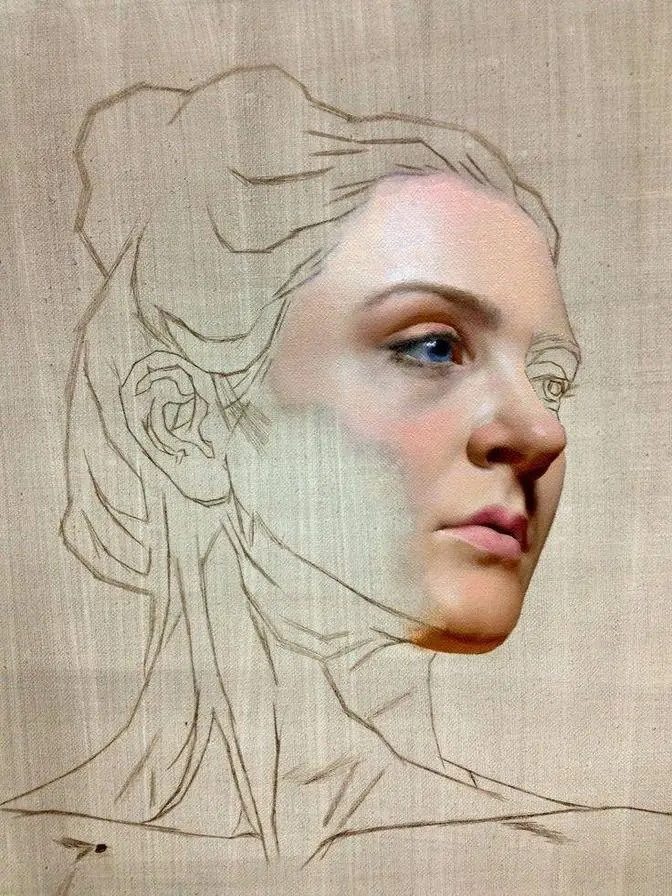
This painting was actually supposed to start with the charcoal transfer.
But as you can see, in the end I decided to start the painting by
sketching the subject with the brush.
Charcoal transfers tend to look angular and stiff.
They sometimes even seem lifeless.
So I wasn't feeling it for this painting.
What I did is, I started over and this time with a paintbrush.
Drawing with a brush has a very different quality to it.
And in this case, right from the beginning,
it gives the painting the kind of dreaminess and softness that it needs.
At this point, I have to mention that when it comes to painting,
I can be quite uncompromising.
I will do whatever it takes to create a piece of art.
And often, despite or rather against my own biases and preferences,
I will do whatever the painting needs and what's best for it.
Do I like to redraw or repaint a painting several times?
No, but I will do it.
And I will paint one and the same painting 10 times
if I feel that's what it takes to create a particular piece of art.
The fact that I'm always letting the painting inspire how I paint
often leads to my paintings having different degrees of realism and a different finish.
Of course, my galleries would love it if I was more consistent with that.
But what I care about the most is what's best for the painting.
And hey, life's too short to always paint the same way.
Okay, back to the painting.
Next, I'm putting down the darkest areas of the most central parts of the face.
This is where the main focus will be.
After that, I'm painting the hair and the remaining dark areas under the jawline.
And with the darkest areas out of the way,
I continue to paint the half tones of the face.
But I try not to spend too much time at this stage.
Basically, what I'm trying to do is cover the face as fast as I can
so that I can start modeling it.
Painting a face is not unlike modeling with clay.
You mold and push material around until you're happy with it.
But to start modeling, you need some material first.
And in our case, that's the paint.
The last thing that's left to do to establish the overall feeling of the painting
is to put in the background.
And with that done, this is where the real painting process begins.
Up until now, I just filled out areas of the painting with paints
so that I have a foundation to work with.
But now I'm starting to juxtapose realism and abstraction.
And that while constantly going back and forth between the two.
I go back to where I started and I rework some areas to push the realism
while leaving or accentuating the abstractions and others.
It's important to note that at this point,
I don't have an image in my mind that I'm working towards.
I also don't have any expectations either.
What I'm doing is letting each decision I make inform the next one.
Yes, I have a certain way of painting and also a certain philosophy.
But after a certain point in the painting,
the whole process of creating a piece of art becomes like a journey.
One without a destination to be precise.
And that's really how it should be.
You should have surprises along the way and setbacks.
Yes, I could tell you what to do every step of the way.
But that wouldn't make for a very interesting journey, would it?
If anything, I would like to inspire you to not be so biased and target driven.
At the end of the day, we are painting in order to create something.
And in my case, as a professional artist, I'm not even painting for myself.
Most of the time, I'm creating something for other people.
So it's all the more important that the process is at least exciting.
I mean, where's the excitement if you already know where you're going
and what you're exactly going to see and experience along the way?
To me, there's nothing more boring than starting in one corner of the painting
and ending in another and then calling the painting down.
It's just as exciting as a hiking tour in your own garden.
Painting should be an experience, a journey, and not something you just execute.
Now, you might be thinking, that's all well and good,
but how do I know when the painting is finished then?
Well, luckily, that's actually quite easy.
You just go outside and you let yourself drift.
And you do that until you find yourself at a place you want to stay.
Metaphorically speaking, of course.
But with that being said, guys, we're gonna bring this video to an end.
Thanks for watching.
Please hit like.
Hit subscribe if you're not already a subscriber.
And yeah, have a good one.