
The Secrets of Einstein's Brain
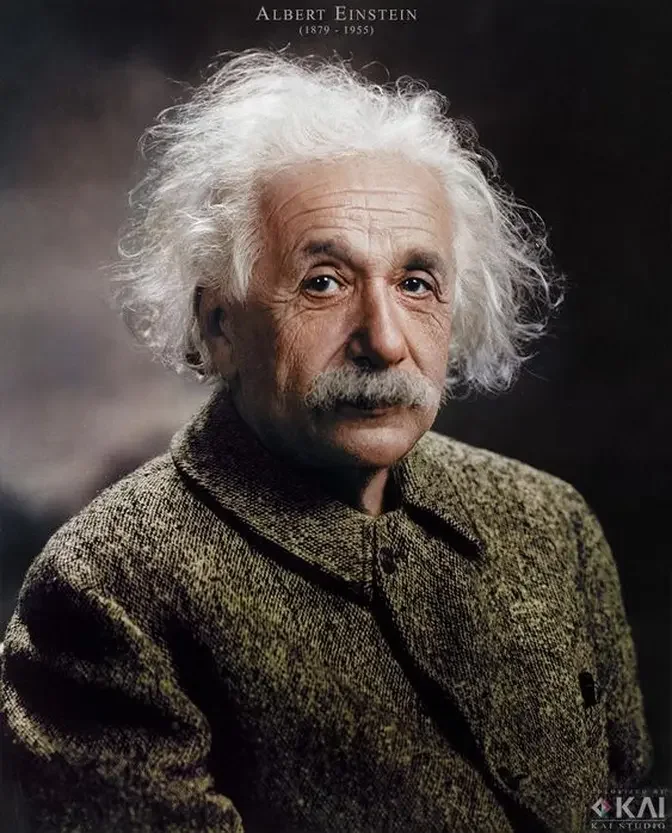
Albert Einstein may have been the world's greatest genius, but what made him so smart?
Tonight, CBS4's Dr. Sean Kniff shows us the bizarre story of what happened to Einstein's brain after he died
in the scientific effort to unravel the secrets of Einstein's brain.
Albert Einstein was a late bloomer. He didn't talk until he was nearly three.
He later joked he put off talking until he could speak in full sentences.
His love affair with numbers began at age 12, and he was doing higher mathematics at age 13.
But his high school diploma showed he was a fair, but unremarkable student.
In 1905, Albert was 26 years old, working as a patent examiner and dabbling in theoretical physics on the side.
That's when he had what he called the happiest thought of his life.
By combining the equations for momentum, time, distance, and mass, much of the universe could be explained by this formula.
It's better known today as the theory of relativity.
It followed from the special theory of relativity that mass and energy are both outward different manifestations of the same thing.
A somewhat unfamiliar conception for the average mind.
It was a Nobel Prize winning thought.
Albert Einstein fled Nazi Germany in 1933 and settled in Princeton, New Jersey,
a sleepy northeastern town that promised the father of the Big Bang and the atomic bomb would have a quieter life.
It was here in 1955 that Albert Einstein died at the age of 76.
The man called upon to perform the autopsy, an unknown pathologist,
who, after opening up Einstein's skull, reached in and removed perhaps the greatest mind of modern times.
That man was Dr. Thomas Harvey. Now 91, he recalls the autopsy in vivid detail.
He had this tremendous aneurysm of his aorta, which had ruptured, and he had an abdomen full of blood.
Einstein had bled to death. That was obvious.
What the world wanted to know was what had made his brain so different, and that, at first, wasn't obvious at all.
I was looking to see if there was any gross, unusual feature, but I didn't see any.
Even under the microscope, Einstein's brain appeared average.
In fact, it was a bit smaller than average, having shrunk with age.
How could such remarkable thoughts come from such an unremarkable brain?
Scientists today are still mystified.
Dr. John Abrams is a neurosurgeon at the Albert Einstein College of Medicine.
It's just hard to believe that his brain would be similar from the layperson.
Convinced time would be able to find something extraordinary, Dr. Harvey took special care of the brain.
He took more than 100 photos from different angles, preserved it by injecting its arteries with formaldehyde,
and then dissected it carefully into 240 pieces.
This brain was one of the greatest in the world, so it deserved special treatment.
Special treatment, indeed.
Dr. Harvey, a man as curious as the brain under his care,
then placed the parts in two large mason jars filled with formaldehyde and took them on a cross-country road trip.
From New Jersey to Missouri to Kansas and back, despite pressure from the scientific community and the media,
he carried the brain from place to place for decades in the trunk of his Buick Skylark.
But the result was, no formal study was performed on Einstein's brain for nearly 30 years,
until one day, on a whim, Dr. Marion Diamond, a neuroscientist at the University of California at Berkeley,
decided she'd ask for some of the pieces.
Long story short, three years later, in a little mayonnaise jar with fluid in it to preserve the tissues,
there were four sugar cube-sized pieces of Einstein's brain.
Dr. Diamond had studied brains for years.
She noticed that smarter brains didn't have any more neurons than average brains,
but they did have more glial cells, brain cells that supply nutrients to neurons and help them conduct impulses faster.
So we were using the data that we had accumulated over the years on experimental work
to hypothesize that Einstein might have more glial cells than the average male.
And she was right. Einstein did indeed have more of these support cells than the average male.
Not coincidentally, the difference was most significant in his left inferior parietal lobe,
an area involved in mathematical and visual-spatial reasoning.
So she decided that certain parts of his brain were more active than the others.
He had more glial cells to help his nerve cells processing.
And after studying Harvey's photos more carefully, other scientists noted
Einstein's parietal lobes on both sides were 15 percent wider than normal,
and the left one was huge and misshapen.
But hold on. Studies have shown when it comes to brains, size doesn't really matter.
And although the evidence about the glial cells is enticing, Dr. Abrams says
intelligence, especially one like Einstein's, is a bit more complicated.
It's also hard to pick out a particular portion of the brain and say that
just because he had more glial cells that it would make you smarter.
But one thing all scientists can agree on, Einstein was able to think like few other human beings ever have.
His theories gave birth to nuclear energy and may one day allow us to travel back in time
and shake the very hand of the man who made it possible.
And although he was intensely private, Einstein chose to share his gift,
a gift that will undoubtedly outlast us all, a gift that Dr. Harvey suspects he was probably born with.
I don't think that we can become an Albert Einstein by working at it.
I think that it's a matter of how we're constructed at birth.
It may seem ironic that the man who was larger than life in this town is relatively obscure in death.
You won't find any Albert Einstein museum, even a monument.
You won't even find a tombstone.
That's how Albert Einstein wanted it. That's how this town plans to keep it.
From Princeton, New Jersey, Dr. Sean Kinev, CBS 4 News.