
did you know there are 1,456 traditional crafts in Japan? (CRAFT CHRONICLES EP.00~10)
There are 1,456 traditional crafts in Japan
and I'll be sharing each and every one of them.
I'm Hana, founder of Oto, helping global brands
find the perfect Japanese traditional supplier.
And get this, in just 47 prefectures,
there are 243 country-registered Japanese traditional crafts
and 1,213 prefecture-registered crafts,
a.k.a. 1,456 traditional crafts in total.
Math is math, I guess.
And each craft has its own unique story
rooted in centuries of traditional history,
From the simple tools used by artisans
to the deep cultural connection they have
within their communities,
these crafts truly represent what Japan is.
But every year, small suppliers
making these crafts are closing.
So throughout this series,
I'm going to be sharing, one by one,
all the crafts from the North all the way to the South,
uncovering stories behind each craft to raise awareness
and help these crafts survive to the next generation.
So buckle up, people,
because we're about to embark on a journey
through Japan together.
See you on episode 1.
Nibutani-attushi is a unique textile
deeply rooted in the traditions of Ainu people
or the indigenous people in Hokkaido.
The name Nibutani comes from the Ainu word nibutai,
meaning a place with dense forests,
where the material of this craft lives.
This textile is made out of the inner bark of the trees,
like ohyo,
and the process of making the textile itself
is incredibly historic and intricate.
So here's how they make it.
First, the bark is carefully stripped
and then boiled with wood ash,
then softened,
and then spun into making the actual threads.
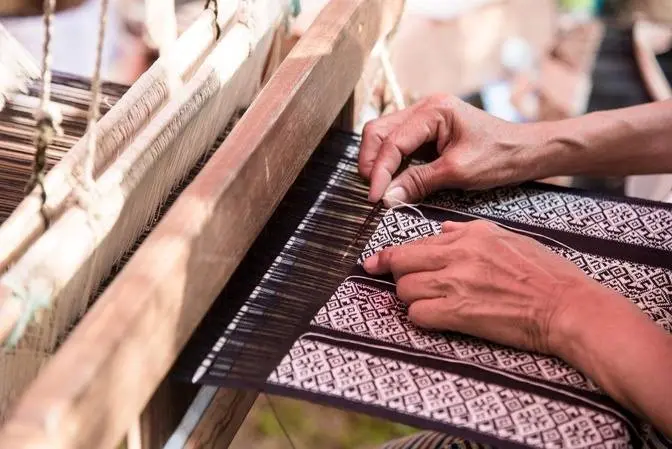
These threads are woven on this traditional Ainu loom,
creating a fabric that is lightweight,
breathable,
water-resistant,
and durable.
Attushi was originally crafted for Ainu people's everyday wear,
later gained recognition for their functionality and beauty,
and became a very sought-after item
during the Edo period,
used by fishermen,
sailors,
and even in kabuki costumes.
And fast forward to today,
in 2013,
this craft was designated as a dento kogehin,
and the Nibutani Craft Cooperative
keeps this tradition alive,
ensuring that Ainu culture and craftsmanship
continues to live in the 21st century and more.
Back in the Edo period,
goldfish like tsugaru nishiki
were a hot and exclusive item
only owned by the It family,
aka the samurai families.
But farmers really admired its beauty,
so they crafted their own version of the goldfish,
goldfish lanterns,
from bamboo and washi paper
so that them and their family were able to enjoy.
And that was the start of kingyo-neputa.
Each kingyo-neputa starts with a delicate frame,
with artisans carefully bending bamboo
into flawless curves
to create its goldfish frame.
The washi paper is then meticulously measured,
cut,
and stretched over the frames,
and brought to life with vivid hand-painted designs
bursting with bold colors
that symbolize joy,
festivity,
and good fortune.
A touch of wax is added to create a unique glow,
refracting light for an ethereal, luminous effect
when the light is placed inside.
And these lanterns became a staple
of the Hirosaki Neputa Matsuri,
celebrated since 1722.
And today, these kingyo-neputa
are carried by children throughout the streets,
or hung outside shops,
a summer tradition,
and even featured on a one-of-a-kind train ride
through Aomori's rich heritage.
Hidehiranuri is a breathtaking lacquerware
with over 800 years of history
dating back to Japan's Heian period.
It's named after Fujiwara no Hidehira,
the ruler of Hiraizumi's Golden Age,
a time when a 70-year gold rush,
combined with flourishing Buddhist culture,
sparked an artistic wave
that used gold to symbolize heaven.
What makes Hidehira lacquerware so unique
is the use of gold leaf
to create stunning patterns
like genji clouds and diamond motifs.
So, how is it made?
The production of Hidehira lacquerware
starts from the extraction of lacquer itself.
Lacquer is a type of sap
secreted by the trees
in order to heal their wounds.
So, cuts are made on lacquer trees
and collected between June and October.
And with this lacquer that they collected,
Hidehiranuri artisans
use wood from trees like zelkova
or horse chestnut
that is dried up to 10 years
to prevent cracking.
Then, the wood is shaved,
sanded,
and sealed with raw lacquer
to strengthen and prevent it
from absorbing any moisture.
Next comes the three stages of lacquering itself.
Undercoat, middle, and final.
With each layer dried carefully
in a humidity-controlled box,
the final coat has to be flawless
because it's not going to be polished.
And for the piece de resistance,
comes the gold leaf.
The patterns are carefully applied
entirely by hand
using washi and brush.
And thanks to Iwate's artisans,
Hidehiranuri continues to shine
as a dento kogehin.
And now we see it evolve.
Its luxurious techniques
are being applied to modern creations
like glassware.
And we finally start to see
tradition meets innovation.
1945, Japan signed a very important document,
the surrender that marked the end of World War II.
And this document was printed on shiroi shibashi.
One official famously said,
they say washi paper lasts for a thousand years,
so let this tree last a thousand years as well.
Unlike ordinary paper that is made out of wood chips,
washi is crafted from tree bark
that has long interlocking fibers.
And this unique structure
makes washi so durable
that it is said to last over a thousand years.
And out of all the washi papers,
shiroi shibashi from Miyagi Prefecture stands out.
Its legacy is dated back to the Edo period
when Lord Masamune
encouraged the cultivation of kozo trees,
a key material used for washi.
This initiative led to shiroi shi
being a renowned hub for washi production
for its exceptionally high quality and high output
that it was often presented to the shogunate
and the imperial palace,
becoming the go-to choice for official documents.
And shiroi shi washi isn't just strong,
but it's very versatile.
It can be stripped into smaller pieces
and weaved into a fabric called kamifu.
And if you pair it with a paste
made out of konjac powder
and apply it to the washi paper itself,
it strengthens even further to create shiroi shi kamiko,
which allows it to be dyed and printed
for everyday items like wallets
or book covers or even full-size bags.
And once this strengthened paper is kneaded and softened,
it becomes a beautiful white fabric
with insulating properties
that is perfect for the cold regions of Tohoku.
And this technique caught the attention of
fashion designer Issey Miyake
creating a range of collections
inspired by this beautiful technique.
Unfortunately, there aren't any artisans
actually making shiroi shi washi
like it was used to be made.
But the good news is,
shiroi shi kamiko actually remains
with two workshops in shiroi shi
that still produces small accessories
We all know and love sakura or cherry blossoms, don't we?
A staple in Japanese springtime.
While our eyes are drawn to the beautiful pink flowers,
the people of Akita had a different perspective.
Kabozaiku is the art of crafting
using the bark of mountain cherry trees,
creating beautiful earthy and natural designs.
This bark categorized into 12 unique designs
which can be polished or unpolished,
and each strip showcasing its
distinctive patterns and qualities.
The true test of craftsmanship
lies in how these barks are applied onto the materials.
First, the bark is steeped with animal glue,
then carefully fixed to its place
using a hot metal rod.
Too little pressure and it won't stick,
leaving a bumpy surface,
and too much pressure and the bark will burn.
Precision is everything with this craft.
This precision is utilized most in crafts
that you need to be precise,
like traditional tea tins used for tea ceremonies.
The cherry bark itself also has
natural moisture-resistant properties
that ensures the tea stays fresh.
And of course, the tea tins aren't the only place
that this technique shines.
Plates, tables, accessories,
and more recently, phone cases.
In everything that the cherry bark transforms into,
it adds a gorgeous, natural design and warmth
that you can only get from kabazaiku.
Imagine having a little piece of Akita's mountains
right into your everyday life.
I love that these crafts connect
everyone around the world
with a little piece of Akita's nature.
Oita Matsumugi is this incredible textile tradition
hailing from Yamagata Prefecture.
The origins of this craft
traces back to the Edo period,
when this visionary feudal lord, Uesugi Ozan,
championed silk production
and invited all these master artisans
from outside of Yamagata
to refine the local weaving techniques.
What sets Oita Matsumugi apart
is that all of its designs
are created using pre-dyed threads,
a technique that ensures
intricate patterns that are
directly woven into the fabric,
rather than being added afterwards.
This method is complemented
by using hiraori,
meaning plain weaving,
which gives the textiles
a smooth, lightweight structure.
Over time, this craft evolved into
three subcategories
based on each region,
Yonezawa, Nagai, and Shirataka,
each developing its own distinctive methods
while contributing to the broader identity
of Oita Matsumugi.
So starting with the southern region,
Yonezawa-ori highlights the beauty of natural dyes,
particularly the safflower
cultivating around this region,
that creates the soft, delicate color tones.
Over the years, its weaving techniques
have evolved to suit modern styles
and functionality,
creating textiles that seamlessly blend in
heritage and contemporary fashion.
Moving slightly north,
Nagai-tsumugi is famously known
for its intricate use of the katsuri technique,
where each of the threads are pre-dyed
to form precise patterns of weaving.
The standout feature here
is the yokokatsuri method
that require meticulous alignment
of the dyed threads,
a hallmark of Nagai craftsmanship.
And at the northernmost point,
we have the rarest of them all,
Shirataka-tsumugi,
produced by just two workshops.
It features the incredible
itajime katsuri technique,
where threads are pressed between wooden planks
that have carvings in them,
only allowing specific sections to absorb dye.
The weaving process is just so intricate,
even the most skilled artisans
can only produce
around 30 centimeters of fabric each day.
And in 1976,
these textiles and their techniques
from these three regions
have come together
under the name Oita-matsumugi
and was designated
as one of Japan's
nationally recognized
traditional craft products.
Collectively,
Oita-matsumugi
represents a perfect harmony
of history, artistry, and skill,
standing as a vibrant testament
to Yamagata's rich textile heritage.
Akabeko is one of Japan's
most cherished traditional crafts,
easily recognized by its bright red body
and a bobbing head.
But it's actually more than just a cute souvenir.
Akabeko has a story of resilience and protection
that goes back 1,200 years.
So here's the legend.
Back in the 9th century,
during the construction of Enzoji Temple in Aizu,
a red cow appeared out of nowhere
and carried heavy materials to the site.
While other cows couldn't handle the job,
this red cow kept going until the work was done.
Its determination made it a symbol of
strength, health, and good fortune.
Artisans began creating Akabeko
using hariko,
a paper mache technique
brought from Kyoto
to honor this incredible legend.
Crafting an Akabeko starts with
wooden molds to shape the body.
Strips of wet washi paper
are carefully layered on
with glue applied to form
a lightweight yet sturdy structure.
After drying, the molds are removed
and the figure gets a fresh
coat of vibrant red paint
with bold black pattern.
Finally, the head is attached separately
to give it that iconic bobbing motion.
Each Akabeko is so unique,
with different artisans
putting their own artistic spin on it.
These Akabeko will be passed down through generations
as a talisman to households
believed to fight off illness.
So fast forward to today,
Akabeko is still going strong.
During the pandemic,
its sales skyrocketed,
five times higher than before COVID,
as people turned to this trusty red towel
to protect their homes from illnesses.
So whether you pick one up as a souvenir
or keep it in your home as good luck,
Akabeko is proof that some stories and traditions
never go out of style.
In a small town of Makabe
in Ibaraki Prefecture
lies a 500-year-old tradition
that has lit the path of shrines, temples,
and gardens across Japan.
Makabe-shidoro or stone lantern
made out of makabe-shi,
a type of granite respected for its
durability and elegance.
The story of makabe-shi started in the late Muromachi period
with artisans creating stone artifacts
like five-ring pagodas and ancient monuments.
The granite from this area is known for its fine grain,
which allows for precise carving
and exceptional durability,
perfect for structures designed to withstand the elements.
By the Edo period,
stone lanterns became insanely popular
with shrines and temples
and its techniques refined over time.
Master craftsman Kubota Kichibe
formalized the traditional methods of
creating stone lanterns in the late Edo period,
techniques that continue to be practiced to this day,
and give makabe-shidoro
its distinctive handmade charm.
Using only chisels and hammers,
artisans craft each lantern entirely by hand,
employing 18 traditional techniques
to complete the entire process.
The result?
A warm, almost soft roundness in every lantern,
far from the cold mechanical sharpness
you might expect from granite.
Each curve, groove, and surface feels alive,
carrying the spirit of the craftspeople that made it.
Kubota often places lanterns deliberately
to allow the moss to grow over time,
enhancing its connection to the surrounding landscape
and deepening its natural beauty.
Whether placed in a serene Japanese garden
or an urban space,
these stone lanterns invite this moment of calm,
a subtle reminder of the wabi-sabi nature
we tend to forget in a fast lifestyle.
Nikko-buri traces its roots back to the grand Edo period,
when the construction of the Nikko Toshogu Shrine,
which is now a UNESCO World Heritage Site,
brought together some of the greatest craftspeople
around Japan.
And during their free time,
what they did was they carved a wooden item as a hobby,
which gave birth to the craft
that what we know now as Nikko-buri.
What sets Nikko-buri apart
is the use of this unique carving tool,
called the hikkaki,
which has this distinct bent tip.
This tool allows the carver to pull instead of push,
creating deep, powerful, yet really elegant lines.
Once the artisans sketch their design onto the wood,
they begin carving with the hikkaki knife,
making precise cuts that bring the patterns to life
and elevate the motifs.
And once the carving is complete,
the wood undergoes Nikko-tsuishu,
a distinct lacquer technique
that involves layering coats of red lacquer
and carbon powder,
which, when polished,
reveals this vibrant red and black contrast.
This finish gives Nikko-buri
their characteristic elegance and durability.
The patterns often include motifs inspired by nature,
like peonies, or sunblossom, or sakura.
Today, Nikko-buri is used to create this wide range of items,
from tea trays, to decorative plates,
to furniture, mirrors, and other everyday items.
Each piece carries a mastery of hand-carved craftsmanship,
making it much more than just a practical item.
It's a work of art.
Once upon a time,
a humble janitor working at the royal palace,
only known by the name of his birthplace, Yamada,
now known as Kiryu,
fell in love with a noblewoman
called Princess Shirataki.
In the beginning,
Princess Shirataki kept her distance with Yamada
due to their different statuses.
But one day,
Princess mocked Yamada
with a poem saying that
there's no way he'll get her.
But she was surprised
when she got a response from him
with a romantic poem
that showcased his intelligence to the princess,
even to the emperor.
Enchanted by his wit and devotion,
she decided to marry him
and followed him back to Yamada,
sharing her expertise in silken weaving.
This was 1,300 years ago.
And over time,
this area became
the eastern capital of textiles in Japan.
The textile known as kiryori
grew in fame
and even served as war banners
during the Sekigahara campaign in the 1600s.
It has mastered seven different
intricate weaving techniques
and embraced innovations like
the jaggered looms during the Meiji period
that allow mass production
of all the intricate designs
and computer simulation for textile designs
to stay ahead and keep up with the trends.
While artisans continue to craft traditional fabrics,
kiryori has also found new life
through haute couture collaboration.
With global exhibitions
that truly showcases brilliance,
kiryori truly became one of the most
versatile and diverse
textile manufacturer centers in Japan.
And this was Craft Chronicles,
and follow for more.