
How to Play Chess
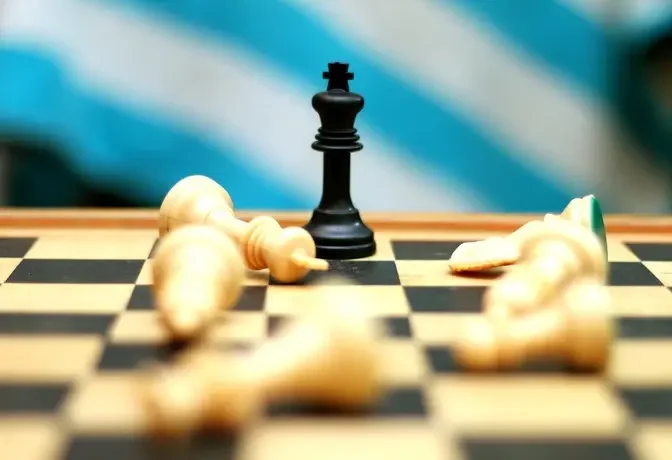
Chess, how to play.
The object of the game is to checkmate the other king.
Checkmate happens when the king is in a position to be captured, it's in check, and cannot
escape from the capture.
At the beginning of the game, the chessboard is laid out so that each player is sitting
across from the other, and has the white or lighter colored square in the bottom right
hand side.
The chess pieces are then arranged the same way each time.
The second row is filled with pawns.
The first row should be set up as following, going from left to right.
Rook, Knight, Bishop, King, Queen, Bishop, Knight, Rook.
You've set it up correctly if your queen is on the same colored square as the color of
the piece.
The player with the white pieces always moves first.
A turn consists of moving one piece one time.
Players alternate turns until the end of the game.
Spaces may not be shared by pieces.
Pieces cannot move through or over any other piece.
Opponents pieces can be captured by correctly moving your piece to the square of the opponents
piece.
When a piece is captured, it is eliminated and removed from the board.
Each of the six different kinds of pieces has a unique way of moving.
Pawns move one square forward, towards your opponents side of the board, at a time, unless
it is the first time it is moved during the game, in which case it may be moved up to
two squares forward.
Pawns can only capture pieces one square diagonal in front of them and cannot capture pieces
directly in front of them, but instead are unable to move forward.
If a pawn reaches the other side of the board, it can be changed into any other type of piece.
This is called a promotion.
Rooks can move any number of squares side to side or back and forth.
Rooks cannot move diagonally.
Rooks cannot jump pieces, but instead capture the first enemy piece they move into.
Knights move in the shape of an L, moving two squares in one direction, except diagonal,
and then one more square at a 90 degree angle.
The knight jumps over any piece in the way, capturing any opponent piece in its final
move position.
Bishops can move any number of squares diagonally.
They capture the first enemy piece they move into.
The queen can move any number of spaces in any direction.
The queen captures the first enemy piece she moves into.
The king can move one square at a time in any direction.
The king can never move himself into check.
Whenever a move directly results in the opponent's king being threatened, meaning if an action
is not taken the next turn the king would be captured, the attacking player must say
check.
The opponent must then use their turn to protect the king by either moving the king out of
check, moving a different piece to block the path of the attacker, or by capturing
the piece that threatens the king.
If a move directly results in the opponent's king being threatened, and there is no move
to protect the king, the attacking player then declares checkmate.
The game is over and he wins.
A draw, or stalemate, occurs when the king is not in check and the player cannot legally
move any of his pieces, or if there is any other situation where there is an impossibility
of checkmate.
There are a couple other types of unique moves.
The first is called castling.
On a player's turn, he may move his king two squares over to one side, and then move the
rook from that side's corner to right next to the king on the opposite side.
However, in order to castle, the following conditions must be met.
It must be the king's very first move, it must be that rook's very first move, there
cannot be any pieces in between the king and the rook, and the king may not be in check
nor pass through check.
The second is called en passant.
If a pawn moves out two squares on its first move, and by doing so lands on the side of
an opponent's pawn, effectively jumping past the other pawn's ability to capture it, that
other pawn has the option of capturing the first pawn as it passes by, but must do so
by the very next turn, otherwise it loses the opportunity.
To capture it, the pawn must move diagonally to the square directly behind the other pawn.
The first player to checkmate their opponent wins.