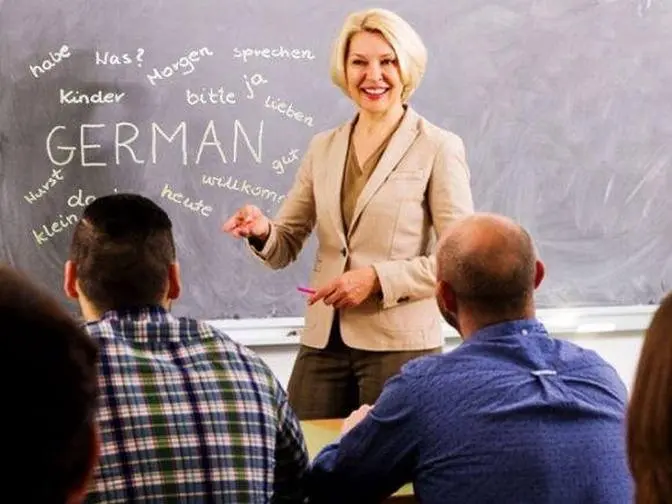
Übersetzen macht dein Deutsch langsamer? JA! In diesem Video erfährst du, warum Übersetzungen dir beim Deutschlernen oft mehr schaden als helfen – und wie du stattdessen schneller, natürlicher und erfolgreicher lernst.
🎯 Du lernst heute:
Warum Übersetzen dein Sprachdenken blockiert Was dein Gehirn wirklich braucht, um Deutsch zu lernen Wie du dir echtes Sprachgefühl aufbaust – ganz ohne Wörterbuch Warum Redewendungen, Chunks & echte Kontexte entscheidend sind Wie du Deutsch lernst, ohne jedes Wort zu verstehen
💥 Theresa zeigt dir mit viel Erfahrung und Klartext, warum Deutschlernen ohne Übersetzungen der Schlüssel ist – vom A1-Kurs bis zum B2+ Erfolg!
🔔 Vergiss nicht, unseren Kanal zu abonnieren und die Glocke zu aktivieren, um keine weiteren Tipps zum Deutschlernen zu verpassen! Viel Spaß beim Deutschlernen – ganz ohne Übersetzung! 🧩
Hello and welcome to a new video.
We often get comments under our videos like
Can you please translate all words and examples into English?
Or why don't you just explain everything in English?
That would be much easier.
And maybe you've already asked yourself this question.
And today we're talking about exactly that.
Why it doesn't help you when you translate everything when you learn German.
And why it's even a disadvantage for you.
At the end of the video you'll understand exactly
why we don't explain our content in English,
why that's a huge advantage for you,
and why learning German without translation
is often the faster, easier and more successful way.
If you're new here, I'm Teresa, German native speaker,
trained teacher and I've been teaching German as a foreign language for over 10 years.
With passion, with heart and without translation.
Point 1. Translations block real language thinking.
Many of our students say,
I need so long to formulate a sentence in German.
I always think of the sentence in English or your native language
and translate it.
That may sound logical, but it's really a big problem.
If you always think like that in your native language
and try to translate the words piece by piece.
But language doesn't work like math, like mathematics.
You can't just translate words like building blocks one by one.
So if you always translate,
you'll never really speak German spontaneously.
You'll just get stuck in your head,
in your native language and in the translation.
But our goal is that you should be able to think and feel directly in German.
And for that, it's important that you move in German from the beginning.
And even if you don't understand everything,
that's completely normal and it shouldn't be your claim.
And believe us, we've been doing this for a long time in our courses.
From second one, even at A1 level.
Only German, no English, no Spanish, no Arabic.
I don't speak Arabic.
And yet, or just because of that,
our participants in our courses have achieved super good results.
Point two, language doesn't work word for word.
Do you know the sentence, I'll give you a thumbs up?
That's German.
But how do you want to translate that?
I press you the thumb?
That doesn't make any sense, does it?
That's exactly the problem.
Many expressions in a language have their own meaning.
So that's especially the case with sentences or fixed phrases.
And the German language is full of such phrases.
If you try to translate something like that,
you usually don't understand what's really meant.
But if you learn German as German,
so not translated, but just recognize the meaning in context,
then you learn much faster how the language really works.
And that brings us to the next important point.
Point three, learning in context is much more effective.
Just because you know a word and its translation,
doesn't mean you can use it correctly.
An example.
You know the word,
to postpone.
You know, that means in English, to postpone.
But when do you say that?
How do you use it in a sentence?
With which preposition?
With which case does this verb come from?
How does the past participle sound?
Point two.
So you see, words alone don't work.
You have to know how and when you use them in real life.
That's why we always say in our courses,
ask yourself, in which everyday situation would I use this word?
And then make your own example sentences.
Not an example sentence from a book, from a textbook,
but your own sentence.
Because if you use the word in a real situation yourself,
you learn your brain much faster and better.
So, for example, we have to postpone the appointment.
The lesson is postponed to next week.
Did you know that the past participle is postponed?
Or an example from everyday life.
Think about cooking.
You can read a hundred cookbooks.
Watch hundreds of YouTube cooking videos.
But you only learn to cook
if you take the spoon in your hand and try it yourself.
And that's exactly how it is with learning German.
Point four.
Your brain loves patterns.
Our brain loves to recognize patterns.
And that's exactly what helps you learn languages.
That's why we always say language is like music.
You don't learn German word for word,
but like a song you've heard a lot.
When you hear a song a hundred times,
you can suddenly sing along.
You know the text, even if you never consciously learned it.
And that's exactly how learning German works
with the so-called chunks, with these components.
As I said, these are small language components
that you automatically keep in mind.
So, for example, something like,
How are you?
I have no idea.
Or can you please help me?
If you hear and use these phrases often,
they become your earworm.
You don't have to think anymore
whether the verb is in the dative or accusative form
or with which preposition it comes
or also in which position the verb or preposition is.
You just speak.
In our chunks series here on YouTube,
you can find some of these expressions,
so be sure to take a look at our playlist.
Point number five.
You need real, unfiltered German.
Many learners only hear simple or artificial sentences
from the textbook,
but that's how a person in Germany sounds.
If you really want to speak,
then you also have to hear real, authentic German
and with natural intonation,
with real words, with everyday language.
That's why we also created our course
Fit in Real German,
in which we show you exactly this real German.
And yes, at first you may not understand everything,
but that's exactly the point.
Because your brain learns with every repetition.
It recognizes structures.
It also develops a sense of language.
And you don't get this sense of language
through translations,
but only through real and authentic German,
as with us in our courses.
Point six.
Difficulty is good for the brain.
Many think, I don't understand that.
That's too difficult.
Yes, I need a translation.
But that's a mistake.
Because just this little feeling of uncertainty,
this moment when you don't understand everything immediately,
is extremely valuable.
In learning psychology,
this is called productive difficulty.
You learn better when your brain has to work a little.
Of course not too much, but also not too little.
If you get everything served on the silver platter,
with translations and with all explanations and so on,
then you stay passive.
But if you dare to make mistakes,
if you dare to discover yourself,
then you really learn.
And language self-confidence does not arise through translations.
It arises when you realize,
I understood that myself.
I can say that myself.
And that's exactly our goal.
So that was our video on the topic
why learning without translations improves.
I hope you had a few aha moments today.
Because remember,
your goal is not to understand every single word,
but to feel the language,
to use it and to think independently.
And now it's your turn.
Feel free to write us in the comments
if you have learned a lot with translations before
or still currently.
And yes, how that works for you.
And if you liked this video,
then feel free to click on the like,
give us a thumbs up
and also subscribe to the channel
so you don't miss a video.
So then, see you next time.