0:00 Introduction 01:23 Abbreviations and Simplifications 02:34 Influence of colloquial language 03:56 Youth language 05:28 Strong influence of Anglicisms 06:40 Language in social media 07:48 Gendering 09:25 Cultural diversity 10:33 New Words 11:43 Increasing Tolerance for Mistakes 13:08 Farewell
Hello and welcome back to my channel.
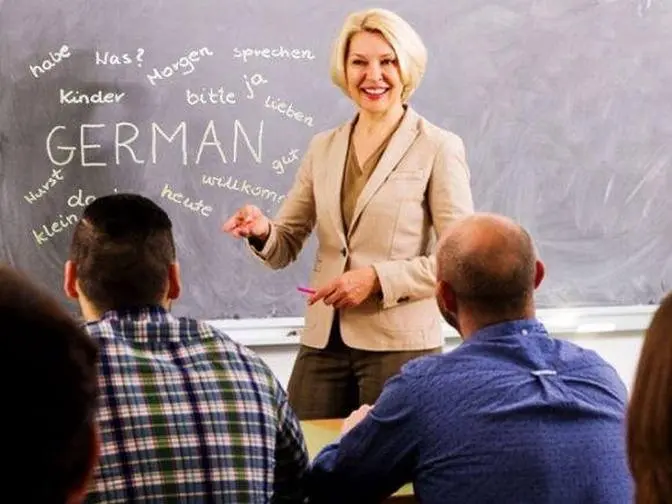
My name is Maria, I am a German teacher and your language coach.
German is no longer what it used to be.
In recent years, the language has changed a lot and it still does.
But what exactly is happening there?
Today we'll take a look together at how the German language has changed.
Today we'll learn the real German.
That's the German that is really spoken in Germany.
Are you already excited? Then let's go!
In this video you will get a lot of important information from me.
You probably already have a piece of paper and a pen prepared.
But you don't have to.
I have put together a PDF for you,
which you can download for free.
Click on the first link below this video.
Enter your name and email address and download it.
And now let's get started. You'll like it.
We'll start with the first point.
Often you shorten words and sentences and simplify the structures.
It used to be quite normal to say
I would like a cup of coffee, please.
I haven't seen it.
Today, often enough, a coffee, please.
I haven't seen it.
In spoken German, it is often shortened.
Syllables disappear, endings disappear.
Even whole words can be swallowed.
Long sentences are considered impractical.
Sentences become shorter, there are fewer subordinate clauses.
We want to communicate quickly, without talking about the hot stuff for a long time.
Talking about the hot stuff means not talking about something directly or hesitating.
So it's more about saying it simply and quickly.
What used to be considered impolite is now quite normal and everyday.
Do you have any other examples of such abbreviations in everyday life?
Feel free to write them in the comments.
I'm looking forward to it.
The colloquial language has an increasing influence on spoken German.
Wow, how chill the guy is!
I swear, that was too wild.
I'm not in the mood.
Does that sound like schoolbook German to you?
No, that's real spoken German.
Just like some people use it every day.
Of course, these examples are a bit exaggerated.
Überspitzt means exaggerated.
But in recent years, the colloquial language has increasingly mixed into our everyday language.
Words like cool, krass, mega are no longer only used by teenagers.
They appear in series, in social media posts, in advertising,
even in radio moderations and in conversations in the office.
In real life, that is.
The colloquial language sounds real, alive, and it is the language of everyday life.
If you want to understand real German, you also have to know the colloquial language.
In my German courses, by the way, you also learn many colloquial expressions.
There are currently A2, B1, B2 and C1.
I am very happy when you are there.
And best of all, write a colloquial expression that you use yourself in the comments.
I'm curious.
Perhaps even more exciting than the colloquial language is the youth language.
It is the language of an entire generation.
Youth language is creative, quick-witted, cheeky and usually totally incomprehensible for us adults.
Oh yes, quick-witted means something changes constantly and quickly loses relevance or meaning.
A son of Kian is just 13 years old and also uses words that I don't understand directly.
The terms often come from rap lyrics, from gaming, from TikTok or generally from social media.
So, here are a few current examples.
If you know what these words mean, please write me a comment.
I didn't know that.
NPC is someone who is passive or follows trends uncritically.
Riz describes charm or flirtability.
So someone has Riz.
Cringe.
Well, I already knew that.
That means embarrassing or embarrassing.
Aura.
Personal expression.
Sigma.
Someone who moves outside of the social norm.
Cool or independent.
Would you understand these words if you heard them on the street?
A little more information.
In Germany, youth words are chosen every year.
Do you actually know which youth words are on the list this year?
Well, go ahead, write them in the comments with explanations.
Today, after my first meeting, I have another Zoom call.
Then I like a few comments, download my bills, make video updates and film a bit of content for my new reel.
Wow, is that still German or is it already English?
Or Denglish?
In the German language, we are currently experiencing a strong influence of Anglicisms.
A very strong influence.
We update, swipe, post and google.
English words have nested everywhere in German these days.
To nest means to permanently settle down, settle down or stay.
Especially in the work world, in the areas of technology and on the Internet.
Some people don't like that.
Others find it very practical.
The fact is, anyone who wants to understand modern German must also be able to live and deal with Anglicisms.
Does it actually bother you when someone uses a lot of Anglicisms?
And how is it in your language?
Are many English terms used there too?
I would be very interested to know.
Does that sound familiar to you?
The language in social media is also part of the modern German language.
WhatsApp, TikTok, Instagram and Co. have a massive influence on how we write and even speak.
The online language is short, creative and changes quickly.
Emojis replace half or whole sentences and are internationally understandable.
Which article has the word emoji?
The, the or that?
Very good, the emoji.
Verbs like unfriend, facetime or swipe show that the digital world also creates its own grammar.
What used to be said only in chats or on TikTok is now part of our very normal language use.
The digital world also changes our language in the here and now.
In the here and now means in the present, in this moment.
Is there actually a word from the Internet that you say or write very often?
Then write it to us!
Dear teachers and teachers.
Dear teachers.
No, dear teachers.
With a little star.
Regardless of whether with a double dot, gender star or neutral formulation,
inclusive language is now part of modern everyday life.
The aim is to make all people visible with the appropriate language as much as possible.
Especially in official contexts, for example at universities, in the news or with authorities,
gender is now part of the standard.
Many people now use these forms of speech quite naturally in everyday life,
even in oral speech.
I absolutely understand why some find gender important.
German, however, is already very complex.
And especially for people who are just starting to learn the language, it is not really easy.
This topic polarizes in any case.
Polarizing means splitting through opposing opinions.
A topic that polarizes divides people into two opposite positions.
Some are for it, others are against it.
Are you actually for gendering or against it?
And how is it in your language?
Is there any gender at all?
Let's discuss in the comments.
Germany is multilingual and you can hear that.
Especially in cities you can sometimes perceive an interesting mix of languages.
Cultural diversity is an important feature of the modern language.
Many people speak, in addition to German, for example Turkish, Arabic, Russian, Polish, Romanian,
Greek, Serbian, Albanian and much more.
Have you ever heard something like this on the street?
For example, voila, I swear or honestly.
Voila, I didn't do it.
Is that maybe your mother tongue?
Please correct me if I pronounce something wrong.
Yalla, go or come.
Yalla, let's go.
These two words are now even in the doden.
Habibi, my darling.
All right, Habibi?
Do you know any other examples?
So German is no longer just what is in textbooks.
Many people in Germany are growing up multilingual and this is also reflected in the language.
Do you sometimes hear words from your mother tongue in German?
Which ones exactly?
If there is no word for something specific, you invent one.
It's that simple.
Word innovations are the next point.
Language change is also word change and sometimes really cool terms are created.
Many word innovations often sound a bit strange at first and then suddenly become completely normal.
The climate glue.
This is, for example, a climate activist who sticks to the streets.
Mostly meant degrading.
The angry citizen.
Someone who is loudly outraged by political decisions.
The leisure stress.
This happens when you have planned so many leisure activities that it gets too stressful again.
Who doesn't know that?
New words are created every year, for example through new technology, politics, different trends or simply because someone was creative.
The doden grows and the language becomes even more alive.
Do you maybe already have an idea for a new German word?
Which word is still missing in German?
Please make your suggestion in the comments.
The real and modern German is more relaxed and relaxed.
You also become more tolerant of mistakes.
It is becoming more and more common that a rule is still officially valid, but it is then simply ignored in everyday life.
For example, what is right here?
Because of the weather or because of the weather?
Today, in fact, most Germans simply say because of the weather.
And no one really bothers.
What used to be considered a mistake is often accepted today as a variant.
For me as a teacher and a fan of grammar, this is of course sometimes not so easy to cope with, because I love the genitive.
Verkraften means to endure, to endure, to cope with something.
I've even made a whole video on the subject of genitive.
Take a look at it if you also love the genitive.
Another example is the confusion of als and wie when comparing.
What is right?
I am taller than you or I am taller than you.
Of course the second sentence, but here too you hear the wrong version very often in everyday life, especially from native speakers.
Actually, we use wie when something is the same and als when two things are different.
Are there such phenomena also in your native language?
Feel free to tell us in the comments.
That's it for today.
Or should I rather say, okay, enough talk for today, you know, there is no more input today.
Enjoy the rest of the day, now you are up to date.
Always remember, language is changing and that is quite normal.
Some changes are practical, some creative, some are confusing.
But all show that language is alive.
By the way, remember the free pdf that you can download directly under the video.
There you will also find all the important information from this video.
If you have learned something new today, feel free to subscribe to my channel and give this video a thumbs up.
That way you'll always stay up to date.
Well, I'll see you again soon in my next video.
Take care, take care of yourself and see you next time.
Bye!
Do I actually have a frizz?