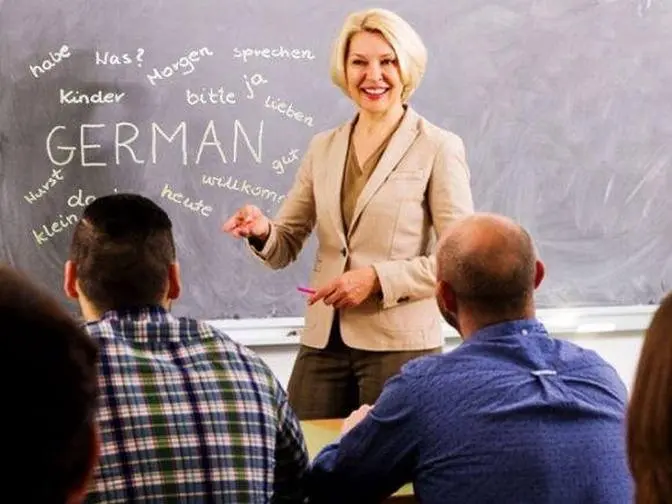
Step 1: Go to https://tinyurl.com/56pr6r9v Step 2: Sign up for a Free Lifetime Account - No money, No credit card required Step 3: Learn with the best online resources and quickly become conversational.
In this video you will learn everything you need to know about school culture in Germany.
If you are an absolute beginner German learner, this video is made for you. Our host express herself in simple German and English. This video will challenge your listening comprehension skills and help you progress in your German language study. This is THE place to start if you want to start learning German.
Also, please LIKE, SHARE and COMMENT on our videos! We really appreciate it. Thanks!
Wait! Before we start, do you want a bundle of 30 printable German PDF cheat sheets
teaching you words and phrases for conversations for free?
Then click the link in the description and sign up for a free lifetime account to get access.
Hello and welcome to a new episode of German with Stories.
Today you will hear the story of Lina, a German student.
We accompany her through her school life and get to know many German words
that describe the typical processes in a German school.
Make yourself comfortable and listen carefully.
Welcome to GermanPod101.com.
I am Elysia, your German teacher.
So now you can lean back and listen to the story.
This story is for intermediate learners with a B1 level.
Okay, also ich fange jetzt an, euch die Vokabeln zu erklären,
die wichtig sind, damit ihr die Geschichte versteht.
I will explain the vocabulary to you.
That will help you to understand this listening exercise.
So lasst uns mit der ersten Vokabel anfangen.
So how do you say student in German?
If it's a boy, you will say der Schüler.
If it's a girl, you will say die Schülerin.
Der Schüler, die Schülerin.
And how do you say teacher in German?
Teacher is der Lehrer.
Und ich, weil ich eine Frau bin, bin eure Lehrerin.
So to make it female, you add en.
Die Schülerin, die Lehrerin.
Die Lehrer geben den Schülern Hausaufgaben.
Teachers give their students homework.
Haus, home, Aufgaben ist Tasks.
So tasks you do at home are your homeworks.
Hausaufgaben.
Now a special word that can be useful is Arbeitsgesellschaft.
Or short, we will usually just say die AG.
So what is AG?
AG is usually when you have afternoon lessons.
According to your child's or your own interests.
So this could for example be Art AG or Biology AG or Theater AG.
Theater AG, Kunst AG oder Biologie AG.
So was euch interessiert.
Die Arbeitsgesellschaft AG.
To raise one's hand is sich melden.
Ich melde mich, um etwas zu sagen.
Sich melden.
Okay.
Dann the class ist die Klasse.
Or in German we would also say die Schulstufe, which means the grade.
Zum Beispiel siebte Klasse, achte Klasse, zehnte Klasse.
Your grade, Klasse.
Dann lesson, we are doing a lesson today, ist der Unterricht.
Jetzt machen wir Unterricht.
Und eine Schulstunde is the period of a lesson.
Eine Schulstunde hat meistens 45 Minuten.
Die nächste Vokabel ist das Gymnasium.
Gymnasium is the higher level of education.
In Germany you have three levels.
The lower level is Hauptschule.
The middle level is Realschule.
And the higher level is Gymnasium.
Okay, Gymnasium.
Then where you have your lunch is in der Schulmensa.
Schulmensa is the school cafeteria.
Schulmensa.
Where you have your lunch break is in the schoolyard.
In German der Schulhof.
Schulhof oder Pausenhof.
Because Pause means break.
Pausenhof, Schulhof.
So logically die große Pause means the big lunch break.
Auf dem Rücken tragen die Schüler einen Schulranzen.
School backpack.
Oder eine Schultasche.
Schulranzen oder Schultasche.
In der Schultasche habt ihr verschiedene Hefte.
Das Heft is usually where you take your notes or where you do your homework.
Das Deutschheft, das Matheheft, das Geschichtsheft.
For each lesson you will have a Heft.
Heft.
Your pencil case in German is called die Federmappe.
Feder means feather.
We are not writing with feathers anymore but we still say Federmappe for pencil case.
Das nächste Wort ist die Brotdose.
Which is your lunch box.
Und hier ist ein Foto von einer typischen Brotdose eines deutschen Schülers.
So in der Brotdose finden wir Brot, Obst und Gemüse.
Also meistens einen gesunden Snack.
German parents try to take care that their kids eat healthy at school so they can concentrate.
Zum Beispiel ein Apfel, ein Brot mit Salat.
Das ist ein typisches Pausenbrot.
Und das letzte Wort für heute ist das Schulfest.
Schoolfest.
So Schulfest.
All diese Vokabeln sind jetzt nützlich um die Geschichte zu verstehen.
All this vocabulary will be useful now to understand our listening exercise of today.
Also pay attention and after each section of Lina's school day I will ask you some comprehension questions.
So let's start with Lina's morning.
So der Morgen hört zu.
Then I will ask you some general comprehension questions.
Lina ist 14 Jahre alt und lebt in Freiburg im Süden Deutschlands.
Sie geht in die achte Klasse eines Gymnasiums.
Ihr Wecker klingelt um 6.45 Uhr.
Lina steht schnell auf, duscht sich und zieht sich an.
Zum Frühstück gibt es Müsli und Milch.
Und ein Glas Orangensaft.
Dann packt sie ihre Schultasche.
Deutschheft, Mathebuch, Federmappe, Brotdose.
Um 7.30 Uhr geht sie los.
Die Schule ist nur 10 Minuten zu Fuß entfernt.
So Hörverstehen Teil 1.
Listening Exercise Part 1.
Meine erste Frage an euch.
Wer ist Lina?
Who is Lina?
A. Eine Lehrerin.
B. Eine Studentin.
C. Eine Schülerin.
Oder D. Eine Köchin.
Of course you know the answer.
Lina ist eine Schülerin.
Wo lebt Lina?
A. In Hamburg.
B. In Freiburg.
C. In Berlin.
Oder D. In München.
Where does Lina live?
In which German city?
Die richtige Antwort ist Freiburg.
In welche Klasse?
In welche Klasse geht Lina?
A. In die dritte Klasse.
B. In die sechste Klasse.
C. In die achte Klasse.
Oder D. In die zehnte Klasse.
Lina geht in die achte Klasse.
Wann steht Lina auf?
I will give you a few sentences
and you will tell me if the answer is correct or incorrect.
Richtig oder falsch?
Lina steht um sieben Uhr dreißig auf.
Richtig oder falsch?
Die Antwort ist falsch.
Um sieben Uhr dreißig geht Lina zur Schule.
Sie steht um sechs Uhr vierfünfzig auf.
Zum Frühstück isst Lina Brot mit Käse.
Richtig oder falsch?
What is Lina eating for breakfast?
Is it bread with cheese?
Nein, das ist falsch.
Lina isst Müsli und Milch.
Nächster Satz.
Die Schule ist zehn Minuten mit dem Auto entfernt.
Ist das richtig oder falsch?
Das ist auch falsch.
Die Schule ist zehn Minuten zu Fuß entfernt.
So, her school is not ten car minutes away.
It's ten walk minutes away.
Okay, let's continue with the next part of her day.
When she has her lessons.
Der Unterricht.
Linas Unterricht beginnt um acht Uhr.
Die erste Stunde ist Biologie.
Heute geht es um das Thema Pflanzenzellen.
Der Lehrer bringt ein Mikroskop mit.
Lina darf eine Zwiebelzelle anschauen.
Dann kommt Mathe.
Sie rechnet und macht Gruppenarbeit.
Um neun Uhr dreißig ist die große Pause.
Lina trifft ihre Freunde auf dem Schulhof.
Sie essen einen Snack und reden über den letzten Kinofilm.
Nach der Pause isst hat sie Deutsch.
Die Klasse liest ein Jugendbuch.
Lina liest gerne.
Und sie meldet sich oft.
In der vierten Stunde hat sie Englisch.
Sie macht ein Rollenspiel im Restaurant.
Lina spielt eine Kellnerin.
She is playing a waitress in her English lesson because they are doing a role play.
Es macht Spaß.
Hörverstehen Teil drei.
So, listening comprehension part three.
Was ist Linas erstes Schulfach?
What is the first lesson of the day for Lina?
Ihre erste Schulstunde ist Biologie.
Biologie, wenn ihr gut zugehört habt.
Okay, was darf Lina im Biologieunterricht anschauen?
Die Antwort ist, was darf sie anschauen?
Sie darf eine Zwiebelzelle anschauen.
Eine Zwiebelzelle.
Letzte Frage.
Was macht Lina in der Englischstunde?
What is she doing in her English lesson?
In der Englischstunde macht sie ein Rollenspiel.
Okay, let's talk about the next part of the day.
Which is her lunch break and die Arbeits-AG.
So, Mittagspause und AGs.
Hört gut zu.
Um 12.45 Uhr ist der Unterricht zu Ende.
Aber nur für manche.
Lina hat Nachmittagsunterricht.
Also geht sie in die Schulmensa.
Heute gibt es Kartoffelpüree und Gemüse.
Und ein kleines Dessert.
Das Mittagessen kostet 3,20 Euro.
Um 14.30 Uhr ist der Unterricht vorbei.
Aber Lina bleibt noch für eine AG.
Arbeitsgesellschaft.
Sie macht bei der Theater-AG mit.
Sie proben ein neues Stück für das Schulfest.
Hörverstehen Teil 4.
Mittagessen und die AGs.
So, I will give you a sentence.
You need to find the right word to complete the sentence.
In der Schulmensa isst Lina mit Gemüse.
So, was isst Lina mit Gemüse?
What does she eat with vegetables?
Die Antwort ist Kartoffelpüree.
Sie isst Kartoffelpüree mit Gemüse.
Das Mittagessen kostet...
Was kostet das Mittagessen?
Remember how much does her lunch cost?
Es kostet 3,20 Euro.
Okay.
Dann, nach dem Essen hat Lina...
What is she doing after lunch?
Eine AG.
Nach dem Essen hat sie eine AG.
Und in der AG übt sie ein neues...
Was macht sie in der AG?
What is she doing?
Sie übt ein neues Theaterstück.
She is working on a playing theater for the Schulfest.
Okay.
Then, towards the end of her day, when she comes at home.
Zu Hause.
Um 16 Uhr kommt Lina nach Hause.
Sie isst einen kleinen Snack.
Meistens Obst oder Joghurt.
Dann macht sie ihre Hausaufgaben.
Mathe, Englisch und ein kleines Plakat für Biologie.
Das dauert ungefähr 1,5 Stunden.
Danach hat sie Freizeit.
Sie hört Musik, schaut ein bisschen YouTube
oder trifft sich mit ihrer Freundin Marie im Park.
Am Abend und schlafen.
So in her evening and before she goes to sleep.
Um 19 Uhr isst Lina mit ihrer Familie Abendbrot.
In Deutschland isst das oft Brot mit Käse oder Wurst.
Dazu Gurken, Tomaten oder Paprika.
Sie reden über den Tag, lachen viel und planen das Wochenende.
Um 21 Uhr geht Lina ins Bad,
putzt sich die Zähne und liest noch ein Kapitel in ihrem Buch.
Um 22 Uhr macht sie das Licht aus.
Morgen ist wieder Schule.
So tomorrow is another school day.
Das war Linas Tag an einer deutschen Schule.
So that was Lina's day in a German school.
Hörverstehen Teil 5.
So listening exercise part 5.
Was macht Lina, wenn sie nach Hause kommt?
So what is Lina doing when she comes at home?
Was macht Lina, wenn sie nach Hause kommt?
Sie macht ihre Hausaufgaben und sie hat einen Snack.
Okay und dann was isst Lina zum Abendbrot?
Was isst Lina zum Abendbrot?
Sie isst Brot, Käse oder Wurst und Tomaten oder Paprika oder Gurken.
Okay, wann geht Lina ins Bett?
When does she go to bed?
Wann macht sie das Licht aus?
Sie geht um 22 Uhr ins Bett, weil um 22 Uhr macht sie das Licht aus.
So now I'm really interested to know how about your school day or your kids school day?
Wie ist denn euer Schultag in eurem Land?
Schreibt mir das doch in die Kommentare.
You can write that to me in the comments.
Vergesst nicht euch auf dem Kanal zu abonnieren für neue Deutschstunden.
So auf GermanPod101.com hoffe ich euch bald wiederzusehen.
Hope to see you very soon back on GermanPod101.com.
Also bis bald, tschüss.
Now that you're finished with this lesson, don't forget as a free bonus you get over 30 conversation cheat sheets.
But only if you sign up via the link in the description.
You'll learn how to have flowing conversations and how to answer the most common questions.
You can also print out these colorful cheat sheets to keep as physical study material.
So don't miss out on this free gift.
Click the link in the description and sign up for a free lifetime account to get your PDF cheat sheets.