
The Czech Countess Turned Liechtenstein Princess: Life & Jewels She Carried On
7 Video Views·Dec 13, 2025
Step into the glittering world of Princess Marie Aglae of Liechtenstein, the Czech countess who married into one of Europe’s oldest princely houses — and carried with her a legacy of royal jewels and Habsburg history.
In this episode of Jewellery Legends, we explore the Liechtenstein royal jewelry collection — from the dazzling Habsburg Fringe Tiara to heirloom diamond necklaces and emerald parures once linked to the imperial courts of Austria.
Discover how these jewels reflect centuries of dynastic alliances, craftsmanship, and hidden stories — treasures that survived wars, exile, and changing times, yet continue to shine in the heart of Europe.
They called her a Czech countess-turned-princess, Marie Aglé, born in Prague, with aristocratic
lineage and a childhood shaped by war and displacement. But when fate brought her into
the princely house of Liechtenstein, she became a guardian of one of Europe's most discreet yet
dazzling private collections. From a fringe tiara once worn by Habsburg brides to a necklace that
becomes a headpiece, Liechtenstein's royal jewels are rarely seen, but their stories sparkle through
time. Welcome to Jewelry Legends. Today we explore the princely house of Liechtenstein's
jewelry collection and how a Czech countess shaped its legacy. Marie Aglé was born in Prague in 1940
She came from the Czech nobility. However, during World War II, her family was forced to flee.
Her early years were marked by loss and upheaval. In 1967, she finally found her fairy-tale little
kingdom, marrying hereditary prince Hans Adam, a handsome rich prince, thus entering the princely
house of Liechtenstein. Their marriage united her Czech aristocratic heritage with a principality
known more for banking, art patronage, and silence than loud public displays of royal regalia.
But let's stop for a moment at her fairy-tale wedding day. It was the first time she got to
wear a special heirloom we could see at several royal weddings, Habsburg fringe tiara. Originally,
a Habsburg piece made around 1890, this tiara came into the Liechtenstein royal jewelry collection
after the death of its prime wearer, Archduchess Maria Theresa, wife of Karl Ludwig of Austria.
Tiara was designed by Kochert, made with diamonds, set in silver and gold,
mimicking the Kokoschnik-style towering tiaras. It has been worn by multiple Liechtenstein
princesses in the family, most noteworthy by Princess Georgina, mother of Prince Hans Adam,
who was particularly fond of jewels. As Princess Maria Gleier wore it on her wedding day in 1967,
it became a tradition for all next brides to wear this piece for their weddings, including
princesses Isabel and Marie-Caroline. And no wonder, this delicate but striking fringe-style
tiara, with multiple droplet elements, very Habsburg in character, looks ideal matched
with a white gown. As it goes without saying, the royal bride usually gets a gift from her husband,
particularly jewelry, to wear it either for pre-wedding gala or right for the wedding.
And Marie wasn't an exception. Prince Hans Adam presented a delicate sapphire necklace tiara
to his bride-to-be as a shining token of love. As it happens with major jewels, it was designed
as a convertible piece, a combination of sapphire and diamond necklace that can also be worn as a
tiara. At her younger years we could see her wearing it as the headpiece for a gala dinner
in New York, which was one of recorded appearances. It was worn in the lead-up events and
possibly on special occasions since. It's a prime example of versatility in royal jewelry.
One piece, two functions. But it wasn't a main point for Princess. She preferred to be humble
and didn't pursue fashionable dresses. Maria Gleier's role was not just as princess,
but as a curator of taste. She took part in the art-collecting life of the family,
contributed to public exhibitions, and of course through her marriage,
several important pieces of jewelry became part of Liechtenstein's collection, or at least part of
its visible royal jewelry legacy. But now our story goes to one more tiara, which had to be
in Marie's possession long before the Habsburg tiara. However, it was lost and found its way
back to the princely family at some point in early 1990s. Kinsky Honeysuckle Diamond Tiara.
This diamond headpiece dates back to the wedding of her great-grandfather,
Prince Ferdinand Kinsky, to Princess Marie of Liechtenstein. He presented his bride with a
lovely diamond honeysuckle tiara around the time of their marriage in 1870. It uses diamonds
set in gold and silver. Classic, elegant, yet with enough flair to stand out. At some point,
this tiara belonged to the next wearer of Kinsky family, right when they faced their wealth loss
at the end of the Second World War. The honeysuckle tiara was lost for years,
probably staying silent in private hands, until resurfacing at auction in Geneva,
where it was bought back by Prince Hans Adam for his wife, Princess Marie. Since then,
this tiara reunited with the royal family, and even became a new piece to go for modern
royal brides. Princess Marie Aglaya first donned this tiara for the wedding of her eldest son,
Prince Alois of Liechtenstein, and Duchess Sophie in Bavaria. What is surprising,
the first bride to show up in the honeysuckle tiara was Marie's daughter, Princess Tatiana,
probably inspired by her mother's tiara debut. And one year later, tiara was loaned to Angela
Gisela Brown for her wedding to the couple's second son, Prince Maximilian. Apart from wearing
tiaras to the most important events, Princess Marie Aglaya also had a pair of grand shining
diamond earrings, which were probably her single large earring piece. On multiple images,
we could see her matching it with Kinsky tiara, and in later years, with a pearl necklace.
While no one knows the real story of these gems, her mother-in-law, Princess Georgina,
also known as Gina, was photographed wearing diamond earrings, meaning they can be a part
of Kinsky heirlooms. Today, Princess Sophie shows diamond heirlooms in all their grace,
carrying on a brilliant piece of royal history. But one large heirloom keeps silence, Princess
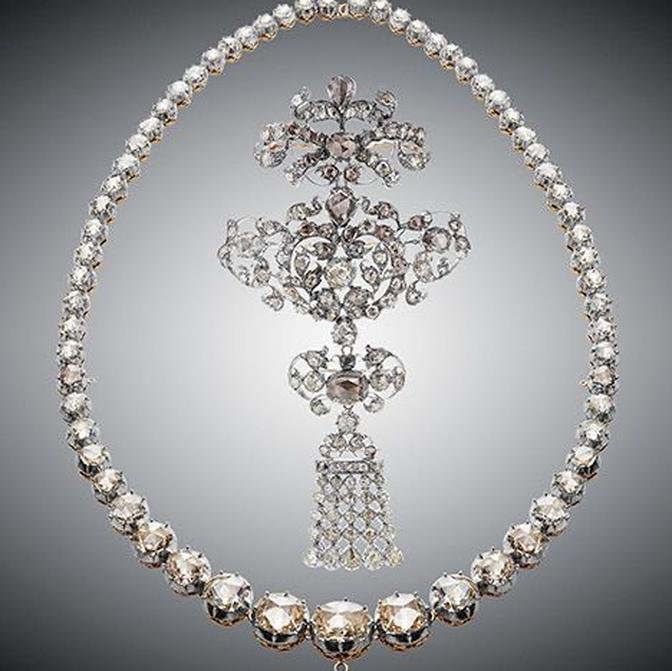
Gina's sapphire parure. The suite, which may have come from Infanta Maria Teresa of Austria,
consists of a large corsage brooch set with faceted sapphires, a pair of diamond chandelier
earrings with a large faceted sapphire, and a striking antique sapphire and diamond necklace.
On one of old Liechtenstein's postal marks, we can see an image of Princess Gina
wearing Habsburg fringe tiara along the sapphire parure. What a beauty, you may say.
She also chose this set for the wedding of her son, Prince Hans Adams, to the then Countess
Marie Kinsky. While the parure looks stunning, the newly turned princess never worn this piece
during her young years, as it was the single jewel very much loved by Princess Gina,
and only after her death 35 years ago, sapphires were inherited by Prince Hans Adams and his wife,
who chose the sapphire suite to a gala that was held in Bavaria before her eldest son,
hereditary Prince Alois, and Duchess Sophie were married. Unlike some other royal houses
that display their jewelry constantly, Liechtenstein's collection is relatively
understated in public. Many jewels are family heirlooms, used sparingly for weddings,
state functions, or portraits, rather than daily wearing. What we like about it is that the
collection shows a blend of influences, Habsburg, Czech aristocratic style, and the quiet elegance
appropriate to a small but sovereign principality. Marie Aglès played an important role in preserving
these pieces, and passing them on, not just physically, but through tradition,
knowing what piece to wear for what occasion, maintaining legacy, ensuring they remain in the
family rather than dispersed. But where are these jewels now? The last time we could witness the
magnificent heirloom was at Princess Marie Caroline's wedding, who is the second child
of Prince Alois. In her wedding at Vaduz Cathedral, she wore the Habsburg fringe tiara,
the same historic piece used by her grandmother as a bridal tiara and diamond drop earrings,
long part of the family heirloom collection. This event gave us one of the rare occasions
where Liechtenstein's royal jewelry was on vivid public display. Now the Habsburg fringe tiara
is primarily worn by hereditary Princess Sophie, who often represents family at state and royal
events, including the notable occasions like the wedding of Crown Princess Victoria of Sweden,
and to King Carl Gustaf's seventieth birthday. However, the sapphire necklace tiara hasn't
appeared for a long time, possibly reserved for the next generation. There is talk among
collectors and royal watchers that these are preserved more as archival heirlooms rather
than jewels for state events, but let's hope to see any of them reappearing again.
And now comes our favorite question. If you close your eyes and imagine one piece from this
collection, which would you choose? The fringe tiara that spans decades, the necklace tiara that
transforms its own shape, or the honeysuckle tiara sparkling like sun? If you enjoyed this
glimpse into royal sparkle and hidden stories, don't forget to like, subscribe, and ring the
bell. There are many more royal jewels, forgotten tiaras, lost brooches, hidden crowns, waiting to
be rediscovered here on Jewelry Legends. Until next time, keep shining and keep wandering.
Thank you for watching.