
All About 1860's Fashion // What did Civil War-era fashion
13 Video Views·Feb 26, 2026
Hello everyone! I'm Rebecca and welcome back to my channel. Today we are going to
continue on with my new Decade Deep Dive series, where we take a close look at how fashion
evolved within one decade of history. Since I covered the 1850s last time, I have decided
to continue on with the 1860s for this month's installment. So we're going to look at the
evolution of fashion from 1860 through 1869. If you have not yet seen the other videos
in this series, I will leave a link to a playlist down below in the description.
Besides that 1850s video that I did last month, I actually already covered the 1830s over a year
ago. So both of these videos can be found down in the playlist. These videos do take a lot of time,
effort, and research to produce. So if you like this kind of video, it would really,
really help me out if you could like and or comment on the video. And if you really,
really like it, you could even leave me a super thanks here on YouTube or send me a Ko-fi,
which is also linked down in the description. Like with the last video, I do want to preface
this with the fact that these fashion trends and changes are based mainly on fashion plates,
just because these are the majority of items that can be pinpointed to a specific date.
Of course, fashion plates are not really representative of what actual people wore,
since only the most wealthy people would have been able to follow these trends in
any short amount of time after publication. Middle class women might have wound up picking
up on these little changes a year or more behind the publication date, though it was also entirely
possible with some of the more subtle changes, such as like popular trim styles, that even middle
class women could have applied these little changes as small alterations to dresses that
were already in their closet. The other thing that we have to keep in mind with these trends was that
for the first half of this decade, ladies in the US may have had difficulty with the
dissemination of information and the availability of materials to the American Civil War, which
likely would have put American women even further behind trends than their European counterparts,
regardless of their wealth or status. All of the fashion plates that you will see in this video
can be found in the respective year folder of my crinoline era Pinterest board, which I've linked
down below in the description. Anyway, let's get on with the 1860s. So when we last left off in
1859, we were looking at extremely full and flouncy cupcakes of dresses with high neck day
bodices, very full pagoda sleeves, and giant skirts just covered in ruffles, which were supported by
a round cage crinoline and at least a couple of petticoats. And honestly, the fashion of 1860 is
basically identical. We see the same large round skirts with lots of ruffles and decorations.
We see both many rows of very short ruffles around the skirt hems, as well as skirts with
vertical or horizontal bands of decorations with no ruffles at all. We also see the use of two
layers of skirts, with the upper layer of the skirt pulled up to reveal the lower layer around the
bottom of the skirt. All of these were elements that were quite popular at the end of the 1850s
as well. Likewise, the most popular sleeves for day wear were still the very full pagoda sleeves.
However, there was also another new sleeve shape that was quite popular in 1860, which was almost
reminiscent of the 1830s or 1630s, a very wide puffy sleeve with many puffs all the way down
the arm. You can even see that multi-puff effect in this undersleeve from the October issue of
Levantin, which was a separate piece that would then be attached into the main bodice, but clearly
carried on that puffed sleeve trend. If you want more information on undersleeves, I do talk a lot
about them in my most recent 1850s project, so I will link that video playlist down below.
As far as bodice shapes go, we see almost exclusively high necklines for day wear,
with a variety of waist shapes. The pointed bodice hem is the most popular, both for day and for
evening, but for day wear we also see waistlines go straight across, and we actually see a lot of
princess-themed bodices where the bodice was cut in one with the skirt. This look was probably second
only to the pointed waist bodices, in fact. A low off-the-shoulder bertha with ruffles over the arms
was the most popular bodice decoration for evening wear, but day wear bodice decoration ran the gamut
from bows to diagonal frills to vertical bands. Basically anything goes for day wear bodices.
In 1861, we start to see the shift in skirt shapes from the round cage crinoline to a slightly more
elliptical shape by the end of that year. Ruffled skirt decorations were still very popular, but
we also start to see applied skirt trimming in very geometrical designs, such as Greek keys,
square crinolations, circles, scallops, and flat bands. The pagoda sleeve bell shrinks significantly
during 1861, and by the end of the year it only has a very slight flare down to the hem of the sleeve.
That said, even these narrower sleeves still retained the white puff at the hem, and the
multi-puff sleeve that was so popular in 1860 is just completely gone in 1861. It was a one-year
trend. All of the bodice shapes from 1860 are still around in 1861, with the pointed waist,
straight waists, and princess seam bodices and skirts that were cut in one. The one difference
here is that while high necklines are still the most popular, we also start to see necklines
become a little lower, with some v-necklines appearing, especially on jacket-style bodices.
These could be filled in with a chemiset, or they could be worn without anything filling them in,
though the chemiset was definitely more popular. We also see some bodices that appear to have
lower, squared-off necklines, which are then filled in with chemisets, though it's possible
that the white fabric underneath may also have been a decoration that was built into the bodice.
Evening bodices, though, were basically identical to the ones in 1860.
In 1862, though, everything starts to get a much more streamlined look. The elliptical skirt shape
is pretty much the same as the previous year, but gone are the layers upon layers of ruffles
that were so popular in previous years. Now, some skirts are still trimmed with a couple of rows of
ruffles, but the most popular trim option seems to be several horizontal bands of trimming going up
from the hem. We also still see those geometric trim designs, such as zigzags, scallops, teardrops,
etc. The majority of skirt decoration is concentrated around the lower third of the skirt,
usually leaving the upper portion completely plain. Bodice trimming has likewise been quite
simplified, with the majority of day bodices having no trimming anywhere besides the sleeves.
The sleeves have mostly kept that gentle flair of 1861, by the way. Bodice waistlines have
lost the sharp point that they previously had, and instead have a gentle dip in the front,
or they just go straight across at the waist. Another bodice hem shape that we start to see
is a double point, one point on either side of the center front opening.
And oddly enough, the princess line dresses that were quite popular in the prior years are
completely gone in 1862. I could not find a single fashion plate with those lines in it.
High-necked bodices remain the most popular, but we also still see the v-necks of the previous year,
as well as square necklines, both of which could be worn open or filled in with chemisets. Evening
bodice necklines tend to be just slightly higher than the few years before, and the sleeves have
become more defined and could be small poofs or just covered in ruffles. By 1863, the elliptical
shape of the crinoline is much more pronounced, which we can really see when it comes to
advertisements for these garments, such as this one from a German publication. Interestingly
enough, skirts of this year also tended to have less decoration than even in the previous year,
though the most popular decorations still tended to be either geometric designs around the lower
third of the skirt or horizontal bands near the hem. Bodices, though, did have a little bit more
decoration than the year before, but these decorations didn't seem to follow any sorts of
rules when it came to, like, the type or placement. And what is also fascinating is that the shape of
the bodice hems went back to what they were in 1862, with pointed bodices and even those princess
dresses coming back into fashion. Even more interesting is the fact that peplum bodices,
which had not been popular since about 1857, returned to fashion. The open V necklines went
away, and while some of the square necklines remained, they were always filled in le chemise
sets. Another thing that was fascinating to me was that I also found a fashion plate from Journal
de Demoiselles that shows a Garibaldi shirt. Now, a Garibaldi shirt is basically a shirt waist,
which would be fitted at the waist and have full sleeves that came down and were fitted at the
wrist. It was a much more casual look, so I feel like this plate could have easily been worn by
a middle class or even a working class woman. To be honest, the shirt that I'm wearing right now
is kind of similar to a Garibaldi shirt, except that Garibaldi shirts never really seemed to have
attached collars. In 1864, the elliptical shape of the crinoline became just a little bit more
pronounced than the year before, as you can see in this advertisement for Philpott's Sans-Flectum
crinolines. The decoration on the skirt again remained largely plain, with most of the
decorations concentrated even lower around the hem than they were in the prior year.
Geometric designs remained popular, and stripes or formations of stripes were also popular motifs.
However, there were also plenty of skirts that were just completely undecorated. For day wear,
sleeves had lost any sort of flair, and they were now relatively fitted all the way down the arm.
Often though, you would still see just a tiny little bit of white
just above the wrist, like some sort of holdover from the previous fashion.
Bodice necklines closed all the way up to the neck, but another fashion was emerging,
which we now recognize as the Swiss waist, where you see something like a Garibaldi shirt,
and over it, an underbust bodice that often had kind of little shoulder straps, for lack of a
better term, that would kind of serve as like a mid-bicep decoration. This Swiss waist could
match the skirt like we see in this fashion plate from an unknown publication, or it could be made
out of a contrasting fabric, like in this evening gown from Le Mode Illustre, where the Swiss waist
is over a low-necked short puff sleeve blouse. For day wear though, a Garibaldi blouse could
also even be used to transform a simpler evening gown into a day look, such as in this plate,
also from Le Mode Illustre. In general, evening gown sleeves were short puffs, and evening gown
skirts often employed that older trend of having a base underskirt, frequently trimmed with ruffles
around the bottom, with an overskirt that's pulled up in places to reveal the decorated underskirt.
The elliptical cage crinoline became so sloped in 1865 that the back was practically at a 40
degree angle, like we see in this advertisement from Beile Gezum Bazaar. Although dress hems had
always dragged on the floor for the whole decade, both for day and for evening, by 1865 even day
wear skirts could be considered to fully have a train, as a significant length dragged on the
floor. Skirt decoration started to travel farther up the length of the skirt, but again mostly stuck
to geometric and striped designs. Those geometric designs were echoed in the bodice embellishment as
well. For day bodices, waistlines could either be straight across or as a princess line, either with
a full length skirt cut in one with the bodice, or sometimes just as a longer jacket. Evening
bodices, though, remained pointed at the hem. The Swiss waist bodice, both for day wear and evening
wear, was even more popular than the year before. Evening gown sleeves shortened significantly,
and day bodice necklines closed all the way up to the neck, whether that was through the use of a
garibaldi blouse or with the bodice itself. Before we move on to 1866, I do want to point your
attention to one of the most fabulous skirts of 1865, which is this gorgeous giant bow skirt from
the January edition of Le Mode Parisienne. The skirt shape really started to change a lot in 1866.
The skirt became significantly slimmer than in prior years, and the cage crinoline underneath
provided a significant slope in the back, with somewhat minimal overall volume. Less decoration
appeared on skirts, with a tendency towards vertical decorations down the skirts,
more so than those decorations around the hem as seen in years prior, which served to further
elongate the look. The majority of skirts consisted of an underskirt with a shorter or pulled up
overlayer, with the overlayer often being cut in one with the bodice. Eliminating that waist seam
also serves to elongate the look of the body, though when waist seams are present, they also
tend to be horizontal lines right at the natural waist, both for day and evening, making the torso
look very short and the skirt look very long. Because this princess line has become so popular,
skirt panels are also rarely gathered or pleated at the waist anymore, and skirts are instead made
up of highly flared panels. The Swiss waist remains incredibly popular, both for day and
for evening, and comes in various lengths now, some ending right at the waist as they were prior,
and some flaring out over the hips, or literally just becoming the overskirt, such as one of my new
favorite fashion plates, this gorgeous plate from Lamode Illustrate, which I think I might have to
recreate at some point. Even the yellow dress in this plate likely follows those same princess
lines, though the waist is delineated on that dress with a belt, so you don't quite get the same
long lines that the red and blue ensemble has. Sleeves have become extremely close-fitted for
day wear and remain very short for evening wear, though you can also see a minor trend both for
day and for evening of additional long hanging sleeves, like a nod to medieval artwork. Necklines
for day wear continue to close right up at the neck, whether for standard bodices or for the
white under bodice-like object that seems to have kind of evolved out of the Garibaldi blouse,
which is basically the same as the previous blouse version, but now with tightly fitted sleeves.
By 1867, it is fascinating to see just how slim the skirts have become. In fact, I would almost
say that the skirts of that year bear more resemblance to the natural form era skirts of
10 years later than they do to the rest of the crinoline era. I think a lot of us have a pretty
decent idea of the shape of an elliptical cage crinoline, but by 1867 that almost completely
changed, and we find ourselves even with a patent for a crinoline that is basically just a sloped
lobster tail from waist to hem in the back with nothing in the front. The other most surprising
thing about fashions from 1867 was the sudden use of many embellished sheer types of fabrics
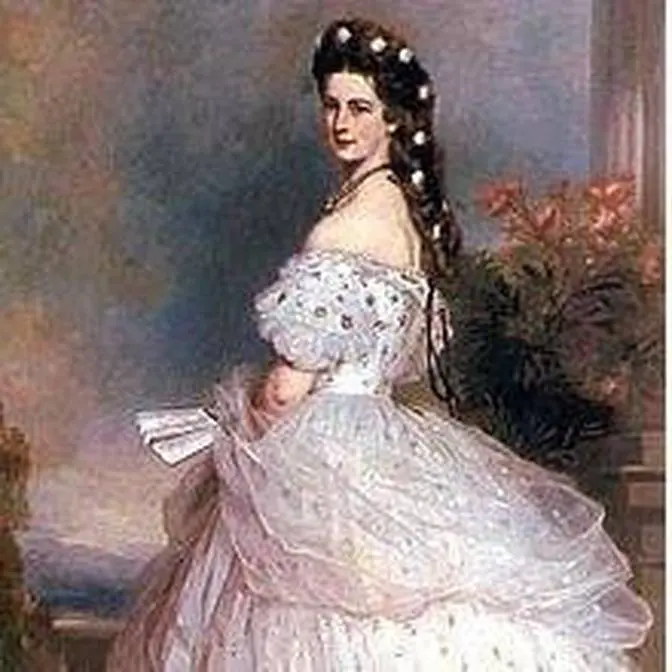
for over skirts on evening wear and bridal ensembles. I have to wonder whether this was
actually something reactionary because, for example, Empress Sissi of Austria, who was one
of the most fashionable ladies of the era, was painted in 1865 in her glorious star embellished
tulle confection, and photos of that painting were then distributed to the public. It is possible
that designs were actually then influenced by her style, or possibly it was a new technology
that made these embellished sheer fabrics easier to produce. I'm honestly just speculating here,
so if you have any ideas as to why embellished sheer over skirts suddenly became popular in 1867,
please do let me know. Other than those two larger changes, most of the style lines remained
relatively the same as the year before, though the majority of waistlines were now back to being
defined by a horizontal sash or seam, with the sash often worn over a princess line cut. The
hanging sleeve trend also became way more prevalent, both for day and especially for evening,
and there were almost always two layers of skirts worn. It's this last trend that very
obviously foretold the coming of the bustle style, as in the latter half of the 1860s,
the over skirts really began to be pulled up in different ways, just as the bustle period
is so known for. In fact, by 1868, we are even beginning to see skirt shapes that have morphed
into that early bustle silhouette. That long diagonal line of the previous couple of years
has largely disappeared by the end of 1868, and fullness has been added to the rear.
This fullness comes from both the method by which the over skirt has been pulled up and arranged,
and also the changing skirt support shape underneath. For example, if we look at this
crinolette, which is stamped with a label naming it as Thompson's Zephyrina from January 1868,
you can see that the fullness has been added back into the crinolette on top,
and the hem has gone back to a more rounded shape than what the elliptical crinolette
supports provided. Skirt decoration was coming back into favor too. Probably in order to balance
the fullness at the tops of the skirts, ruffles were once again added around the hems. For bodices,
while sleeves remained long and tightly fitted, the arms actually crept up the shoulder a bit
from the lower line that it had lived at for the last 10 plus years, and the v-neck line was once
again an option. For evening wear, because that arm's eye seam was now raised up, the shoulder
straps and the little short sleeves of evening bodices also moved a little bit farther up the
shoulder. Sheer over layer fabrics in evening wear remained popular. With 1869, we are closing out
both the decade and also the crinoline era itself. 1869 is really what most people consider the start
early bustle or first bustle period. Skirt supports were crinolettes with even more fullness
over the rear, and somewhat rounded hoops supporting the bottoms of the skirts. Skirt
ruffles were practically a requirement, often with many rows of ruffles around the bottoms of the
underskirts, and sometimes used to trim over skirts as well. The swiss waist that had been
so popular had taken the last couple of years to morph into a sort of over bodice,
with the straps now sitting high on the shoulders because of the raising of the arm's eye,
and a low usually square neckline that would generally pair with a contrasting
neck fill piece and or contrasting sleeves. I believe that sometimes these were wholly
separate bodices that were worn underneath, as evolved from the Garibaldi blouse, and sometimes
they were actually just lower necked bodices with attached sleeves that were then filled in with a
My favorite version of this, which is from Le Mode Illustre, I believe involves a white under
bodice, the orange silk over bodice, which may possibly be attached to the underskirt,
and a sheer black striped third bodice layer, which is likely attached to the overskirt of
the same fabric. More commonly though, the over bodice slash overskirt combo, when made of the
same fabric, actually resembles a sort of pinafore, such as this plate, also from Le Mode
Illustre. Because waistlines are still horizontal lines right at the natural waist, the ensembles
from 1869 wind up looking quite short-waisted, with very long skirts below. And the skirts are
often still quite long. They may be a tiny bit shorter than they were in those few elliptical
years, where they really, really drag the train on the floor, but as a rule, they do all drag
quite a bit on the ground still. The one other trend for 1869 that I found quite new and different
was the occasional addition of Watteau pleats, like on 18th century robe a la francaise, which
would hang from the neckline or shoulders, and then become incorporated into the overskirt draping
in the back. Nice little nod to history. Anyway, that wraps up our deep dive on the evolution of
1860s fashion. I hope you've enjoyed this analysis. Was there something in particular that stuck out
to you? Or do you have a favorite fashion plate from the era, whether it's one that I showed or
one that you found on your own? Please do let me know. I do hope to continue this series with the
1870s, but these videos do take an immense amount of time to research and edit, and the 1850s video
that I did for this series didn't really perform particularly well, so I may not be able to make
this a monthly series. If you do like this sort of video though, please do be sure that you click
the thumbs up icon, leave a comment, and do share it with your friends. And of course, if you have
not yet done so, please subscribe to my channel and hit the little bell icon to be notified every
time I post a new video. I do post videos here on YouTube twice a week, with my sewing vlogs out on
Tuesdays and other random costuming content like this out on Saturdays, but I post every day over
on my Instagram, so please go follow me on Instagram, that's at LadyRebeccaFashions. And if
you'd really like to help support my channel, you can send me a super thanks right down here on
YouTube, or I also have links down in the description below where you can join my Patreon for bonus
perks, or you can send me a tip over on Ko-fi. I'd also like to give a special shout out to my
Wardian level patrons, Sharon and Mirage. Thank you all so, so much for joining me today. I hope
you all have a wonderful week, and I will see you very soon in my next video. Happy sewing!