
How Much Food Can One Small Elevated Bed Actually Grow
3 Video Views·Mar 1, 2026
From setup to multiple harvests of kohlrabi, cabbage, lettuce, radishes, and spinach, this is a full season growing journey that proves anyone can grow their own food, no matter how little outdoor space they have.
A lot of people think that growing your own vegetable is only possible if you have a big yard,
but that's not always the case and today I'm going to show you exactly how.
We're setting up the Vegogarden elevated garden bed in a 2 by 6 foot size,
and right out of the box this thing already feels really well made.
Now if you ever spent a full afternoon tending to a ground level garden bed,
you already know how much your back feels it by the end of the day.
And that's one of the reasons why I wanted to try an elevated bed.
This one sits a full 32 inches tall so your plants are right at comfortable working height.
No bending, no kneeling, your back will genuinely thank you.
Now I went with a version that includes wheels, and this might be my favorite feature.
You can roll your entire garden around.
If your plants aren't getting enough sun, you can roll it over.
If you need to free up some patio space, roll it out of the way.
And it stays completely rock solid even when it's full of soil.
The material is built to survive anything.
Sun, rain, heat, cold, and without rusting or breaking down.
It's also completely food safe so nothing harmful is getting anywhere near your vegetables.
And this is meant to last for over 20 years.
Another great benefit of getting your garden off the ground is less controls.
Slugs, rabbits, all those little guys that love snacking on your vegetables,
they've got a much harder time to reaching up here.
That means less damage to your plants and more veggies making it to your dinner table.
Before any soil goes in, I'm laying down twigs, branches, and dry brown leaves at the bottom.
Now this stuff is completely free, just grab it from your yard.
It takes up space so you need less soil to fill the bed, which saves a lot of money.
It also helps with drainage and slowly breaks over time.
Feeding the soil from underneath like a natural fertilizer you never have to think about.
And now for a soil mix.
A lot of people wonder why not just use ground soil.
Regular garden soil is too dense and heavy for a raised bed.
It compacts, suffocates the roots, and doesn't drain well.
A quality soil mix on the other hand stays light and fluffy so roots spreads easily,
water drains properly, and your plants get the oxygen they need.
And to finish it off, a 1-2 inch layer of compost right on top.
This is especially important when planting new seedlings.
Young plants have tiny, tender roots and having that rich compost right at the surface
means I can start soaking up the nutrients right away.
It's a small step that gives your plants the best possible start.
In all honesty, if you don't have the space to grow tons of vegetables, you just need this.
This 2x6 bed is honestly all you need to grow real, meaningful amounts of food.
Even if all you got is a small patio, a balcony, or just a tiny outdoor space.
Just look what we're able to fit in here.
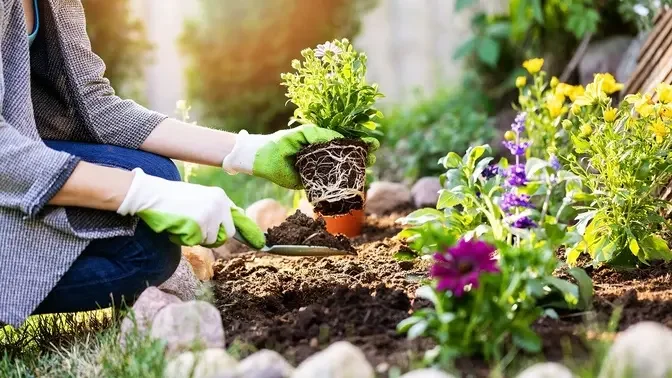
2 cabbages, 8 kohlrabi, 2 spinach, 6 lettuce plants,
and I'm even sprinkling radish seeds in the gaps between everything.
Radish grows fast and fill those empty spaces perfectly
while the bigger plants are still getting established.
This is what's called companion planting,
making the most of every single inch of space you have.
And the beauty of a bed this size is that it fits just about anywhere.
A patio, a deck, even a large balcony.
You don't need a yard, you don't need a lot of space either.
A lot of people think growing your own food is only for people with big gardens
and they really want to change that idea.
Now since we're in spring and there's still a chance of frost overnight,
I'm placing a temporary plastic cover over the bed to keep these young seedlings safe.
Frost can damage or even kill newly transplanted seedlings really quickly.
So this is just a simple way to protect young seedlings
while the weather is still unpredictable.
And once the temperature starts climbing, we're past the frost risk,
I'll swap this plastic cover for a mesh netting instead.
Mesh allows air, sunlight, and water to pass right through the plants
so that they can breed freely.
But it still acts as a barrier against pests
and with cabbage, kohlrabi, and leafy greens in here,
cabbage worms are a real concern.
They can do a lot of damage fast if you let them.
The mesh keeps the adult cabbage moths from laying eggs underneath the leaves.
And this keeps the plant safe without any chemicals, which is always the goal.
So think of it as two covers for two seasons.
Plastic for the cold, mesh for the warm.
Simple and effective.
And it's only been a few weeks and the bed has already taken off.
The mesh netting did its job keeping everything protected while the plants grew.
We're able to harvest radish, which is the fastest growing vegetables you can plant.
And they're really great for filling those gaps between bigger plants.
And also now that it's getting warmer, some of the plants have started to bolt
so I'm harvesting the spinach.
Bolting means it's sending up flower stalks which makes the leaves turn bitter.
So I'm harvesting all the bolted spinach just at the right time to get the best flavor.
And this is the thing about growing your own food.
You're harvesting at peak freshness,
something you simply can't get from the grocery store.
And normally I would put back the mesh netting again here
to keep our plants protected.
So I'm going to upgrade it with a better mesh cover
specific to this 2x6 elevated planter.
Now I'm going to attach the Vego Garden Mesh Cover System.
And this thing is really the perfect companion for this elevated bed.
It's actually a 4-in-1 system.
It works as a pest cover, a wall trellis, an arch trellis,
and a tool storage rack all in one.
Right now I'm simply using it as a cover to protect against pests.
Specifically cabbage worms and other insects
that would love to get into these kohlrabi and cabbage plants.
The mesh is really fine so bugs can't get through them.
But sunlight, air, and water pass right through them without any problem.
What I also love is how sturdy the frame is.
It's powder coated steel so it's built to handle whatever the weather throws at it.
And assembly is super simple.
It's a basic screwdriver and you're done in about 15 minutes.
It's perfect on the elevated garden bed
and honestly it makes the whole setup really functional.
Now that the setup is completely done,
this is how well the plants grew and how much vegetables we harvested
from this 2x6 elevated bed.
Now if you've been thinking about starting a garden
that felt like you didn't have the space,
I hope this video showed you that you really don't need much.
And just like that, winter is here.
The garden is resting under a blanket of snow
but the bed is still standing strong out here.
And that's the kind of beauty of it.
You grow your harvests, you enjoy, and then you wait.
Because spring always comes back around and so does the garden.
Thanks for watching and happy growing everyone!