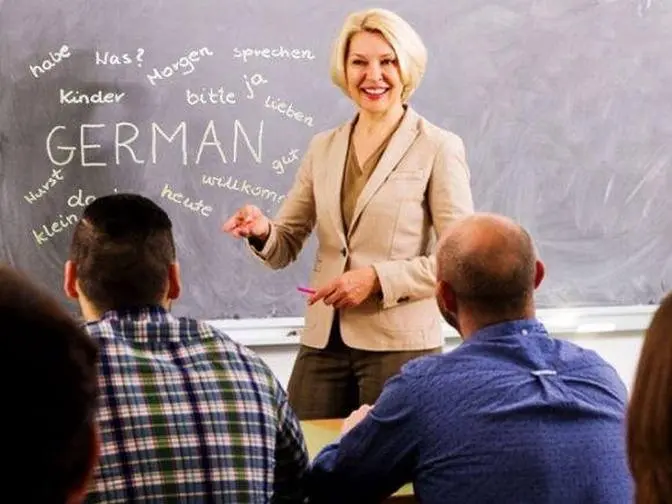
#deutschlernen#deutsch#deutschsprechen In diesem Video lernst du 7 typische Sätze, die die deutschen Muttersprachler benutzen (Deutsch lernen | learn German).🚀
Do you want to speak like native German speakers?
Then this video is exactly right for you!
Hello and welcome back to my channel!
My name is Maria, I am a German teacher and your language coach.
In today's video, you'll learn to speak just like native German speakers.
I'll teach you seven simple expressions that will make you sound instantly like a native German speaker.
Do you not have time to learn German thoroughly?
Then watch this video, learn the sentences, and your German will improve immediately.
Let's get started right away!
Here we go!
I have prepared a PDF for this video.
Here you will find all the sentences from the video, along with explanations and examples.
Scan this QR code and download the PDF, or click the first link below in the description.
And we begin with the first phrase.
I must say, I simply love her.
I also like using them very much.
I had better start with an example.
Today it is considerably warmer than yesterday.
A bit warmer.
A few things.
That means clearly, much more or much better.
While language learners would say a lot, native German speakers use far fewer words.
Today is much warmer than yesterday.
Today it is considerably warmer than yesterday.
One uses quite a bit to say that the difference is fairly large.
Something is therefore not just a little different, but clearly stronger, larger, or better.
Typical is the combination with a comparative.
Also somewhat better, faster, larger, or more difficult.
Would you like to see more examples?
Of course.
Today I have learned much more than yesterday.
Today I have learned a lot more than yesterday.
This test was much more difficult than the last one.
This test was considerably more difficult than the last one.
The new laptop is much faster than the old one.
The new laptop is considerably faster than the old one.
A few things.
That's not even a complete sentence, but simply a small phrase.
And already, the whole thing sounds considerably more lively and authentically German.
Would you also like to learn to sound so naturally and effortlessly?
Then I have some good news for you.
Today, a speaking campaign begins.
She is called "Secure and Fearless in Speaking German."
The action lasts five days.
During this time, you can sign up for my conversation training and book your trial lesson for just €10.
This is 1-to-1 instruction with native-speaking teachers.
No group classes, individual lessons.
Do you want to speak German more confidently and finally no longer fear expressing your opinion or participating in conversations?
Then it is now your chance.
You can find the registration link below this video.
I wish you lots of success in your speech.
The next sentence is also very popular among native German speakers.
I'm wondering right now whether Sophie has forgotten the appointment today.
Could be good, right?
Could be good.
That means it is possible.
Maybe it's true.
Attention, the subject is missing here.
Something like that is typical of spoken language.
A whole sentence is also possible and would read as follows.
It could be good.
With this sentence, one expresses that something might be likely, but one is not entirely certain.
It is therefore not a definite statement, but rather a cautious agreement, a conjecture, or a speculation.
One can often use "man" well when someone says something and one responds.
Yes, that could be correct.
Yes, that is possible.
Could be good.
But one is simply not 100 percent certain.
Incidentally, the word "good" is not used here in its usual sense.
We also do not emphasize it.
The word "good" merely indicates that something is significantly more likely.
Look here, could be.
The probability here is approximately 50 percent.
That often sounds somewhat uninterested or brusque.
Could be.
Could be good.
The probability here is approximately 70 to 80 percent.
That sounds more confirmatory, active, and convincing.
To make it not too easy, I'll show you a few examples with a subordinate clause.
Maybe she has already gone home.
She may well have already gone home.
It might rain later.
It might be good that it rains later.
Today is Sunday.
I can imagine that the office is closed today.
Today is Sunday.
It may be good that the office is closed today.
Please now create your own example.
What can be good?
The next sentence is particularly interesting.
Parking is actually not allowed here.
That would normally cost 30 euros.
Whatever.
I'll be back in two minutes.
I'll risk it.
That means I do something even though there might possibly be problems.
I'm taking a possible risk and will wait to see what happens.
You use this phrase when you're not sure what will happen, but you still do something anyway.
So one doesn't decide against it out of fear, but simply tries it.
One uses the phrase when a negative outcome is possible, yet one is unwilling to concede or make extra effort to prevent it.
Or if one accepts the consequences should it go wrong.
Quite in keeping with the motto.
I'll just try it and see what happens.
I'll risk it or I'll let it ride.
For example.
Maybe the boss won't like my idea, but I'll state my opinion anyway and wait to see what happens.
Maybe the boss won't like my idea, but I'll state my opinion anyway and leave it at that.
I'm going without a reservation.
I'm just watching to see what happens.
I'm going without a reservation.
I'll risk it.
I don't know if I'll get the job, but I'll apply anyway and see what happens.
I don't know if I'll get the job, but I'm just going to apply and take my chances.
What a beautiful sentence, isn't it?
Now let's practice.
Think of a situation in which you could use this sentence and write it in the comments.
I will read the comments shortly.
Are you ready for phrase number four?
I am feeling lazy right now.
I might go running once a week, at most.
Even that one time is already greatly appreciated.
It is most likely much less, so not at all.
When it comes to the highest point, it means at most, at best, when it comes to the highest point.
This phrase is used when one wants to indicate that a number or amount is likely not larger.
It is therefore the upper limit.
Probably not much more.
By that, one means that in the best or worst case, it is this value, but likely even less.
For example, there were at most ten people there.
There were, at most, ten people there.
I slept at most three hours.
I have slept, at most, three hours.
It may take five minutes, at most.
The journey takes five minutes, if it's busy.
This phrase can stand at the beginning, in the middle, or at the end of the sentence.
When it's high, it costs five euros.
It costs five euros, at most.
It costs, at most, five euros.
I know you have an example too.
In the comments, write it down.
I'm sure you've heard the next phrase before.
Here is a situation.
Do I like German food?
It depends.
I really like currywurst, but I don't like sauerkraut at all.
And you? It depends.
That means it depends on the situation.
It depends.
You use this phrase when there is no clear or definite answer.
The result varies depending on the situation, person, or circumstances.
So one means that one must first have more information.
It depends.
Someone asks a question and you want to signal that the answer is complicated.
By saying that, you're telling me I can't give you a definite answer because the outcome depends on other factors.
It depends on whether we're going for a walk later.
It depends on the weather.
Whether we will go for a walk later.
It depends on how the weather is.
Whether it is difficult.
It depends on how much experience you have.
Whether it is difficult.
It depends on how much experience you have.
Whether we'll see each other tomorrow evening.
It depends on how much work I have tomorrow.
Whether we'll see each other tomorrow evening.
It depends on how much work I have tomorrow.
And I have a lot of work.
Did anything catch your attention?
This expression can also be varied somewhat.
It depends.
It depends, or it depends, or even shorter, it depends.
All sentences are correct.
Will you write me a comment right away?
It depends.
Why did he suddenly cut off contact?
You're not involved in that.
One doesn't exactly know what actually happened or why something happened.
It is not exactly known.
You don't know what lies behind the situation.
Only the person concerned themselves knows the true reasons.
This expression is used when one wants to say that outsiders cannot fully understand a situation.
One therefore does not exactly know why someone did something or why something happened.
It's often said when someone judges other people or is surprised by their behavior.
Maybe my neighbor had a bad day.
You never really know what was going on with her.
Maybe my neighbor had a bad day.
You're not involved in that.
Some people suddenly change their minds.
That's how it is sometimes.
Some people suddenly change their minds.
You're not involved in that.
Sometimes things happen that you simply can't understand.
That's life.
Sometimes things happen that you just can't understand.
You're not involved in that.
Can you think of a situation in which you could use this expression?
Do you want to discuss politics for another hour?
There I go, out.
That means I'm not getting involved in that.
I'm not participating in that.
This informal phrase is used when one wants to express that they do not wish to participate in something or want to stay out of a situation.
This phrase is very direct, but usually not impolite.
It often sounds relaxed or humorous, sometimes also clear and distinct.
Depending on the tone.
They are used in two main contexts.
I have no idea or competence.
The topic is too complicated for me.
There I am out.
Or I am not interested.
I do something not out of principle.
I don't want to have anything to do with this particular action.
There I am out.
For example, do you really want to hike for twelve hours tomorrow?
I'm not doing that.
Are you really going to hike for twelve hours tomorrow?
There I go, out.
Do you want to play this game for money?
I'm not doing that.
Do you want to play this game for money?
There I am out.
You want to work the entire Saturday?
I'm not doing that with you.
You want to work the entire Saturday?
There I go, out.
And now perhaps write an example for Maria?
There I go, out.
Or not?
Did you learn something new today?
Mega!
That was exactly my goal.
Download the free PDF as well.
Then you can repeat the words from the video once again.
Scan the QR code or click the first link below in the description.
And if you liked the video, I would greatly appreciate it if you subscribed to my channel.
Then I'll put in even more effort and create more wonderful videos just for you.
And do you finally want to speak German without fear and gradually become more confident?
Then I'm already looking forward to seeing you in my conversation training.
You'll really enjoy it, and you'll see how quickly you make progress.
Then take care.
Take care of yourself, and we'll see each other again soon in my new video.
Until next time.
Bye!
It may well be that your German is now considerably better.