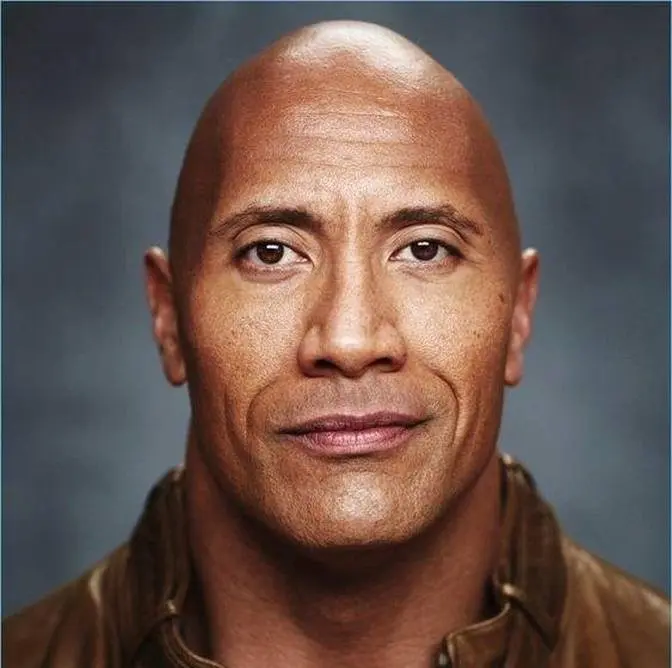
The Rock Is A Pebble || His Downfall After Losing 50lbs
🎬 ABOUT THIS VIDEO:
For decades, Dwayne “The Rock” Johnson was defined by his size — the muscles, the discipline, the image of an unstoppable force. But when that image suddenly changed, so did the internet’s perception.
This documentary unpacks the rock downfall after his shocking 50lb weight loss — from steroid speculation and fan backlash to a brand built on strength now showing cracks in authenticity. Was this just physical transformation for a role… or the unraveling of a persona crafted over decades? For many, it became the moment that truly symbolized the rock downfall.
▪ Subject: Dwayne “The Rock” Johnson — WWE legend, Hollywood actor, and global icon under fire for his changing image. If you want to understand the rock downfall, this video gives you the full picture. #film#entertainment#Dwaynejohnson#actor
AI Generated·May contain errors
Once Hollywood's ultimate muscle icon, raking in billions and hailed as the Natty King,
The Rock is now mired in an unprecedented string of scandals.
From Joe Rogan publicly exposing his alleged 20-year steroid use to authorities reopening
investigations into murky Maui wildfire charity funds, millions of followers have vanished,
$100 million deals are crumbling, and social media overflows with criticism and mockery.
There's not a chance in hell he's clean. No.
Not a chance in hell. As big as The Rock is, at 50, he's so massive,
and he's so different than he was when he was 30.
It's hard to believe this embattled figure once reigned supreme over 400 million followers,
a fortune exceeding $800 million, and a film career generating over $10 billion
in box office revenue. From the planet's top muscle icon to a labeled liar,
this brutal contrast has made The Rock's fall one of Hollywood's most painful.
So why did a muscle icon once celebrated as a people's hero get exposed as a deceiver before
the world? Why did Hollywood shine and hundreds of millions of followers turn so quickly into
scorn and ridicule? And what was the moment that sent The Rock from the peak of power to
the depths of disgrace? Before becoming a Hollywood star, Dwayne Johnson electrified
the world as a WWE wrestler, immortalized by his iconic catchphrase,
Can you smell what The Rock is cooking? From the ring, he steadily transitioned to film,
quickly becoming one of the world's highest-paid actors.
With blockbusters like Jumanji nearly $1 billion in box office revenue,
Fast and Furious billions in global gross, and Moana over $680 million, The Rock repeatedly
topped Forbes lists with annual earnings once surpassing $120 million. He wasn't just a movie
star but a global media phenomenon. On Instagram, he amassed over 400 million followers, one of the
largest accounts worldwide, each post easily racking up millions of likes. In WWE, he won
over 10 world championships, cementing his status as one of the greatest wrestlers in history.
Time magazine repeatedly named him among the 100 most influential people on the planet.
Throughout his journey, The Rock maintained a consistent image, a hardworking, disciplined,
and principled man. He shared his grueling workout routines, meticulously planned meals,
and a go-all-in-life philosophy. On social media, he spread positivity,
inspiring millions to overcome challenges and chase their dreams.
This image wasn't just a PR strategy, it was a fortress built on trust. Millions saw him as the
ideal embodiment of strength and effort, but even the strongest walls can crumble if the foundation
isn't solid, and the first crack appeared at the very core of the hardest-worker persona
The Rock had painstakingly crafted.
In September 2025, at the Venice Film Festival, The Rock appeared to promote the Smashing Machine,
but the spotlight wasn't on his new role, it was on his physique, strikingly leaner.
The massive muscles that defined his brand seemed to have vanished in just a few months,
igniting a firestorm of steroid speculation and sparking a heated debate.
On one side was The Rock, steadfastly defending his natural image. On the other,
a coalition of fitness experts and gym enthusiasts led by Greg Doucette, alongside Joe Rogan,
American Thor, and Derek from More Plates More Dates.
The battle kicked off with a study from the Journal of Strength and Conditioning Research
revealing that steroid users can gain up to 13 pounds, about 6 kilograms of muscle in 100 days,
while natural lifters achieve only around 5 pounds, about 2.2 kilograms in the same period.
Beyond numbers, the difference lies in recovery, protein synthesis, and training efficiency,
factors giving steroids an edge no natural body can match.
The coalition wielded this evidence as a direct counter, arguing that The Rock's
physique over two decades surpassed natural limits and his natty claims were mere deflection.
You see some photos of him in his 30s. He's way bigger and leaner now.
Then you watch his little workout. This is The Rock. I'm going to go through my leg workout.
And then he gets in there. He had two plates on each side of the leg press.
This is the waist. I'm like, it's his first set. He's warming up. No,
he's stuck with that weight the whole time. So he did this work. He's like,
look how hard is 30 pound walking lunges. Two plates was every exercise. I'm like,
is he a bikini competitor? And he's faking how hard it is, you know, like,
he's grimacing. Sounds like you don't like him because he's tall.
I love The Rock, which is the funny thing. I don't hate him for it, but it's like,
come on. He's just training like a...
Greg Doucette quickly became the coalition's spearhead, dissecting The Rock's physical
transformation across social media with sharp mocking commentary. The Rock's turned into a
pebble. He's wilted. He's withered. I believe I have more muscle than The Rock now. And I'm
just a five, six guy. The Rock has become a pebble. He's eroded. He's withered away.
What you don't know because you didn't watch my previous video is that The Rock was suffering
from cardiovascular disease. How many of you think The Rock is natural? Do I have to keep
reminding you? There's a one in a million chance he's natural. Behind the sarcasm,
Doucette highlighted a key point. Dwayne Johnson's loss of 50, 60 pounds, about 27 kilograms of
muscle in such a short time was a hallmark of someone halting steroid use. We've seen other
WWE superstars go about this. Remember Batista? He looked significantly smaller. And why do you
think that is? He's no longer abusing performance-enhancing drugs. And so he followed
in the footsteps of none other than the legend Batista, who did the exact same thing. If y'all
think that The Rock was natural, that I'm just talking out of my ass, explain how he lost all
his muscles in a matter of months. He argued that such a rapid mass of muscle loss couldn't be
explained by role preparation or aging. If he were truly natural, Doucette concluded,
he couldn't have sustained that massive muscle mass at 50, let alone lose nearly 30 kilograms
of muscle in months. You thought that previous physique was just up at 430, hardest worker in
the room? Are you insane? The only way you lose that much muscle that quickly like that is if
you go from abusing steroids to not. For Doucette, this decline was a silent confession, louder than
any statement. And so my only wish on top of this would be if The Rock came out and explained
exactly what he's doing. Hey guys, you see how I've lost all my muscles? The reason is because I
had to stop abusing performance-enhancing drugs. I was playing the superhero actor card. I had to
have a greater physique than last time. I wanted to be at my best shape ever in my 50s. Does that
even make logical sense? I mean, bro isn't Michael Hearn. And so because of that, because of the right
circumflex artery, it was being shut down. I had to decide to make a change. And if I didn't do that,
I wouldn't be living longer than last time. As The Rock, please don't do what I'm doing.
Doucette wasn't alone. Joe Rogan, with his trademark bluntness, jumped in, dismissing
The Rock's past claim of trying steroids once at 18 as crazy talk. Rogan explained,
you can't use once at 18 and keep building muscle until you're 50. To prove it, he pointed to the
stark contrast between Johnson's early WWE physique, muscular, healthy, but within normal
bounds, and his extraordinary, almost implausible middle-aged body. Rogan concluded, that's impossible.
To counter the mounting criticism, Dwayne Johnson finally spoke out. He explained that his muscle
loss was a calculated decision, slimming down to fit the role of Mark Kerr, a gritty MMA fighter
notorious for heavy steroid use. Johnson insisted this was an artistic sacrifice, a dedicated
immersion into the character, not a sign of ceasing banned substances. I had to set aside my
ego and my familiar physique to embody the role, he said in an interview, trying to frame it as
purely about acting. But Greg Doucette swiftly dismissed this defense with biting sarcasm.
Did he need to lose 60 pounds of muscle to play a steroid pumped fighter?
Is he acting or running from the truth? And so The Rock went on a juice cleanse,
lost about 50 pounds of muscle. We're not talking about orange juice, we're talking about steroids.
Now, the only reason we're talking about this is because in comparison to how he looked before,
he's significantly smaller. For Doucette, this wasn't role preparation,
but a staged cover-up for the reality that a superhuman physique at 50 couldn't be natural.
He quipped, if that's artistic sacrifice, it looks awfully like the biological symptoms
of stopping a steroid cycle. You don't just lose 50 to 100 pounds of muscle in one year.
It's hard to maintain muscle mass when you stop abusing steroids. Get it right.
From another angle, Joe Rogan dug deeper into the explanation's flaws.
He stressed, if The Rock is truly clean, why has he never released blood test results?
Why just talk? Rogan contrasted Johnson's muscular but normal WWE days with his near
superhuman middle-aged physique, asserting, that just doesn't happen.
For Rogan, citing the role only proved Johnson was dodging the truth.
American Thor joined in, escalating the debate emotionally.
He declared, Dwayne Johnson's body is living proof of chemical intervention.
For Thor, the real outrage wasn't what Johnson used but how he sold it as an illusion to the
public. He peddled an unattainable dream, making millions of young people think they
could achieve the same with just training and diet. What Johnson created wasn't motivation,
it was a massive lie. If the sarcasm wasn't enough, Derek from More Plates More Dates
delivered a clinical analysis. He stated that sustaining a superhuman physique for years
almost certainly required hormones, TRT, growth hormone, GH, or high-dose nandrolone.
The rapid physical decline seen in Venice suggested cessation of such a regimen.
Derek concluded, this isn't just weight loss for a role, it's a body crashing post-cycle,
likely tied directly to health concerns. Facing intensifying accusations, The Rock didn't stay
silent. He countered that age and work pressures were the real reasons. At 50, maintaining that
physique isn't easy. I lost muscle mass not because of steroids but for long-term health
and the role. I've never relied on drugs to build this career, Johnson insisted.
But the coalition of critics didn't relent. Cal Sonnen, a former UFC star,
landed a shocking comparison, Dwayne Johnson is just a Hollywood liver king. For Sonnen,
the issue wasn't substance use but crafting an illusion that millions bought into.
As the debate turned ethical, Greg Doucette posed a piercing question,
if he truly chose health, why not admit the truth? Why keep fans living a lie?
American Thor echoed, Dwayne Johnson owes the public an explanation for letting them
discipline and sweat alone were enough. From initial doubts, the entire wall of trust The
Rock built over decades began to tremble. He was no longer just an actor or entertaining wrestler,
but a case study in concealment and contradiction. Those who once saw Johnson as a symbol of hard
work, discipline and integrity, now faced a fractured image. When the first crack appeared
with steroid allegations, the public dug into his past for more evidence. They recalled the
Maui Fund scandal where unresolved questions about money and accountability became a fatal blow.
Turning the people's champion into a symbol of betrayal and greed in the eyes of some fans.
If the steroid allegations cracked the people's champion image, the next scandal widened that
crack into a gaping hole. In August 2023, the Maui wildfires devastated homes, lives and hopes.
Amid this tragedy, Dwayne The Rock Johnson and Oprah Winfrey launched the Maui People's Fund,
pledging $10 million, $5 million each while urging the public to donate $1,200 monthly.
Initially, this seemed noble. But as the gloss faded, the public saw the paradox and near
billionaire asking ordinary people struggling to survive on $1,200 to share the burden.
This insensitivity sparked outrage. On X, one user wrote,
A billionaire asking poor people to donate? That's peak shamelessness.
Another mocked The Rock could buy Maui, but he's asking us to fund relief?
This sense of injustice hit hard, especially amid inflation and economic hardship,
where money was a daily struggle for millions. But the money issue was just the surface.
The bigger controversy was the lack of transparency. The Rock didn't disclose
how the fund was distributed or why he and Oprah, capable of giving far more,
opted to offload responsibility onto the public. His silence echoed the steroid scandal,
a dodging, evasive Rock avoiding proof of truth. Some even compared him to Sam Pepper,
a figure exposed for exploiting audience trust. While The Rock faced no fraud accusations,
the similarity in his handling dealt a severe blow to his image.
More than just The Rock, the Maui fund scandal raised a broader question about
celebrities and charity. When the ultra-wealthy stand on stage asking struggling crowds to donate,
is it genuine sharing or responsibility shifting? When fundraising becomes PR,
does goodwill retain its original meaning, or does it become a commercialized media tool?
The steroid and Maui scandals differ in nature but lead to the same point,
a disconnect between the crafted image and real actions.
If the steroid issue raised doubts about his physique and honesty, the Maui fund expanded
into a societal issue, the warped relationship between celebrity wealth and the burdens placed
on ordinary people. When the stage lights dim, what remains isn't just doubt about one man but
skepticism toward the entire hero archetype Hollywood creates. Dwayne The Rock Johnson's
story reveals a seemingly simple but rarely embraced truth, honesty and transparency are
the only foundation for sustaining trust. Muscles may fade, wealth may vanish, but once trust cracks
it's nearly impossible to mend. This lesson isn't just for celebrities but for anyone seeking
lasting respect and credibility. It shows that truth can't be hidden forever. A perfect image
can be crafted through media, a physique enhanced by steroids and goodwill promoted through charity
appeals. But time and public scrutiny always expose the gap between the story told and reality.
When the curtain falls, all efforts to embellish become meaningless. Thus, transparency outweighs
glamour. The public never demanded perfection from idols, but they craved truth. Had The Rock admitted
to medical enhancements or openly detailed the Maui fund's operations, he might have earned more
respect than criticism. In a skeptical world, transparency is the strongest currency for
maintaining trust. Moreover, this story underscores that a celebrity's responsibility extends beyond
the spotlight. The public grants them fame and in return they must wield it fairly and wisely.
When a wealthy star asks poorer people to donate, they expose a bitter paradox,
those with less bear the burden for those with more. This raises the question, is goodwill still
about sharing or has it become a calculated PR tool? Ultimately, it's a wake-up call for fans
don't blindly trust an image. People may hit the gym inspired by The Rock or adopt his hustle
mindset, but they shouldn't tie their fate to a constructed persona. Idols are human with
ambitions, mistakes, and sometimes deceit. Only by seeing this clearly can the public embrace the good
without being hurt when the image crumbles. Dwayne The Rock Johnson spent his career
crafting an image as a people's hero, strong, disciplined, and principled. But as steroid
allegations and the Maui fund scandal erupted, that image began to crack. This isn't just a star
story, but a bitter reminder that a gap always exists between public persona and true self.
Fans may forgive weakness, but deceit is harder to pardon. The lingering question is, can The Rock
reclaim the lost trust or will it remain an unhealable fracture in the public's heart?