
The Mysterious Titus Tunnel In Turkey
3 Video Views·Apr 16, 2026
Check out our upcoming major tours
https://hiddenincatours.com/tours/#major
Hi, this is Brian Forster and we're very close to the Mediterranean in Turkey.
And what we're looking at, look at the wall on the left. This is the beginning of what's called
Titus' Tunnel, supposedly created, first started by Vespasian in 70 AD, continued by Titus,
Roman emperor in 80 AD, and completed by Antonius Pius in 161 AD. Now this, I believe,
what you just saw on the right is Roman work, but there's no way that I believe that this huge
opening in the bedrock was done solely with hand tools. It's just too big a work. Again,
look at the left-hand side and look at the right-hand side. You can see that the bedrock,
which is limestone, but it's also metamorphose limestone, almost perfectly flat surfaces,
vertical surfaces. And as we continue on, continue looking at the wall on the left.
Again, very flat, and we haven't even reached Titus' Tunnel yet. So as we continue along,
again, you can see the flat surfaces in the bedrock. And here, this shows you the depth
of how big it is and how much work would have been required. I think this is definitely a
candidate for lost ancient high technology and was found and then fine-tuned by the Romans. I
don't think the Romans did this out of the bedrock and were able to... Here, this could be a natural
surface. And there in the background, you can see that the giant wall continues. On the left-hand
side, you saw some shaping there, the limestone. This is a classic Roman arch. So of course,
this would have been the work of the Romans. Not particularly super-fine workmanship. But then
again, the big wall continues on the left side and now on both sides. Now, this is the beginning
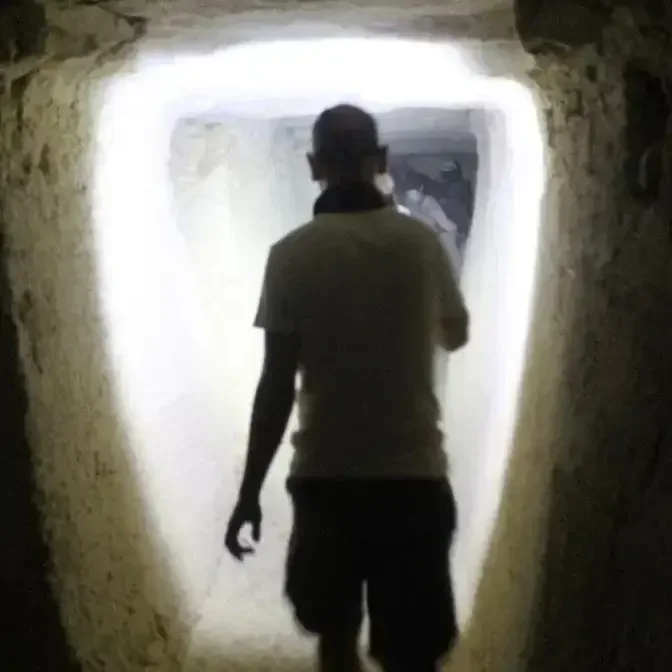
of the actual Titus' Tunnel, and it's almost a mile long through the bedrock, the ceiling a
minimum of 20 feet tall. The Romans, of course, did have steel chisels and other hand tools,
but I think this is way too big of a construction project to have been done solely by hand during
Roman times. And again, we continue along. You can see a water channel that has recently been
repaired on the right-hand side. That was also probably a Roman work. So either this initially
was something created by water erosion over the course of millions of years, or it's a very good
example of lost ancient high technology that was then fine-tuned during the Roman time period.
As we walk out, once again, look at the flatness of the wall.