
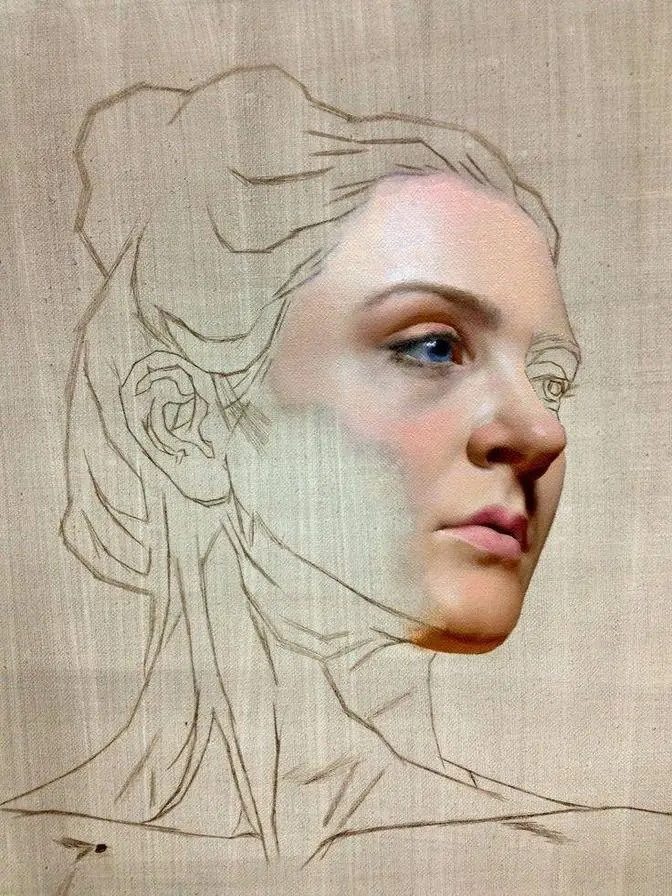
How to START portrait PAINTING in OILS using shadows
#GJWart #portraitpainting #portraitart #oilpainting #oilpaint #potrait #painting #drawing #art #arts #traditionalart
AI GeneratedMay contain errors
Video Summary
AI GeneratedThis video demonstrates a professional approach to alla prima portrait painting, emphasizing the use of dark shapes to establish form, composition, and three-dimensionality. The instructor explains how to simplify complex scenes through squinting and the strategic application of sharp and soft edges to create a realistic illusion of light and volume.
I teach my students to start the painting using the dark shapes first.
I believe that the strong design of the dark shapes can help to build the likeness,
to create a strong composition, and to achieve the illusion of three-dimensionality.
In this video, I will show you how to build solid portrait painting in one sitting
by focusing on the dark shapes, applying two types of edges,
and by simplifying all the shadows into one transparent unified shape.
Let's have a look at this shape.
One value, very simple, clear design.
So far we don't see enough of visual information
to believe we look at a representation of the object.
Everything is rather flat.
But if we change the edge of the part of the shape, it is starting to look like an object.
And if we modify the drawing of the dark shape like this,
we can assume now that we are looking at the sphere,
resting at the plane, and being illuminated by the spotlight.
So one shape with two different edges can tell us a story
of multiple objects, source of light, and their spatial relationship.
On this photo, we can see that the soft edge represents the core shadow
and shows the form as it is turning away from the light,
while the sharp edge is representing the shadow
which the object is casting upon other object or surface.
Notice that only short distance cast shadows have sharp edges,
the edge of the cast shadow getting softer with distance.
And if we have more complex form and arrangements,
we can see how cast shadow is describing the form
on which this shadow is being casted upon.
So when you know what you are looking for,
you can find simple and powerful shadow shapes
even in very complex reference images or scenes.
Notice how combination of sharp and soft edges
can create an illusion of the form on this photo.
If we look at paintings done by masters like Rembrandt, Sargent, and many others,
we will notice that the values in the shadows are compressed
and very often all the darks in the painting are almost blending into each other.
Such approach can make the composition stronger and simple
while the flat and unified shadows create an illusion of luminosity
of the light parts of the painting.
Notice how half tones in the light are rich with texture, colors, and subtle value changes.
The best way to simplify the shadows and to see all dark shapes as one unified shape
is squinting.
So when I look at my model or reference photo,
I squint my eyes and I see the image like this one
so I can focus on design of this shape and on most crucial edges.
When I squint and see all the darks combined into one shape,
I try to find out its approximate color.
I don't try to match the value.
I just mix substantially darker than the tone of my canvas.
I'm using this mixture to draw all the darks
and I thin this mixture with Gamsol.
The practical benefit of starting with a shadow is that I need just one mixture
and if I need to change the shape,
I can erase easily with paper towel or clean brush
and I can modify the shape as I like.
I don't rush at this stage and I want to be sure that the dark shapes are correct
and I like how composition looks in general
before I proceed to the actual mixing and filling in the halftones.
I soften the edges of the core shadows as a reminder to myself
to render proper transition in these areas
and to follow the visual logic of describing the form.
...of this shape with soft and flat brushes before I start painting the lights.
So squinting and initial drawing of the shadows with thin and fast drying mixture
is helping me to achieve basic likeness,
to get sense of compositional balance
and to start focusing on the subtle value and color transitions
inside of the light areas
without worrying much about construction of the head in general.
My approach to halftones is very straightforward in this case.
I start with indicating most obvious local color areas
and temperature shifts in transitional halftones.
I keep in mind that I will smooth this starting construction
with subsequent layer of paint
and I apply paint thinly so this layer will dry faster.
And as I work more in the lights I use thicker mixtures
and I introduce more pigments to my palette.
I revisit the shadows now and then to make things softer
to smooth the texture and to make small corrections and improvements.
Towards the end of this study I concentrate on the small shapes,
subtle gradations and temperature shifts.
Logical step-by-step approach like this one
is one of my favorite ways to paint alla primo portraits.
Now when the relationships between the darks and lights are established
I use temperature shifts in the highlights to add vibrancy to the skin tones.
For me this is very comfortable way to paint.
Focus more on construction and on general things in the beginning
and to be more relaxed and more poetic towards the end
so I can feel really free to experiment with the textures and colors.
And this is pretty much it.
We can see now that shadows can be really powerful tool
to depict the form to describe the three-dimensional object
and of course there are many different lighting choices.
Some of them are going to be way more delicate than this
so we don't have to paint this way all the time.
It is just convenient and natural way of rendering the form
and practicing realistic art so when you gain the confidence
and when you know how to build the form how to render it
you can drift away from this traditional approach
and to start your own experiments
or maybe working with the two light sources or with diffused light.
And if you struggle with the form or your painting looks too flat
my advice to you first try to change the light
to have more dramatic and contrast shadow design
squint to simplify the shadows
and use edges to show the form and the cast shadows.
So I wish you to stay creative and improve constantly.
Until next time!