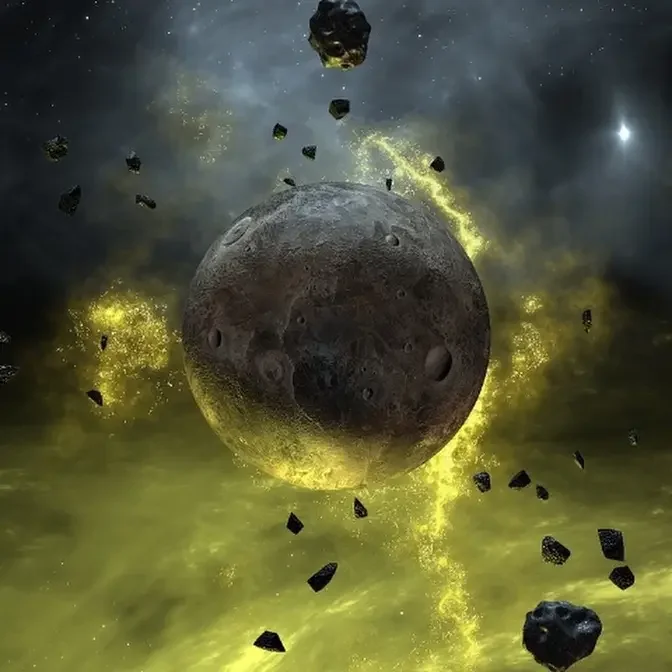
For decades, the idea of parallel universes belonged mostly to science fiction. But now, some physicists believe there may be a way to detect evidence that our universe has interacted with other universes beyond our own.
According to new theoretical research, the cosmos may contain hidden regions of reality existing alongside our universe. These "other universes" could leave subtle fingerprints on the structure of space, time, and even the quantum world. If true, the strange patterns we observe in the universe today might not have originated here at all.
This raises a mind-bending possibility: everything we see around us may be part of a much larger cosmic system, where multiple universes coexist and occasionally influence one another.
Could unexplained features of our universe be messages from beyond our cosmic horizon? Could reality itself be far bigger than we ever imagined?
Scientists are still testing these ideas, and no direct evidence has been found yet. But if even a fraction of these theories turn out to be correct, it would completely transform our understanding of existence and our place in the cosmos.
The universe may be stranger than science fiction ever imagined.
AI Generated·May contain errors
Video Summary
AI Generated
Recent quantum experiments suggest that parallel realities may not be isolated, but instead subtly influence one another. By reversing quantum evolution, scientists have found that \"collapsed\" possibilities must still exist to allow a system to return to its original state, supporting the Many-Worlds Interpretation where reality branches rather than disappears.
In a recent experiment, scientists found evidence suggesting that parallel realities may not be completely isolated from one another.
If the interpretation is correct, events occurring in other quantum branches could subtly influence what happens in our own reality.
As many of us already know, scientists can send a single photon through two different paths at the same time.
But something strange happens when one of those paths is measured.
The photon suddenly appears to choose a single path, while the other possibility collapses and seemingly ceases to exist.
For decades, physicists have debated what really happens to that other path.
Does it truly disappear, or does it continue to exist in another reality?
But then scientists performed an even more shocking version of the experiment.
They designed the system in such a way that they could reverse the quantum evolution and bring the photon back into its original state again.
And this created a deeply disturbing question.
If one of the photon's possible paths truly disappeared after measurement, then how could the original quantum state return again when the process was reversed?
And how could the two different paths of the photon begin influencing each other once more to recreate the original interference pattern?
Scientists now believe this experiment may be revealing something extraordinary about the nature of reality itself.
What if reality is not being shaped only inside our universe?
What if other versions of reality, other universes entirely, are quietly influencing what happens here?
This sounds impossible at first, like pure science fiction.
But the shocking part is that this idea is emerging directly from real quantum physics.
And one simple thought experiment involving a man named Bob and a pair of sunglasses may help explain why.
The idea was recently discussed by Oxford physicist Flacco Vedril in a fascinating article exploring one of the strangest consequences of quantum theory.
According to this view, when you observe reality, you are not necessarily changing the universe.
Instead, reality may be changing you.
That may sound like wordplay, but it leads to a possibility so bizarre that even many physicists struggle to fully accept it.
Because according to quantum mechanics, multiple versions of you may exist simultaneously.
And under certain conditions, those different realities could interact.
To understand why scientists are even considering such an idea, we first need to go back to one of the most famous experiments ever performed, the double-slit experiment.
Scientists first realized something was deeply wrong with reality through the famous double-slit experiment.
In simple terms, when tiny particles like photons or electrons are fired through two slits, they behave like waves and create an interference pattern.
As if each particle somehow travels through both slits at the same time.
But the moment scientists try to observe which slit the particle actually passes through, the interference disappears and the particle behaves normally again.
Isn't it surprising that just observing the system changes the outcome?
This created one of the greatest mysteries in science.
What exactly counts as an observation?
Does consciousness collapse reality?
Does the universe somehow know when it is being watched?
Or is something even stranger happening?
Over time, physicists developed different interpretations to explain this mystery.
One of them became known as the many worlds interpretation.
And according to this idea, reality never collapses at all.
Instead, the universe splits.
And this is where the Bob and the sunglasses experiment becomes incredibly important.
This scenario sounds simple, but it reveals something astonishing about quantum reality.
Imagine a photon, a tiny particle of light, traveling toward Bob who is wearing sunglasses.
When the photon hits the surface of the sunglasses, quantum mechanics says something strange happens.
The photon enters a superposition.
In simple language, this means the photon exists in multiple possible states simultaneously.
One version of the photon passes through the lens and enters Bob's eye.
Another version reflects away from the glasses and never reaches him at all.
In normal everyday life, we would assume only one of these outcomes actually happens.
But quantum mechanics says both possibilities mathematically exist together.
And this creates two different versions of Bob.
In one branch of reality, Bob sees the photon.
In another branch, Bob never sees anything.
The photon and Bob become entangled, meaning their realities are linked together.
This is similar to the famous Schrodinger's cat thought experiment,
where a cat can exist in both alive and dead states until measurement occurs.
But now the strange behavior is happening to a person.
One Bob experiences light, the other Bob does not.
Both versions exist inside the mathematics of quantum physics.
And according to the many-worlds interpretation, neither reality disappears.
Instead, reality branches into multiple histories.
Now here comes the truly mind-bending part.
Oxford scientist Flatco Vedral argues that Bob is asking the wrong question if he wonders,
why did I end up in this reality?
Because from the quantum perspective, reality did not change.
Bob changed.
The interaction with the photon created different versions of Bob.
Reality itself remained a larger quantum structure containing both outcomes simultaneously.
This completely reverses the way humans normally think about observation.
We usually believe that we are affecting the world around us.
But quantum theory may suggest the opposite.
The world is affecting and splitting us into multiple versions.
Now comes the idea that shocked many readers of this article.
According to quantum theory, these separate branches may not always remain completely isolated.
Under extremely special conditions, different branches of reality can interfere with each other again.
This process is called quantum interference.
To explain this, the thought experiment introduces another physicist named Alice.
Alice controls the entire Bob and photon experiment.
After Bob either sees or does not see the photon, Alice performs an incredibly difficult operation.
She reverses the interaction completely.
If done perfectly, the entire system returns to its original state before the photon ever touched the sunglasses.
But for this reversal to work, both realities must still mathematically exist.
The universe cannot reverse something that was destroyed.
This means the branch where Bob saw the photon and the branch where he did not see it
must both continue existing together inside the quantum system.
And during this reversal, the two realities effectively interfere with each other.
In other words, another version of Bob influences what happens to this Bob.
That sounds unbelievable, but interference between quantum possibilities is already a normal part of physics.
The double slit experiment itself depends on interference between multiple possible paths.
And the real question is whether such effects could ever happen at larger scales involving humans and entire realities.
However, most physicists think this becomes nearly impossible
because large systems interact constantly with the environment, causing something called decoherence.
Decoherence rapidly destroys delicate quantum superpositions.
That's why humans do not visibly split into separate realities in everyday life.
But according to quantum theory, the branching may still happen invisibly beneath the surface.
And technically, the mathematics does not forbid interference between branches.
It is just unimaginably difficult.
This leads to a haunting possibility.
Could your reality already be shaped by countless invisible interactions with alternate versions of events?
Well, here is another modern example from quantum computers that supports this idea.
Quantum computers use qubits, which can exist in multiple states simultaneously through superposition.
Unlike normal computers that calculate one path at a time, quantum computers can process many possibilities together.
This led physicist David Deutsch to suggest something extraordinary.
When a quantum computer performs a calculation, the computation may actually be distributed across many parallel realities.
In simple language, a quantum computer may work because multiple versions of reality are contributing to the final answer.
This idea is controversial, but quantum computing experiments strongly show that quantum systems behave as though many possibilities exist simultaneously and influence measurable outcomes.
What makes all of this even more fascinating is that experiments over the last few decades keep pushing physics toward increasingly strange conclusions.
One important example is the delayed choice experiment.
In this setup, scientists decide how to measure a photon after it has already entered the experimental apparatus.
Shockingly, the later choice seems to determine whether the photon behaved like a wave or a particle earlier in the experiment.
This creates the eerie impression that future measurements somehow influence past behavior.
Other experiments involving entanglement show that two particles separated across vast distances can instantly share linked properties.
Einstein famously disliked this idea and called it spooky action at a distance.
Even today, scientists still debate what these experiments truly mean.
Some believe reality itself may not be fully objective.
Others think quantum mechanics simply reflects limits in human knowledge.
And some physicists argue that all possible realities genuinely exist simultaneously.
Research has even explored whether other universes could leave detectable marks on our cosmos.
Nothing has been proven yet, but the fact that serious physicists are actively studying these possibilities shows how dramatically our understanding of reality has changed.
A century ago, the universe seemed like a predictable machine.
Today, reality looks more like a vast probabilistic structure filled with overlapping possibilities.
And perhaps the strangest part of all is this.
Quantum physics works perfectly.
Despite how bizarre it sounds, it remains the most accurate scientific theory ever created.
The equations correctly predict experiments with astonishing precision, which means the weirdness may not be a flaw in the theory.
That brings us to the end of this video.
We've done our best to break down this complex idea in a simple and engaging way, and we truly hope you enjoyed it.
If you'd like to support the channel, you can do so through Super Thanks, or by grabbing one of our James Webb telescope image printed t-shirts from our store.
And finally, a heartfelt thank you to all our channel members.
Both old and new, your support means everything to us.