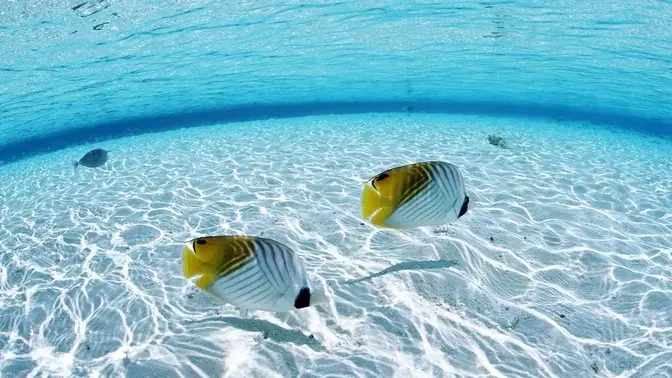
WILD OCEAN | Hidden Sea Creatures In The Most Colorful Ocean On Earth takes you on an extraordinary journey into one of the most vibrant and mysterious marine worlds on the planet, where coral reefs, shallow gardens, open blue waters, and dark abyssal zones reveal the incredible diversity of ocean life. This colorful underwater world is home to some of nature’s most fascinating creations, each shaped by evolution to survive through beauty, intelligence, camouflage, speed, cooperation, and power.
In this documentary, we explore the hidden creatures of the ocean, from clown fish living safely among venomous anemones to reef sharks patrolling coral kingdoms, parrot fish shaping tropical beaches, octopuses changing their skin like living shadows, and manta rays gliding through the open sea with majestic grace. Every creature plays a vital role in maintaining the fragile balance of marine ecosystems.
Through stunning 4K cinematography and immersive storytelling, the film reveals how sea creatures hunt, hide, protect their young, build habitats, and survive in some of the most beautiful yet dangerous environments on Earth. Witness the secret world of coral reefs, the intelligence of cephalopods, the peaceful movement of ocean giants, and the glowing mystery of abyssal life.
But this colorful ocean world is under threat. Coral bleaching, plastic pollution, habitat loss, and human pressure are changing the future of marine life across the planet.
Discover the hidden creatures of the most colorful ocean on Earth and explore nature’s wonderful creation like never before. #seacreature#lifeofthesea#oceancreature
AI Generated·May contain errors
Comments are disabled for this video.
From above the ocean looks endless and calm. A blue world of rolling waves,
pale sunlight and distant horizons. It surrounds continents, shapes coastlines,
carries clouds across the planet and hides a world far older than humanity itself.
But calm is not the same as peace. Beneath the surface, every shadow has a purpose
and every movement has meaning. A ripple may be nothing,
or it may be the first sign of a hunt beginning in silence.
A school of fish may turn as one body, not because it chooses to,
but because something unseen has entered the water behind it.
In the wild ocean, survival is never guaranteed by size alone.
The largest animals can still be vulnerable,
the fastest can still be trapped and the strongest can still be exhausted.
Here, life belongs to those that can read the water and sense danger before it arrives.
It belongs to those that can act in the narrow space between instinct and death.
In this vast world, survival is not a single skill. It is a constant act of adaptation,
shaped by predators, hunger, movement and the endless pressure of the sea.
This is a world of beauty, but also a world of pressure.
It is a world of coral cities, open water deserts and predators that hunt as living teams.
To understand the ocean, we must first understand one of its most powerful truths.
In the sea, raw power can shape a battle, but survival often belongs to the creature
that waits for the right moment. It belongs to the one that reads the movements around it
and turns patience into a plan before the attack begins.
Few hunters reveal this truth more clearly than orcas,
animals whose intelligence has made them one of the most formidable forces in the ocean.
They are often called killer whales, but they are not whales in the way most people imagine.
They are the largest members of the dolphin family, highly social, deeply intelligent
and capable of learning from one another across generations.
An orca is powerful enough to dominate almost any environment it enters.
Its body is built for speed, endurance and force, while its jaws are lined with strong teeth
and its senses allow it to move through the water with frightening precision.
But its greatest weapon is not its size or its bite. Its greatest weapon is the pod.
Orcas do not hunt like solitary predators drifting through the sea and waiting for luck.
They hunt like families with memory, communication,
patience and a sense of timing refined through experience.
They can separate roles, pressure, prey from different angles
and change their tactics depending on the animal in front of them.
Some orcas specialize in fish, while others specialize in marine mammals.
Transient orcas, also known as bigg's killer whales, are among the most formidable hunters
in the ocean. Seals, sea lions, porpoises, dolphins and even young whales can become their targets.
They approach in silence and watch before they strike. One orca may distract the prey,
another may block escape, while a third waits for the exact second when the prey turns the wrong way.
They are not reckless because they do not need to be.
In their world, a hunt is not only a chase, but a calculation made by many minds moving as one.
This patience is what makes them different from many other predators.
A shark may rely on surprise and force, while a fast fish may depend on speed.
But orcas often turn the entire environment into part of the hunt.
They use distance, silence, pressure and timing as if each one were a weapon.
In cold northern waters, this kind of intelligence becomes especially dangerous
because every mistake costs energy and every injury can change the fate of the group.
And yet, even for orcas, not every hunt is easy because sometimes the prey is strong enough to
fight back. Ahead of them is a massive male stellar sea lion and he is not ordinary prey.
Stellar sea lions are the largest sea lions on earth and a mature male is built like a heavyweight
fighter. Compared with smaller sea lions such as the California sea lion, he is broader, heavier
and far more intimidating. His neck is thick, his shoulders are powerful and beneath his skin lies
dense muscle, heavy bone, thick blubber and a body designed to survive cold violent water.
He does not look fragile because he is not fragile. A male stellar sea lion is armed with huge teeth
and powerful jaws and a clean bite can tear flesh, break through tissue and cause serious injury.
In water, he is also more maneuverable than his size suggests. He can twist, turn and face his
attackers with shocking speed making him dangerous to any predator that approaches from the wrong
angle. To a careless hunter, he is not just prey but a risk. To an orca that comes too close at
the wrong moment, he can be costly. For an animal like this, survival is not passive. He does not
simply flee and hope the hunters lose interest. When cornered, he turns into the threat, faces
the attack and forces the orcas to respect the danger of his jaws. His size gives him endurance,
his body gives him protection and his aggression gives him a chance. Against a weaker predator,
those advantages could be enough to survive. A direct attack would be too risky. The orcas have
to wear him down first. The sea lion is alone but he is not helpless. He is a warrior in the water
and now the hunters begin to circle. The stellar sea lion is no easy prey. Armed with huge teeth
and powerful jaws, he can inflict serious wounds on any orca that comes too close.
In the water, he is also more maneuverable than the larger hunters. Even under attack,
he turns toward them, chases them and snaps back with dangerous force.
The orcas cannot simply rush in. First, they have to wear him down. They strike with crushing rounds
then pull away and regroup before attacking again. Each hit is carefully timed to weaken his body
without giving his jaws a clean target. Several orcas distract him while another moves in for a
safer blow. At times, they leave him alone for a few minutes, allowing the damage to take effect
before beginning another attack. The sea lion keeps fighting for nearly three hours, using muscle,
teeth, endurance and instinct to stay alive. But the pod does not fight as scattered individuals.
It moves with the patience and coordination of a single living force.
In the end, the orcas prevail and the battle reveals a larger truth about the ocean.
Strength may shape the struggle, but strategy often decides how the struggle ends.
The ocean covers most of our planet, but it is much more than a vast body of water.
It is a living system that produces oxygen, stores heat, shapes weather, carries nutrients
and connects life across distances too large for the human mind to easily imagine.
From tropical reefs to polar seas, from shallow coastlines to the open blue,
the ocean is not one world. It is many worlds layered together, each with its own rules,
dangers and forms of life. In its sunlit waters, microscopic plankton drift with the currents
help support the foundation of marine life. Small fish feed in glittering schools,
larger fish follow them, birds dive from above, dolphins rise from below and sharks patrol the
edges. Everything is connected. A single change in one part of the ocean can ripple through the rest.
If reefs collapse, thousands of species lose shelter. If great hunters disappear,
the balance of entire ecosystems can shift. If the smallest organisms decline, the fish that
feed on them suffer. If the fish vanish, predators must move or starve. The ocean is beautiful
because it is alive, but it is also dangerous for the same reason. In the ocean, no meal appears
without a hunt and no journey is free from danger because even the safest place can change with the
next movement of the water. And in the bright waters near the surface, where sunlight makes
the sea appear gentle, the struggle for life is already underway. Near the surface, sunlight
enters the water and transforms the ocean into a place of movement, color and constant activity.
This is where many of the ocean's most familiar travelers live. Dolphins break through the waves,
their bodies flashing silver in the light, and they often seem playful, almost carefree.
But beneath that graceful appearance is one of the most sophisticated minds in the animal kingdom.
Dolphins live in social groups, communicate through sound, and use echolocation to map their
surroundings. In murky water, where eyes alone are not enough, sound becomes a kind of vision.
Clicks travel through the sea, bounce off objects, and return as information, allowing a dolphin to
sense the shape, distance, and movement of prey in a fraction of a second. When they hunt, they often
do not act alone. A school of fish moves through the water like a single shining cloud, and at first
the fish seems safe in numbers. But then the dolphins begin to surround them. One dolphin
dives below, another closes from the side, and a third drives the fish upward toward the light.
The school tightens into a bait ball, spinning in panic as the water flashes with silver bodies.
Then the dolphins strike, rushing through the mass with speed and precision.
This is not random feeding. It is teamwork shaped by intelligence, communication, and timing.
The scene lasts only moments, but it reveals a larger pattern of life near the surface.
Sunlight makes this part of the ocean appear open and generous, yet it also exposes every movement.
Prey can gather in huge numbers, but predators can read those movements from far away. In these waters,
survival often depends on sensing the first change in the rhythm of the group, because once panic
spreads through a school of fish, the hunters have already begun to win. Above the surface,
seabirds watch for the same opportunity. When fish are pushed toward the light,
birds drop from the sky like arrows, and for a moment, air and water become one hunting ground.
Dolphins attack from below, birds strike from above, and the fish are trapped between two worlds.
But not all survival in the sunlit ocean depends on speed. Some journeys are slower,
older, and filled with danger from the very beginning. Sea turtles have crossed the oceans
for millions of years. They migrate across enormous distances, guided by instinct, memory,
and the invisible forces of the planet itself. Many females return to the same beaches where
they were born to lay their eggs. At night, a female turtle crawls from the sea and pulls her
heavy body across the sand. She digs a nest, lays her eggs, covers them carefully, and returns to
the waves. Weeks later, the sand begins to move, and tiny hatchlings emerge into darkness. For them,
life begins with a race. The ocean is only a short distance away, but that distance is filled with
danger. Crabs wait on the sand, seabirds circle above, and fish patrol the shallows. The hatchlings
move toward the brightest horizon, driven by instinct, each one carrying an ancient map
written into its body. Many will not reach the water, and even fewer will survive to adulthood.
Yet those that do will become travelers of the blue world, crossing currents, feeding in seagrass
beds, and returning one day to continue a cycle older than human history. In the sunlit waters,
life seems open and bright, but every wave hides a test. As we move closer to tropical
coastlines, the ocean changes again. The empty blue gives way to structure,
and coral rises from the seafloor in towers, branches, domes, and walls.
Fish move through narrow passages, crustaceans hide in cracks, turtles glide over the reef like
shadows, rays pass across the sand, and sharks patrol the outer edges. A coral reef is often
described as an underwater city, and like any city, it is crowded, competitive, and full of
hidden lives. At first, everything seems peaceful. Colors glow in the sunlight, soft corals wave in
the current, and small fish flicker between shelters. But the reef is not only beautiful,
it is also a place of ambush. Among the most famous residents is the clownfish. Small, bright,
and protected by a dangerous ally, it lives among the stinging tentacles of a sea anemone,
a place that would be dangerous to many animals, but becomes a shelter for the clownfish.
This relationship is one of the reef's many forms of cooperation. The anemone provides shelter,
while the clownfish helps clean it, defend it, and sometimes attract food. Only a short
distance away, another resident waits in darkness. The moray eel hides deep inside a crack in the
reef, with only its head visible as water moves over its gills. It does not need to chase across
open water. It waits until a fish moves too close, and then the eel explodes from the rock.
The strike is fast, sudden, and violent. A second set of jaws, hidden in the throat,
helps pull the prey inward, and in an instant, the reef's beauty reveals its teeth.
Elsewhere, seahorses cling to coral, seagrass, and sponges with curled tails. They seem delicate,
almost impossible in a world filled with hunters, but they survive through patience and camouflage.
Their bodies blend into their surroundings, their movements are slow, and their strategy
is to become almost invisible. On the edge of the reef, reef sharks glide in silence.
They are smaller than the great sharks of the open ocean, but their presence changes everything.
A school of fish shifts direction before the shark even arrives, as if the reef itself senses
the predator moving through it. Across the reef, every creature survives in its own way. The clown
fish finds safety among stinging tentacles, the seahorse vanishes into its surroundings,
the moray eel waits inside the cracks, and the shark moves along the edge like a silent guard.
The reef is not ruled by one kind of strength. It is shaped by many small strategies happening at
the same time. Some animals survive by staying close to danger, others by disappearing into
the background, and others by waiting for a mistake that lasts less than a second.
And the coral itself, though it may look like stone, is alive. It is a foundation built by
countless tiny animals over thousands of years, creating shelter for one of the richest
communities in the sea. But this city is fragile. When water becomes too warm,
corals can lose the microscopic algae that help feed them and give them color.
The reef turns pale, and life begins to weaken. Pollution, overfishing, and careless coastal
development add more pressure, reminding us that a reef may look strong, but it depends on balance.
And balance can break. In cooler coastal waters, another kind of forest rises from the sea floor.
It is not coral, but kelp. Giant strands of algae stretch upward toward the light,
forming golden green columns that sway with the movement of the sea.
Swimming through a kelp forest feels like entering an underwater jungle.
Fish hide among the blades, lobsters and crabs move across the bottom, and octopuses slip into
rocky shelters. Seals and sea lions pass through the forest in search of food, while small sharks
patrol the edges. Kelp forests are not just scenery, they are living architecture, creating
shelter, slowing waves, capturing carbon, and supporting entire communities of marine life.
One of their most important guardians is the sea otter. Sea otters feed on sea urchins,
which can multiply and consume kelp at destructive levels when otters are absent.
By controlling the urchins, otters help protect the kelp. And by protecting the kelp,
they help protect the animals that depend on it. This is how the ocean works. A small predator
can protect a forest, a forest can shelter fish, fish can feed larger hunters, and one missing
piece can change the whole system. The kelp forest reminds us that survival is not always dramatic.
Sometimes the most important battles happen quietly, through balance, pressure, and the daily
work of keeping an ecosystem alive. Beyond the reefs and forests, the seafloor drops away,
the coastline disappears, and there is no shelter left, only open water. The open ocean is vast,
exposed, and unforgiving. Here, animals must travel, hunt, and survive in a world with few
hiding places. For predators, this means covering enormous distances, while for prey,
it means reading danger from every direction. This is the world of sharks. Sharks have existed
for hundreds of millions of years, long before humans, and long before many of the animals we
know today. Their design has been refined by time. They have streamlined bodies, powerful senses,
replaceable teeth, and a nervous system tuned to the smallest signals in the water.
A shark can detect movement, follow scent, and in some species, sense tiny electrical fields
produced by hidden animals. To many people, sharks are symbols of fear, but in the ocean,
they are not villains, they are regulators. By hunting weak, sick, or vulnerable animals,
sharks help maintain balance in marine ecosystems. Their presence can shape behavior even when they
do not attack, causing fish to move differently, turtles to avoid certain areas, and seals to
remain alert. A healthy ocean needs its hunters. Still, sharks themselves are not invincible.
Many species grow slowly, mature late, and produce relatively few young compared with
smaller fish. When too many are removed, their populations can take a long time to recover,
and the effects can spread through the food web. This is why their role is so important. A shark
is not simply an animal with teeth, it is part of the structure that keeps the open ocean from
falling out of balance. But the open ocean is also home to giants that survive in a completely
different way. The blue whale is the largest animal known to have ever lived on earth.
Its body can stretch longer than a city bus, its heart can be enormous, and its voice can travel
through the sea across great distances. And yet, this giant feeds on some of the smallest animals
in the ocean, krill. During feeding season, a blue whale opens its massive mouth and takes in a huge
volume of water filled with tiny crustaceans. It then pushes the water out through baleen plates,
trapping the food inside. The contrast is extraordinary. The largest creature on earth
survives by feeding on life almost too small to notice. Blue whales travel across oceans,
moving between feeding grounds and breeding areas. Some spend long periods alone, crossing distances
that dwarf the scale of human journeys. Their songs move through the water like low thunder,
reminders that the open ocean is not empty, but alive with voices we barely understand.
In this world, sharks and whales represent two different kinds of power.
The shark is ancient precision, while the whale is peaceful scale. One patrols with teeth,
and the other migrates through the blue, feeding by filtering the sea itself.
Both are essential to the story of the ocean, and both reveal the same truth.
Greatness in the sea does not take only one form. Among the open ocean's many forms of power,
orcas still stand apart because they combine strength with intelligence,
speed with patience, and family with strategy. The hunt against the stellar sea lion shows why
they are so formidable. They do not depend on a single attack, and they do not need to
overpower every opponent immediately. They study, adjust, and work together. Some orcas create waves
to knock seals from ice, some herd fish into tight groups, and some have learned how to attack sharks
by flipping them into a state of temporary immobility. Different pods can hunt in different
ways, passing techniques from one generation to the next. Their vocalizations, behaviors,
and hunting patterns can vary like traditions, and in the ocean, this is more than instinct.
It is culture passed through families. An older female can guide a pod through difficult waters,
while young orcas learn by watching how adults move, when they strike, and when they hold back.
The group remembers where prey gathers, when to travel, and how to handle different targets.
This makes orcas more than apex predators moving through the sea.
They are teachers and students, natural strategists, and most important of all,
united families. Their power is not only in the body of one animal, but in the connection between
many. The stellar sea lion fought with everything he had. His strength was real, his defense was
dangerous, and his resistance forced the orcas to be careful. But that is what makes the outcome
reveal so much. The ocean does not always belong to the largest animal, or even to the animal with
the most obvious strength. It belongs to the creature, or the family, that can adapt fastest.
And few adapt like orcas. The wild ocean is powerful, but it is not invincible.
For millions of years, its creatures have adapted to storms, predators, migrations, cold, heat,
hunger, and change. But today, many of the greatest threats come from outside the sea.
Plastic drifts through currents and washes into feeding grounds. Sea turtles can mistake plastic
bags for jellyfish. Birds can feed fragments to their chicks. And fish can swallow particles
too small for us to see. Overfishing removes animals faster than populations can recover.
Sharks are killed for their fins. Some reefs lose the fish that help keep algae under control.
And abandoned fishing gear continues to trap animals long after humans have left. Warming
waters bring another danger. Coral reefs, already under pressure, can bleach when temperatures rise
too high. Kelp forests can shrink when ecosystems lose balance. And prey can move as waters change,
forcing predators to travel farther, or struggle to feed their young.
The ocean may look endless, but every system inside it has limits. When balance breaks,
the damage spreads quickly, as reefs lose their color. Kelp forests thin into empty seafloor.
Predators disappear from their hunting grounds, and ancient migrations begin to fall apart.
And when one part breaks, others feel the impact. Protecting the ocean is not only about saving
beautiful places. It is about protecting the systems that help make life on Earth possible.
Protecting the ocean means protecting the air we breathe, the climate we depend on,
the food webs that support millions of species, and the wildness that reminds us this planet is
larger, older, and far more connected than ourselves. For millions of years, the ocean
has given life the space to change, adapt, and evolve into countless forms. Now its future
depends in part on whether we can understand what is at stake. The ocean is not only a place
of danger. It is a place of memory, movement, and connection. It is a place where giants sing
across the empty blue, sharks patrol ancient roots, turtles return to the beaches of their birth,
and dolphins turn intelligence into motion. Coral cities rise in sunlight, and kelp forests sway
like underwater cathedrals. A sea lion can fight with the strength of a warrior,
while orcas remind us that cooperation can become one of nature's most powerful forces.
Every wave carries a story, and every shadow hides a choice. Every creature beneath the surface
is part of a balance older than civilization. The wild ocean is beautiful because it is alive.
It is dangerous because life is always struggling to continue, and it is fragile because even the
greatest systems can be changed. But its story is not over. Somewhere beyond the horizon,
dolphins are hunting in the light. A whale is singing in the deep blue. A shark is moving
silently beneath the surface. A turtle is crossing an ocean it has never forgotten.
And beneath the waves, the wild ocean continues. Endless, powerful, mysterious,
and still waiting to be understood.