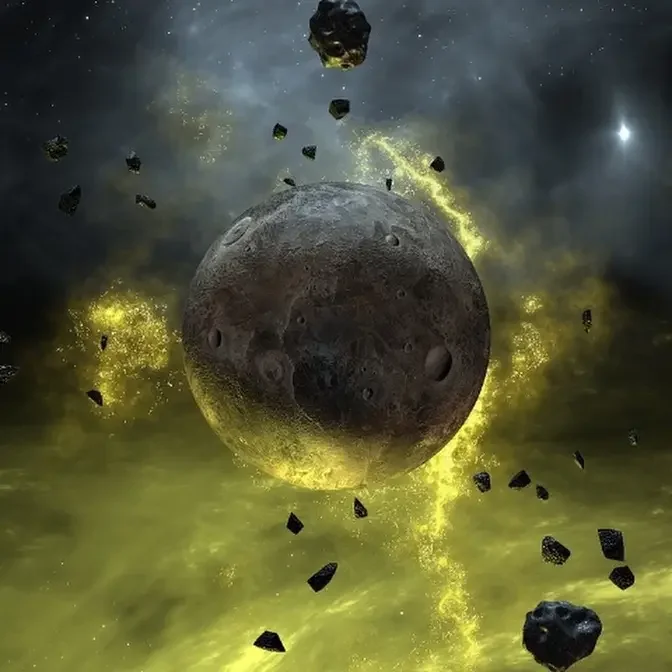
The mass extinction of the dinosaurs 66 million years ago was not a random accident, but the result of a mathematically improbable sequence of coincidences. From the specific composition of the asteroid to the exact location and angle of impact, several rare factors converged to create a \"worst-case scenario\" that collapsed the global food chain and paved the way for the age of mammals.
The asteroid that wiped out the dinosaurs didn't just appear out of nowhere.
For millions of years, it traveled around the sun on an orbit that repeatedly crossed Earth's path.
With every pass, the subtle pull of gravity gradually reshaped its trajectory
until its orbit aligned with Earth's at exactly the wrong moment.
It was a multi-million year game of cosmic Russian roulette,
where every oint was another chance for catastrophe.
Then, 66 million years ago, the countdown reached zero.
At the time, the dinosaurs were the undisputed kings of planet Earth.
And I don't just mean they were doing well for a little while.
They ruled this planet for over 165 million years.
To put that into perspective, modern humans have been around for roughly 300,000 years.
We are a blip.
The dinosaurs were an institution.
They survived shifting continents, wild climate fluctuations,
and the evolution of weird, hairy little mammals that essentially looked like terrified rats.
But then, in the blink of an eye, it was all over.
A rock fell from the sky, and boom.
Farewell giant majestic reptiles.
Hello, the age of mammals, and eventually, us.
For a long time, we just accepted this as bad luck,
a random, unfortunate act of cosmic violence.
But recently, scientists have been looking a lot closer
at the exact circumstances of the Chicxulub impact.
And the more they study it, the more they realize something absolutely wild.
The dinosaurs weren't just unlucky.
They were the victims of a sequence of coincidences so incredibly rare
and so mathematically improbable,
that if the dinosaurs had somehow survived,
they could have legally sued the universe for targeted assassination.
Well, I'm not kidding. I'm entirely serious.
The mass extinction of the dinosaurs was the result of a staggering sequence
of extremely unlucky coincidences.
If even one of the factors we are about to talk about today had been slightly different,
the mass extinction likely would not have occurred.
You and I wouldn't be here, and I'd probably be a highly evolved feathered velociraptor
making a YouTube video about how to properly season a giant ground sloth.
Today, we are going to look at the absolute worst case scenario
that ended the Cretaceous period.
Let's break down the staggering one in a million coincidences that murdered the dinosaurs.
Coincidence number one, location.
Before we get into the crazy math, let's set the scene.
Imagine Mount Everest.
Now, imagine Mount Everest flying through the vacuum of space
at 20 times the speed of a rifle bullet.
That is what was heading toward Earth.
Now, when a rock that big hits a planet, it's going to be a bad day no matter what.
But a bad day doesn't necessarily mean the end of 75% of all life on Earth.
The Earth is huge.
An impact will cause tsunamis, earthquakes, and a massive explosion.
But life is surprisingly resilient.
To cause a global mass extinction, you don't just need a big rock.
You need a big rock to hit exactly the right spot.
The asteroid struck the Yucatan Peninsula in modern-day Mexico.
To a dinosaur, this was just a nice, sunny coastal property.
But geologically speaking, it was a powder keg.
This specific region was exceptionally rich in two things.
Hydrocarbons, which is basically organic matter and crude oil,
and sulfate evaporites.
In plain English, the asteroid didn't just hit solid rock.
It hit the Earth's equivalent of a giant underground matchbox wrapped in dynamite.
When the asteroid made impact, it instantly ignited and vaporized these materials.
This ejected massive amounts of soot, sulfur, and fiery aerosols
straight up into the stratosphere.
This terrifying cocktail wrapped around the entire globe,
acting like a giant, impenetrable blackout curtain.
It blocked out the sun, stopped photosynthesis in its tracks,
and plummeted global temperatures into a brutal, years-long winter.
Here is where the math gets genuinely insulting if you're a dinosaur.
Geologists have calculated that areas with enough of this specific,
explosive, soot-producing rock to cause this level of global cooling
covered only about 13% of the Earth's surface.
Let that sink in.
87% of the Earth's surface was essentially a safe zone.
If the asteroid had hit the deep Pacific Ocean,
or literally almost anywhere else with low organic matter,
there would have been massive local devastation.
The coastal dinosaurs would have had a terrible afternoon,
but the global climate change would have been much, much milder.
The sun wouldn't have vanished for years.
The plants wouldn't have died.
The food web wouldn't have collapsed,
and the dinosaurs likely would have survived.
Imagine a giant cosmic dartboard.
You blindfold the universe, spin it around 10 times,
and it manages to throw a dart that perfectly hits the tiny 13% section
labeled Maximum Global Annihilation.
But it gets worse.
So the universe found the 13% explosive weak spot on the planet.
But hitting the weak spot isn't enough if you don't hit it correctly.
When a space rock hits a planet,
the angle of the strike determines what happens to all that pulverized debris.
If the asteroid had come in straight down at a perfect 90 degree vertical angle,
it would have buried itself deep into the crust,
trapping a significant portion of its explosive energy underground.
If it had come in at a very shallow grazing angle, say 10 or 15 degrees,
it would have skipped across the upper atmosphere
or carved a shallow elongated trench,
dispersing the energy harmlessly into space
and minimizing the amount of rock it kicked up.
But no.
The asteroid came in at a steeply inclined trajectory
of exactly 45 to 60 degrees to the horizontal.
According to supercomputer simulations,
this specific angle was the absolute worst case scenario
because it maximized the vaporization of the Earth's sedimentary rocks.
Let's look at the numbers.
By hitting at this exact 45 to 60 degree angle,
the asteroid ejected 2 to 3 times more climate-altering gases
than a perfectly vertical strike would have,
and it ejected 10 times more than a shallow strike.
Not only did it vaporize the maximum amount of toxic rock,
but that specific angle acted like a cosmic shotgun,
ensuring that the lethal soot and debris were spread perfectly,
symmetrically, and rapidly across the entire globe.
It was the optimal angle for absolute destruction.
It's like the universe didn't just throw a rock.
It lined up a trick shot in a game of billiards and called the pocket.
Now, number 3.
An exceptionally rare slipped asteroid.
Okay, so we have the perfect location and the perfect angle,
but what about the bullet itself?
Our solar system is absolutely full of space junk,
but Earth actually has a built-in planetary bodyguard, Jupiter.
Jupiter is so massive and its gravitational pull is so incredibly strong
that it acts like a giant cosmic goalie.
It catches, deflects, or completely swallows
most of the dangerous distant space rocks
that try to migrate from the outer solar system
toward the inner planets like Earth.
But the rock that killed the dinosaurs wasn't a normal asteroid.
It was an incredibly rare carbonaceous ornan meteorite,
or a CO meteorite,
which originated from the far, cold, dark outer edges of the solar system.
How rare is this? Let's crunch the data.
Out of all the meteorites that fall to Earth today,
carbonaceous chondrites account for less than 5%.
They are incredibly uncommon.
And CO meteorites?
They are just a minuscule, microscopic fraction
of that already tiny 5%.
So, not only did Jupiter, our faithful goalie,
somehow completely miss the block,
but the rock that slipped past was a 10-kilometer-wide,
world-ending monster of a class so rare
that it's essentially a shiny, limited-edition collectible of meteorites.
The astronomical bad luck required for a rock
from the outer rim of the solar system to dodge Jupiter,
navigate the crowded inner solar system,
and hit Earth is staggering.
Jupiter had one job, and 66 million years ago,
Jupiter apparently took a coffee break
at the worst possible moment in planetary history.
Now, let's look at the fourth coincidence,
the worst possible time of year.
At this point, the universe has rolled the dice three times
and hit the jackpot of destruction every single time.
Rare rock? Check.
Optimal vaporization angle? Check.
The 13% explosive sweet spot? Check.
But the cosmos wasn't quite done.
The universe looked at the dinosaurs and said,
let's make this personal.
In recent years, paleobotanists and fossil experts
made a groundbreaking discovery
by studying a fossil site in North Dakota called Tannus.
This site captured a mass grave of fish
that died literally on the exact day of the impact,
buried alive by a massive surge of water.
By looking closely at the microscopic growth rings
in the bones of these fossilized fish,
which grow differently depending on the season,
much like tree rings,
scientists figured out exactly what time of year the asteroid hit.
It struck during springtime in the Northern Hemisphere.
Spring is the single most critical, sensitive season for biology.
It's when animals come out of winter dormancy.
It's mating season.
It's when creatures lay their eggs, give birth,
and expend all their stored energy foraging
to feed their highly vulnerable newborn offspring.
Striking during this specific biological window
meant the impact couldn't have come at a worse time.
Imagine you're a dinosaur in the Northern Hemisphere.
You've just survived a cold, lean winter.
You finally found a mate.
You just laid a clutch of eggs.
You are completely exhausted, hungry,
and trying to gather food for your babies,
and then the sky catches fire and blocks out the sun.
Because it was spring,
the flora and fauna were at their absolute most vulnerable.
The Northern Hemisphere species suffered devastating,
immediate population collapses.
They didn't have winter fat reserves built up.
Their young were entirely unprotected
and unable to fend for themselves.
Now, let's put all this together
and look at the sheer, undeniable, mathematical absurdity of this event.
Let's do some simple cosmic accounting.
First, you have a 13% chance of hitting
the exact explosive rock formation
required to cause a global winter.
Next, you need the perfect angle.
Let's be generous to the universe
and say there was a 25% chance of the rock
hitting at that specific, highly lethal
45 to 60 degree trajectory.
Then, the rock itself.
A massive, incredibly rare CO meteorite
from the outer solar system
successfully dodging Jupiter's gravity.
That is easily less than a 1% chance.
Finally, the season.
It hits exactly in the worst possible part of the year
for the Northern Hemisphere,
which is a 1 in 4 chance, or 25%.
If we multiply those probabilities together,
that is roughly a 0.008% chance.
That is about a 1 in 12,000 chance
that this specific asteroid hitting at this specific angle
in this specific location
at this specific vulnerable time of year
would happen perfectly in sequence.
If literally any of those variables had changed,
if the rock arrived just 30 minutes later
and the Earth had rotated just enough
to put the deep waters of the Atlantic Ocean in the crosshairs,
if it hit in autumn instead of spring,
if it came in straight down,
if Jupiter had just been slightly to the left in its orbit,
the global temperature wouldn't have plummeted quite so far.
The food chain wouldn't have collapsed completely.
The non-avian dinosaurs might have limped through the disaster,
recovered, and maintained their 165 million year grip on the planet.
So, the next time you feel like you are having a string of really bad luck,
just take a deep breath.
Look up at the sky.
And remember, at least the universe didn't line up
a 1 in 12,000 cosmic trick shot
just to personally vaporize you and your entire species.
We must take a stand against this injustice.
The asteroid was not an accident.
We demand a voice.
We silenced.
We will not be silenced.