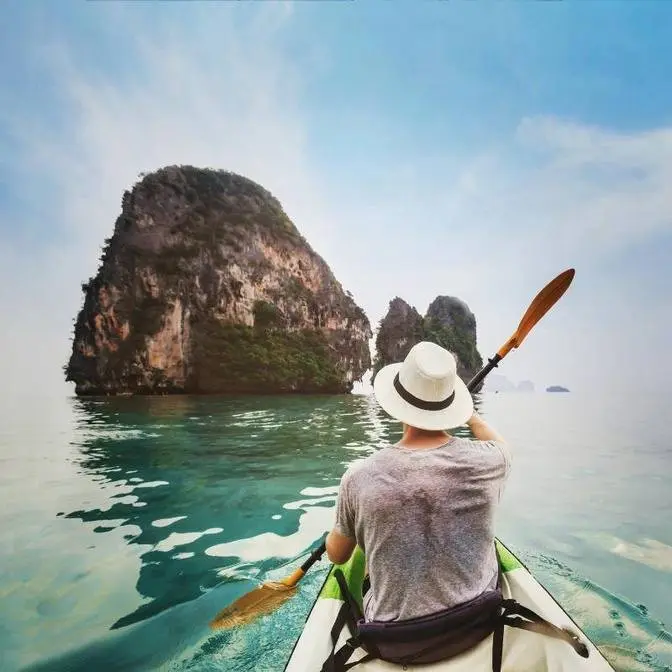
#travel Living in Seychelles | I Never Expected This in the World's Most Beautiful Islands | 4K DocumentaryWhat is it really like living in Seychelles, one of the most beautiful island destinations on Earth? At first glance, Seychelles looks like the definition of paradise — crystal-clear water, white-sand beaches, tropical forests, and islands scattered across the Indian Ocean. But behind the postcard-perfect scenery is a way of life that may surprise you. In this cinematic 4K travel documentary, we go beyond the beaches to discover what everyday life in Seychelles is really like. Explore local communities, island culture, traditional lifestyles, beautiful coastal towns, and the unique relationship people have with the ocean. From the vibrant streets of Mahé to remote islands surrounded by turquoise water, discover the beauty, challenges, and unexpected realities of living in Seychelles. What is life like when paradise is your home? Is island living really as perfect as it looks? And what are the things tourists never get to see? Join ExtremeX Travel on a journey through Seychelles and discover the hidden side of one of the world's most extraordinary island paradises. If you enjoy travel documentaries, island life, tropical destinations, hidden places, and cinematic 4K journeys, subscribe to ExtremeX Travel for more incredible destinations around the world.
This is Seychelles, an isolated archipelago out in the ocean,
thousands of kilometers from the African mainland,
with a total landmass smaller than many cities on earth.
An archipelago that had no permanent human residence at all until 1770.
And yet, in fewer than 250 years since,
it's become the wealthiest country in Africa by per capita income,
despite having a population of just over 100,000,
the smallest of any country on the entire continent.
What's even more remarkable, that wealth didn't come from oil or minerals,
but from tuna fishing and beaches often considered among the most beautiful on earth.
So how did an island this small pull that off?
Seychelles is an archipelago of 115 islands,
scattered across the Indian Ocean, northeast of Madagascar.
But not all its islands are alike.
Two entirely different island types coexist within a single country.
Around 42 inner islands, including Mahé, Praslin, and Ladigue,
are made of ancient granite, actual surviving fragments of the supercontinent Gondwana.
Which broke apart hundreds of millions of years ago.
Meanwhile, roughly 73 outer islands, like Aldabra and the Amarantes group,
are low-lying coral islands, formed through a completely different process.
And there's a scale paradox here that catches nearly everyone off guard.
Seychelles' total land area is just 459 square kilometers,
smaller than many cities in the world.
Yet the exclusive economic zone it manages spans more than 1.35 million square kilometers,
larger than the entire land area of France.
Because of that, Seychelles' officials have chosen to describe their country
not as a small island nation, but as a large ocean state.
On Ladigue Island sits what's often considered the most photographed beach in the world,
Anse Source d'Argent.
Massive granite boulders, smoothed over millions of years by ocean waves,
divide the beach into separate little pools,
each catching a different quality of light as the sun rises.
On Praslin Island sits a small patch of primary forest,
less than 20 hectares in size, yet designated a UNESCO World Heritage Site since 1983.
It's the only place on Earth where an intact forest of one remarkable tree species still survives,
the Coco de Mer, or sea coconut palm.
This tree produces the largest and heaviest seed in the entire plant kingdom,
weighing over 20 kilograms each, with a shape that makes plenty of first-time visitors blush.
And there's a fascinating historical story tied to this very forest.
In 1881, a British general named Charles Gordon visited Vallée de May
and became completely convinced it was the biblical Garden of Eden,
believing that the seed's distinctive shape was actually the true forbidden fruit
from the story of Adam and Eve, not an apple as commonly assumed.
Locals also passed down another folk legend, claiming that on stormy nights,
male and female Coco de Mer trees will actually move toward each other to mate,
and anyone who witnesses it is said to suffer bad luck.
Thousands of kilometers to the south lies the world's second-largest coral atoll, Aldabra.
Its isolation is so extreme that the entirety of Mahé, Seychelles' largest island,
could actually fit inside Aldabra's own lagoon.
That total isolation has turned Aldabra into a living laboratory of evolution,
home to more than 400 endemic species and subspecies found nowhere else on Earth.
Most notably, it holds the largest population of giant tortoises anywhere in the world,
an estimated 100,000 individuals,
more than five times the famous population found in the Galapagos.
But did you know that number, 100,000, once nearly dropped to zero?
In 1874, none other than Charles Darwin himself intervened,
helping campaign to protect these tortoises from being hunted to extinction for meat,
an act that saved an entire population of these massive creatures, one that survives to this day.
And giant tortoises aren't the only thing that makes Seychelles biologically remarkable.
Hidden deep in its dense forests lives a crab with a leg span exceeding one meter,
the largest land-dwelling arthropod on Earth.
Affectionately nicknamed Crabzilla by locals,
this crab is strong enough to crack open a whole coconut using nothing but its own claws
and is mostly active at night, making a chance encounter with one
a genuinely startling experience for first-time visitors.
Unlike most countries in the world, Seychelles had no permanent population at all until 1770.
In other words, every resident living in Seychelles today
descends from settlers who arrived within the last 250 years,
making it one of the youngest societies on Earth in terms of settlement history.
The French were the first to establish a formal settlement,
bringing along both African and Indian laborers.
But behind that story lies a painful chapter that can't be avoided.
Seychelles' early plantation economy, cotton, later coconut and spices,
was built almost entirely on the forced labor of enslaved Africans and Malagasy people,
funneled through the slave trade networks of the wider Mascarine Islands region.
After the Napoleonic Wars, control of the islands passed to Britain,
formalized by the Treaty of Paris in 1814.
When Britain enforced the abolition of slavery in the 1830s,
plantations lost their forced labor supply,
pushing the economy to shift toward less labor-intensive crops, coconut, vanilla and cinnamon.
And there's another chapter of Seychelles' history, one with a much more adventurous flavor.
During the golden age of piracy, Seychelles' isolation
and countless hidden coves made it an ideal hideout for pirate crews operating across the Indian Ocean.
Even today, legends of buried treasure are still passed down,
especially on the tiny island of Moyenne, where amateur treasure hunters
still believe part of an unrecovered pirate horde remains buried somewhere beneath the sand.
And here's a question for you.
If you were free to dig up a small island in search of pirate treasure,
would you take your chances?
Drop your answer in the comments.
Seychelles officially gained independence at midnight on June 29, 1976.
But that young independence barely had time to settle
before a bloodless coup just a year later, in 1977,
plunged the country into a period of one-party socialist rule.
It wasn't until the early 1990s, under both domestic and international pressure,
that Seychelles officially transitioned to a multi-party system,
holding its first multi-party presidential election in 1993.
And most recently, the country witnessed another notable transfer of power.
In the October 2025 election, a completely peaceful transfer of power took place,
as the opposition candidate won by a narrow margin of 52.7 percent
to the incumbent president's 47.3 percent,
a testament to the stability of a democracy that once endured a period of single-party rule.
Alongside that transfer of power, Seychelles also marked another milestone,
for the first time in its history, a woman was elected Speaker of the National Assembly.
If vanilla and cinnamon were once Seychelles' signature exports,
today its economy actually rests on two entirely different pillars, tourism and tuna.
Port Victoria, the capital of Seychelles,
is one of the busiest tuna transshipment ports in the world.
Every year, it processes roughly 200,000 tons of fish,
with nearly 87 percent of all tuna caught in Seychelles' waters passing through this very port.
And right in the capital, Victoria, sits a tuna canning factory
that happens to be the country's single largest private employer.
This factory employs around 1,800 workers,
a massive figure for a country with just over 100,000 people,
and it ranks among the largest tuna canneries in the entire Indian Ocean region.
In July 2026, Seychelles signed a new tuna fishing agreement with the European Union,
allowing European vessels to continue operating in these waters
in exchange for significant financial support for the domestic fishing industry.
Beyond tourism and tuna, Seychelles has also built a third economic pillar,
offshore financial services.
For years, its model for registering international companies
landed it on several international bodies' lists of financially opaque jurisdictions.
But under global pressure, Seychelles carried out a wave of legal reforms,
from economic substance requirements to digital asset regulations.
By 2024, the European Union officially removed Seychelles from its tax blacklist,
though it remains under a lower level of monitoring.
But perhaps Seychelles' proudest contribution to the world
has nothing to do with tourism or tuna at all.
It's an entirely new kind of financial innovation.
In 2018, Seychelles became the first country in the world to issue a sovereign blue bond,
raising capital from international investors
to directly fund sustainable fishing and marine conservation projects.
This innovation built on an earlier arrangement,
a debt-for-nature swap carried out in 2015 and 2016,
trading a portion of national debt for marine conservation commitments.
Thanks to these initiatives, by 2020,
Seychelles had officially placed roughly 30 percent
of its entire exclusive economic zone under protection,
a dramatic leap from just 0.04 percent before,
making it a marine conservation model
that many other countries have since looked to as an example.
With a population of just over 100,000,
mostly descended from a mix of African, French, Indian, and Chinese heritage,
Seychelles is a genuinely rare multicultural society.
The native language of nearly everyone here is Seychellois Creole,
a French-based blend shaped by people who arrived from all corners of the world.
Its cuisine reflects a delicate mix of African, French, Indian, and Chinese influences.
Grilled fish with chili sauce, octopus curry simmered in coconut milk and cinnamon,
or a local take on pilau rice.
But perhaps the proudest cultural symbol of the Seychellois people
is a dance carrying an entire history of resistance within it.
The Mutia dance was created by enslaved Africans as a form of silent defiance,
danced around fires at night to the rhythm of goat-skin drums warmed over flame.
Colonial authorities and the church alike tried to ban it,
yet it survived generation after generation,
and in December 2021 was officially recognized by UNESCO
as an intangible cultural heritage of humanity.
Every October, the Creole Festival turns the entire country into a vibrant cultural stage,
drawing artists from Creole-speaking communities worldwide,
from Mauritius and Réunion Island, all the way to the distant Caribbean.
But behind the vibrant beauty of Seychelles' ocean
lies a quiet battle that locals here are now facing.
Severe coral bleaching events struck in 1998, 2016 and most recently in 2024,
wiping out much of the coral cover that existed back in the 1990s
and weakening the reef's natural ability to shield the coastline from waves and storms.
But not every conservation story in Seychelles centers on hardship.
One small island has written one of the most remarkable species recovery stories in the world.
Cousin Island, purchased by an international conservation organization in 1968,
became the world's first nature reserve owned by an international body.
By the late 1960s, an endemic bird, the Seychelles warbler,
had dwindled to just 26 individuals worldwide,
all confined to this single small island, thanks to sustained conservation efforts
that population has since rebounded to the thousands now spread across multiple islands.
Another species, the Seychelles magpie robin, faced a nearly identical brush with extinction,
down to just about 14 individuals before recovering through much the same process.
And there's a fascinating detail about this island.
Hawksbill sea turtles, critically endangered worldwide, actually nest during daylight hours
on Cousin, unlike nearly every other hawksbill population on Earth,
which nests exclusively at night to avoid danger.
In response, local conservation groups launched the Reef Rescuers Project,
growing and transplanting coral across several sites around Praslin,
while also researching heat-resistant coral strains for future planting.
And it's not just underwater.
Seychelles land has seen an equally remarkable recovery.
The jellyfish tree, a rare plant once believed completely extinct,
was unexpectedly discovered still surviving on Mahe Island,
making it one of the most endangered plant species left on Earth.
But this isn't simply about preserving or losing a beautiful ecosystem.
For thousands of years, these very reefs have served as a natural breakwater
for Seychelles' entire coastline.
And as that protective barrier fades away,
the consequences will fall directly on the people living right along the shore.
Because Seychelles' granite islands are mostly mountainous,
yet most of the population lives right along the coast,
the country faces a genuinely serious risk.
An estimated 90% of the population, along with most critical infrastructure,
roads, the airport, hotels, all sit within just a few meters of sea level,
leaving the entire nation extremely vulnerable to rising seas and coastal erosion.
2025 was a record year for Seychelles' tourism industry.
With international arrivals surging compared to the year before,
surpassing the previous year's total in just 11 months.
But at the same time, this small nation is also grappling with a sensitive geopolitical question.
On the remote island of Assumption,
plans for a foreign-funded facility have sparked domestic controversy.
Some fear it could become a foreign military base, threatening national sovereignty.
The government, meanwhile, maintains that any facility built there
would remain fully under Seychellois command,
with no discussion whatsoever of leasing the island for military purposes.
Clearly, even a small, peaceful nation like Seychelles
can't escape weighing the benefits of development against protecting its own sovereignty.
We mentioned earlier a type of granite formed 750 million years ago,
older than the first life on land itself.
And in that very same place, the first humans arrived less than 250 years ago,
a moment almost negligible compared to the age of the very islands they now stand on.
That may well be the most remarkable thing about Seychelles.
This is a land where no one can truly claim to be the sole, first, or native people.
Everyone here arrived afterward, carrying languages,
religions, and cuisines from far-flung corners of the world.
Yet from those brought here in chains, to those who came seeking these waters willingly,
together they built a dance of their own, a language of their own,
and a way of living in harmony with the ocean found nowhere else on earth.
Perhaps a place doesn't need a single point of origin
to become a true home for so many different people.
Thanks for joining Xtreme X travel on today's journey to Seychelles.
Drop your thoughts in the comments below,
and don't forget to subscribe to keep exploring the world with us.