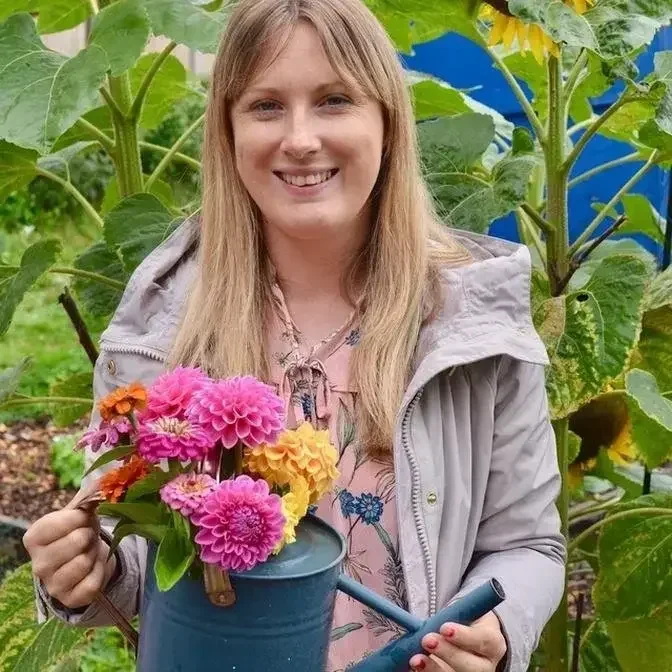
Emma details her autumn allotment activities, focusing on infrastructure upgrades and seasonal planting. She discusses optimizing pathways with quality wood chips, implementing rainwater harvesting to combat drought, and managing compost. The video also highlights the emotional benefits of gardening and specific techniques for sowing autumn carrots to ensure successful germination.
I think that was a frog. I think that was a frog.
Right, I'd like to sow some more carrots today.
There's a spider in there. Can you see one?
What a weird few days I've had. What a weird few days. How are you all? I hope you had a
lovely weekend. Welcome back to my allotment diaries. My name's Emma. I'm currently walking
through the jungle to my allotment plot. There's this really lovely kind of wooded pathway that
I have to come through. It takes me completely out of London life. It makes me feel like I'm
in the middle of the countryside and I love it. I'm just going to stop at the top here and have
a little look at the quality of that wood chip. There's quite a big pile of wood chip there,
which I want to use to top up my pathways, but I want to check the quality of it. Make sure that
there's more sticks than leaves, basically, because sometimes it can be full of leaves.
And though I love leaves, and leaves are very useful in the garden, they're not very useful
on a pathway because they will just disintegrate very quickly. Also a little bit creepy walking
past the woods every morning, but you know what? Let's just, you know, positive thoughts.
There's no bears in the UK. That's a pretty positive thought, to be fair. This, I have to say,
is my favourite autumnal tree. Every year it turns into the most gorgeous golden colour,
but this year, because of the drought, it's already dropped most of its leaves, so it's
got hardly any leaves on it. It's just, it's so sad. I look forward to this tree every autumn.
Right, here are our great big piles of wood chip. One, two, three, looking fantastic. No one's really
taking it much at the moment, so it's all mine. There are quite a few, so this is like one of
those holly bushes, holly trees. There are quite a few leaves in this one. Though there is some
wood chip in between the leaves, there are quite a lot of leaves. This is better because the chips
are quite chunky. All of this will disintegrate if you use it on pathways. It will all kind of
rot down, biodegrade. It's natural material, so it's not going to last forever. But of course,
the bigger the chips are, the longer they're going to take to sort of biodegrade or break
down into nothingness. I don't know what the word is. Biodegrade, breakdown, disintegrate,
whatever it is. I mean, all of the above, really. This looks better because it's quite chippy,
but if I dig a little bit, you can see it's already sort of starting to compost down,
and that's the leaves. This here, where it's all starting to sort of look compost down like that,
that's leaves. So the leaves aren't a good thing, basically. They keep it damp, they keep it wet.
I always find that the more leaves there are, the worse the pathway sort of looks. But I think
on the whole, this pile looks pretty good. There was also just one more thing I wanted to check
out here. I hope no one's watching me chatting to myself on a camera. So my friend Emma has this
plot at the front, and she's got a greenhouse. And attached to her greenhouse, she's got like
her water collecting system. I just wanted to see, because her polycarbonate greenhouse is pretty
much the same as mine, and it's quite clever. Yeah, look at this. You see what I mean? So
she's got one of these on every single corner of her greenhouse. I have no idea what this is.
So if you know what this is, because I'm going to contact her and ask,
if you know what these are and how I can buy them, please let me know. She's got the tube going
through, which then attaches up onto the guttering, which is sort of inbuilt into the greenhouse. And
I think I've got this as well. I'm going to have to check when I get back to mine. But this is the
system I'm looking for. It's quite a clever way of collecting water without having to have like a
great big... Those parakeets are noisy, aren't they? Without having to have a great big water
butt. I think this is more space saving, but also very effective. She has another one as well,
just sort of a big barrel filled with water. And then she's got a little sort of hose thing
attached to the end of it. So that's also quite clever. Yeah, that's very clever. So one of my
big jobs over the autumn time will be to collect water, and to have as many different water
collection points on my allotment plots as possible. Obviously this year with the drought,
it was just really difficult to water my plot. And even though I've got the hose pipe now,
and we didn't technically have a hose pipe ban here, I still think collecting water is probably
going to be something really important to do. This is currently where I'm getting my water from. So
it's sort of attached to the mains and we pay for water at this allotment plot. But also there's a
great big sort of trowel here. It sort of collects water from the rain and I think has an overspill
or something like that. I don't know the technical mechanics of it, but this is where I'm currently
getting my water. But we pay for this water and the tap gets turned on and off. So the water gets
turned on and off depending on the time of year. But this water in here is always available.
Good morning guys. Welcome back to my allotment diaries. My name's Emma. These are my allotment
diaries. Yeah, just really interesting on the way in to have a little look at what other people
are doing to collect water. There are obviously many, many ways of doing it. But it's something
that I'm definitely going to be putting in to this allotment plot over the autumn time. One of my big
jobs basically. And doing it properly and making sure that the water that I collect is water that's
not going to evaporate away. And that is actually going to substantially kind of collect enough of
to hopefully last me through the spring summer. Though a lot of you have warned me that because
of the drought this year, you've collected a lot of water yourselves and even you guys are running
out of it. So, but I think anything will help. Anything is better than nothing. And obviously
rainwater is really, really good for our plants. I mean, you only have to look at my allotment to
see how much better it's doing. Now we've had rain. Everything always just looks better and
lush after the rain, doesn't it? So rainwater is really what I want. And also for topping up my
wildlife pond. And I think that's the reason, the reason why my wildlife pond gets that kind of
green algae pond weed top to it is because I'm filling it up with tank water, with the tap water.
And I should be filling it up with rainwater. So that's another thing that I can use it for. But
let me see the edge of my greenhouse and see if it's got the same things that Emma's plot's got.
It has, it has, this is what it's made for. So I need to get some of that tubing. So this here is
my guttering. So I have to clear the guttering, obviously, and sort it all out. And then it's
got the little tube thing that can go down into some kind of water butt. So she's literally got
the same greenhouse as I have. So maybe I'll just have to ask her where she got those things from.
And if you know, just leave me a comment because I don't think she's been here this year.
But yeah, that is really good to know. I was thinking wouldn't it be nice to have one of those
little metal kind of water tank things that could turn into a pond at one side of the greenhouse as
well. Maybe this side where the carrots are. Imagine having a little sort of metal tank
that could sort of act as a wildlife pond and a dipping tank and be connected to the greenhouse
guttering to top it up all the time. I think that would be great. I think that was my original plan
for the side of the greenhouse. So we might have to revisit that in the autumn as well.
I've come to the plot today with my head absolutely spinning with ideas and things
that I want to get done over the autumn time. And I just have to share it all with you. Today,
I'd very much like to visit the compost heap. It hasn't rained for a couple of days.
So it should be a little bit easier to manage and to chop up. So I find compost really hard.
It's really difficult when it's too dry. But when it's been raining, and then it's been dry for a
couple of days, that's the perfect time to sort of visit the compost. So what I want to do is go and
have a look at it. So obviously, compost is not my not my specialty at all. I've tried for a long
time to get these compost heaps working productively. I think there might be some
compost under the underneath this one. This is my oldest compost. And I do think at the bottom of
it will be something I can use. So I think today the plan is going to be to chop up this one,
and then to chop up this one and move most of it into this one. So I can get to the bottom of this
one. Does that make any sense at all? I think this one's mainly full of sweet peas. And these are all
of my old, old sweet peas. There's some seeds in here as well, which I could technically collect.
So I've got a lot of them already. I think it's just over the summertime, I just lose momentum
with the compost. And when I sort of take things down, I just throw it into the pile,
and without chopping it up and stuff. So let's just give it a good old chop,
and then we'll just sort of figure it out from there.
I feel like there's got to be a better tool for cutting up compost. It's, it's dried, but it's
also still a little bit wet inside. And these shears really struggle to go through wet things.
If it's bone dry, straight through it. But if it's got a little bit of moisture to it,
it just really struggles. And because it's such a big pile, there's got to be an easier tool,
some kind of like slashing, cutting tool or something. I'm going to have a look actually
this weekend and see if I can find something because I don't think I can get through that
pile. I've moved all of this sweet peas into that one. And what I'm going to do is this one here,
we're going to sort of turn it over and see what's underneath it.
Right, let's have a little look what's under here then.
I think that was a frog. I think that was a frog. I think there might be a frog.
I'm pretty sure that was a frog that just jumped out my compost heap. So that's where they've all
gone then in the compost heap. Why would they be living in a compost heap though? For what purpose?
I suppose because there's loads of bugs. It's stayed nice and cool in there. Maybe it's been
damp underneath. I keep seeing the grass move. I know he's in there somewhere. I don't want to sort
of terrify him, you know. I don't want to freak him out too much. But yeah, so the frogs must have
gone into the compost then. Maybe I should be leaving the compost alone. Let's just see if
we can have a look at what's going on at the very bottom and then I'll put it all back.
Now the further I'm going into it, the more I'm just finding uncut compost
bits. There doesn't seem to be a bottom to the compost, if that makes sense. I'm just
turning over more and more crops that haven't sorted out properly. I don't think I'm going
to be able to get through that with my shears. I know what you're thinking. Don't slice up a
frog in there. I don't think, I think they've all hopped out or they're all at the bottom
and I wouldn't worry because these shears can barely go through plant, let alone through a
frog. I'm just really struggling to get through it. It might be that it's just literally too wet.
I don't know, but I'm going to have a little look for another tool because this is just,
this is backbreaking work. I don't feel like it has to be. I feel like I'm just doing,
I'm working harder, not smarter. Basically, I need to work smarter.
So we'll revisit the compost again. It obviously is something that I really want to get sorted
and have a functioning compost heap that I can actually use to mulch my beds. It's just something
I'm struggling with. I've struggled with for a long time. I'm doing my best. Let's revisit it.
Right. I'd like to sow some more carrots today. I've got these ones which are sweet candle F1
and they're supposed to be quite good carrots. I have had so much success with carrots this year.
I cannot believe it. And I think early autumn is a really good time to get them in the ground.
I think carrots are really difficult to grow when it's really hot and sunny because the seeds dry
out very, very quickly and it's hard to keep them watered. It's hard to keep the baby seedlings
watered when it's really hot because they can literally dry out within like an hour. And because
this is an allotment plot and it's not my home garden, I can't be watering it all the time. It's
lucky if it gets the water once a day. Autumn is a great time for carrots. We're going to stick
these in a bed. Also, I've just noticed, do you remember when I accidentally chopped off
some of these green tomatoes? They are actually starting to change colour in my greenhouse.
What tomatoes need to change colour is heat, not sun, heat. And so these have got plenty of heat
in the greenhouse and they're changing colour. So I'm just going to leave them in here and see
how they go. Right. Let's get these carrots in the ground, I think. And we're going to see if
I've got any cardboard to cover them with. Do I have any cardboard? Is that going to be full of
spiders? Definitely going to need my cool job gloves for this. I need to sort this out. Is
there a spider in there? Can you see one? Am I going to freak out? No, just a few webs. All
right, that's okay. So we just need a bit of this cardboard. Not like that. We need that.
Right. So what I'm going to do is soak this cardboard in the water so it's completely soaked.
I've got to leave it for a little bit. Are you stuck in there, woodlice? Oh my gosh.
Oh, I've just made him sink. I think he's dead already. Okay. Oh, that's a shame. This is
basically going to go over our carrots and the wet cardboard will keep the carrot seeds wet for as
long as possible, keep them moist so they don't dry out. And hopefully they'll have more chance
of germinating. Also carrot seeds like pitch black to germinate in. So covering it with cardboard
just ensures that no light gets to the seeds while they are germinating. And that's everything I know
about carrots. Don't ask me. Don't ask me anything else. That's pretty good. I'll be honest. I haven't
had the biggest, the biggest success with carrots here. But I do think that is something to do with
the time of year I was sowing it. I was sowing them a lot over the summer months when it was
too hot. So I have a feeling. I just have a good feeling about it. I think I'm going to get lucky
now it's the autumn time. So it's quite fine. It's got a little bit of horticultural sand in here as
well, which will help the carrots not to fork or hit any rocks. We'll just give it a bit of a water.
Don't we waspy? We're not after you. I'll give it a water before I sow the seeds and then again
after. That wasp is going to keep bothering us. What does it want? Right. Sweet candles. Here we go.
So just pour them into my hand. Oh, they're quite big seeds. You know,
does that mean they're going to be big carrots? Well, I hope so. Sow them. Go away wasp. We're
not after you. We don't care about you. Leave us alone. Right. All right. And I've got some
over in case they don't work because we always need a contingency plan. So then I'm just going
to grab some of that compost over there. It looks quite good. Really, really happy with that. Give
it a bit of a pat down. We'll give it a water. I'll pop over this wet cardboard right over the
top of the bed like this. I might give that water too. I'm really happy with that. I actually feel
really positive about those carrots. So I will keep you updated on their progress.
The flowers on this plot are making me so happy. The cosmos has really come back to life since I
pruned it and took all the dead flowers off and so have the sunflowers. They are just thriving.
These multi-headed sunflowers I think are my absolute favourite because even when the main
flower's gone and it's died and finished, it sends up so many more flowers and they're just
gorgeous. They just keep flowering. There's no signs of stopping.
Look at the amount of sunflower heads here. It's absolutely insane and I love them.
I feel so energised and excited by my allotment again. I wish that I could go back in time and
tell myself in the summer that I would be feeling this way in the autumn time because she wouldn't
believe it. And I think it would really help her. Emma in the summertime was a different person.
She was down. She was not feeling the allotment. Everything was doom and gloom. Nothing was working
for her and I was honestly on the verge of giving this place up. That wasp has followed us in here.
Why? I have nothing for you. Now I just feel so energised. I'm here and I'm just seeing the plot
come together. Everything that I'm doing, I'm seeing the results of and I think that's really
helping. Mulching over beds, planting in new crops, having the rain just make everything grow
again. I just love it here so much. It's just filling me up. Also, coming here really early
in the morning when it's pretty much empty is really helping because all I can hear is the
birds and I'm just really enjoying that kind of time alone here. Even if there are other people
here, they're quite quiet and it's very relaxed. It's very chill in the morning. I would suggest
if you have an allotment plot over the autumn and even into the winter time, try going to your plot
just maybe like 15 minutes before you go to work. There is something so magical about allotment
plots and these spaces. When I walk into my plot now, I'm one of the first people here. The birds
scatter and there's foxes playing out and you know cats are all about and the squirrels are running
everywhere because it's a place for wildlife. It just takes it over and it's just so nice to sort
of be here and be a part of it and see it all. Yeah, I would suggest that you go to your allotment
plots first thing in the morning, as early as you can, as soon as the sun's up and just enjoy it for
15 minutes with a cup of coffee on your own. They're just beautiful, beautiful places and we
must protect them at all costs forever. Anyway, hope you've enjoyed my vlog today. I have no
idea how much I filmed because it was just a very busy day. I'll be back again on Wednesday
so I will see you then. Thank you so much for watching.