GEORGIA: 8,000 Year Old Hidden Gem of the World | 4K Travel Documentary
Forget about Atlanta. Forget about sweet peaches. The Georgia we are exploring today has stood at the jagged crossroads of Europe and Asia for millennia, long before the American South even had a name. It is a fortress of mountains and memory, where winemaking began eight thousand years ago. While empires rose and fell around it, this small nation quietly preserved a culture that feels older than history itself. Welcome to the original Georgia.
► See More: The Real Morocco Most People Never Discover | 4K Travel Documentary • The Real Morocco Most People Never Discove... The Real IRAN Most People Will Never See • IRAN: The World’s Most Misunderstood Place... ►Best Playlist: • Asia Travel Documentary ►Subscribe: / @trueglobe66
Georgia is a land of profound contrasts, situated between Europe and Asia. It blends ancient traditions, such as 8,000-year-old winemaking and medieval cave cities, with bold, futuristic architecture and Soviet-era ruins. From the rugged Caucasus Mountains to the arid southeast, the nation offers a diverse geological landscape and a resilient cultural identity rooted in hospitality and art.
The Georgia we are exploring today has stood at the jagged crossroads of Europe and Asia
for millennia, long before the American South even had a name. It is a fortress of mountains
and memory where winemaking began 8,000 years ago. While empires rose and fell around it,
this small nation quietly preserved a culture that feels older than history itself.
Welcome to the original Georgia.
Most capital cities are born from strategic maps or military conquests.
Tbilisi was born from heat. Legend says that in the 5th century, King Vakhtang Gorgasali was
hunting in the dense forests when his falcon struck a pheasant mid-air. Both birds tumbled
into a ravine and vanished. When the king's men finally retrieved them, the birds were found
boiled alive in a natural spring. The water was scalding hot and smelled of sulfur. Seeing a gift
from the earth, the king ordered the forest cleared and a city raised around those thermal waters.
The name Tbilisi literally translates to the warm place. Today, that warmth still radiates
from the ground, but the city itself has mutated into a chaotic masterpiece. The topography is
disorienting. Wooden houses with intricate hanging balconies cling to the cliff sides,
stacked precariously on top of one another like a medieval version of San Francisco.
Look up and you see the Narikala Fortress. They call it the Mother Fortress. Built in the 4th
century, its jagged stone walls cling to the steep ridge like the scars of an old soldier.
It has withstood earthquakes and sieges from Persians, Arabs, and Mongols. Yet, directly
opposite the 4th century Narikala Fortress stands the Bridge of Peace. It is a bold architectural
statement. Spanning 150 meters over the Mitkvari River, this fluid wave of glass and steel creates
a jarring, beautiful shock against the ancient skyline. Designed by Italian architect Michel
Delucchi, the canopy is studded with thousands of LED bulbs. When the sun sets, the bridge
comes alive. The lights do not just blink randomly, they pulse in a specific rhythm,
transmitting a message in Morse code into the night. It serves as a literal and metaphorical
link, a glowing handshake connecting the crumbling, cobblestone history of the old town
with the ambitious, modern future of the new district. But the architectural madness does not
stop at the river. Looming over the highway is a structure that seems to defy physics.
This is the Bank of Georgia Headquarters. Though it looks less like an office and more like a game
of Jenga played by giants, built in the 1970s, it is a masterpiece of Soviet brutalism. The
concrete blocks interlock and jut out into thin air, leaving massive gaps of empty space between
them. It resembles a space station from an old science fiction movie that somehow landed in the
middle of the Caucasus. It is a concrete declaration that in Tbilisi, gravity is just a suggestion.
Just 20 minutes outside the capital, on a rocky mountaintop, overlooking the ancient city of
Mtskhita, stands Dzhivari Monastery. Dating back to the 6th century, this UNESCO World Heritage Site
is a masterpiece of early medieval harmony. But the real spectacle lies directly beneath the cliff.
From this vantage point, one can witness a natural phenomenon that has captivated poets
for centuries, the confluence of the Aragvi and Mitkvari rivers. The distinct turquoise
water of the mountains crashes into the silt-heavy grey current of the valley.
For a few hundred meters, the two rivers flow, side by side, swirling together but refusing to
immediately mix. It is the perfect visual metaphor for Georgia itself, a meeting point of different
worlds that flow together while strictly maintaining their own unique character.
To truly grasp the scale of this nation's memory, the gaze must shift to the hills
overlooking the Tbilisi Sea. Here stands a monument, often called the Stonehenge of the
Caucasus. The Chronicles of Georgia is a colossal structure consisting of 16 pillars, each rising
nearly 120 feet into the air. Crafted from bronze and copper, they depict 3,000 years of Georgian
history and the life of Jesus. Standing at the base, a human figure looks like an insignificant
ant beneath these dark, towering giants. It feels less like a historical monument and more like a
set piece from a science fiction film, silent and imposing against the sky.
Back in the heart of the old town, the smell of rotten eggs
still drifts through the air of the Abenotubani district. Beneath the brick domes that dot the
ground lie the fabled bathhouses. The tradition here is not one of gentle relaxation. It involves
a vigorous, physical ritual where attendants use rough mitts to scrub and slap the skin,
purging the body of impurities through heat and friction. Yet, in the middle of this architectural
chaos, there is a structure that looks like a hallucination. Tucked away in the old town
stands the Gabriatsi Clock Tower. It is a leaning, disjointed spire that looks like
it was built by a child using leftover pieces from a fairy tale. It seems to be held together
by magic rather than mortar. Every hour, a tiny mechanical angel steps out from the top
to ring a bell. It is whimsical, bizarre, and perfectly at home in a city that refuses to be
normal. Leaving the capital behind, the Georgian military highway winds northward, cutting a path
toward the Russian border. This ancient route has served as a conduit for armies and traders
for centuries. The first guardian on this road is the Anunnuri Fortress. Standing on the edge of
the Zhunvali Reservoir, the complex creates a striking visual contrast. The cold, 17th-century
grey stone walls rise sharply against the vibrant turquoise waters of the lake below.
For generations, this stronghold served as the castle of the Dukes of Aragvi, a feudal dynasty
that controlled the route from the north. It was never just a residence, it was a blockade.
The massive defensive walls and the pyramidal watchtowers were designed to stop invading
armies dead in their tracks. Today, the battlements are silent, the ornate carvings on the church
facades depicting grapes, crosses, and animals have survived fires and sieges. It stands now
as the gateway to the High Caucasus, a stone sentinel watching over the shifting waters.
Continuing north toward the ski resort of Gudari, perched precariously on the edge of the Devil's
Valley, stands the Russia-Georgia Friendship Monument. Built in 1983, this Soviet relic
is a giant semi-circular wall adorned with vibrant complex tile murals depicting Russian
and Georgian legends. It stands as a monument to a political unity that history has since
complicated. The structure frames a terrifyingly beautiful drop into the gorge below, turning the
Further north, the landscape transforms into a theater of vertical rock and ice.
Dominating the horizon is Mount Kazbek, a dormant stratovolcano rising more than 16,000 feet into
the thin air. In local mythology, this frozen peak is the very spot where Prometheus was chained
as punishment for stealing fire from the gods. But the true icon of this region is not the
mountain itself, it is the solitary stone structure standing in its shadow.
Perched on a steep ridge at 7,000 feet sits the Gergeti Trinity Church. From a distance,
the 14th century silhouette appears incredibly vulnerable against the crushing mass of the
glacier behind it. However, this isolation was intentional. During the chaotic centuries
when Persian and Mongol armies ravaged the lowlands, this remote outpost served a critical
purpose. It was designed as a high-altitude vault. Whenever the capital was threatened,
the most sacred relics of the Georgian kingdom, including the cross of Saint Nino, were rushed
up the mountain to this sanctuary. The logic was simple and ruthless. Invading cavalries might burn
the cities in the valley, but they could not march their horses up these sheer cliffs.
For centuries, the monks living here were not just men of prayer, they were the guardians of
the nation's soul, protecting its treasures in a place where the clouds touch the earth.
If Svaneti is the stone shield of Georgia, Tusheti is its ghost. Tucked away in the remote
northeast corner of the country, this region remains one of the most isolated places on the
entire continent. The only way to reach it is via the Abano Pass, a terrifying ribbon of dirt
carved directly into the precipice that climbs to nearly 9,300 feet.
There are no guardrails here, there is only a narrow track, often shrouded in thick fog,
with a vertical drop-off that disappears into the gorge below. One mistake, one patch of slick mud,
and a vehicle simply vanishes. It is frequently ranked among the most dangerous roads in the world,
yet it serves as the only lifeline for the ancient stone villages of Amalo and Datlo,
waiting on the other side. Life in these high altitudes requires a special kind of toughness.
Scaling the vertical rock faces, you might spot the East Caucasian Tur.
These mountain goats are defying gravity, living on cliffs that no human could climb.
But the true guardians of the mountains are the dogs. These are the Georgian Shepherds,
or Nagazi. They are massive, fearless beasts bred for one purpose, to protect the flocks
from wolves and bears. They are not pets, they are ancient warriors. With their cropped ears
and thick coats, they stand as the living line of defense between the shepherd and the wild.
Once the pass is conquered, the terror of the road fades into a pastoral dream,
where herds of wild horses graze freely on emerald slopes surrounding ancient stone hamlets.
Deep in the western range lies Svaneti, a region that looks less like a province
and more like a fortification against the apocalypse. At the end of the road sits Ushguli,
resting at nearly 7,000 feet. It claims the title of the highest continuously inhabited settlement
in Europe. Rising from the grassy slopes are dozens of medieval stone towers standing like
jagged gray teeth against the backdrop of Mount Shkara. These towers were not built for kings,
they were built for families living in fear. For centuries, the Svan people lived by a code
of honor so strict that a single insult could trigger a blood feud lasting generations.
When the threat of violence arrived, a family would retreat into their tower. The architecture
was a masterclass in survival. The entrance was built high off the ground and accessible
only by a heavy wooden ladder. Once the family was inside, they pulled the ladder up with them.
The tower instantly became a sealed stone silo, impenetrable to avalanches and vengeful neighbors
alike. But the secrets of Svaneti are not just in the stone, they are in the water.
The mountain rivers here rush down from the glaciers carrying heavy deposits of sediment.
This is the true home of the Golden Fleece. It wasn't a Greek fairy tale, but ancient mining
technology. Locals would submerge sheepskins in the glacial streams to trap floating gold dust.
When pulled out, the wool glittered in the sun, proving that the legend of Jason and the Argonauts
was simply a traveler's account of daily life in these mountains. Drive far to the southeast,
the snow-capped peaks vanish, the green forests disappear. We suddenly find yourself on Mars.
This is Vaslovani National Park. It is a semi-desert landscape of sharp limestone cliffs.
Dry riverbeds and arid badlands that look more like the African savannah than the Caucasus.
The ground here is alive in a different way. At the Taktitefer site, gray mud volcanoes
bubble up from the center of the earth, creating an alien soundscape of bloops and hisses.
It is a harsh land, yet it is full of life. This is the realm of the Caucasian lynx and the rare
goitered gazelle. And if you are incredibly lucky, you might spot the ghost of these badlands.
The Persian leopard, a predator once thought extinct here, now slowly returning to reclaim
its territory. Just a short distance from the arid badlands, near the border with Azerbaijan,
the earth changes its skin again. These are the rainbow mountains of Gareha. Mineral deposits
have painted the undulating hills in vivid stripes of red, ochre, and green. It creates a landscape
that feels more like a painting than a geological formation. Amidst this surreal colorful terrain
lies the David Gareha Monastery Complex. Founded in the 6th century, it is not built on top of
the hills, but carved directly into the rock face. Hundreds of cells, chapels, and refectories
are hollowed out of the sandstone cliffs. Here, monks have lived in silence for over a thousand
years, looking out over a vast painted desert that stretches to the horizon. Leaving the painted
desert behind, the landscape shifts into a masterpiece of natural geometry. Just north of
the capital lies the Sabajuri Forest. While the rest of Georgia's wilderness is untamed and chaotic,
the trees here stand in perfect hypnotic alignment. In autumn, the canopy explodes into a tunnel of
fiery copper and gold, creating a warm glow that surrounds travelers from all sides.
In winter, the frost coats every branch, transforming the woods into a stark, frozen
cathedral of white spikes. It is a place of silent, rhythmic beauty, a breathing gallery
where the trees themselves are the art. To find relief from the jagged peaks and the stone towers
of the north, the journey descends into the humid, subtropical lowlands of the Samagrelo region.
Here, the landscape softens. The color palette shifts from gray and white to a vivid,
overwhelming green. Hidden deep within the forest lies Martvili Canyon. It feels less
like a real geographical location and more like a set from a fantasy film.
The Abasha River has carved a narrow gorge through the limestone over millions of years,
creating a series of waterfalls and calm pools. The water itself is the star. It glows with an
unnatural, translucent emerald hue, illuminated by shafts of sunlight filtering through the dense
canopy above. Moss hangs heavy from the canyon walls, dripping water into the silent river below.
For centuries, this paradise was strictly off-limits to the common people.
It served as the private bathing ground for the Dadiani noble family.
The Georgian aristocracy would come here to escape the summer heat, swimming in the cool,
mineral-rich waters in total privacy. Today, small boats drift silently between the towering cliffs,
allowing visitors to float through a prehistoric world that looks remarkably unchanged since the
days when dinosaurs roamed these forests. While Martvili offers a gentle drift through the past,
the Dzauka Canyon offers a sharp jolt of the future.
Suspended nearly 900 feet above the gorge floor stretches a structure that defies the natural
order. The diamond bridge is not built for the faint of heart. It is a nearly 800-foot span of
transparent glass and steel that forces travelers to walk on air, looking directly down into the
green abyss below. But the bridge itself is merely the walkway to the main attraction.
Hanging dead center, suspended by heavy cables right over the void, is a massive,
multi-level bar shaped like a giant faceted diamond. It glitters against the rough volcanic
rock of the canyon walls. This architectural oddity holds the record for the largest hanging
diamond structure in the world. It stands as a bold, perhaps brazen, statement of modern Georgian
tourism. It proves that this nation is not content to simply rest on its ancient history.
It is willing to build daring, vertigo-inducing monuments to drag the landscape into the 21st
century. But the most surreal landscape in the Imereti region is not found under the sun.
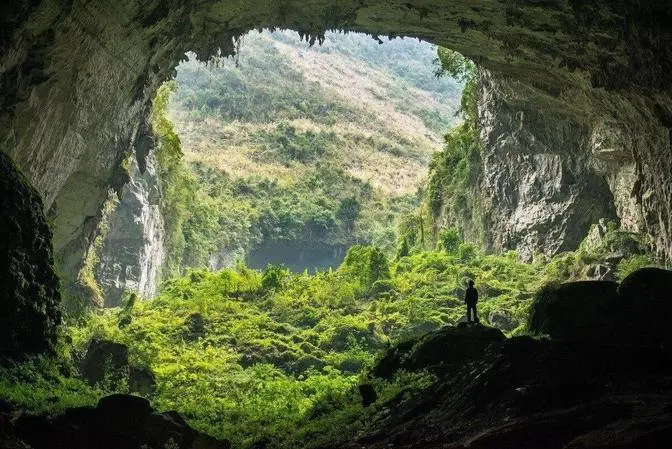
It is found under the earth. Just outside the city of Kutaisi lies a gateway to the underworld
known as Prometheus Cave. Discovered only in the 1980s, this massive cave system stretches for
miles into the limestone crust. Stepping inside feels less like entering a cave and more like
walking into an alien cathedral. The silence is absolute, broken only by the steady drip of water
that has been sculpting these chambers for millions of years. Massive stalactites hang
from the ceiling like stone curtains, while stalagmites rise from the floor to meet them.
The visual impact is amplified by a psychedelic lighting system bathed in shifting hues of violet,
electric blue, and gold. The rock formations take on a fantastical, almost breathing quality.
The cave gets its dramatic name from the local legend that Prometheus was chained to the
mountains above, making this dark abyss the basement of his prison. It is a vast, parallel
world that ends with a final surprise. The tour does not conclude on foot. It ends on a boat.
An underground river flows silently through the final chambers, allowing visitors to drift
through the darkness before bursting back out into the blinding daylight of the surface.
Emerging from the natural underground, the journey turns toward a different kind of ruin.
Just a short drive away lies Tskaltubo, a place that feels less like a town
and more like a lost civilization swallowed by the jungle.
Decades ago, this was the crown jewel of the Soviet health system, a sprawling spa resort
where the elite of Moscow took direct trains to soak in the waters of immortality.
Even Joseph Stalin maintained his own private sanctuary here, known simply as Bathhouse No. 6.
Today, the water is gone and nature has returned
to reclaim the stone. It is a haunting masterpiece of decay.
Sunlight streams through shattered Romanesque domes,
illuminating grand halls that are slowly turning into greenhouses.
Thick green vines curl around white marble columns and moss carpets the intricate mosaic floors
where the most powerful men in the Eastern Bloc once walked.
It is a scene of tragic beauty, standing as a silent, crumbling reminder that no empire,
no matter how solid it seems, lasts forever.
Deep in the emerity gorge lies Chiatura, a Soviet mining town defined by rust.
To scale the sheer cliffs, engineers built a massive network of aerial tramways in the 1950s.
Known to locals as the Flying Coffins.
And for decades, these metal boxes swung over the abyss on original parts.
While modern lifts are finally taking over, the skeleton of this steampunk nightmare
still looms over the valley, a place where the Soviet Union didn't just collapse,
it slowly rusted away in midair, leaving the rust behind.
The journey turns south to the town of Akhaltsiki, where history has not been allowed to decay.
It has been rebuilt.
Rising from the hill is the massive complex of Rabati Castle.
Unlike the crumbling Soviet ruins,
this fortress shines as a polished symbol of Georgia's complex identity.
Walking inside the seven-acre compound is like walking through a physical map
of the country's history.
It is one of the few places on Earth where you can stand in the shadow of a gold-domed mosque,
turn your head, and look directly at an Orthodox church.
For centuries, this was a trading hub where Christian and Muslim cultures collided,
traded, and coexisted.
The architecture reflects this chaotic harmony,
blending traditional Georgian stone towers
with the elegant arches and fountains of the Ottoman Empire.
It proves that this land was never just a battlefield.
It was a marketplace of ideas, a bridge where the East and West didn't just meet, they merged.
But the ultimate testament to Georgian resilience is not found in what they built up.
It is found in what they dug out.
In the arid southern valleys lies Vardzia,
a place that looks from a distance like a sheer cliff face
that has been attacked by a swarm of giant insects.
It is a honeycomb of caves stretching across the Eresheti Mountain.
This was not a primitive dwelling.
In the 12th century, this was a high-tech,
invisible metropolis designed to hide the population from the invading Mongol hordes.
Commissioned by King Georgi III and his daughter, the legendary Queen Tamar,
the complex spanned 13 stories deep into the solid rock.
It contained 6,000 rooms, including throne rooms, chapels, pharmacies,
and a sophisticated irrigation system that pumped fresh water through ceramic pipes.
The genius of Vardzia was its invisibility.
From the outside, the mountain looked untouched, but nature eventually betrayed them.
A massive earthquake in the 13th century sheared off the entire front face of the cliff.
The secret city was sliced open like a dollhouse,
revealing its inner workings to the world,
and forcing its people to abandon the safety of the dark.
After the silence of the caves, the sensors crave electricity.
Driving west to the Black Sea coast,
the humidity rises and the timeline jumps forward a thousand years.
Welcome to Batumi.
If the rest of the nation is a history book, this city is a comic book drawn by a madman.
It has been called the Las Vegas of the Black Sea,
but it feels more like a fever dream of neon and steel.
The skyline is dominated by the bazaar.
The most surreal silhouette belongs to the Batumi Tower.
Rising high above the promenade, it features a fully functional gold ferris wheel
embedded directly into the facade of the 27th floor.
It serves no practical purpose.
It exists simply because it can...
Nearby stands the Alphabet Tower,
resembling a strand of DNA spiraling 400 feet into the sky.
It is wrapped in 33 giant aluminum letters.
This is a monument to the Georgian script,
a linguistic system unrelated to any other on Earth.
In a world of globalization,
building a skyscraper just to honor your own alphabet is a defiant statement of identity.
The architectural audacity continues inland,
right in the heart of the ancient city of Kutaisi.
Amidst medieval monasteries and crumbling Soviet blocks,
a spaceship seems to have crash-landed.
This is the former parliament building.
It is a massive 130-foot-high dome of glass and concrete
that curves over the landscape like a giant, unblinking eye.
It looks less like a government building
and more like a headquarters from a Star Wars film.
Built as a bold symbol of transparency and a radical break from the dark,
secretive Soviet past,
the glass walls were meant to literally allow the public to see their democracy at work.
While the politicians have since moved back to the capital,
leaving the structure largely empty, it remains a powerful presence.
It stands as a polarizing, futuristic monolith.
It is a concrete declaration that this ancient nation
is desperately and sometimes clumsily trying to see its own future.
But if Batumi is the city of neon lust,
there is another town dedicated to something softer.
Perched high on a hilltop overlooking the vast Alazani Valley,
with its red tile roofs, Italian-style cypress trees, and winding cobblestone streets,
it looks like it was airlifted straight out of Tuscany.
Yet Signagi offers a specific service you won't find in Italy.
In the center of town stands a modest building that never locks its doors.
This is the wedding house.
In most countries, getting married requires months of paperwork.
Appointments and waiting periods.
In Signagi, the only requirement is a partner and a passport.
The registry operates 24 hours a day, seven days a week.
Some might call it a tourist gimmick,
but for the locals, it is a testament to the Georgian character.
They are a people who value passion over planning.
In a country that has been invaded so many times,
there is a pervasive sense that one should not wait for tomorrow
to do what the heart wants to do today.
Before a single drop of wine is poured,
the true spirit of the nation reveals itself in motion.
Nothing captures the Georgian soul quite like their traditional dance.
It is not just performance.
It is a stylized simulation of war.
The men defy gravity.
They spin like tornadoes and leap high into the air,
landing with explosive power.
It is athletic, fierce, and visually stunning.
In stark contrast, the women do not jump.
They float, wearing long gowns that hide their movement.
They glide across the floor with such smoothness
that they resemble swans drifting on a still lake.
This visual duality, the violent power of the warrior
and the serene grace of the queen,
is the perfect metaphor for the country itself.
Drive east into the Alazani Valley,
and the world turns into a sea of green.
This is the vineyard of the gods.
Endless rows of vines stretch out like veins across the landscape.
Georgia is home to over 500 varieties of grapes.
Many of which grow nowhere else on earth.
It is a biodiversity
that would make French vineyard owners weep with envy.
Come here in autumn during Arte Vallée.
The harvest season, and the air hangs heavy
with the scent of crushed fruit and sugar.
It is a time when the line between work and celebration disappears.
Entire villages gather to strip the vines.
Baskets overflowing with Saparavi black grapes and Akatsetele gold.
But the true guardians of this legacy are the traditional winemakers.
They are families who have lived on this same soil for generations.
In the cool shadows of the family Marani or wine cellar,
you will see grandfathers with weather-beaten hands
teaching their grandchildren how to clean the clay vessels with herbal brushes.
For them, a vine is not just a plant, it is a family member.
While the rest of the world uses stainless steel and oak barrels,
the valleys of Kakiti hold onto a ritual
that has remained unchanged for 8,000 years.
Archaeologists have proven that Georgians were fermenting grapes
while humanity was still inventing the wheel.
But the method is what matters.
Walk into a traditional cellar
and you will see a dirt floor dotted with round stone lids.
Beneath them lie the Kvevri,
massive clay vessels buried deep in the earth.
The grapes are poured in whole and left to nature.
When opened months later,
the result is not the clear white wine of Europe.
It is deep, rich amber.
It looks like liquid gold,
wild, unpredictable and completely unfiltered.
Drinking it feels like tasting the earth itself.
But wine here is never drunk alone.
It is the fuel for the supra.
To call a supra a simple dinner is an understatement.
It is a chaotic, beautiful academy of emotion.
The Georgian people believe that a guest is a gift from God.
And they prove it with overwhelming hospitality.
The tables are visually overwhelming,
stacked high with plates of cheese bread and dumplings
until there is no wood left visible.
Yet the food is just the background.
The main event is the connection.
Every feast is led by a tamada or toastmaster.
He dictates the rhythm of the night,
raising a glass to God,
to the motherland and to love.
It is a tradition that turns a simple meal
into a sacred bond,
ensuring that no one ever leaves a Georgian table
feeling like a stranger.
As the sun sets over the Caucasus,
the true nature of this land becomes clear.
Georgia is a living paradox.
It is where ancient stone towers
stare down neon skyscrapers
and where the silence of monks
meets the roar of dancers.
For 8,000 years, this nation has been burned and rebuilt.
Yet it has never lost its soul.
But heed this warning.
The secret is out.
Asphalt is paving the high villages
and glass hotels are rising.
If you want to see the Georgia of legends,
do not wait.
Come take your seat at the table.
Before the world changes it forever,
subscribe to uncover the next secret.
Until the next journey.