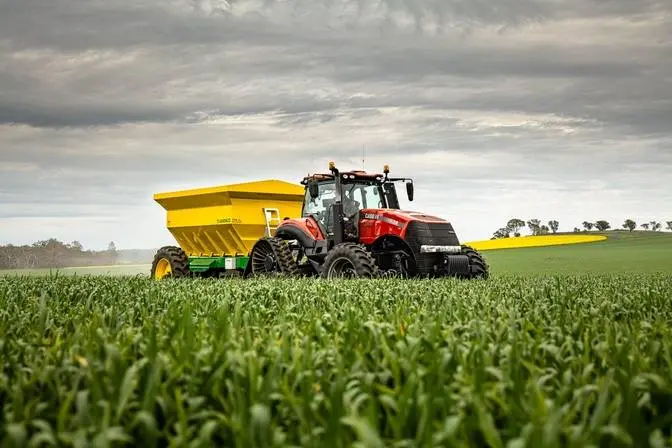
Today I’m visiting Michael Farms in west-central Ohio, one of the largest vegetable farms in the state. With nearly 3,000 acres of vegetables, their operation is on a completely different scale than what we’re used to at Wishwell Farms.
I start the day riding along in their sweet corn harvester as they work through part of their roughly 1,000 acres of sweet corn. From there, we head over to their potato harvest, where they’re still using the same massive equipment from the days when they grew nearly 500 acres of potatoes.
I wasn’t able to film inside their packing facilities on this visit, so this video focuses on the harvesting action out in the fields — including plenty of unique in-cab, ground-level, and drone footage.
I also spent part of the day with Michael Farms’ green bean harvest crew, getting some great in-cab, GoPro, and drone footage as they harvest part of their 1,400 acres of green beans. That will be featured in a separate video coming next.
A huge thanks to everyone at Michael Farms for letting me spend the day with them and giving us a behind-the-scenes look at harvest on this scale.
Thanks for watching!
AI Generated·May contain errors
Cool Farms is a nearly 3,000 acre vegetable farm here
in West Central Ohio growing sweet
corn, green beans, and potatoes.
Today I'm starting right here in the cab
of their sweet corn harvester before heading
over to see their potato harvest later on.
I wasn't able to film inside the packing facilities
on this visit, so we'll be focusing on the
harvesting action out in the fields.
It's a completely different scale than what we're used to on our farm,
and I'm excited to show you
what harvest looks like here at Michael Farms.
All right, I'm in here in the harvester with Tony.
He's been harvesting sweet corn with Michael's for over 20 years now.
And what is the exact
name of this unit we're driving? I know it's an Oxbow.
Does it have a model number or size or
something? It's called an Oxbow Super Jack.
Super Jack. All right. We're attempting to harvest
Five, six, seven acres today, maybe?
Something like that.
And normally in the heat of the season,
it's probably closer to 10 acres, you said?
10 to 15, somewhere in that range.
So, what is the main things you need
to watch for while harvesting corn?
What's the most important things to keep track of?
Where the ear comes through the rollers,
so that way it doesn't get pinched or damaged.
Okay.
And is that...
by the height by the height of the picking head the header will raise
and lower and you can open
it up and down to shine your camera out there you
can see it move down yeah yeah i saw the tilt
okay and then if i do this one i can move it up
and down on the front wheel okay so
Up and down this way and tilt this way.
Those are the two important adjustments.
Yep. I see there's a hydraulic gauge right there.
What are you watching for there?
Certain pressure. That's my, oh yeah,
that's the pressure of the spinners on the front.
Okay. They cut the corn.
The only time you got to worry about that is if you get into a weedy
situation where there's grass and that.
When it gets about straight up and down,
you want to slow down or you're going to plug up.
Okay. We have a little camera monitor right
there. We can see the hopper getting filled up with sweet corn.
A little bit behind us there.
We're gliding up out of the top of a sheet.
So you said you have two, three sweet corn harvesters,
two that you mainly use every
day.
Yeah.
We have this one and then the big jack that just left.
Okay.
That's the one you saw dumped.
The first time.
Yeah.
Hopper.
Right.
The first time it dumped.
And you're harvesting about 1,000 acres.
Probably.
Throughout the season.
The entirety of the season.
And we're getting near the end.
How many acres did you say you have left here total
for the end of the season?
About 40.
Forty acres left, getting near the end.
So when I was talking to Scott about when you guys start,
Scott's the owner of Michael Farms, Scott Michael.
I don't know.
You guys start picking usually 4:30, 5:30 a.m. on the board?
Usually depends on where we're at, how far away we are from the farm.
Yeah.
We are at remote fields.
Usually it's
About 5 30. Okay quarter till six something like that.
Um we're here because we're close enough they can have
take a single wagon in and it can be in in
a few minutes we can start about 6:20, 6:30.
Then you try to get their corn harvest
all wrapped up fairly early in the
morning mid-morning usually. Well yeah you were usually done
harvesting by then because they pack sometimes until
They start packing corn around 8.
Sometimes it's somewhere between 9
and 11 o'clock at night when they get done.
Wow, so it's an all-day process, packing all that corn.
But they're also packing beans.
Is that a different packing area?
Yes.
Different crew, or does it sometimes cross over?
Sometimes they cross over.
Usually a different crew.
Beautiful morning on our hands.
Absolutely perfect weather.
It's a little cool.
Starting to feel like early fall.
One of the things that blows my mind about
an operation of this size is that
Every three or four days they're harvesting
as much sweet corn as I harvest during an entire
growing season. I think we peaked at 40-45 acres maybe a decade ago
and now we're growing about 25.
I don't know if you guys can see
the center pivots over there very well,
but they have a lot of center pivots on this farm.
They probably didn't run as much this year as past years, did they?
With all the rain?
No, not as much.
They did early.
You can see all their green wagons over there.
There.
Their sweet corn and green beans.
Do the green beans go in the same wagons as the corn?
They used to, not as much anymore because we use semis more.
Okay.
Our green bean fields are not right here at the farm.
Right.
All right, we've got a full hopper.
Heading up to the wagons to dump our load.
So can you briefly explain what happens to the corn
after you dump and it gets hauled out of the field?
What's the process?
It goes in, it goes through a hydro cooler,
which cools down, gets boxed, shipped off to,
most of it goes to a tray pack company.
Some of it goes to Kroger, some other grocery stores.
Okay.
So does it get picked first and then hydro cooled?
No, hydro cooled first.
It gets hydro cooled first?
Wow.
Okay.
And that process will go on throughout the whole day,
like you said, almost into nighttime sometimes.
Well, it won't today, but typically, yeah.
During the season when we're running normal, it's most of the day.
There's a look at the full hopper.
We're getting ready to dump.
So since you've been doing this for so long,
what is your favorite part of corn harvest?
That's a good question.
Wrapping up the season?
Yeah.
Although at the end of the season,
it seems like it's slower than the rest of the season.
Yeah.
We're not doing as much each day.
Yeah.
I definitely feel a sense of accomplishment at the end of the season,
knowing that things have all been harvested.
So I'm sure you feel a little bit of that as well.
What's the most difficult part of it?
Down corn.
Down corn.
The wind blows it down.
Yeah.
We have to try to get it up off the ground.
And you guys had some tornadoes in this area.
We did.
I don't know if you can see across the field.
There's a pivot laying on the ground.
Oh, wow.
You won't be able to see it through the camera.
Maybe we'll get it with a drone later.
But right behind the wagons, there's a center pivot laying on its side.
And that was from the tornado or the winds?
Yeah.
Wow.
All right, he's backing up to dump the super jack.
I'm guessing this is the exact same unit
that Bell's Farming uses, Cornzilla.
Let's
look
at
the
front
of
the
unit.
Those are some wicked looking blades right there.
We're heading back
to dump another small
load to top off
this first wagon.
And I was asking Tony about the yields they get out here.
Typically between two and four hundred cases an acre.
A case is four dozen.
So if you're curious about the kind of yields they're getting,
what is that, eight hundred to sixteen hundred?
Which is pretty typical I think.
I've always heard you get, you know,
an average is about twelve hundred dozen to the acre.
A
decent
average.
Two full loads heading back to the packing shed.
They just have one more load to fill today,
and then I'll ride back
to the packing shed after they get that one filled up.
We're
back
up
here
at the
packing
shed.
I've
got a
load
of
corn
backed
up in
here.
Hopefully we can see this process of it being unloaded
and what happens to the corn
from field to cooler and everything in between.
All right, we're back here where they're unloading
the wagons of corn, and I'm here with Alex,
the HR manager here at Michael Farms.
He's going to explain his role and what's happening back here.
Yes, you can see the sweet corns being unloaded
by these mechanical elevators.
These, we call them even feeders
because they're set up with an optical sensor inside so that
the hydro cooler that this corn is being run into is not overloaded,
so it's evenly fed
onto this conveyor belt.
And this is coming out of the field at ambient temperature,
so we're talking whatever it
is today, 70 degrees or 65 or something.
It's going to be chilled to 33 degrees
in that hydro cooler over the course of about 45 minutes.
So we run ice cold water over it to cool it off.
We don't use any ice in the process, just that water.
Anyway, as you said, my name is Alex.
I do HR here and on the farm.
We all wear a lot of hats and do a lot of things,
so we get pulled into production.
I get pulled into QA and food safety work,
which is an ever-growing concern.
Of course, and that proliferates.
We're now looking at social responsibility audits.
These are things that look at environmental factors.
They look at labor issues.
So it dovetails with the HR work that I do as a recruiter.
When I recruit staff, we're looking for people
that mainly can deal with the work that we do, which is.
Intense hours, because we've got to do, you know, all of our annual
sales in a three and a half, four month period of the year.
So it concentrates that project and kind of intensifies it.
So I'm looking for people that can handle
that and they'll stay on site for that for that period of time
and then they'll be laid off for the season.
So when I hire local people, I'm.
The issue that they have is planning their life around that job
gets really complicated
when they hear they're going to be laid off in October.
But we've got a traditional migratory route from South Texas
where people for generations have migrated up into the north,
the northern states, as I said, for generations to do farm work,
whether it's here in Indiana, Illinois,
on over in New York and sometimes they
move around before heading back to South
Texas so we tap into that migratory stream and we do a job fair down in
McAllen Texas in March April bring folks up
and we try to incentivize them to
come back year after year
so okay anyway what these guys are doing is just aiding
the mechanical process as you can see
So, after the corn rides up this lift,
it's going right into the hydro cooling system.
Yeah, so it's running just behind this wall,
it's running on a conveyor, on a lateral conveyor,
in front of about five
or six people that are going to grade out damaged corn, small ears,
pull out any trash, stalks, leaves, that type of thing.
To try to get a, you know,
clean bit of corn into the hydrocooler and then it's going right
back across into the hydrocooler
and from there it'll be packed out into boxes of 48
cases are four dozen.
So there's a belt on the bottom of these wagons
and it's been feeding forward.
Here's where it comes out and rides up the lift.
Unfortunately I'm not going to be allowed
to go inside the warehouse today.
That's okay. I'll show as much of the process out here as I can.
All right, I'm here with Joe, and how long have you been working here?
A couple years, yeah. A couple years.
And what is your main role here on the farm?
Me? Well, right now I'm here with you, right?
Yeah.
But usually I'm over there, like, taking care of the belt,
making sure the corn is fed the right way.
And basically I just wait for the wagon to empty,
then hook it up to the tractor.
Tractor takes it brings the other one. It's just like just non-stop
all day long usually depends how many we're doing right now
It's like five so we'll be out by lunch or something.
Okay, that's the end of the season
So right now, but at the beginning you can catch me here at 12
Whoa, ----, we got 12 and 11, 30, yeah.
Pretty long day, it's crazy
Digging potatoes is kind of cool. Yeah, I'm huge digger.
It's I've seen a small one before. Yeah. No, this is great
This is one that
We basically inherited from our former selves
when we were doing 500 acres you know we needed
um but it's not it's like it's a six row each one is 30 inches.
Okay I'll definitely check that out.
I can take you out there the setup takes
a while it probably won't be half hour or so okay
but it's right out here okay we can pretty much walk all right
but I'll show you this
mobile clinic for a minute.
So I was just talking with Alex again and one thing that's
very different on a large farm versus a small scale farm like mine
Is that, you know, because of all the migrant workers they have here,
there's going to be people getting sick
and needing prescriptions and some health care.
And you want to elaborate on that a little bit?
Yeah, that's absolutely right.
What's going on here?
Yeah, so we've got a housing complex that's licensed
by the state health department for 100 people.
Okay.
There's 20 units out here,
and we have a rec center kind of in the middle.
And, yeah, exactly that, what you said.
Folks are here like...
Like it's summer camp for three or four months of the year,
they don't have a social life.
They don't have a family doctor out in town,
and it's kind of a hassle establishing that type of care.
So we bring them a mobile clinic that comes.
It's about a half-hour drive for them,
but they can come up and set up in our rec room to see patients.
And they bring an eye doctor so we we do vision evaluations
and folks can get glasses and
a lot of times it's just for simple prescription refills
and but it's it's you know one of the
services that is available to folks that just kind
of keeps the you know keeps things moving along
makes things easier. This is where all the migrant housing is?
Yeah so this this is the housing complex it's
It's these four buildings and then the rec center.
Now, because of HIPAA laws and everything,
obviously we can't talk to any patients or see any of that,
but we can just take a peek.
This is the rec center here at Michael Farms.
Potato harvest.
We got Alex here.
He brought me out to the field to kind of show me around,
and they used to grow over 500 acres of potatoes
here at Michael Farms,
and now the acreage is 50, 60 acres or something?
Yeah, it's cut back significantly, but it's a...
It's a heritage crop for us,
because it's where we really got started generations ago.
And we still supply a couple of niche markets,
especially regionally in Ohio.
We're supplying some of our Buckeye brand potatoes in some regional
chain stores in the Cleveland area and Cincinnati as well.
So, this is the harvester that was used
when they were farming 500 acres.
Yeah, we basically inherited this from our former selves.
It's a six-row Lenco harvester
and the planting rig that we use
is also that cab and part of
that is sort of interchangeable.
Oh, really?
It gets outfitted.
Yeah.
Okay.
And these are white potatoes.
It's a round white variety.
They do really well Midwest here in Ohio.
We do grow a variety of russets as well,
but a lot of times people think of a potato,
they just think of a big Burbank, you know, potato.
Any red potatoes?
We don't do red potatoes anymore.
We used to do red potatoes,
and we even did some yellow varieties and things like that.
There's a lot going on.
There's a million specialty varieties of potato.
Potatoes can be adapted to a lot of different soil types,
but those cool nights in the
Idaho
and
the
sandy
soils
blend
themselves
to
that
big
classic
baker
potato.
We're up in the rig now, getting a close look at everything,
and Mike's the one driving.
He's down inspecting everything,
making sure it's good to go for the next round.
My gosh, this is a massive machine.
A lot of mud
on them,
isn't there?
A lot of washing.
Yep.
The ground's probably got
to be somewhat dry to be able to harvest potatoes.
Yeah, when it gets real wet like these, it gets a little bit muddy.
Right and then and then we'll go
over spray bars with brushes.
Okay. Underneath the machine now
just checking everything out making sure it's good
to go. It's not all fun and games sometimes
you got to crawl into the belly of the beast.
All right that's going to wrap up my visit here
at Michael Farms. I found it so interesting seeing sweet corn
and potatoes being harvested
at this scale and a huge thank you to the crew here
at Michael's for letting me tag along today.
I hope you guys found the video informative
and I hope you learned something today.
Thank you so much for watching. I really appreciate it
and don't forget to hit that like button
if you enjoyed the video
and I will see you all again next time down on the farm.