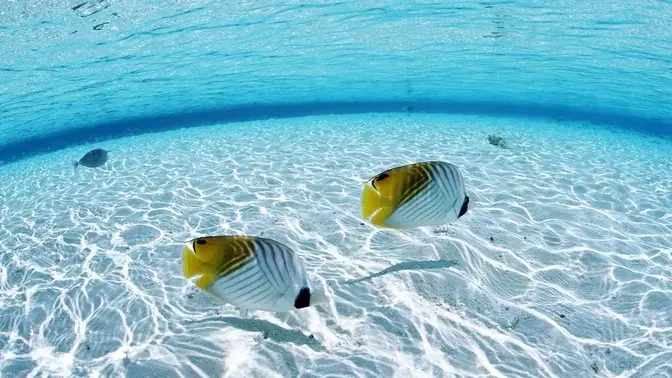
We dive 11 kilometers down, from the sunny surface to the bottom of the Mariana Trench, to meet the weirdest animals on Earth. Most of them on REAL footage from deep-sea robots! 🐙 See the ghost octopus found in 2016, a real anglerfish, the dumbo octopus, black-smoker chimneys hotter than melting lead, the deepest fish ever filmed, and tiny animals living 10,898 meters down. Play "Real or doodle?" and find out which creatures are real!
🎥 Real footage: • Deep-sea footage: NOAA Ocean Exploration (public domain): ghost-like octopod (Hohonu Moana 2016), jellyfish (Deepwater Exploration of the Marianas 2016), Venus flytrap anemone (American Samoa 2017), psychedelic medusa (Océano Profundo 2018), glass squid (Musicians Seamounts 2017), anglerfish (Southeastern U.S. Deep-Sea Exploration 2019), dumbo octopus (Hidden Ocean 2016), abyssal plain and sea cucumber (Cook Islands 2026), vent shrimp (Mid-Cayman Rise 2011), snailfish (Seascape Alaska 5, 2023) • Black smoker: Ifremer, "Cheminée hydrothermale active" (CC BY 4.0) via Wikimedia Commons • Hadal amphipods at 10,898 m: Kobayashi et al. (2012), PLOS ONE (CC BY 2.5) via Wikimedia Commons • Sea turtle, school of fish, humpback whales: Pexels (free licence) Footage is used for education; it does not imply endorsement by NOAA or any other agency.
0:00 Into the deep 0:37 The sunlight zone (0–200 m) 1:23 The twilight zone (200–1,000 m) 2:29 The midnight zone (1,000–4,000 m) 3:49 The abyss (4,000–6,000 m) 5:00 Chimneys of boiling water 5:50 The trenches (6,000–11,000 m) 7:11 What we haven't seen yet
💬 Which deep-sea animal was your favorite? Tell us in the comments!
Subscribe to Wiggly Facts for weird facts and wobbly doodles. Stay wiggly! ✏️
Sources: • NOAA Ocean Service: How deep is the ocean? Ocean zones; pressure in the deep sea • NOAA Ocean Exploration: Hohonu Moana 2016 (ghost-like octopod), Deepwater Exploration of the Marianas 2016, deep-sea vents and tube worms • WHOI: Ocean Twilight Zone, diel vertical migration; Hydrothermal vents discovery (1977) • Martini & Haddock (2017), Scientific Reports: Quantification of bioluminescence from the surface to the deep sea • MBARI: Vampire squid eats marine snow (Hoving & Robison 2012); barreleye fish • Jamieson & Vecchione (2020), Marine Biology: First in situ observation of Cephalopoda at hadal depths (dumbo octopus ~6,957 m) • University of Western Australia / Tokyo Univ. of Marine Science (2023): deepest fish ever filmed, snailfish at 8,336 m • Smithsonian Ocean: anglerfish, giant squid, whale falls • Bell et al. (2025), Science Advances: How little we've seen of the deep seafloor #seacreature#lifeofthesea#oceancreature
AI Generated·May contain errors
Video Summary
AI Generated
This video takes a journey from the ocean surface to the deepest trenches, exploring the diverse zones of the sea. It highlights how animals adapt to extreme pressure and total darkness, showcasing bizarre creatures like the barrel-eye fish and the snailfish, while emphasizing that most of the deep ocean remains an unexplored mystery.
Comments are disabled for this video.
This is real. In 2016,
a robot camera 4,000 meters under the sea filmed this little ghost
of an octopus. Nobody had ever seen anything like it.
And it's not even the strangest thing
down there. Today, we're diving all the way
to the bottom of the ocean, 11 kilometers down,
to meet the weirdest animals on Earth.
Most of them, you'll see for real.
Welcome to Wiggly Facts. Climb into our little submarine, Pip.
Hatch closed, and down we go.
The first 200 meters are the sunlight zone.
This is the ocean you know, warm, bright,
full of fish, turtles, and whales.
But look up. With every meter, a little more of the sunlight is gone.
Red fades first, then yellow, until everything looks blue,
and something else is building up.
Pressure. The water above you is heavy.
Every 10 meters down,
it presses on you as much as the whole sky above the sea.
Most scuba divers stop around 40 meters,
but some animals go way deeper.
Sperm whales hold their breath for an hour
and dive more than two kilometers down,
hunting for squid in the dark.
200 meters.
Welcome to the twilight zone.
It's as dim as the last minute of a sunset, and it's getting darker.
Here's a secret. Every single night,
billions of animals from down here swim hundreds of meters up
to the surface to eat, then sink back down before sunrise.
It's the biggest migration on our planet,
and it happens every night.
Some fish down here have a clever trick. Little lights on their
bellies. From below, they glow just like the faint light above,
so hunters can't see their outline.
And this is the barrel-eye fish.
Its head is see-through, like a glass dome, and its glowing
green eyes look straight up through it, watching for shadows of food.
And this is the vampire
squid. It drinks blood, right?
It isn't even a real squid, and it eats marine snow,
tiny flakes of dead plankton, and, well, poop drifting down from above.
1,000 meters. No sunlight reaches here at all.
It's the midnight zone, and it stays dark forever.
But it isn't totally dark.
Look, in one study, about three out of every four animals scientists
saw in the deep water could make their own light.
Jellyfish flash like fireworks. Some shrimps spit
out clouds of glowing goo to escape.
And the anglerfish dangles a glowing fishing rod right
right over her own mouth.
Anglerfish are weird in another way, too.
In some kinds, the male is tiny. He bites onto the
female and stays stuck to her for the rest of his life.
Somewhere around here lives the giant squid,
as long as a bus, with eyes as big as dinner plates,
some of the largest eyes in the animal
kingdom. It's so hard to find
that it wasn't filmed alive in the deep until 2012.
Real or doodle?
This animal looks like a fluffy pink flower growing on the sea floor.
Is it a plant or an animal?
Animal.
It's a Venus flytrap anemone.
And it can't be a plant because no plant can grow down here.
There's no sunlight to make food.
4,000 meters.
We've reached the abyss.
A huge, flat, muddy plain close to freezing
that covers about half of our planet.
This is where the ghost octopus lives.
Scientists think it lays its eggs on dead sponges and guards them,
maybe for years.
Real or doodle?
An octopus with two flappy ears on its head like a tiny elephant.
Real or made up?
Real! It's a Dumbo octopus. It swims by flapping those ear fins,
and it's the deepest living
octopus we know, seen almost seven kilometers down.
With no plants, how does anything eat down here?
Most food falls from above,
and sometimes a feast arrives, a whole whale.
When a whale dies and sinks, it can feed deep-sea animals for decades.
Sharks and hagfish eat the meat, crabs clean up,
and then zombie worms with no mouth move in to eat the bones.
But in a few places on the seafloor, something incredible happens.
The ground cracks open, and black smoke pours out.
These are hydrothermal vents,
chimneys of super hot water, up to 400 degrees.
That's hot enough to melt lead,
but the crushing pressure stops it from boiling.
Scientists first found them in 1977,
and they couldn't believe what was living around them.
Crabs, shrimp, and giant tube worms two meters long.
Here's the crazy part.
Tube worms have no mouth and no stomach.
Bacteria living inside them make food
from the chemicals in the smoke.
A whole world
that runs without any sunlight at all.
6,000 meters.
Below the abyss, the seafloor splits into deep trenches.
This is the hadal zone, named after Hades, the underworld.
the Mariana Trench is the deepest place in the ocean.
If you dropped Mount Everest inside it,
would the top stick out of the water?
No way. The deepest spot, the Challenger Deep,
is almost 11,000 meters down. Everest would sink
with more than two kilometers of water still on top.
The pressure here is over a thousand
times stronger than at the surface.
That's like having an elephant standing on your thumb.
And yet life is here too.
This is a snailfish, soft, wobbly, and almost see-through. Its cousins
live deeper than any other fish.
In 2022, one was filmed 8,300 meters down, the deepest fish
ever seen. And at the very bottom, 10,900 meters down,
little shrimp-like animals called amphipods
Scurry across the mud.
Only a few dozen people have ever been down here.
The first two went in 1960, in a submarine called the Trieste.
It took them almost five hours just to sink to the bottom.
Here's the most amazing fact of all. People have only ever seen
less than one-thousandth of one percent of the deep sea floor.
All the rest is still a mystery.
Every time scientists send a robot down, they find new
So the strangest creature in the deep sea?
We probably haven't met it yet.
Time to head home. Pip blows the tanks and up we go.
From the trenches, through the abyss,
the midnight zone, the twilight zone, and back into the sun.
Which deep sea animal was your favorite? Tell us in the comments.
And for more weird facts and wobbly doodles, subscribe to Wiggly Facts.
Stay wiggly!