Renne Vanasse and Ian Brooks sit down with me to discuss how you should play two of the most popular classic pieces of all time. Ian has spent a lifetime analyzing human anatomy for the purposes of understanding how to play piano without hurting yourself. Renee brings the artist's perspective on playing and practicing.
WATCH RENEE PLAY BEETHOVEN'S FUR ELISE AND DEBUSSY'S CLAIR DE LUNE HERE. 👇🏼
IF YOU ENJOY OUR CONTENT, DON'T FORGET TO COMMENT, LIKE & SUBSCRIBE & CHECK OUT ALL OUR SOCIAL MEDIA PLATFORMS DOWN BELOW AND SIGN UP TO OUR MAILING LIST ON OUR WEBSITE FOR A CHANCE TO WIN ONE OF MANY PRIZES ____________________________
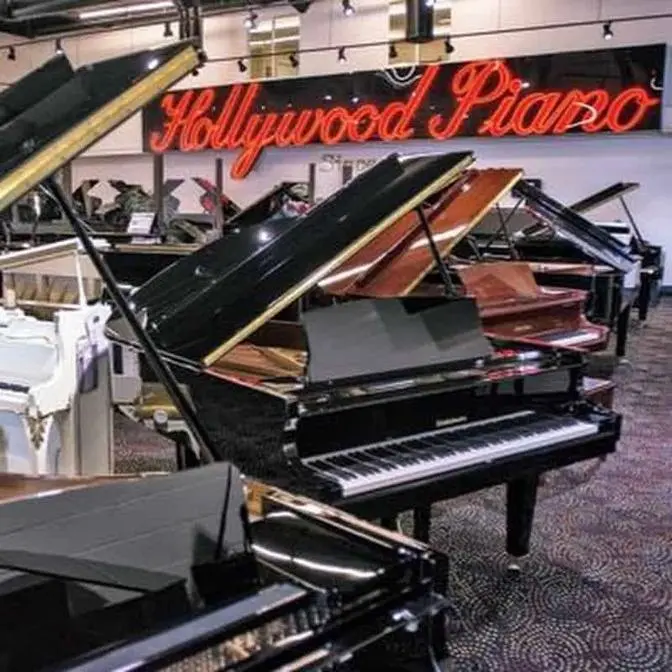
Hi, this is Glenn Tribetz from Hollywood Piano, and today we're going to talk a little bit about
a subject called piano pedagogy. And this is kind of dissecting piano pieces, and I'm joined by
two great friends. On the right is Ian Brooks. Ian, welcome. It's good to see you. Thank you.
Ian studies piano technique, fingering, how pieces should be played, interpretation. I mean,
he's made a lifelong study of this like nobody else. And on my left, I'm joined by our dear
friend, Renee Vanass, and you've heard Renee on a few of our videos on our channel. And as you know,
Renee is a great classical pianist. Thank you, Renee, for being here. My pleasure. And, you know,
recently Renee played two of the great classical favorites. One, Farrelly's, and those of us who
sell pianos, we hear this piece many, many, many, many, many, many, many, many, many, many, many,
times per day. And we get a little tired of it, but I thought it would be really fun to have
someone who plays the piano at the high level that Renee does play this, because many of you,
I know, are learning this piece, and you want to kind of model after someone, and not necessarily
on a concert stage with a Horowitz or something like that. So I thought it'd be really fun to
have someone that you could listen to and model what you're doing on what she did. And I thought
we'd talk about it. And the other piece that Renee played for us recently is Clair de Lune
by the great Debussy. And it is probably one of the most lovely, lovely pieces ever written. It's
magical. And Renee played that on the Mason and Hamlin seven-foot double B. But first, guys,
you know, let's talk a little bit about Farrelly's, because every pianist plays it,
and many of them don't quite get the intention that Beethoven had when he wrote it.
So what do you think that a lot of pianists do wrong when they attack or attempt to play
Farrelly's? Well, they don't play the whole piece, for one thing. They just play the first part.
Okay. And they're always surprised at the key change and the fast part.
They need probably to be more advanced than they are when they're trying that first part.
Because it's not such an easy piece. Once you get into the other movements.
But everybody plays the very first section. And they play it badly.
And how could they play it better? Well, play the right notes, play it in time.
Do you find that a lot of people don't play the right notes?
Yeah. And what about the timing?
The timing. Oh, my goodness. They play it however they want to.
Okay. And they don't put the right number of
at the beginning. I see.
They never learn to count. They just put whatever number of they think goes there.
What do you think can help somebody learn it better? What can they do to improve
how they play Farrelly's? Well, learn the music and use a metronome.
Metronome. So, do you recommend that everybody who learns to play Farrelly's use a metronome with it?
Well, if they're having trouble. I mean, it's a tool.
Right. Not everybody needs the tool.
Right. But some people do.
And do you think that using the metronome will help somebody be a better pianist?
That's a difficult question. I use the metronome
religiously, but I use it to help me learn the piece. I start very slow,
and then I move the metronome up a few notches to something that I can confront.
Right. And then I move it up a few notches
until I'm playing it up to speed. And that gets me to the place where I can play the piece.
Then the real work begins. The musical work begins.
So, would you recommend for young pianists who are learning to play a piece like Farrelly's,
they play it very slowly and precisely with the metronome and build it up slowly?
If they don't do it, most kids won't. Okay. But if they do that.
If they do that, that will help them. That's the way to really get it. So,
you keep practicing it and slowly inch up the metronome and play it a little faster
and a little faster. Just a little bit at a time.
So, then you say you get to the musical part. Yes. Then you have to get into the part, well,
where do I accent it? Where I get louder? Where do I get softer? Do I slow down here? Do I speed up?
And do you follow precisely the composer's recommendation or do you add in your own ideas?
Well, yes to both. Okay.
After all, a pianist is an artist. Right.
And the composer puts his indications down and there are performance practices of the period.
Right. Which you should be aware of.
Performance practices of the period. What does that mean?
Well, goodness me, I opened a can of worms there.
Now that you opened it, you have to spill it.
In the Baroque period, most people have the idea that it was the strictest
period in music. And people have a tendency to play,
no matter what. And it actually was the freest. Really? It was. The notes,
the rhythm was only, on the paper, was only an approximation. You could play written eighth
notes. They didn't use their thumb mostly. So for us the rhythms would come out a little
distorted. They didn't play da-da-da-da-da-da-da-da-dum. They would play da-da-da-da-da-da-da-da-dum,
or maybe da-da-da-da-da-da-da-da-dum. Really? And it was written in eighth notes. Wow.
And that practice was in use for about 500 years. Oh my god.
That practice. You told me something I never in a million years would have known.
Okay. Then that gradually changed in the Classical period. The directions how to do something was
not always written on the music. It was written in the books. So you had to go to the books
to find out what you should do. As far as dynamics? Well, there were no dynamics because
every instrument sort of patterned themselves after the harpsichord. I see. The harpsichord
could not get any louder or softer. And so the rest of the instruments hadn't really thought of
making themselves expressive yet. They made the music expressive, not the instrument. But what
about the music written before the invention of something like the pianoforte? Did they go back
later and add expression? They did and it wasn't justified. I see. So it wasn't the
composer's initial intention. No. They wouldn't have thought of it because their instruments
couldn't do it. That died out and by the time of the Classical period they were writing a bit more
on the page and they would use slurs. But the slurs didn't mean just legato like it does today.
It meant rubato as well. So if two notes had a slur over it then you wouldn't play it evenly.
You'd play it not so evenly. They didn't have the long phrase marks. They would have it over five or
six notes, maybe a couple of measures, and that meant that you would have put rubato in it as well as
more legato. Renée, I want to ask you, when you play a piece like Farrelly's,
how do you approach the expression, the dynamics? How do you interpret what Beethoven wrote in there?
When I play a piece I don't have the knowledge that Ian has and so when I work on a piece
I work on it emotionally. I listen for the story and the story of Farrelly's is actually, or one
of the stories, the one I like best, is Beethoven was totally deaf. His friends dragged him to a
party. He had become a total recluse and he didn't want to be there. And when he got there he saw the
most beautiful woman in the world and he just sat there and enjoyed her beauty the entire day.
So when he went home that night he wrote... That was Elise? Her name was Elizabeth. Elizabeth.
But you know we're talking in another era. Right. And so he wrote on his slate when he got home
who was that beautiful woman and they said her name was Elizabeth.
And so when he went to bed that night he couldn't go to sleep so he got up and he wrote this piece
and the part in the left hand that's bum bum bum bum bum bum bum that's his heart beating for her.
You know they don't make men like that, ladies, anymore. So anyhow. Wait, what are you saying?
Our hearts still beat? I know, but they don't write it in the music like that.
So he sent it by messenger to her the next morning and for release is for Elizabeth.
How did he send it? They didn't have recordings then? No, they had messengers.
And he came and sang it or played it? No, he gave her the music, the sheet music.
How cool. Yes, anyhow that's the story that I hear in the music and so
I listen for the emotion of the music and Ian says that's not the way it's supposed to be.
I don't have the knowledge that he has and sometimes I like the emotion over the
strict time or the whatever. So you're inspired by the story of Farrelly's? Oh absolutely. As much
as you are by the notes on the page? Well it isn't just Farrelly's. I may see fairies, you may see
butterflies. I may see a hippopotamus and you may see an elephant. You know everyone has their own
interpretation and when I play in the schools I love to tell the kids listen to what the music
is saying. What do you see? Use your imagination. These kids haven't got any imagination anymore.
It's been knocked out of them. I mean they, imagination? What's that? Let's just sit and
play a game and it'll all show us on the video. Whatever it is, these kids are not
thinking for themselves and they're not enjoying what they can see and hear
and they have a wonderful time doing that. Strangely enough they really enjoy the classical
music when they're taught to participate. Well that's so cool. Let's talk about Claire de Lune
written by Claude Debussy. He paints beautiful pictures and images with the music
and well of course this piece was written when they were notating the expressions and so on and
what tips could you give the pianist who's attacking Claire de Lune?
Don't put your own rubato in it. It's written in. It's not romantic music. The music's not
supposed to say I love you. The music is supposed to just evoke this calm, clean
effect of moonlight. That's all it is. But use your metronome again. Use your metronome
because I notice when people play Claire de Lune it's very loose. Yeah well he wrote it loose if you
keep strict time. He's got two notes in some beats. He's got three notes in some beats.
Some beats he has four and if you play it the way it's written there's rubato written in.
So I guess the advice is for a young pianist, play these pieces with the metronome at first.
Make sure you're right on it and then you start exploring the musicality. Yes the metronome is
a tool to help you learn the piece. Absolutely. Then after you've got the piece learned
then you work musically. Renee, Ian said that he still uses metronome to learn something. Do you
still use a metronome? Absolutely and I work with the metronome and then I guess I kind of do my
own thing on a lot of music including Claire de Lune. But the one thing I can tell kids about
for release is it doesn't start on one. It doesn't go one, two, three. It goes three,
one, two, three, one and that makes a big difference. So you've got to count it not
just with the metronome because it's not just the beat. He starts on an upbeat so you've got to
not play 20 da-da-da-da-da-da-da-da-da-da because it isn't written that way. Right.
And that's what makes piano people crazy.
Well I think we've gone through some really excellent tips for people who are learning to
play two of the very favorite classical pieces in the repertoire. Farrelly's and Claire de Lune.
This is Glenn Tribetz at Hollywood Piano and I really want to thank Ian Brooks
for giving us all of his insight and knowledge and Rene Vannasse. Everybody don't forget to
like this video, comment and subscribe to our channel.
This is Glenn Tribetz for Hollywood Piano saying bye for now.