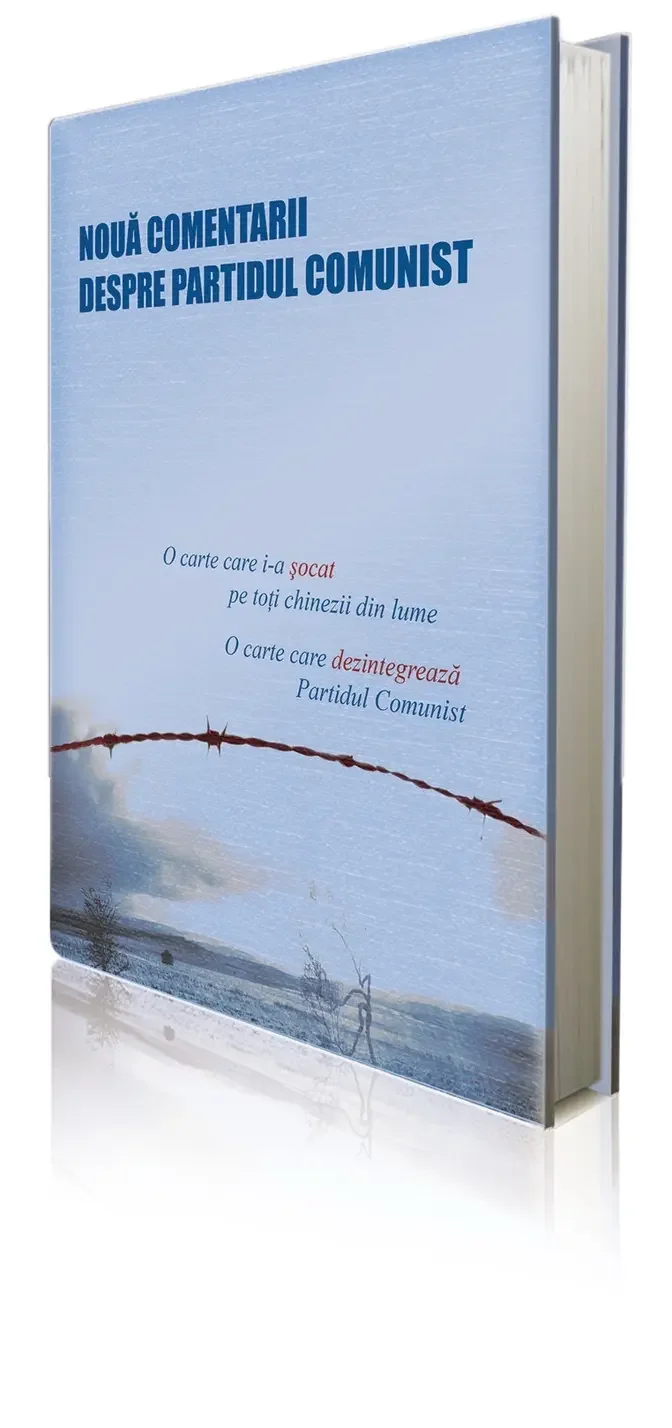
Privind istoria Chinei din ultimii 160 de ani, aproape 100 de milioane de oameni au fost omorâţi şi aproape toată cultura şi civilizaţia tradiţională a fost distrusă. A fost Partidul Comunist o alegere a cetăţenilor, sau a fost impus din afară?
Despre cele 9 Comentarii
Cele 9 Comentarii prezentate aici au fost publicate în limba chineză în 2004. Accesibile în China prin intermediul internetului, sau introduse pe ascuns, comentariile sunt căutate şi citite avid de mulţi dintre cei aflaţi în bezna propagandei comuniste.
Comentariile au la bază o documentare istorică riguroasă, dezvăluie cu curaj ororile inimaginabile ale comunismului practicat în China, începând cu perioada maoistă şi terminând cu perioada actuală; analizează lucid şi cuprinzător originile comunismului, trăsăturile sale şi mecanismele care asigură existenţa "fiarei roşii". Este inedită în special prezentarea comunismului ca fiinţă vie, malefică, preocupată obsesiv de asigurarea propriei existenţe şi supremaţii, capabilă de orice infamie.
Adevărul despre comunism este cutremurător, iar comentariile de faţă nu par să treacă cu vederea nici unul dintre aspectele sale. Este expus un lung şir de samavolnicii: măcelurile din timpul Revoluţiei Culturale, actele de canibalism din timpul Marii Foamete, grozăviile campaniei guvernului chinez împotriva practicanţilor Falun Gong, etc
For over 5,000 years, the Chinese people created a splendid civilization on the land nurtured by
the Yellow River and the Yangtze River. During this long period of time, dynasties came and went,
and the Chinese culture waxed and waned. Grand and moving stories have played out on the historical
stage of China. A hundred and fifty years ago, a spectre, the Communist spectre, appeared in Europe.
In the beginning of the 20th century, under the name of the Communist Party,
it found a place to stay in China while the national power was deteriorating. Since then,
China has faced unprecedented challenges. Everything the CCP has touched has been marred
with lies, wars, famine, tyranny, massacre, and terror. Traditional faiths and values have been
violently destroyed. Original ethical concepts and social structures have been disintegrated by
force. Empathy, love, and harmony have been twisted into struggle and hatred. Veneration
and appreciation of heaven and earth have been replaced by an arrogant desire to fight with heaven
and earth. This has resulted in a total collapse of social, moral, and ecological systems,
and a profound crisis for the Chinese people and the entire mankind. In the 1990s,
the former Soviet Union and Eastern European Communist regimes fell one after another,
and the formerly blossoming appeal of the Communist movement wilted. Barely able to
maintain its feeble existence, the Communist Party has become impotent. Under its seemingly powerful
and prosperous appearance is a tattered and torn picture of its crumbling end.
With the collapse just around the corner, China may soon evolve into a society without the CCP.
On the eve of the new replacing the old, we must reflect upon this phase of history.
What is the Communist Party? How did the Chinese Communist Party begin?
What did the Communist Party bring to China and the Chinese people? And how can the Chinese people
maintain their traditions and pass them on to later generations? These are the questions that
the Chinese people face today. The overturned cart in front is a warning to the carts behind.
By reflecting the true history of the CCP, we can help prevent such tragedies from ever recurring.
In the process, each of us can also re-examine our inner world. Are there many tragedies that
shouldn't have happened but indeed happened due to our weakness and compromises?
The year 1840, the beginning of China's contemporary era, marked the start of China's
journey from tradition to modernization. From then on, Chinese civilization experienced four
major episodes of challenge and response. The invasion of Beijing by the Anglo-French
Allied force in the early 1860s and the desertion of Emperor Xianfeng of the Qing dynasty created
unprecedented shock to the Chinese people and forced China to respond with the westernization
movement. In 1894, the Sino-Japanese War broke out and China was defeated. This caused Chinese
people to re-examine the westernization movement, which emphasized imports of modern goods and
weapons. People pushed for institutional reforms through the Hundred Days Reform in 1898,
and attempted to establish constitutional rule at the end of the late Qing dynasty.
In 1904, in order to vie for an advantage in China, a war between Russia and Japan broke out
in northeast China. The Qing dynasty declared neutrality over the battle, fought on her own soil,
which enraged the populace and intellectuals. Afterwards, China began a more intense
transformation and started the Xinhai Revolution in 1911. It overthrew the monarchy and built the
Republic of China. In 1918, at the end of the First World War, though China emerged victorious,
its benefits were not considered at the Paris Peace Conference by stronger powers at that time,
which led to the May Fourth Movement. Many Chinese believed that the first three episodes
of response had failed. In extreme disappointment and anger, some people chose to follow the path
of violent revolution, as had just occurred in Russia. This led to the fourth and last episode
of challenge, with the most powerful impact. It has affected China for nearly a century and
continues today. The Communist Movement. Quote, The Communists disdain to conceal their views
and aims. They openly declare that their ends can be attained only by the forcible overthrow
of all existing social conditions. Unquote. This quote is taken from the concluding paragraph
of the Communist Manifesto, the Communist Party's principal document.
Violence is one of the main means by which the Communist Party gained power.
This character trait has been passed on to all subsequent forms of the party
that have arisen since its birth. The world's first Communist Party was established many
years after Karl Marx's death. This party grew out of the use of violence against so-called
class enemies and was maintained through violence against party members and ordinary citizens.
According to statistics, during Stalin's purges in the 1930s, the Communist Party of the Soviet
Union slaughtered over 20 million so-called spies, traitors, and those thought to have different
opinions. As a branch of the Third Communist International, which was controlled by the
Communist Party of the Soviet Union, the CCP naturally inherited the willingness to kill.
In August 1927, when the Beiyang warlords had just been overthrown by the Nationalist government
and China was soon to be unified, the CCP initiated an armed rebellion in Nanchang,
Jiangxi province, and established the Chinese Soviet. During the so-called
Civil War between the Nationalists and Communists from 1927 to 1936, the population in Jiangxi
province dropped from over 20 million to only about 10 million. The damage wrought by the CCP's
use of violence can be seen from these figures alone. Using violence may be unavoidable when
attempting to gain political power, but there has never been a regime as eager to kill as the CCP,
especially during otherwise peaceful periods. According to statistical data in
The Black Book of Communism, published in 1997 in France, the entire Communist movement caused
100 million deaths. Among them, China's death toll was 65 million, a number that surpasses the total
casualties of World War I and World War II and the total casualties of all previous Chinese dynasties.
An excellent example of the Communist Party's use of violence to the people
is its support of the Cambodian Khmer Rouge. After it captured political power in 1975,
it unexpectedly murdered a quarter of Cambodia's population, including a majority of Chinese
immigrants and descendants. China still blocks the international community from putting the
Khmer Rouge on trial so as to cover up the CCP's notorious role in the genocide. No wonder people
say, other political groups slaughter in order to conquer, the Communist Party conquers in order to
slaughter. One of the theories the Communists employ is Social Darwinism. In 1859, based on
his observations, Charles Darwin proposed his theory to attempt to explain the origin of man.
Due to the lack of evidence, his theory was unceasingly challenged and doubted in the
scientific circles. The Communist Party, however, treats it as a scientific law and takes it
absolutely. They even applied species competition to human society, maintaining that class struggle
is the only driving force for societal development. Struggle, therefore, became the primary belief of
the Communist Party, a tool in gaining political control and means to survive. Mao's famous words
plainly reveal the logic of survival of the fittest. With 800 million people, he said, how can it work
without struggle? Another one of Mao's claims that contains similar survival logic is that the
Cultural Revolution should be conducted every seven or eight years. The repetitive use of force
is an important means for the CCP to maintain its rule in China. The goal of using force is to
create terror. Every struggle and movement served as an exercise in terror, so that the Chinese
people trembled in their hearts, submitted to the terror, and gradually became enslaved under terror.
This crazy sentence, shouted by Wang Chaoshi,
a character in a movie about the tragic time of the Cultural Revolution,
has been like a haunting ghost echoing in the minds of the Chinese people.
Today, in the 21st century, terrorism has become the main enemy of the civilized and free world.
The CCP's exercise of violent terrorism, thanks to the apparatus of the state,
has been larger in scale, much longer lasting, and its results more devastating.
In Chinese society today, the saying, taking the class struggle as the key link,
is no longer mentioned. But in the business world, any and all means are resorted to in competition.
The Party has used China's so-called special characteristics, and the right to subsistence,
as excuses to deny basic human rights. Isn't this a mutation of the struggle philosophy
of survival of the fittest? The level of civilization can be measured by the degree
to which violence is used in a regime. By resorting to the use of violence,
the communist regimes clearly represent a huge step backward in human civilization.
Unfortunately, the Communist Party has been seen as progressive by those who believe that violence
is an essential and inevitable means to societal advancement. This acceptance of violence has to
be viewed as an unrivaled and skillful employment of deception and lies by the Communist Party.
This is another trait inherited by the CCP. On July 4, 1947, the CCP official newspaper,
Xinhua Daily, published this editorial.
Since a young age, we have thought of the United States as a lovable country.
We believe this is partly due to the fact that the United States has never occupied China,
nor has it launched any attacks on China. More fundamentally, the Chinese people hold good
impressions of the United States based on the democratic and open-minded character of its people.
At that time, the CCP, besieged in Miannan, was trying hard to win favorable impressions
from America and to receive military aid. A mere three years later, the CCP sent soldiers
to fight American troops in North Korea and painted the Americans as the most evil imperialists
in the world. To this day, this CCP editorial and other similar publications are still banned
in mainland China. The reason is that the CCP does not want its deception and lies to be exposed.
In 1957, the CCP called on the intellectuals to offer their opinions to help rectify the
Communist Party. On June 8th, the People's Daily published an editorial. It was called
Why Is This? Taking this as a turning point, the rectification movement suddenly transformed
into an anti-rightist campaign. When some criticized the persecution as a conspiracy
or a plot in the dark, Mao claimed publicly, this is not a plot in the dark, but a stratagem in the
open. This is a part of the speech by Zhang Qing, the first Vice Director of the Central
Leading Committee for the Great Cultural Revolution, recorded in the initial period
of the Great Cultural Revolution. Soon, the President of China, Liu Shaoqi, was taken as
a rebel and a traitor from within and a scab, that's what he was called, and forever he was
expelled from the party. Remarkably, ten years later, Liu Shaoqi was announced at the rehabilitation
as a great proletarian revolutionist, great communist soldier, and great Marxist-Leninist.
Details of his persecution is still a forbidden area of research. Since coming to power, the CCP
has employed similar strategies in every single movement, from the Three Antis and Five Antis,
to the Cultural Revolution, and from the Tiananmen Square Massacre, to the persecution of Falun Gong.
Deception and lies go hand in hand with violence. Deception and lies serve to justify and mask the
rule by violence. When violence becomes too weak to sustain control, the CCP resorts to deception
and lies.
Chinese intellectuals have had the greatest faith in history since ancient times. China enjoys the
longest and most complete history in the world, and the Chinese people have used history to assess
current reality and even to achieve personal spiritual improvement. To make history serve
the current regime, the CCP has made a practice of altering and concealing historical truth.
Concealing, altering, and rewriting history, whether it be in the divisions of time,
in the assessment of historical figures, or in the accounts of historical events,
such historical alterations have continued for more than 50 years since 1949. And all efforts
to restore historical truth have been ruthlessly blocked and eliminated by the CCP. Every person
from China who goes overseas feels shocked when seeing how the international society explains the
historical events of the Northern Expedition, the Sino-Japanese War, the Korean War, and others.
A Western proverb states that the truth never changes, while a lie must be constantly retold.
This statement really makes clear a general principle.
During its 80-year history and its 16 national conventions for the party representatives,
the CCP even revised its party constitution 16 times. The guiding theories of the CCP started
with Marxism-Leninism, Maoism was added, and then Deng's thoughts and recently Jiang's
three represents have been added. Marxism-Leninism and Maoism are not at all compatible with Deng's
theories and Jiang's ideology. They are actually opposite to them. This hodgepodge of communist
theories employed by the CCP is indeed a rarity in human history. The Communist Party's evolving
principles have largely contradicted one another. The Communist Party has never had a motherland.
Their earliest slogan was World Commonwealth, using communism to unify the world. Today, however,
Communist China has become a case of extreme nationalism. The Communist Party originally
emphasized social classes, eliminating all private ownership and all exploitative classes.
Today, the CCP promotes capitalists to join the party. The present China has the most severe
polarization between the rich and the poor in the world. Many CCP members have become filthy rich,
while the country has 800 million living in poverty. The CCP even allowed capitalists to
join the party and wrote this into the Communist Party constitution. Yesterday's principles have
become reversed in today's politics, with further change expected tomorrow. For example, whether it
be collaboration with the KMT, the Nationalist Party, having a pro-US foreign policy, promoting
nationalism, or having a cycle of suppression and subsequent rehabilitation, each of these decisions
occurred at a moment of crisis. In the history of the CCP, there have been more than a dozen
movements that are life-and-death struggles. In reality, all of these struggles have coincided
with the transfer of power following changes of the basic party principles. Every change has come
from an inevitable crisis faced by the CCP, threatening its legitimacy and survival. Every
goal is for capturing and maintaining power, as well as enjoying monopoly over social rights.
The CCP promised land to the peasants, factories to the workers, freedom and democracy to the
intellectuals, and peace to all. None of these promises has ever been realized. One generation
of Chinese died deceived, and another generation continues to be cheated. Societies other than
communist regimes, even those suffering under rigid totalitarian rule and dictatorship,
often allow some degree of self-organization and self-determination. Ancient Chinese society
was, in fact, ruled according to a binary structure. In rural regions, clans were the
center of an independent social organization, while urban areas were organized around the guild.
The top-down government did not extend below the county level. Even the Nazi regime,
during World War II, still allowed rights to private property. Only communist regimes
eradicated any form of social organization or elements independent of the party,
replacing them with highly centralized power structures from the top-down. If the former
social structures conform to nature, then the communist regime is anti-nature in its essence.
Since the inception of the CCP, three basic lines have been established. They are the political line,
the ideological line, and the organizational line. The entire content of the so-called
organizational line is that all CCP members, and those ruled by the CCP, are to obey party
commands unconditionally. In China, most know about the dual personalities of CCP members.
In private settings, CCP members are ordinary human beings with feelings of happiness,
anger, sorrow, and joy. They possess ordinary human beings' merits and shortcomings. They may
be parents, husbands, wives, or friends. But placed above human nature and feelings
is the party nature, which always transcends humanity. Thus, the concepts of good and evil,
as well as all laws and rules, are arbitrarily manipulated. Murder is not allowed, except for
those categorized as enemies by the Communist Party. Respecting one's elders is welcomed,
except in the case of parents of those who have been deemed class enemies. All Chinese people
are protected by the constitution, except for Falun Gong members. Benevolence, justice, courtesy,
wisdom, and sincerity are all good, but not applicable when the party is not willing
or doesn't want to consider these traditional virtues. The Communist Party completely overthrows
universal human nature and social standards, and builds itself on principles that oppose human
nature and social standards. They completely overthrow the superstructure of the old society.
During the Cultural Revolution, it was all too common that fathers and sons tortured each other,
husbands and wives struggled with each other, mothers and daughters reported on each other,
and students and teachers treated each other as enemies. Party nature motivated the conflicts
and hatred in these cases. The plot of the Beijing opera Farewell My Concubine
gives a vivid description of how the Chinese Communist Party warps human nature.
What needs to be pointed out is that such absolute obedience to the party nature
results from the CCP's prolonged course of indoctrination. This training starts in
preschools and kindergartens, where party-sanctioned answers to questions are rewarded.
Answers that do not comply with common sense or with a child's human nature are rewarded.
Students receive political education when they attend primary school and middle school and all
the way to college, and they learn to follow party-sanctioned standard answers. Otherwise,
they are not allowed to pass the exams and graduate. Today, the CCP has completely
degenerated into a political entity struggling to maintain self-interest. It no longer pursues
any of the lofty goals of communism. However, the organizational structure of communism remains,
and its demand for unconditional conformity has not changed. A party member must remain
consistent with the party line when speaking publicly, no matter how he feels privately.
The organizational structure of the CCP is a gigantic pyramid, with the central power on top
controlling the entire hierarchy. This party, situating itself above humanity
and human nature, removes any organizations or persons deemed detrimental or potentially
detrimental to its own power, be they ordinary citizens or high-ranking CCP officials.
The Chinese traditionally believe in the unity of heaven and human beings.
Lao Tzu said, man follows the earth, the earth follows heaven, heaven follows the Tao,
and the Tao follows what is natural. Human beings and nature exist within a harmonious
relationship in the continuous cosmos. The Communist Party does not believe in God,
nor does it even respect physical nature. The notorious saying of the CCP was,
battle with heaven, fight with the earth, struggle with humans, therein lies endless joy.
In this context, the so-called elimination of private ownership turned out to be looting and
everyone's properties, while the so-called public ownership became the Communist oligopoly's
ownership. Religious beliefs are forcibly cracked down upon and absolutely prohibited,
and in the meantime, humanity and human rights are suppressed and trampled. Religious beliefs
were replaced with belief in communism's promise of a harmonious society and its rule by the
deified Communist Party. The promise of a harmonious society was entirely fabricated
to deceive the people. Communism transformed from a false theory into an evil practice,
and the Communist Party that implemented the practice thus became an evil specter
that opposes mankind, earth, heaven, nature, and the cosmos.
In China, nobody has ever seen fiscal budgets for the CCP's organizations,
only fiscal budgets for the state, local governments, and enterprises. But in the
people's daily learning, work, family lives, social activities, and almost all information
sources, the CCP actually extends everywhere and controls everything. From the central government
to the village committees in rural areas, the municipal officials are always ranked lower than
the Communist cadres. So municipal governments have to follow instructions from the Communist
Party committees at the same level. The expenses of the party are paid by the administrative units,
yet they are not budgeted separately. The organization of the CCP, like a giant evil
possessing spirit, attaches to every single unit and cell of the Chinese society as tightly
as a shadow following an object. It penetrates deeply into every capillary and cell of society
with its finest blood-sucking vessels, and thereby controls and manipulates society.
For this reason, Chinese farmers live in such poverty and drudgery,
they not only have to support their traditional administrative officials,
but also as many or even more Communist cadres. For this reason, Chinese workers lost their
employment in vast numbers. The omnipresent blood-sucking vessels of the possessing CCP
have been extracting funds from their factories for many years. For this reason,
Chinese intellectuals find it so difficult to gain intellectual freedom. In addition to their
administrators, there are CCP shadows lingering everywhere, doing nothing but monitoring them.
In the book Communist Manifesto, the founding principles of the Communist Party,
Marx proclaimed that, in 1848, a specter is haunting Europe, the specter of communism.
Over a century later, communism is more than a haunting specter.
It has possessed a concrete material body. It spread around the world like an epidemic.
It killed tens of millions and took away property and the free mind and spirit of hundreds of
millions. The CCP, an evil possessing specter, supported by force, deception, and the frequent
change of its appearance and images, now shows signs of decay. Nervous at every slight disturbance,
it attempts to survive by accumulating more wealth and tightening control. But these actions only
serve to intensify the crisis. It may repeat its intrigues from the past with some sort of retreat,
for instance, redressing the Tiananmen Square Massacre or Falun Gong, or expelling a small
number of people as the enemy. Nevertheless, it cannot change its intrinsic evil nature.
Facing challenges over the past 100 years, the Chinese nation has responded by importing weapons,
reforming its systems, and enacting extreme and violent revolutions. Countless lives have
been lost and most Chinese traditional culture has been abandoned. It appears that the responses
have failed. When agitation and anxiety occupied the Chinese mind, an evil specter took the
opportunity to enter the scene and eventually controlled this last surviving ancient civilization
In future crises, the Chinese people will inevitably have to choose again.
No matter how the choice is made, every Chinese must understand that any lingering hope in the CCP
will only worsen the damage done to the Chinese nation and inject new energy into this evil
possessing specter. We must abandon all illusions, examine ourselves thoroughly without the influence
of hatred, greed, or desire. Only then can we rid ourselves of the nightmarish control that the
possessing spirit of the CCP has had over the last 50 years. In the name of a free nation,
the Chinese civilization can be re-established based on respect for human nature and compassion
for all.