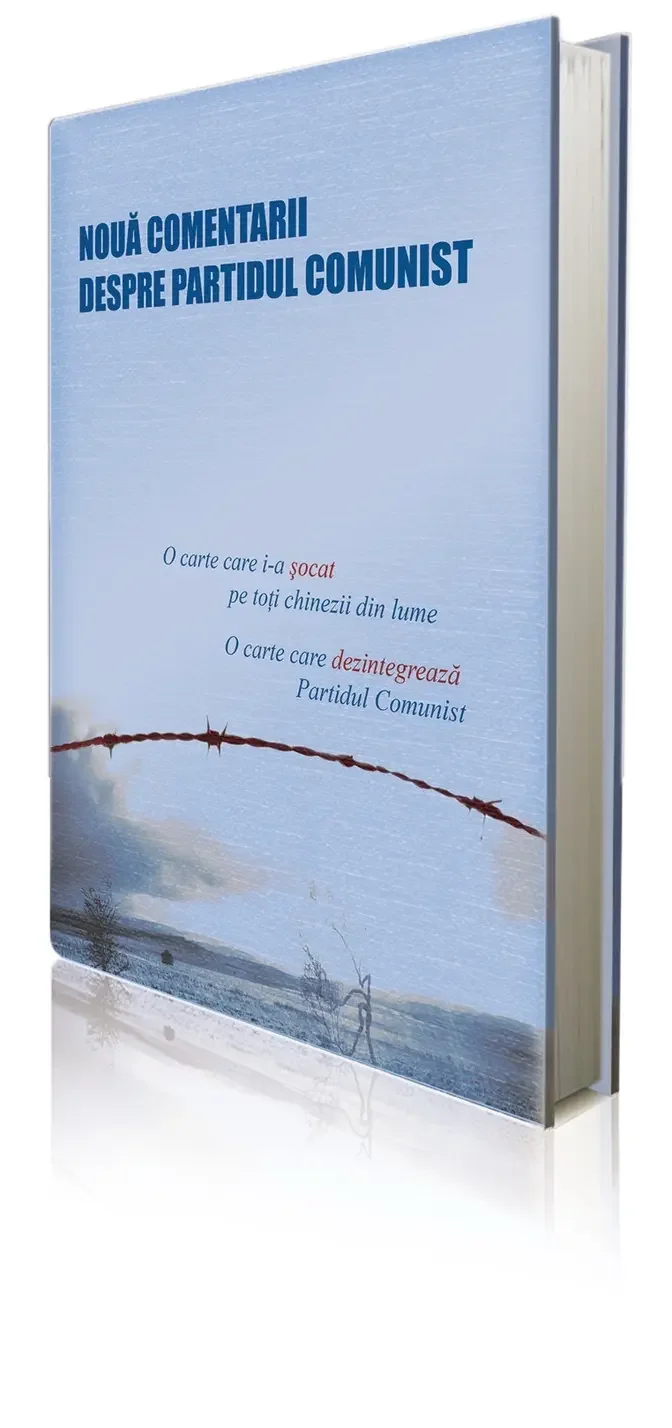
Mişcarea comunistă a fost introdusă în China ca un experiment, iar Partidul Comunist Chinez (PCC) s-a impus deasupra tuturor, cucerind totul în cale, aducând astfel o catastrofă fără de sfârşit Chinei.
Istoria PCC este un proces de acumulare treptată a oricărui gen de ticăloşie, internă sau străină. PCC a perfecţionat cele nouă caracteristici moştenite, dându-le „trăsături chinezeşti”: răutate, înşelăciune, incitare, dezlănţuirea drojdiei societăţii, spionaj, jaf, luptă, eliminare şi control. Răspunzând crizelor sale continue, PCC şi-a consolidat şi întărit mijloacele intensificând folosirea acestor caracteristici.
Despre cele 9 Comentarii
Cele 9 Comentarii prezentate aici au fost publicate în limba chineză în 2004. Accesibile în China prin intermediul internetului, sau introduse pe ascuns, comentariile sunt căutate şi citite avid de mulţi dintre cei aflaţi în bezna propagandei comuniste.
Comentariile au la bază o documentare istorică riguroasă, dezvăluie cu curaj ororile inimaginabile ale comunismului practicat în China, începând cu perioada maoistă şi terminând cu perioada actuală; analizează lucid şi cuprinzător originile comunismului, trăsăturile sale şi mecanismele care asigură existenţa "fiarei roşii". Este inedită în special prezentarea comunismului ca fiinţă vie, malefică, preocupată obsesiv de asigurarea propriei existenţe şi supremaţii, capabilă de orice infamie.
Adevărul despre comunism este cutremurător, iar comentariile de faţă nu par să treacă cu vederea nici unul dintre aspectele sale. Este expus un lung şir de samavolnicii: măcelurile din timpul Revoluţiei Culturale, actele de canibalism din timpul Marii Foamete, grozăviile campaniei guvernului chinez împotriva practicanţilor Falun Gong, etc
The traditional Chinese character party consists of two radicals advocate and black. Confucius said
the superior man has friends but does not belong to a clique. In Chinese history party or party
member which can also be interpreted as gang or gang member carries a derogatory meaning.
The communist party emerged grew and eventually seized power in contemporary China.
The CCP has constantly instilled into the people's minds that history chose the CCP and that without
the CCP there would be no new China. Did the Chinese people choose the communist party or
did the communist party gang up and force the Chinese people to accept it? Let us review China's
history in the 20th century to seek the real answers. From the late Qing dynasty China experienced
tremendous external shocks and extensive attempts at internal reform. The entire Chinese society was
in disarray. Discontented with the then reality many people with lofty ideals wanted to save the
country and its people and looked for a solution. When the British and French styles failed they
switched to the Russian method. Like people who turn to any available doctor in times of illness
they did not hesitate to prescribe the most extreme remedy for the illness in the hope that China
would quickly become strong. Some people advocated anarchism others proposed to overthrow the
and still others suggested bringing in foreign culture. In 1918 the first communist party in the
world was officially formed in Russia. In order to achieve the revolutionary goal of conquering the
whole world the Soviet Union established the Far Eastern Bureau in 1920. It then started to look
for comrades in China. The idea of using violent revolution to seize political power lifted from
the theory of Marxism-Leninism appealed to the anxious minds of the group of young people.
Under such circumstances communism a completely foreign concept was introduced into China.
The founders of the CCP did not realize that the deity they had introduced from the Soviet Union
was in reality an evil specter and the remedy they sought for strengthening the nation was actually a
deadly poison. It was not an easy task to introduce the foreign and evil specter into China a country
with a history of 5,000 years of civilization. The CCP deceived the populace and the intellectuals
with the promise of the so-called communist utopia. The CCP inherited communism's denial of
private ownership, imported Lenin's theory of violent revolution and adopted the industrial
revolution's destruction of belief. At the same time the CCP inherited and further strengthened
the worst parts of the Chinese monarchy. The communist party presented the fantasy of a
communist paradise as the truth and aroused people's enthusiasm to fight for it. Employing
such an absolutely absurd idea the CCP severed the connections between humanity and earth and cut
the lifeline that connects the Chinese people to their ancestors and national traditions. By
summoning people to give their lives for communism the CCP strengthened its ability to do harm.
The communist movement was introduced to China as an experiment. The CCP's success in defeating
other theories and eventually gaining control of the entire Chinese nation comes from its cruel
evil and violent nature. The history of the CCP is a process of its accumulation of every kind
of wickedness. In this process the CCP has continuously perfected its nine inherited traits
evil, deceit, incitement, fighting, robbery, unleashing the scum of society, espionage,
elimination and control. Responding to continuous crises the CCP has consolidated and strengthened
the means and extent to which these malignant characteristics have been playing out.
The CCP acknowledges that it is a religion imported from other countries. From ideology
to experience, from organization to capital, everything is brought in from the Soviet Union.
It carried out the imperialism of the Russian Red Army, following the Soviet party on everything.
From the beginning the CCP was a traitorous party. In July 1921 the CCP was officially formed
as the China branch of the Comintern. The CCP began to receive funding from the Comintern
beginning in October 1921. According to statistics available from declassified party documents,
during the period from 1924 to 1927 the contribution from the Comintern averaged
around 20,000 yuan per month. At the Second National Congress of the CCP in July 1922
there were only 195 CCP members across all of China. The Comintern criticized the CCP
for not working diligently. Based on the all-Russian Communist Party's experience,
it ordered the CCP to join the KMT. The CCP made itself bigger and more powerful through the KMT
and won people's hearts through participating in the National Revolution Movement.
With the support of the Soviet Union, the CCP wantonly seized political power within the KMT
during the alliance. Among the KMT ministers, CCP member Tan Ping Shan became the minister
of the Central Personnel Department. Mao Zedong assumed the position of acting minister of the
Propaganda Department. Zhou Enlai held the position of director of the Political Department
of the Huangpu Military Academy. Lin Zuhan was the minister of rural affairs.
Many communists served as KMT party representatives at various levels of the
National Revolutionary Army. The number of the CCP members increased dramatically from 420 in 1923
to 30,000 by 1928. The CCP members who joined the KMT did not obey the KMT rules.
They publicly aired their views attacking the KMT. They breached their promises and organized and
expanded an underground CCP within the KMT. In January 1925, when the CCP only had 994 members,
it had already raised the question of who would have leadership in China. Had Sun Yat-sen not died,
he, instead of Chiang Kai-shek, would have been the target of the CCP in its quest for power.
Human nature universally repels violence. Violence makes people insane, ruthless,
and tyrannical. Marxist-Leninist violent revolution and dictatorship of the proletariat
promote power politics and proletarian domination. Proletarians use violent struggles to seize
political power. The Communist Manifesto clearly declared that their ends could be attained only
by the forcible overthrow of all existing social conditions. That is, to use violent revolution
to destroy the old state apparatus and to establish a dictatorship of the proletariat.
This is the root of evil in Marxism and Leninism. Evil is the main character trait
that the Marxist-Leninist specter passed on to the CCP. It is the root of all evils.
In order to overthrow the warlords and restore peace that people had been expecting for so long,
the KMT government began the Northern Expedition in February 1926.
Ignoring the people's wishes and interests, the CCP used all kinds of schemes and intrigues
to sabotage the Northern Expedition in order to seize political power. From October 1926
to March 1927, the CCP launched three armed rebellions in Shanghai. During the Northern
Expedition, they distributed flyers everywhere, put up banners, and organized workers to strike.
Picket squads of workers organized by the CCP engaged in violent conflicts with the police
almost daily. The KMT government had to assign the army to assist maintaining social order.
The KMT became impatient with the CCP's blatant provocation and decided to thoroughly purge its
members. On April 12, 1927, the National Revolutionary Army disarmed the workers'
picket squads in Shanghai and took over the Shanghai General Labor Union, which was the
CCP's rebellion headquarters in Shanghai. At that point, the first CCP-KMT alliance
was declared a failure and ended in blood and slaughter. However, the CCP twisted the facts
and accused Chiang Kai-shek of betraying the revolution.
When the National Revolutionary Army was at war with the warlords, the CCP was advocating
peasants to rebel and to confiscate land from its owners in the rural areas. Between April and May
in 1927, under the banner of, The Peasant Association Has Supreme Authority, the entire
area of Hunan Province was shrouded in red terror, with violent mobs instigating rebellions all over.
CCP leader Li Lishan's father was killed by the Peasant Association. National Revolutionary Army
Corps commander He Jian's father was paraded around and publicly criticized until his death.
The family members of middle and lower class officers and soldiers from the Northern Expedition
Army were also killed. The horrible sight of it was very similar to that of the Cultural Revolution
when countless other people were tormented. This is the well-known Hunan Peasant Movement.
The deeply rooted patriarchal clan system in the Chinese countryside served as a fundamental
barrier to the Communist Party's establishment of political power. The rural society initially
had a harmonious relationship between the landowners and tenants. Landowners lent land
to peasants so that they could make a living, and in return, the peasants paid rent to support the
landowners. This somewhat mutually dependent relationship was twisted by the CCP into
extreme class antagonism and class exploitation. The CCP took advantage of the rebellion of social
scum and hoodlums in the rural areas to establish the CCP's new social order for the revolution.
These scum of society were praised by Mao Zedong as the bravest and firmest in the revolution in
the rural areas. Unleashing the scum of society and robbery became the second and third inherited
traits of the CCP. Taking advantage of the rebellions of hoodlums can be said to be the
CCP's tradition. In 1871, a group of lumpen proletarians rebelled and occupied Paris and
formed the Paris Commune. They are the ancestors of the CCP. During the rebellion of the Paris
Commune, they cruelly killed the Archbishop of Paris and clergymen. They set fire to palaces,
destroyed buildings, and censored the press. From then on, they regarded seizing political power
as the most direct and convenient means for reaping without laboring. During the Cultural
Revolution, in a debate over the term lumpen proletarians, the CCP felt that the word lumpen
did not sound very good, so the CCP simply replaced the term with proletarians. Robbing
can help the proletariat become men of property. Forming an army to establish its rule through
military force requires arms, food, and money. Yet the best way to raise funds is to rob.
The Red Army kidnapped the rich in counties of western Hubei province and held their families
ransom for continued monetary support until the families were drained of their resources.
Only then were the hostages sent home, many at their last gasp. Is there any difference between
these actions and those of bandits? In his investigative report on the peasant movement
in Hunan, Mao Zedong said the following, It is necessary to create terror for a while in every
rural area. Otherwise, it would be impossible to suppress the activities of the counter-revolutionaries
in the countryside. Many of their deeds in the period of revolutionary action were in fact the
very things the revolution required. Revolution, a word that has been given a positive implication
by the CCP, has always been regarded as a synonym for the most advanced and the most just. For
several decades, under the name of revolution, the CCP has conducted countless of the most evil
and despicable deeds. In August 1927, the CCP within the KMT Revolutionary Army initiated
the Nanchang Rebellion, which was quickly suppressed. In September, the CCP launched
the Autumn Harvest Uprising, and it was suppressed as well. The CCP began to implement a network of
control by establishing party organizations at even the smallest grassroots level in the
countryside. In October 1930, after exterminating the remaining warlords, the National Revolutionary
Army began to encircle and annihilate the CCP's Soviet areas, which lasted four years.
From October 1933 to January 1934, the CCP suffered a total defeat in its fifth sally.
The CCP lost its rural strongholds one after another. With its base areas continually shrinking,
the main Red Army had to flee. This was the true origin of the 7,500-mile-long Long March.
The CCP trumpeted the Long March as a Chinese revolutionary fairy tale,
but it is actually the most dishonorable phase of the CCP history. The so-called
anti-Japanese northbound operation was a complete and obvious lie. Pretending to be righteous,
the CCP could only rely on lies. Deceit is the fourth evil inherited trait of the CCP.
At that time, the Japanese army was mainly in the plains of north and northeastern China. Yet the
CCP traveled to the plateau region of Shanbei, which was poles apart from where the Japanese
actually were. In fact, the actual route of the Long March was toward the south and west.
The CCP Central Red Army first fled south to western Hunan province, attempting to unite with
the No. 2 and No. 6 Red Army and to establish its rule through military force. Met with defeat,
the Red Army then fled to northwest Sichuan to unite with Zhang Guatao. By the time they finally
arrived in northern Shanxi province, the main force of the Central Red Army had decreased from
80,000 people to 6,000. During the Sino-Japanese War, the CCP cried out to resist the Japanese.
On the other hand, it hid in the enemy's rear areas. The CCP completely left the KMT army alone
on the front lines. During the Sino-Japanese War, the KMT lost over 200 marshals,
while the commanding officers of the CCP side bore nearly no losses. During the entire Sino-Japanese
War, the only major battles the CCP fought were the Pingxing Pass Battle and the Hundred Regiment
Battle. In the Pingxing Pass Battle, the CCP was neither the leader nor the predominant force.
In fact, the CCP troops merely ambushed Japanese supply units. The One Hundred Regiment Battle
that the CCP later boasted about was at that time criticized in an internal document. It had
violated the strategic policies of the Party's Central Committee and caused extremely negative
influences. In reality, the battle simply revealed the CCP's military strength. This made it difficult
for the Party to continue its policy of focusing only on expanding itself. This was one of the
reasons why Peng Dehuai, one of the commanders of the battle, was condemned and purged from the
central government during the Cultural Revolution. Although the CCP claimed to be anti-Japanese
to win people's hearts, in reality, the CCP fought shoulder to shoulder with Japanese invaders to
defeat the KMT. After the Japanese occupied the city of Shen Yun on September 18, 1931,
the CCP instigated the people in the KMT-controlled areas to rebel, calling on workers to strike and
soldiers to revolt in attempts to overthrow the Nationalist government. When the anti-Japanese
war broke out in 1937, the KMT had more than 1.7 million armed soldiers. The total size of the CCP
army, including the new Fourth Army, did not exceed 70,000 people. The CCP could be eliminated
in a single battle. Therefore, during its cooperation with the KMT, the CCP gave priority
to the struggle for political power. While the KMT was busy fighting the Japanese, the CCP took
advantage of it for themselves. The goal of the CCP was to use this chance to expand its power
while conveniently breaking the KMT. On January 24, 1961, Mao Zedong said when he met with a
Japanese government official, it is because the Japanese army took half of China that caused the
Chinese people to understand, to take up arms and fight, and establish many anti-Japanese resistance
bases. It created the conditions for victory in the so-called War of Liberation. So the Japanese
warlords and monopolistic capitalists have done a good deed. If I had to thank someone,
I'd thank the Japanese warlords. No wonder the historians of the CCP say the eight-year
anti-Japanese war established the fundamentals for the victory of the Liberation War.
Espionage is the fifth inherited trait of the CCP. Infiltration, sowing dissent,
and disintegration and replacement are the unique methods it used to incite rebellion
and seize power. The Xi'an incident is a typical example. In December 1936, Zhang Shiliang and
Yang Hucheng, two KMT generals, kidnapped Chiang Kai-shek, the leader of the KMT, in Xi'an. The
Xi'an incident helped the CCP escape from the crisis of its own elimination, and also gave
the CCP the opportunity to latch onto the KMT government for a second time. According to CCP
textbooks, the Xi'an incident was a military coup initiated by Zhang and Yang, forcing Chiang Kai-shek
to fight against the Japanese. As a matter of fact, this coup was directly instigated by the CCP.
Before the Xi'an incident, many CCP members had already gathered around Yang Hucheng and Zhang
Shiliang. Among those working at Yang Hucheng's side, his own wife Xu Baozhen was a CCP member
and worked in Yang's political department of the army. Xu married Yang Hucheng in January 1928,
with the approval of the CCP. CCP member Wang Bingnan was an honored guest in Yang's home at
the time. Wang was sent by the common turn to persuade Yang to detain Chiang Kai-shek.
The CCP members around Yang and Zhang directly instigated the coup. At the beginning of the Xi'an
incident, the leaders of the CCP wanted to kill Chiang Kai-shek. In order to pin down the Japanese
and prevent them from attacking the Soviet Union, Stalin personally wrote to the central committee
of the CCP, asking them not to kill Chiang Kai-shek. The CCP could not destroy the KMT,
so the CCP changed its tone. The CCP forced Chiang Kai-shek to accept so-called cooperation
a second time, in the name of joint resistance against the army of the Japanese. The Red Army
was soon turned into the Eighth Route Army, and the Nationalist government paid its soldiers
and supplied their provisions. The CCP first was like the bad guy, pointing the gun at Chiang
Kai-shek, but then turned around and acted like the good guy. One must admire the CCP's unmatched
skills of deception. During the three years of civil war, the CCP managed to plant a secret
agent that Chiang Kai-shek ended up keeping in close confidence. Liu Fei, an undercover agent
for the CCP, was the deputy minister of defense. He was in charge of dispatching the KMT army.
Before the KMT army found out about their next assignments,
the information had already reached the headquarters of the CCP.
After the anti-Japanese war was over, with the strength that it accumulated during the
eight-year war, the CCP then enjoyed the fruits of the labor of the KMT. The CCP
selfishly launched the so-called War of Liberation to overthrow the KMT government,
bringing the disaster of war to the people of China once again after they had just finished
eight years of war. In 1947 and 1948, the CCP signed the Harbin Agreement and the Moscow Agreement
with the Soviet Union. The CCP surrendered national rights and interests and gave away
resources from the Northeast in exchange for the Soviet Union's full support in foreign relations
and military affairs. According to these agreements, the CCP promised the Soviet Union
special transportation privileges in China's Northeast, provided the Soviet Union with
products from the Northeast, such as cotton and soybeans, and military supplies in exchange for
advanced weapons. The CCP granted them preferential mining rights in China, allowed them to station
armies in the Northeast and Xinjiang, and permitted them to set up the Far East Intelligence
Bureau in China. If war broke out in Europe, the CCP would send an expeditionary army of 100,000
plus 2 million laborers to support the Soviet Union. In addition, the CCP promised to merge
some special regions in Liaoning province into North Korea if necessary. The resources and
capital the CCP used in the Civil War were accumulated by not putting up resistance against
the Japanese, as well as by selling out China's national rights and interests. Its coming to power
was also at the expense of countless civilian lives. The CCP is well known for its huge crowd
strategy. They sent thousands of unarmed civilians to the front lines, forcing the KMT to either
murder them or give up. They called it using a sea of people in the war of the people.
When besieging the city of Chongchun in 1948, in order to exhaust the food supply in the city,
the People's Liberation Army was ordered to forbid the people from leaving the city.
As a result, during the two months of siege, nearly 200,000 died of hunger or froze to death
in the city. After the battle was over, the CCP, without a tinge of shame, proudly proclaimed
that they had liberated Chongchun without firing a single shot. Using ways like this, the CCP used
harsh violence and deception, sinister and ruthless methods, successfully chased the KMT
away from the mainland. The Communist Manifesto relates the Communist Party's historical and
philosophical basis to class conflict and struggle. The proletariat broke free from
traditional morals and social relations for the sake of seizing power. Communist philosophy
promotes fighting. Struggle relies on hatred. Where hatred does not exist, it can be incited
and created. Incitement and fighting are the sixth and seventh inherited traits of the CCP.
A well-known story of class oppression, The White-Haired Girl, was originally a story about
a woman immortal. It had nothing to do with class conflicts. But under the pens of the military
writers, she became a person who was being persecuted with enormous hatred. They created
a landlord to bully the white-haired girl and transformed a classic folktale into a propaganda
piece, promoting class struggle. The story was then transformed into a modern drama, opera,
and ballet. Inciting the masses to struggle against each other is a classic trick of the CCP.
That is where the formula for class division comes from, making 95% of the population
struggle against the remaining 5%. The CCP has made full use of and developed this technique
in many of its political movements. People classified into the 95% were safe, but those
within the 5% were enemies and were struggled against. Out of fear and to protect themselves,
most people strived to be included in the 95%. This resulted, though, in many cases in which
people brought harm to others, even adding insult to injury. Fighting to the CCP is more than the
armed forces and armed struggle. Mao Zedong said, a revolution is not a dinner party,
or writing an essay, or painting a picture, or doing embroidery. A revolution is an insurrection,
an act of violence by which one class overthrows another. We need to struggle to seize power,
and we also need struggle during periods of peace. In 1941, the CCP began the so-called
Rectification Movement in Yan'an. It created a model for persecution that is most fearsome.
The first step of the rectification was to set up individual personnel archives. One had to list
all acquaintances since birth, all important events, and the times and places of their
occurrence. Emphasis was placed on personal thought processes during these social activities.
Evaluation based on party nature was even more important, and one had to confess any anti-party
thoughts or behavior in one's consciousness, speech, work attitudes, everyday life or social
activities. In fact, the Rectification Movement was a so-called cleansing movement by which Mao
Zedong intended to purge and eliminate party dissidents. The CCP used methods of testing
everyone. It extorted so-called confessions through torture, resulting in countless frame-ups,
false and wrong accusations. During the Rectification, Yan'an was called a place
for purging human nature. According to the Guangzhou District County statistics,
the number of types of corporal punishment they used was around two dozen. The Rectification
Movement was the most horrendous, darkest and most ferocious power game ever played out in
the human world. It blasphemed human civilization and dignity. It distorted human nature and
conscience. Under anxiety and fear, people abandoned honor and self-respect. Under intimidation and
torture, people betrayed their conscience and friendship. According to a report in the CCP
controlled Liberation Daily newspaper, in Shuishe County, 160 people were said to have repented,
more than 280 were said to have confessed, and 190 people were exposed. Even teenage
children went up to the stage and confessed that they were spies. In order to protect one's own
life, the people stopped expressing their own opinions and began to simply recite quotations
from party leaders instead. The Rectification Movement in Yan'an has since become the template
for CCP's political movements. Since its early stages, the CCP has continuously built up its
comprehensive theoretical system of genocide. It is composed of the CCP's theories on class,
revolution, struggle, violence, dictatorship, political movements, political parties,
and more. Elimination is the CCP's eighth inherited trait. The CCP has also done other
things with absolute cruelty, similar to the Rectification Movement in Yan'an. It deprived
landlords and capitalists of their property, exterminated the landlord and rich peasant
classes, destroyed rank and order in the countryside, kidnapped and extorted the wealthier
people, brainwashed war prisoners, and even claimed to reform industrialists and capitalists.
It infiltrated and disintegrated the KMT, and it split from the Communist International and
betrayed it. It has even threatened its own members with coercion. Everything the CCP did
was hard line. Everything mentioned above was based on the CCP theory of genocide.
The essential expression of the CCP genocide is the extermination of conscience and independent
thought. If Hitler was said to have exterminated the flesh body of human beings, then the CCP
not only wants to exterminate the flesh body, but even more so wants to exterminate the human mind
and spirit. Each and every political movement has been to reform the people's mind and brainwash
the human spirit. Genocide serves the fundamental interests of the CCP. Under this reign of terror,
the CCP will not only eliminate you if you are against it, but it may also destroy you
even if you are for it. It will eliminate whomever it deems should be eliminated.
Consequently, everyone lives in the shadow of terror, and everyone fears the CCP. All of the
CCP's inherited traits and means aim to achieve one single goal, control. To control is the CCP's
ninth inherited trait. Through its evil actions, the CCP has proved itself to be the natural enemy
of all existing social forces. Since its inception, the CCP has struggled through
one crisis after another. The perpetual fear for survival has made maintaining its existence and
power the highest interest of the party. The party's interest is not the interest of any
single party member, nor is it a collection of any individual interests. Rather, the interest of
the party as a collective entity overrides any sense of the individual. Party nature is one of
the most vicious characteristics of the Communist Party. Party nature overwhelms human nature and
conscience and has the power to make people lose their humanity. The beautiful melody of this folk
song from northern Shanxi province is a familiar tune to people's ears. Yet the scent rising from
this flower basket is not that of any grain or cotton flowers, but rather of the opium poppy.
The scent, indeed, was opium, and Mao Zedong named it the revolutionary opium.
In 1942, in order to build up its financial resources for a civil war,
a mass production movement was launched in Yan'an.
The Central Political Bureau of the CCP established an opium production committee
led by Ren Buxi, one of the early leaders of the CCP. They, along with the Japanese,
sold opium to regions controlled by the KMT, poisoning their own countrymen. In the Vladimirov
Diaries, Peter Vladimirov, a representative of the Comintern and a reporter from the TASS news
agency based in Yan'an, recorded a statement made by Dong Fa, a member of the Central Political
Bureau of the CCP. He said, In the past, we sent out one truckload of food after another,
and we came back with only a small bag of money. Now we send out small bags of opium to KMT
territories, and we actually bring back big bags of money one after another. We can use the money
to buy guns, cannons, and bullets to fight the KMT. At the 100th anniversary of the birth of Ren,
the director of the opium production committee, his party nature was highly praised by the CCP,
claiming him to possess superior character, a firm belief in communism, and unlimited loyalty
to the cause of the party. He was a model party member. Upon gaining power, the CCP expanded its
party nature even further. It successfully launched a campaign of mind control to mold
new party tools and screws, such as leifeng. These protocols demanded the Chinese people
to willingly comply, obey, and cooperate for the benefit of the party. Under CCP rule,
everything is done for the interest of the party. Nothing is done for the people,
because the party interest overrules everything. When it comes to the party's interest,
there is no right from wrong, no good from evil, no justice. The CCP uses party nature
to control the entire party, and subsequently the rest of society. Clothed in the name of the nation,
party nature has been forced upon the people as a set of proper thoughts, a range of stereotypical
behaviors, and a regulatory system. From the party leader to the ordinary people, not one person was
left out. After several decades of brainwashing, the party nature way of thinking has become
inherent in the Chinese people. They became self-restrained, self-compliant, and self-disciplined.
The CCP is as hard as steel. It has discipline as solid as iron, and has unified intentions.
All party members are made of special materials, and the actions of all Chinese people must be
in unity. The CCP has a life of its own, with its own independent body. The party runs the officials.
It's not the officials running the party. In fact, a majority of the highest party officials,
the general secretaries, have, in the end, been labeled anti-communist. The founder of the CCP,
Chen Duxiu, was an intellectual and a leader of the May 4th student movement in 1919. He showed
himself not a fan of violence, and warned the CCP members that if they attempted to convert the KMT
to communist ideologies, or had too much interest in power, that would certainly lead to strained
relationships. While being one of the most active in the May 4th generation, Chen was also tolerant.
However, he was the first to be labeled a right-wing opportunist. Another CCP leader,
Qiu Zhibai, believed that the CCP members should engage in battles and fighting, organize rebellions,
overthrow authorities, and use extreme means to return the Chinese society to its normal
functioning. However, he said before his death, I left your movement a long time ago. History played
a trick, bringing me, an intellectual, onto the political stage of revolution, and keeping me
there for many years. In the end, though, I still could not overcome my own notions of gentry.
I cannot become a warrior of the proletariat class, after all. The CCP leader, Wang Ming,
at the advice of the Comintern, argued for unity with the KMT in the war against the Japanese,
instead of expanding the CCP base. At the CCP meetings, Mao Zedong and Zhang Wentian could not
reveal the truth of their situation. According to the limited military strength of the Red Army,
they would not be able to hold back even a single division of the Japanese by themselves.
Mao Zedong was forced to remain silent at the meetings. Later, however, Wang Ming was ousted,
first for a left-wing deviation, and then branded an opportunist of the right-wing ideology.
Hu Yaobang, another party secretary, won back support for the CCP from the Chinese people
by bringing justice to many innocent victims who had been criminalized during the Cultural
Revolution. Still, he was kicked out. Zhao Ziyang wanted to help the CCP in furthering reform,
yet his actions brought him dire consequences. So what could each new leader of the CCP accomplish?
To truly reform the CCP would imply its death. There is a certain limit, then,
on what even the CCP members can do to transform the CCP system. So there is no chance for any
true reformation of the CCP to succeed. Many party leaders ended their political lives in tragedy,
yet the CCP has survived. In many instances, when the CCP was at its most evil, the highest
officials failed in their positions. This was because their extent of evil did not meet the
requirements of the party. Only the most evil would meet its requirements. The CCP leaders
who survived their positions were not those who could influence the party, but those who could
comprehend the party's evil intentions and follow them. No wonder party members were capable of
battling with heaven, fighting with the earth, and struggling against other human beings. But never
could they oppose the party. They are the tame tools of the party, or at most, symbiotically
related to the party. The CCP has mixed violence, terror, and high-pressure indoctrination to form
its theoretical basis, which is then turned into the party nature, the spirit of its leaders,
the functioning mechanism of the entire party, and the criteria for the actions of all CCP members.
The history of the CCP tells us precisely its illegitimacy. The Chinese people did not choose
the CCP. Instead, the CCP forced communism, this foreign evil specter, onto the Chinese people
by applying the evil traits that it has inherited from the Communist Party. Evil, deceit, incitement,
fighting, robbery, unleashing the scum of society, espionage, elimination, and control.
When the Communist Party needed workers, it named them the leading class and pioneers of the
proletarian revolution. But in the end, the workers became the ones who absolutely own nothing.
When the Communist Party needed farmers, it praised them, saying,
without the poor farmers there would be no revolution. It promised land to the tiller.
The happiness of the fortunate farmers who were given a piece of land lasted a mere few days.
Their land was later taken to establish the people's communes.
When the Communist Party was almost exterminated by the KMT, it appealed loudly,
Chinese do not fight Chinese. However, as soon as the anti-Japanese war was over,
the CCP turned full force against the KMT and overthrew its government.
When the CCP needed the support of democratic parties, it urged that all parties strive for
long-term coexistence, be sincere with one another, and share honor and disgrace. But
anybody who disagreed with or refused to conform to the party's concepts was eliminated. The
Communist Party's political power would not be shared with any other individuals or groups.
History tells us never to believe in any promises the CCP makes. If one were to believe the words of
the Communist Party in any issue, that issue would be the one that would cost one one's life.
Without deceit and violence, the CCP would not be in power.
For the past several decades, the CCP has brought ceaseless disasters
and endless miseries upon the Chinese people. The indulgence of the CCP in wanton massacre
and willful persecution throughout China has been the greatest misfortune for the Chinese people.
To be free from the CCP's shackles will bring new hope to China.