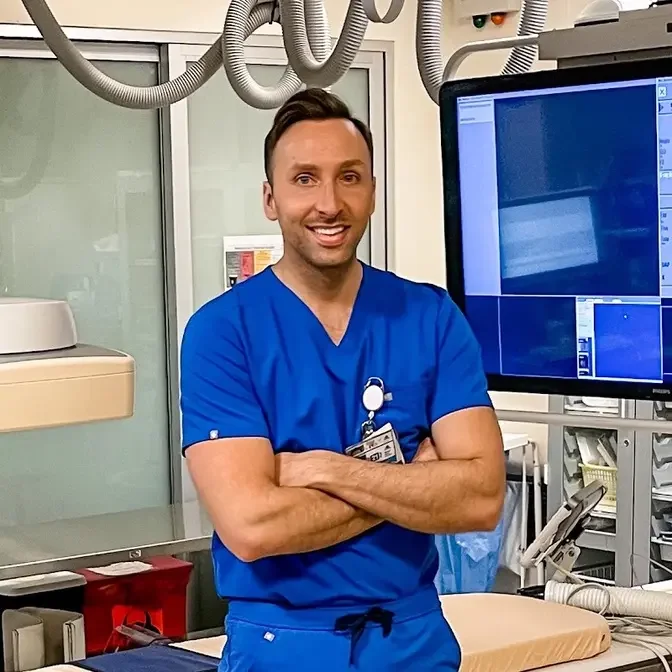
I often get asked the question if doing an interventional radiology fellowship is worth it or not, and I answer that in great detail! You have to watch to see my thoughts on it if it is truly worth it!
All right, so you probably saw by now I was
at work earlier today and now I am home from work in my unfinished,
completely disastrous studio, which I'll show you on an oncoming video.
I'm doing like this whole unboxing video slash desk setup video,
but literally disaster because of everything that's happening with my desk.
Not going to get into it now because you've seen by the title of this video,
we were going to be talking if fellowship is worth it.
So let's go ahead and get into it.
All right. So again, excuse the mess. This is like literally,
I don't know if you can see this or not.
This is literally the upside down desk that I'm setting up on the floor right
now. They had to re-deliver the actual top to this desk two times now. Oh wait,
three times now. So that's coming soon. And I already talked about it.
And I already said I wasn't going to talk about it, but I did,
but let's get into the video. So answer the first question,
was interventional radiology fellowship worth it? And the answer is yes.
All right. So reason number one,
why I think IR fellowship is perfect and you should do it is because IR is very
much a hands-on field.
It is very much a tactile field just as much as it is cerebral.
And what I mean by that is almost everything you do in IR is based on feel.
Every procedure you do has a certain tactile response.
Ultimately doing a whole year of IR,
it teaches you just how hard you can push or how aggressive or when to be
aggressive. And that's something you can't really teach.
You have to just do it. So when you do it over and over again,
you know exactly the limitations,
exactly how hard you can push and exactly the tactile response when things are
going great or when things are not going great.
This entire field is almost based around knowing how hard you can push or how
when to push harder or how aggressive to be with your push.
So I'll give you a little example.
So anybody who's starting out doing central lines,
especially like a dialysis catheter,
which is a pretty big catheter going in your neck,
you have to tunnel the catheter underneath the skin.
And oftentimes getting that catheter in the neck or getting the PLOA sheath into
the neck can be very difficult because you're fighting against a lot of soft
tissue with a very large 15 French or higher object.
So the biggest thing I see with people starting out is when they're first
trying to place that line and put the sheath over the wire,
they get to the skin and then they get to it and it's not going easily.
So they just stop because mainly they don't know how hard you can push and they
don't know how safe it is to push hard. So what I always do,
it's easy for me now is if someone's struggling and I'll just go over there and
go and like jam it in because I know the limitations.
And that's mostly what IR is is basically knowing how hard to push and knowing
when you can push harder. That simplifies our field quite a bit,
but that's a lot of it. I promise.
The second reason you should do a fellowship and why I thought it was worth it
because it gives you a chance to kind of immerse yourself into interventional
radiology and eat, sleep and breathe IR.
And that is all you do the whole year.
And it gets you in that mindset of thinking like an interventional radiologist
doing IR things or doing IR procedures or thinking about IR becomes routine and
it becomes a habit and you end up doing it without even thinking about it,
which is exactly what you should be doing in fellowship.
And that's exactly how you will be expected to perform when you're in the
hospital as an attending.
It's kind of like when you go away for a basketball camp or something,
you eat, sleep and breathe basketball and you learn basketball and that's all
you do the whole time you're at camp and then you come out better than when you
started. It's the same thing in IR, except you do it for a year long.
It's like a year long IR camp. It's kind of a bad analogy,
but you know what I mean?
The next reason why IR fellowship was worth it to me is that you get to meet a
lot of cool people. You get to meet all of your co-fellows.
You get to form bonds with your co-fellows because you are both going through
that crazy thing that is fellowship.
And as you all have seen on my prior videos, when I was on call on fellowship,
if you haven't seen those, go check them out up here.
But you've seen how hard we work and how little sleep we get and how long we
spend at the hospital.
And you kind of want to commiserate with your friends or co-fellows because
they're the only people that actually understand what you're doing at that
time.
You form really close bonds with your colleagues and co-fellows and that
friendship will last forever. Point being,
now I'm two months out of fellowship and all of my fellows still have a group
chat where we text each other pretty much daily. We text each other cases.
If we're doing a procedure we're not comfortable with,
we ask them advice on that procedure.
We ask them what techniques they use, what supplies they use, what catheter,
what wire, all this stuff.
And we run things by each other because like I've said many times before,
there's nobody you can really go to after you finish fellowship.
Once you're in attending,
you are the person and there's nobody that's going to really teach you anything
anymore.
So it's good to have a group of colleagues that you can rely on that you train
together with. And yeah, not to mention you have these friends for life.
And I don't think I will ever stop texting the group or running things by each
other because that's what you do. Even as 10 or 20 year,
30 year attending, they still run things by each other.
And usually it's either their mentors or their co-fellows who they did fellowship
with.
Also I have another group text with all of my co-fellows slash fifth year
residents at UNC who I chat with all the time about cases as well.
So it basically just further demonstrates how you keep contact with these people
and you build amazing relationships together.
The next reason why you should do an IR fellowship is you get to learn what you
don't want to do or what you don't want out of a career.
The thing with fellowship is you get to work with a lot of different attendings
and a lot of different mentors.
Every single person has a different way of doing things.
You get to learn a little piece from each one of them and you get to realize
which way you don't like doing things, which technique you don't like doing,
which technique you do like doing and you get to kind of pick and choose what
you like amongst every single person you work with and put it all together and
develop your own personal way of doing things.
I can't tell you how many times you see your attendings do things and the back
of your head and you're like, I would never do that. If I was in practice,
I would do it this way instead of that way.
Obviously you don't say that while you're in fellowship, but you think it,
you talk with your co-fellows about it and then make a little mental note.
I'd rather do it this way than that way. That happens with every procedure,
every single day you're in fellowship and you just kind of make mental notes and
you move on. You also get to learn what kind of career you want.
Do you want to be an academic interventionalist?
Do you want to be a private practice interventionalist?
Do you want to do complex cases day in and day out?
Do you not want to do IR at all or do you want to do minimally complex cases?
You learn all this in fellowship and you get to see a little bit of everything
and that's the most important part. It's like you have a full buffet.
You can grab a little bit of this,
a little bit of that and kind of gear your career towards whatever way you want.
Now just to piggyback that a little bit,
you also get to figure out what kind of niche you want to fall into in
interventional radiology. So every attending you'll notice,
if you do an interventional fellowship,
they always sub sub specialized or super sub specialized in certain aspects of
our field. For instance,
some may do more pediatric interventional work or some may do only vascular work
like renal angiograms, venous procedures or venous repients.
Some may do hepatobiliary work or oncology work where you're embolizing liver
tumors. Others may focus on urological aspects of IR like prostate artery
embolization or others may focus on uterine fibroid embolizations.
There's so many different niches in IR and it's good to see all of them and
figure out which kind of niche or pathway you want to go down in your career.
For me, I'm still only two months out,
so I don't really know what pathway I want to go down.
I'm still trying to figure it out,
getting used to kind of working on my own and eventually I'll decide what I
want to do,
but at least I know I have an idea of what I want to do because I got to see it
all.
It's way better than not being able to see anything and kind of figuring out
your path as you go.
You quickly realize in fellowship you like or dislike something almost
immediately.
The next reason I thought IR fellowship was worth it is because you get to see
and do the most crazy,
crazy cases in the entire world that you'll probably never see again.
You'll probably never do again,
but you get to see them and that's really important because you get to see the
sickest patients.
You get to see the most one-off cases of all time.
You get to participate or do all of it.
You take everything you learned during those cases and apply it going forward
and pretty much anything.
And even if you don't do complex,
crazy stuff later on in your career,
at least you can either say you did it or at least take something you learned off
that case and apply it to something you do.
The next reason I thought IR fellowship was worth it is probably my favorite
reason.
And that's because you get to try something new.
You get to go to a different place and live somewhere new for a year.
Maybe you're stuck in a rut.
Maybe you're sick of living in the same city for four years and you want to
change.
Maybe you broke up with your fiance or significant other.
Maybe you want to move and live in a new apartment in a huge city and meet other
people.
That's one of the best benefits of being able to do a fellowship.
You don't have to stay put where you are in residency.
You can go somewhere new and try something else.
Change is a good thing.
Whoa, my light flickered.
Change is always a good thing.
I don't hear what people say.
And arguably the most important thing after doing fellowship,
you will finally feel comfortable.
And that itself is worth doing an entire year of fellowship because that is the
goal.
When you are an attending physician,
feeling comfortable,
feeling confident,
doing procedures,
doing them safely,
doing them effectively and doing them efficiently is worth everything.
It's worth all the hours of call.
I promise you it's worth it.
And that's why I think fellowship is totally worth it.
Probably in any field,
but definitely interventional radiology.
So on that note,
hopefully this office will be ready on the next video or two and it won't be so
echoey in here.
Coming soon.
I promise.
Just bear with me.
We're still getting our thing set up,
but thank you for watching this video.
Make sure you smash that subscribe button,
follow me on Instagram and TikTok if you don't already.
And I'll see you all on the next video.
And injure on this video.
Go check her out too.
Bye.